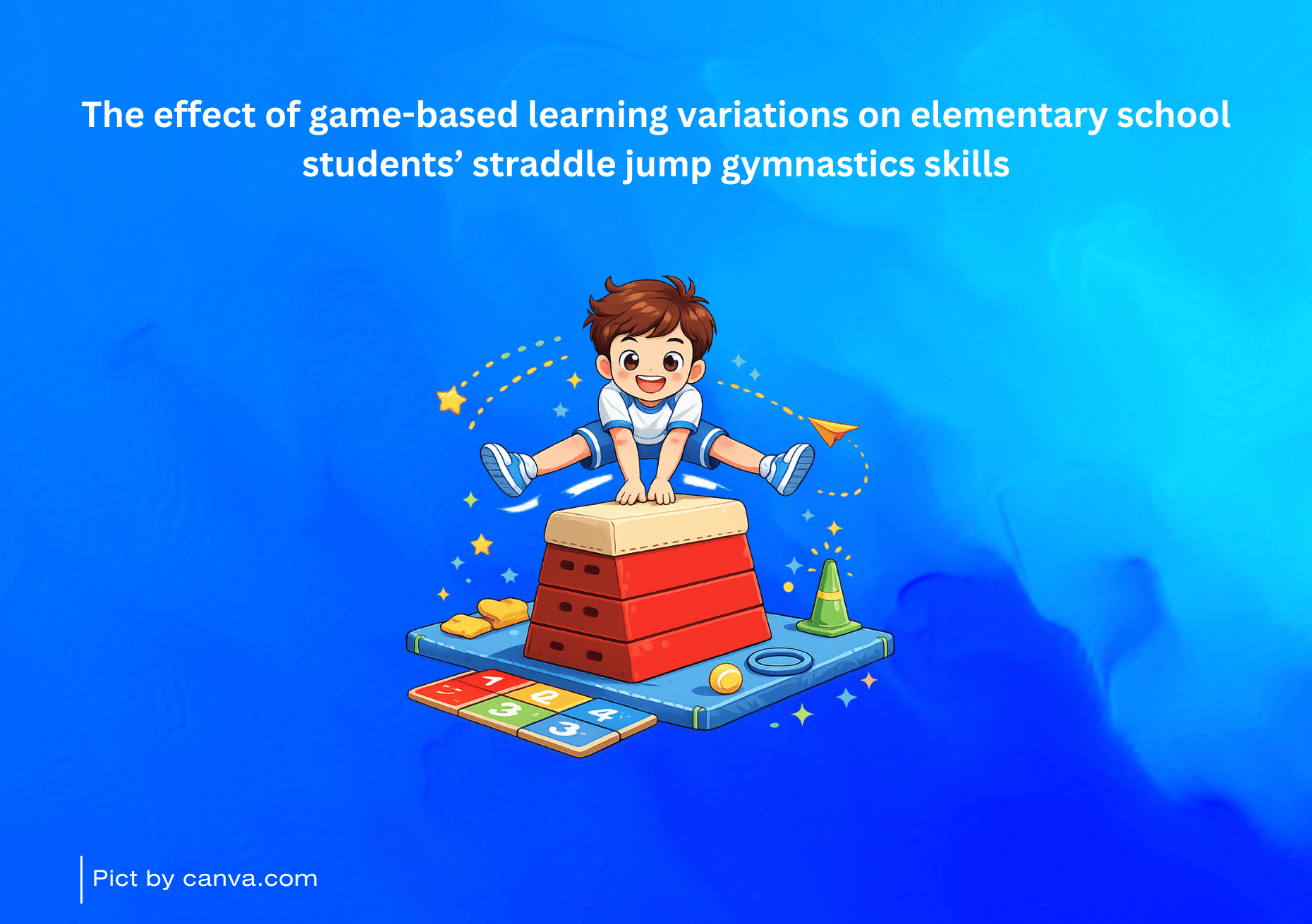
The effect of game-based learning variations on elementary school students’ straddle jump gymnastics skills

Background: Physical education in primary schools is essential for the development of students' motor skills, including gymnastic abilities such as the straddle leap. In fact, numerous students continue to struggle to execute these movements accurately because of repetitive teaching approaches that fail to engage them actively. Consequently, a more stimulating and diverse educational methodology, including game-based activities, is required.
Objectives: This study examines the impact of fluctuations in game-based learning on the enhancement of straddle jump gymnastics skills among primary school students.
Methods: This research employed a quantitative methodology using a pre-experimental framework, namely the One-Group Pretest–Posttest Design. The study population comprised all 40 fourth-grade students at Citungku Elementary School, who were sampled using a total sampling technique. Data were gathered via a practical examination of straddle jump movement proficiency, adhering to the Australian Gymnastic Federation's evaluation criteria, which encompass four components: the initiation, propulsion, suspended posture, and landing. The intervention lasted four weeks and included eight sessions featuring activities such as frog leaps, mirror jumps, rope jumping, and hopscotch, all aimed at training the elements of the straddle jump. The Shapiro-Wilk normality test and paired-samples t-test were conducted in SPSS version 27 for data analysis.
Results: The study found an improvement in students' capabilities following the implementation of game-based learning modifications. The mean pretest score of 58.00 rose to 74.76 in the posttest. The paired-samples t-test yielded a t value of -9.894 and a p-value of 0.001 (< 0.05), indicating a significant difference between pre- and post-treatment outcomes. This demonstrates that the executed game activities facilitated improvements in students' motor coordination, push-off strength, body control during floating, and landing methods during the straddle jump movement.
Conclusions: Variations of game-based learning, including frog jumping, mirror jumping, rope jumping, and hopscotch, have demonstrated efficacy in enhancing straddle jumping gymnastics skills among elementary school students while fostering a more dynamic and pleasurable physical learning experience.
Downloads
Abdullah, F., & Mongsidi, W. (2022). Pengaruh Latihan Small Sided Games (Ssg) Terhadap Keterampilan Passing Dan Stopping Ball Siswa Sekolah Sepakbola (Ssb) Rekminers Kendari. JOKER (Jurnal Ilmu Keolahragaan), 3(3), 106. https://doi.org/10.36709/joker.v3i3.24871
Ahadi, G. D., & Zain, N. N. L. E. (2023). The Simulation Study of Normality Test Using Kolmogorov-Smirnov, Anderson-Darling, and Shapiro-Wilk. Eigen Mathematics Journal, 6(1), 11-19. https://doi.org/10.29303/emj.v6i1.131
Anggraeni, E., Fadjri, M., Musa’ad, F., & Robi, L. (2025). Lompat Kodok: Modifikasi Lompat Kangkang Berbasis Permainan untuk Anak Sekolah Dasar. INTEGRATIF: Jurnal Pengabdian Kepada Masyarakat, 3(2), 54-60. https://doi.org/10.60041/integratif.v3i2.335
Ansharullah, A. Z., Hidayat, C., Juhrodin, J., Kamarudin, K., & Suardika, I. K. (2026). Strategi Guru Pendidikan Jasmani Olahraga dan Kesehatan dalam Meningkatkan Motivasi Belajar Siswa Sekolah Dasar. Jambura Health and Sport Journal, 8(1), 69-79. https://doi.org/10.37311/jhsj.v8i1.35648
Arieska, P. K., & Herdiani, N. (2018). Pemilihan teknik sampling berdasarkan perhitungan efisiensi relatif. Jurnal Statistika Universitas Muhammadiyah Semarang, 6(2), 166-171. https://doi.org/10.26714/jsunimus.6.2.2018.%25p
Asmi, A., Neldi, H., & Khairuddin, F. U. (2018). Meningkatkan Minat Belajar Siswa dalam Pembelajaran Pendidikan Jasmani Olahraga dan Kesehatan melalui Metode Bermain pada Kelas VIII-4 Sekolah Menengah Pertama Negeri 2 Batusangkar. Jurnal MensSana, 3(1), 33-44. https://doi.org/10.24036/jm.v3i1.64
Budi, D. R., & Listiandi, A. D. (2021). Model Pembelajaran Dalam Pendidikan Jasmani. https://doi.org/10.31219/osf.io/xzh3g
Dupri, Nazirun, N. ., & Candra, O. (2021). Creative thinking learning of physical education: Can be enhanced using discovery learning model?. Journal Sport Area, 6(1), 29–36. https://doi.org/10.25299/sportarea.2021.vol6(1).5690
Estrellado, E., Charoensilp, P., & Yamada, S. (2023). The effects of game-based soft skills training: A quasi-experiment with Ethiopian garment workers. International Journal of Educational Development, 101, 102823. https://doi.org/10.1016/j.ijedudev.2023.102823
Fauzi, R. A., Suherman, A., Saptani, E., Dinangsit, D., & Rahman, A. A. (2023). The impact of traditional games on fundamental motor skills and participation in elementary school students. International Journal of Human Movement and Sports Sciences, 11(6), 1368-1375. https://doi.org/10.13189/saj.2023.110622
Habibi, S. M., & Tjaahyo Kuntjoro, B. F. (2023). Pengembangan Model Pembelajaran Gerak Dasar Lokomotor Melompat Untuk Peningkatan Permainan Lompat Katak Sdn V 147 Kapasan Surabaya. Riyadhoh : Jurnal Pendidikan Olahraga, 6(1), 149-154. https://doi.org/10.31602/rjpo.v6i1.11497
Handayani, S. G., Komaini, A., Callixte, C., Lesmana, H. S., & Dafun Jr, P. B. (2023). The effect of the teaching game approach in the gymnastics learning process to improve roll forward. Jurnal SPORTIF: Jurnal Penelitian Pembelajaran, 9(1), 125-134. https://doi.org/10.29407/js_unpgri.v9i1.19922
Heri, L., Rusilowati, A., & Raharjo, T. J. (2017). Pengembangan Instrumen Penilaian Psikomotor Senam Lantai dalam Pembelajaran Penjasorkes pada Siswa Sekolah Dasar. Journal of Research and Educational Research Evaluation, 6(1), 19-29. https://doi.org/10.15294/jrer.v6i1.16204
Kollo, N., Suyono, S., & Anggraini, A. E. (2024). Penguatan Pendidikan Karakter di Sekolah Dasar. JIIP - Jurnal Ilmiah Ilmu Pendidikan, 7(2), 1447–1451. https://doi.org/10.54371/jiip.v7i2.3846
Lestari, I., Fahrizal, F., Amirzan, A., Hidayat, R., & Syatiri, M. (2025). Revitalisasi Permainan Tradisional Sebagai Warisan Sejarah Dalam Meningkatkan Aktivitas Fisik Anak Sekolah Dasar. Pedamas (Pengabdian Kepada Masyarakat), 3(03), 955-965. https://pekatpkm.my.id/index.php/JP/article/view/678
Louk, M. J. ., Boleng, L. M., Babang, V. M. M. F., Tajuddin, A. I., Fufu, R. D. A., Siahaan, J. M., Runesi, S., & Ladjar, M. A. B. (2023). Socialization of The Teaching Games for Understanding Learning Model to School Physical Education Teacher Upper Middle School in Kupang City. GANDRUNG: Jurnal Pengabdian Kepada Masyarakat, 4(1), 836–844. https://doi.org/10.36526/gandrung.v4i1.2467
Marcella, C. (2022). The Effectiveness of The Use Game Based Learning on Student’s Motivation and Learning Outcomes in Camera Movement Engineering Materials. Indonesian Journal of Instructional Media and Model, 4(1), 1-10. https://doi.org/10.32585/ijimm.v4i1.2053
Mawardani, S. I., Prakoso, B. B., Febriyanti, I., Dinata, V. C., & Khusairi, A. (2025). Pengembangan model permainan dalam pembelajaran senam lantai terhadap hasil belajar guling depan. Bravo's: Journal of Physical Education and Sport Science, 13(3), 610-625. https://doi.org/10.32682/bravos.v13i3/188
Petruk, L., Sinitsyna, E., Biruk, I., & Kosobutskyy, Y. (2022). Sports games are a priority for the students of a higher educational establishment. Scientific Journal of the Dragomanov Ukrainian State University. Series 15, (6(151), 109-112. https://doi.org/10.31392/NPU-nc.series15.2022.6(151).24
Rejeki, H. S., Purwanto, D., & Mentara, H. (2024). Pengembangan Model Pembelajaran Berbasis Permainan Untuk Meningkatkan Kebugaran Jasmani Siswa Sekolah Dasar. Journal of SPORT (Sport, Physical Education, Organization, Recreation, and Training), 8(2), 620–631. https://doi.org/10.37058/sport.v8i2.11007
Sahabuddin, Hakim, H., & Hasanuddin, M. I. (2025). Efektivitas Pendidikan Jasmani Terhadap Perilaku Fisik Dan Kesehatan Siswa Sekolah Menengah: Kajian Longitudinal. Holistic Journal of Sport Education, 5(1), 62-83. https://doi.org/10.52434/penjas.v5i1.43124
Salsabila, Z. S., & Pratama, R. S. (2025). Membangun Keterampilan Motorik Kasar Anak Usia Dini Melalui Olahraga. Khirani: Jurnal Pendidikan Anak Usia Dini, 3(1), 27-39. https://doi.org/10.47861/khirani.v3i1.1465
Sudrazat, A., & Rustiawan, H. (2020). Hubungan Aktivitas Fisik dengan Keterampilan Sosial. Jurnal Terapan Ilmu Keolahragaan, 5(1), 8-15. https://doi.org/10.17509/jtikor.v5i1.23498
Suharnoko, F., & Firmansyah, G. (2018). Pengembangan Model Pembelajaran Melompat Melalui Permainan Lompat Cermin untuk Siswa Sekolah Dasar. Jurnal SPORTIF : Jurnal Penelitian Pembelajaran, 4(2), 145. https://doi.org/10.29407/js_unpgri.v4i2.12169
Tauchid, Warni, H., & Kahri, M. (2020, February). An Evaluation of Physical Education in Elementary School Learning Education. In 1st South Borneo International Conference on Sport Science and Education (SBICSSE 2019) (pp. 171-173). Atlantis Press. https://doi.org/10.2991/assehr.k.200219.050
Timba, F. N. S., & Yanuarius, Y. (2020). Pengaruh Latihan Loncat Katak dan Loncat Naik Turun Bangku Terhadap Kemampuan Lompat Jauh Gaya Jongkok Siswa Putra Kelas V Sekolah Dasar Katolik 077 Kewapante. Pendas: Jurnal Ilmiah Pendidikan Dasar, 5(2), 229-237. https://doi.org/10.23969/jp.v5i2.3563
Wardani, D. K., & Wafa, M. A. (2025). Uji T Berpasangan Untuk Mengetahui Efektifitas Media Pembelajaran Rolling Ball Terhadap Pemahaman Siswa Mata Pelajaran PAI. Jurnal At-Tarbiyyah: Jurnal Ilmu Pendidikan Islam, 11(1), 1-9. https://doi.org/10.54621/jiat.v11i1.1043
Copyright (c) 2026 Fadhilah Nurwahid, Rizal Ahmad Fauzi, Adang Sudrazat

This work is licensed under a Creative Commons Attribution-ShareAlike 4.0 International License.