

Editorial Pick

Professional and Elite Young Soccer Players: Differences in Functional Movement ScreenTM Values
Sannicandro et al.
📅 31 Oct 2023📖 Vol. 2 No. 2 (2023): Physical Education and Sports: Studies and Research

An Examination of Meaningful Experiences During Sport Education
Alshuraymi et al.
📅 30 Apr 2024📖 Vol. 3 No. 1 (2024): Physical Education and Sports: Studies and Research

Improving physical self-perception and health-related fitness through gamification in physical education: A cluster randomized controlled trial
Cereda
📅 08 Mar 2026📖 Vol. 5 No. 1 (2026): Physical Education and Sports: Studies and Research
1 / 4
About the Journal

Physical Education and Sports: Studies and Research (PESSR)
Physical Education and Sports: Studies and Research (PESSR) is a peer-reviewed scholarly journal published by CV. Rezki Media, Indonesia. The publisher was registered with the Indonesian Ministry of Law and Human Rights on July 23, 2020, under registration AHU-038612-AH. PESSR is published in collaboration with the International Association of Physical Education and Sports (IAPES) and the Faculty of Sports Science, Universitas Negeri Malang, Indonesia.
PESSR publishes original research and reviews in five areas: (1) Physical Education and Sport Pedagogy; (2) Sport Training and Performance; (3) Sport Psychology and Athlete Behavior; (4) Physical Activity, Fitness, and Health; and (5) Sport Injury Prevention and Recovery. The journal encourages research that offers clear scientific and practical contributions to physical education and sport sciences.
PESSR welcomes manuscripts from Indonesia and the international research community. Manuscripts must be written in English and comply with the journal's scholarly, ethical, and submission requirements. Submissions undergo editorial screening and independent peer review.
PESSR is published three times a year, in April, August, and December.
Journal Information
Journal Title
Physical Education and Sports: Studies and ResearchJournal Initials
PESSRAbbreviation
Phys. Educ. Sport. Stud. Res.Editor in Chief
Yulingga Nanda HaniefPublisher
CV. Rezki MediaFrequency
Three issues per year (April, August, December)Country
IndonesiaISSN
2829-5846DOI Prefix
10.56003/pessrCurrent Issue
Vol. 5 No. 2 (2026): Physical Education and Sports: Studies and Research
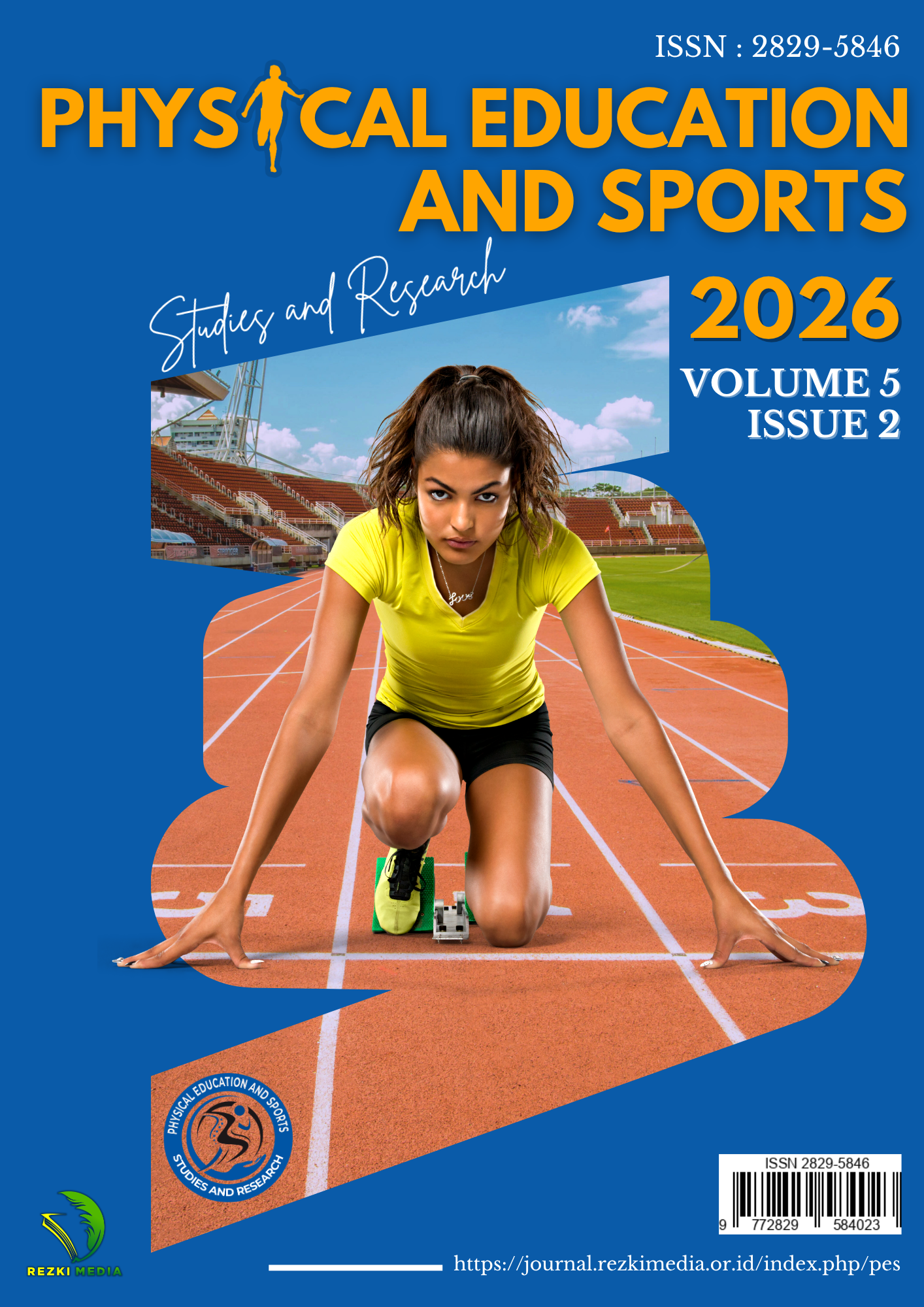
Physical Education and Sports: Studies and Research (PESSR), Volume 5, Number 2 (2026), features 6 scientific publications, comprising 5 original research articles and 1 opinion article, with 13 authorship contributions from 3 countries, comprising Indonesia (10 authors), the Philippines (2), and Greece (1).
The geographical distribution of Indonesian author affiliations covers 2 provinces, comprising Central Java (8 authors) and East Java (2 authors).
These contributions represent 6 higher education institutions, including Universitas PGRI Semarang, Indonesia (3 authors); Universitas Muhammadiyah Surakarta, Indonesia (3); Universitas Negeri Semarang, Indonesia (2); State University of Malang, Indonesia (2); Saint Louis College La Union, Philippines (2); and the University of Thessaly, Greece (1).
This issue reflects national and international scholarly contributions to physical education and sport sciences, covering peer-review standards in sport science publishing, psychological well-being among student-athletes, functional movement assessment, athletic performance, motor activity in preschool children, and technology-enhanced physical education.
Published:
2026-08-01
Opinion
-

A domain-specific peer-review checklist for sport science journals: Translating a conceptual framework into practice
Spyridon Plakias11. University of Thessaly , GRAbstractThe peer-review process plays a central role in ensuring the quality and credibility of scientific research; however, it remains characterized by variability, limited standardization, and a lack of domain-specific evaluation criteria. These limitations are particularly evident in sport science, a multidisciplinary field involving complex, context-dependent, and applied performance data. Although several guidelines for peer-review exist, they are often either generic or tailored to specific domains, limiting their applicability to sport science research. The aim of the present study was to develop a comprehensive, domain-specific reviewer checklist for sport science journals. Building on a previously proposed conceptual framework of publishable research, the checklist operationalizes key dimensions of manuscript evaluation into structured criteria, spanning editorial screening, conceptual foundation, methodological and analytical rigor, research transparency, scientific communication, and scientific and practical impact. In addition, the framework integrates both hierarchical and iterative elements of the peer-review process, conceptualizing manuscript evaluation as a cyclical process that begins and concludes with editorial decision-making. The proposed checklist provides a structured and contextually relevant tool to support reviewers in conducting more consistent and transparent evaluations, while assisting editors in decision-making and offering authors clearer expectations. Although not yet empirically validated, the proposed framework represents a step toward improving the quality, consistency, and contextual relevance of peer-review in sport science.
APA Citation StylePlakias, S. (2026). A domain-specific peer-review checklist for sport science journals: Translating a conceptual framework into practice. Physical Education and Sports: Studies and Research, 5(2), 172-181. https://doi.org/10.56003/pessr.v5i2.741

Original Research
-
Examining the mediating role of perceived psychosocial support in the relationship between sport grit and psychological well-being among high school student-athletes
Daphne Scott Fernandez1, Kahreen Lou Mondina21. Saint Louis College La Union,Saint Louis College La Union , PH2. Saint Louis College La Union,Saint Louis College La Union , PHAbstractBackground: Psychological well-being is essential for student-athletes because they must simultaneously cope with competitive sport demands and academic responsibilities. Although both sport grit and perceived psychosocial support have been associated with positive psychological outcomes, the mediating role of psychosocial support in the relationship between sport grit and psychological well-being remains insufficiently understood.
Objectives: This study examined whether perceived psychosocial support mediates the relationship between sport grit and psychological well-being among high school student-athletes.
Methods: A quantitative cross-sectional correlational design with a mediation analysis framework was employed. A total of 362 high school student-athletes from the first district of La Union, Philippines, participated using total enumeration sampling. Data were collected using standardized questionnaires assessing sport grit, psychological well-being, and perceived psychosocial support. Descriptive statistics, regression analysis, and bias-corrected bootstrap mediation analysis (5,000 resamples) were performed using JASP.
Results: Student-athletes reported high levels of sport grit, psychological well-being, and perceived psychosocial support. Sport grit significantly and positively predicted psychological well-being, whereas it did not significantly predict perceived psychosocial support. Perceived psychosocial support demonstrated a significant but negative association with psychological well-being. Furthermore, the indirect effect of sport grit on psychological well-being through perceived psychosocial support was not statistically significant, indicating the absence of a mediating effect.
Conclusions: Sport grit is an important direct psychological resource associated with psychological well-being among high school student-athletes. Although perceived psychosocial support contributes to athletes' psychological functioning, it does not explain the relationship between sport grit and psychological well-being. These findings highlight the importance of strengthening athletes' internal psychological resources while maintaining supportive sport environments.
APA Citation StyleFernandez, D. S. , & Mondina, K. L. (2026). Examining the mediating role of perceived psychosocial support in the relationship between sport grit and psychological well-being among high school student-athletes. Physical Education and Sports: Studies and Research, 5(2), 182-195. https://doi.org/10.56003/pessr.v5i2.725 -
Functional movement patterns and bilateral asymmetry in badminton athletes: A Functional Movement Screen analysis at the Malang Regional Training Center
Avi Kholifatuz Zahro'1, Muhammad Atiq Noviudin Pritama21. State University of Malang , ID2. State University of Malang , IDAbstractBackground: Badminton involves repetitive unilateral overhead movements, rapid changes of direction, and explosive actions that may contribute to side-to-side differences in functional movement patterns.
Objectives: This study aimed to describe functional movement patterns and bilateral asymmetry among badminton athletes at the Malang Regional Training Center using the Functional Movement Screen (FMS).
Methods: This cross-sectional study involved 16 sub-elite badminton athletes aged 15–20 years selected through purposive sampling. Functional movement was assessed using the seven-component FMS. Total scores were classified as high (≤14), moderate (15–17), or low (18–21) injury risk. Bilateral asymmetry was identified from differences between right- and left-side scores in five bilateral FMS components. Data were analyzed descriptively using means, standard deviations, frequencies, and percentages.
Results: Most athletes (62.5%, n = 10) were classified as having moderate injury risk, while 18.75% (n = 3) were classified as high risk and 18.75% (n = 3) as low risk. Shoulder Mobility showed the highest prevalence of bilateral asymmetry (100%, n = 16), followed by the In-Line Lunge and Rotary Stability (62.5%, n = 10 each), Hurdle Step (50.0%, n = 8), and Active Straight Leg Raise (43.75%, n = 7).
Conclusions: Bilateral functional movement asymmetry was common among badminton athletes, particularly in shoulder mobility, while most athletes were classified within the moderate injury-risk category. These findings support functional movement screening to identify movement limitations and inform individualized corrective exercise strategies.
APA Citation StyleZahro', A. K. , & Pritama, M. A. N. (2026). Functional movement patterns and bilateral asymmetry in badminton athletes: A Functional Movement Screen analysis at the Malang Regional Training Center. Physical Education and Sports: Studies and Research, 5(2), 196-207. https://doi.org/10.56003/pessr.v5i2.756 -
Associations of lower limb muscle strength and body reaction time with crescent kick performance in competitive pencak silat athletes
Jery Setiawan1, Siti Baitul Mukarromah21. State University of Semarang , ID2. State University of Semarang , IDAbstractBackground: Crescent kick performance is an important technical component of competitive pencak silat and may be associated with physical capacities such as lower limb muscle strength and reaction time. However, evidence regarding the relationships of these physical characteristics with crescent kick performance remains limited.
Objectives: This study aimed to examine the associations of lower limb muscle strength and body reaction time with crescent kick performance among competitive pencak silat athletes.
Methods: This quantitative correlational study involved 30 competitive pencak silat athletes (age: 19.8 ± 2.1 years; height: 168.4 ± 6.3 cm; body mass: 61.7 ± 8.2 kg; body mass index: 21.7 ± 2.3 kg/m²) recruited using total sampling. Lower limb muscle strength was assessed using a leg dynamometer, body reaction time using a reaction timer, and crescent kick performance using a 10-second crescent kick test. Data were analyzed using descriptive statistics, Pearson correlation, and multiple correlation analysis, with statistical significance set at p < .05.
Results: Lower limb muscle strength was positively associated with crescent kick performance (r = 0.734, p < .001), whereas body reaction time was negatively associated with crescent kick performance (r = -0.739, p < .001), indicating that shorter reaction times were associated with better kick performance. Multiple correlation analysis showed a strong combined association of lower limb muscle strength and body reaction time with crescent kick performance (R = 0.754, R² = 0.568, p < .001). Together, these variables accounted for 56.8% of the variance in crescent kick performance.
Conclusions: Greater lower limb muscle strength and shorter body reaction time were associated with better crescent kick performance among competitive pencak silat athletes. These findings highlight the relevance of muscular strength and neuromuscular responsiveness to crescent kick performance and may inform physical conditioning programs for pencak silat athletes. Further studies with larger samples and additional biomechanical, physiological, and technical measures are needed to better understand the factors associated with crescent kick performance.
APA Citation StyleSetiawan, J. , & Mukarromah, S. B. (2026). Associations of lower limb muscle strength and body reaction time with crescent kick performance in competitive pencak silat athletes. Physical Education and Sports: Studies and Research, 5(2), 208-219. https://doi.org/10.56003/pessr.v5i2.762 -
Association between ADHD symptom severity and motor activity in preschool children: A cross-sectional study
Adnan Faris Naufal1, Chevanya Diva Titania Davinci2, Anida Azkia Fitri31. Department of Physiotherapy, Faculty of Health Science, Universitas Muhammadiyah Surakarta , ID2. Department of Physiotherapy, Faculty of Health Science, Universitas Muhammadiyah Surakarta , ID3. Department of Physiotherapy, Faculty of Health Science, Universitas Muhammadiyah Surakarta , IDAbstractBackground: Attention-deficit/hyperactivity disorder (ADHD) is a neurodevelopmental disorder characterized by inattention, hyperactivity, and impulsivity. Objective measurement of motor activity may complement parent-reported assessment of ADHD symptoms.
Objectives: This study aimed to examine the association between ADHD Rating Scale-5 scores and step counts, used as an objective indicator of motor activity, among children aged 4–6 years.
Methods: A cross-sectional observational study was conducted among 110 children aged 4–6 years selected through purposive sampling. ADHD symptoms were assessed using the parent-completed ADHD Rating Scale-5, while step counts were measured using a digital pedometer during a 15-minute school recess. Data normality was assessed using the Kolmogorov–Smirnov test. Pearson's product–moment correlation was used to examine the association between total ADHD Rating Scale-5 scores and step counts, whereas Spearman's rank correlation was used for the Inattention and Hyperactivity–Impulsivity domain scores.
Results: Total ADHD Rating Scale-5 scores showed a very strong positive correlation with step counts (r = .865, p < .001). At the domain level, Inattention scores showed a strong positive correlation with step counts (ρ = .756, p < .001), while Hyperactivity–Impulsivity scores showed a very strong positive correlation (ρ = .818, p < .001).
Conclusions: Higher ADHD symptom scores were strongly associated with higher motor activity, as indicated by step counts, among preschool children. Step-count measurement may provide a simple objective measure that complements parent-reported assessment of ADHD symptoms; however, it should not be interpreted as a diagnostic measure for ADHD.
APA Citation StyleNaufal, A. F. , Davinci, C. D. T. , & Fitri, A. A. (2026). Association between ADHD symptom severity and motor activity in preschool children: A cross-sectional study. Physical Education and Sports: Studies and Research, 5(2), 220-232. https://doi.org/10.56003/pessr.v5i2.777 -
Development and evaluation of a web-based interactive flashcard tool (Aero’Zen) for low-impact rhythmic activity instruction in physical education
Zenny Ni'matul Ulya1, Donny Anhar Fahmi2, Ibnu Fatkhu Royana31. Department of Physical Education, Faculty of Social Sciences and Physical Education, Universitas PGRI Semarang , ID2. Department of Physical Education, Faculty of Social Sciences and Physical Education, Universitas PGRI Semarang , ID3. Department of Physical Education, Faculty of Social Sciences and Physical Education, Universitas PGRI Semarang , IDAbstractBackground: Teaching rhythmic activities in physical education continues to face challenges due to the limited availability of visual learning aids that demonstrate movements systematically, repeatedly, and accessibly.
Objectives: This study aimed to develop and evaluate Aero’Zen, a web-based interactive flashcard tool integrating movement illustrations, QR codes, and demonstration videos for basic low-impact rhythmic activities.
Methods: This research and development study employed the ADDIE model. Following product development and expert validation, learning outcomes were evaluated using a one-group pretest–posttest pre-experimental design involving 30 tenth-grade students at SMK Negeri 2 Semarang. Product feasibility was assessed by media experts, subject matter experts, and a physical education practitioner. Pretest and posttest scores were analyzed using the Shapiro–Wilk test for normality and paired-samples t-tests, with the significance level set at α = .05.
Results: Aero’Zen was rated highly suitable by media experts (95.75%), subject matter experts (94.50%), and a physical education practitioner (88.75%). Mean scores increased from 75.40 to 89.97 in the cognitive domain, from 28.80 to 32.77 in the affective domain, and from 19.87 to 32.00 in the psychomotor domain. Paired-samples t-tests revealed significant differences between pretest and posttest scores across all three domains (all p < .001).
Conclusions: Aero’Zen is a highly suitable web-based learning medium with the potential to support students’ cognitive, affective, and psychomotor learning outcomes, including movement coordination and performance, in low-impact rhythmic activities. Its integrated flashcards, QR-code access, and demonstration videos provide a flexible resource for repeated and independent learning. Future studies should use randomized controlled trials with larger and more diverse samples to strengthen causal inference and generalizability.
APA Citation StyleUlya, Z. N. , Fahmi, D. A. , & Royana, I. F. (2026). Development and evaluation of a web-based interactive flashcard tool (Aero’Zen) for low-impact rhythmic activity instruction in physical education. Physical Education and Sports: Studies and Research, 5(2), 233-247. https://doi.org/10.56003/pessr.v5i2.761
Global Visitors Map
Explore the geographical distribution of visitors to Physical Education and Sports: Studies and Research (PESSR).




















