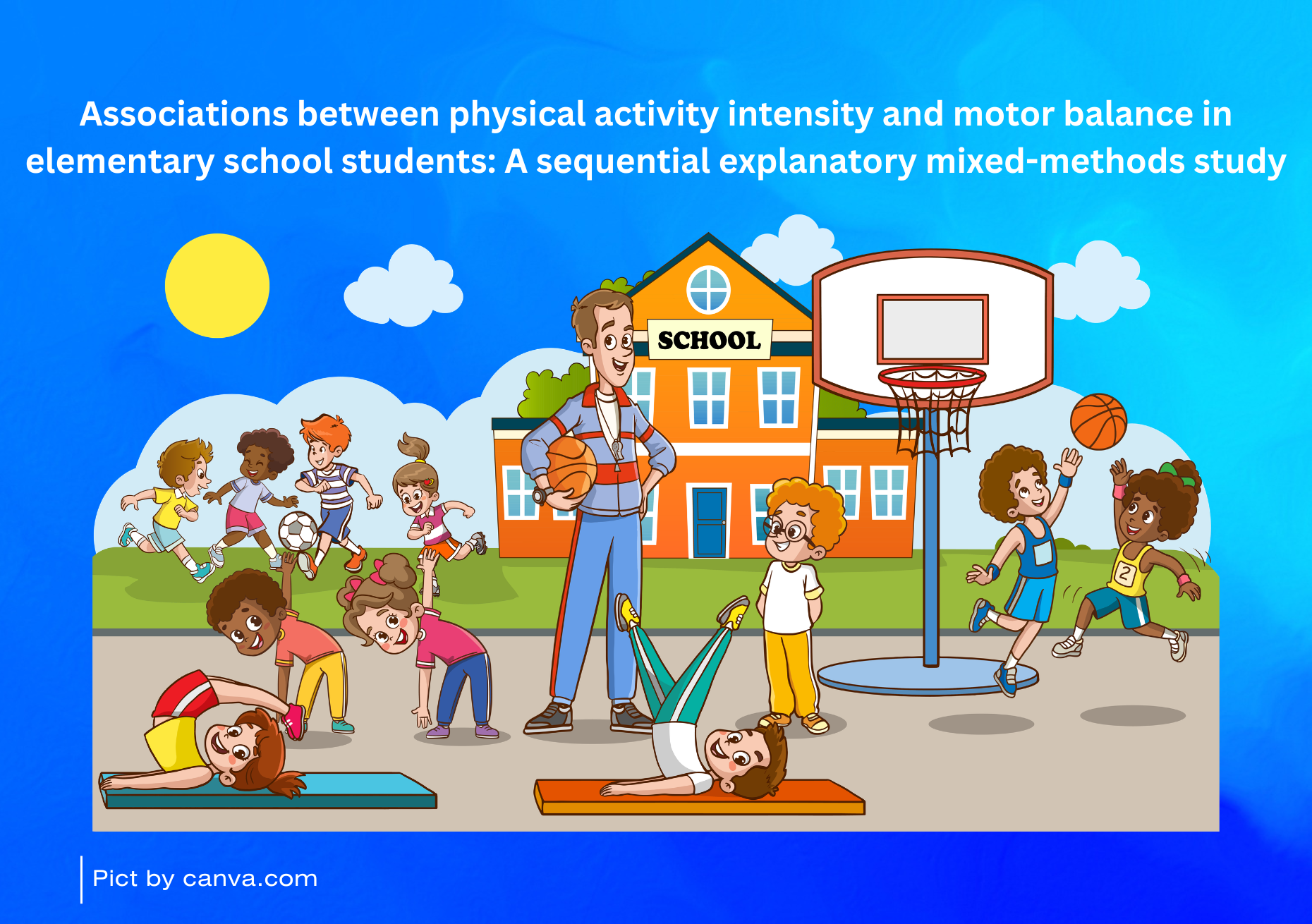
Associations between physical activity intensity and motor balance in elementary school students: A sequential explanatory mixed-methods study

Downloads
Abstract
Background: Children in primary school are becoming more sedentary due to advances in digital technology, which may reduce their physical activity levels. The development of motor skills, especially balance, which is an essential feature of children's motor abilities, can be impacted by a lack of physical activity.
Objectives: This study aimed to examine the association between physical activity intensity and motor balance in elementary school students.
Methods: This study used a sequential explanatory mixed-methods design. The quantitative phase involved 50 students selected using saturated sampling, while the qualitative phase involved teachers and students selected purposively. Physical activity intensity was measured using the Physical Activity Questionnaire for Older Children (PAQ-C), while motor balance was assessed using the Balance Beam Test. Quantitative data were analyzed using Spearman's rank correlation, and qualitative data were analyzed using thematic analysis in NVivo.
Results: With a correlation coefficient of r = 0.687 and p < 0.05, the analysis demonstrated a strong, substantial positive link between motor balance levels and physical activity intensity. The intensity of physical activity accounted for 47.2% of motor balance. Qualitative research revealed that students with high levels of physical activity were more likely to engage in active play, such as running outside, cycling, and soccer, which, in turn, indirectly improve balance and postural stability.
Conclusions: This study demonstrates that physical activity intensity plays an important role in the development of motor balance among elementary school students. These findings highlight the importance of integrating active movement-based learning strategies in physical education programs.
Adi, S., Masgumelar, N. K., & Fathoni, A. F. (2022). Development of gross motor skills exercise models and physical activities to enhance physical fitness of elementary school students. Journal of Physical Education and Sport, 22(12), 2947–2954. https://doi.org/10.7752/jpes.2022.12372
Agafonov, S., Chub, S., & Trufanova, S. (2021). Actual problems of physical development of children in the age of digital technologies. E3S Web of Conferences, 273. https://doi.org/10.1051/e3sconf/202127309034
Balaban, V. (2018). The relationship between objectively measured physical activity and fundamental motor skills in 8 to 11 years old children from the Czech Republic. Montenegrin Journal of Sports Science and Medicine, 7(2), 11–16. https://doi.org/10.26773/mjssm.180902
Dana, A., Ranjbari, S., Chaharbaghi, Z., & Ghorbani, S. (2023). Association between Physical Activity and Motor Proficiency among Primary School Children. International Journal of School Health, 10(3), 128-135. https://doi.org/10.30476/INTJSH.2023.98237.1295.1
Dao, C. T. (2025). Motor Ability in Active and Less Active Students Aged 12-13 in The Mekong Delta, Vietnam. Polish Journal of Sport and Tourism, 32(1), 14–20. https://doi.org/10.2478/pjst-2025-0003
DuBose, K. D., Gross McMillan, A., Wood, A. P., & Sisson, S. B. (2018). Joint Relationship Between Physical Activity, Weight Status, and Motor Skills in Children Aged 3 to 10 Years. Perceptual and Motor Skills, 125(3), 478–492. https://doi.org/10.1177/0031512518767008
Felix, E., Silva, V., Caetano, M., Ribeiro, M. V. V, Fidalgo, T. M., Rosa Neto, F., Sanchez, Z. M., Surkan, P. J., Martins, S. S., & Caetano, S. C. (2020). Excessive Screen Media Use in Preschoolers Is Associated with Poor Motor Skills. Cyberpsychology, Behavior, and Social Networking, 23(6), 418–425. https://doi.org/10.1089/cyber.2019.0238
Ferriyani, N. M., Nugraha, M. H. S., Putra, I. P. Y. P., & Sutadarma, I. W. G. (2021). Hubungan Antara Daya Tahan Otot Core Dengan Kemampuan Olah Kaki, Keseimbangan Statis, Dan Keseimbangan Dinamis Pemain Bulutangkis Laki-Laki Usia Muda Di Kota Denpasar. Majalah Ilmiah Fisioterapi Indonesia, 9(3). https://doi.org/10.24843/mifi.2021.v09.i03.p10
Haugland, E. S., Aadland, E., Nilsen, A. K. O., Lervåg, A. O., & Aadland, K. N. (2026). Bidirectional, prospective associations between physical activity, fundamental motor skills, and physical fitness in preschool children. BMC Public Health, 26(1). https://doi.org/10.1186/s12889-025-25871-7
Iqbal, K. (2011). Mechanisms and models of postural stability and control. Proceedings of the Annual International Conference of the IEEE Engineering in Medicine and Biology Society, EMBS, 7837–7840. https://doi.org/10.1109/IEMBS.2011.6091931
Krivolapchuk, I. A., Chernova, M. B., Kesel, S. A., Chicherin, V. P., & Savushkina, E. V. (2022). Morphofunctional and motor development of 4-5 year old children with different physical activity in a preschool educational institution. Perspektivy Nauki i Obrazovania, 59(5), 304–319. https://doi.org/10.32744/pse.2022.5.18
Li, B., Liu, J., & Ying, B. (2022). Physical education interventions improve the fundamental movement skills in kindergarten: a systematic review and meta-analysis. Food Science and Technology (Brazil), 42, e46721. https://doi.org/10.1590/fst.46721
Markowicz, M., Skrobot, W., Labuć, A., Poszytek, P., Orlikowska, A., Perzanowska, E., Krasowska, K., Drewek, K., & Kaczor, J. J. (2023). The Rehabilitation Program Improves Balance Control in Children with Excessive Body Weight and Flat Feet by Activating the Intrinsic Muscles of the Foot: A Preliminary Study. Journal of Clinical Medicine, 12(10), 3364. https://doi.org/10.3390/jcm12103364
Moon, D.-C., & Jung, J.-H. (2021). Effect of Incorporating Short-Foot Exercises in the Balance Rehabilitation of Flat Foot: A Randomized Controlled Trial. Healthcare, 9(10), 1358. https://doi.org/10.3390/healthcare9101358
Muhammad, A. F. N., & Alexander, B. (2024). The Role of the school environment in the development of gross motor skills of primary school students. Fizjoterapia Polska, 2024(4), 39–44. https://doi.org/10.56984/8ZG01A8E9F3
Nilsen, A. K. O., Anderssen, S. A., Johannessen, K., Aadland, K. N., Ylvisaaker, E., Loftesnes, J. M., & Aadland, E. (2020). Bi-directional prospective associations between objectively measured physical activity and fundamental motor skills in children: A two-year follow-up. International Journal of Behavioral Nutrition and Physical Activity, 17(1), 1. https://doi.org/10.1186/s12966-019-0902-6
Ostrowska, A., Grzyb, A., Domagalska-Szopa, M., Lis, M., & Koralewska, A. (2020). Assessment of aerobic capacity levels and selected motor skills in children with excessive body weight. Fizjoterapia Polska, 20(5), 72–83. https://fizjoterapiapolska.pl/en/article/ocena-poziomu-wydolnosci-oraz-wybranych-zdolnosci-motorycznych-u-dzieci-z-nadmierna-masa-ciala/
Papale, O., Festino, E., Papargyri, L., Cortis, C., & Fusco, A. (2025). Designing, Developing, and Evaluating a Stakeholder-Informed Mobile App to Promote Physical Activity in Children. International Journal of Environmental Research and Public Health, 22(9). https://doi.org/10.3390/ijerph22091460
Promsri, A., Haid, T., & Federolf, P. (2020). Complexity, Composition, and Control of Bipedal Balancing Movements as the Postural Control System Adapts to Unstable Support Surfaces or Altered Feet Positions. Neuroscience, 430, 113–124. https://doi.org/10.1016/j.neuroscience.2020.01.031
Rogge, A.-K., Röder, B., Zech, A., & Hötting, K. (2018). Exercise-induced neuroplasticity: Balance training increases cortical thickness in visual and vestibular cortical regions. NeuroImage, 179, 471–479. https://doi.org/10.1016/j.neuroimage.2018.06.065
Simões, E., Tavares, N., & Saraiva, M. (2026). Acute effects of dynamic stretching on knee joint position sense and dynamic balance in recreational runners: A randomized controlled trial. Gait and Posture, 124. https://doi.org/10.1016/j.gaitpost.2025.110049
Skaltsa, E., Kaioglou, V., & Venetsanou, F. (2021). Development of balance in children participating in different recreational physical activities. Science of Gymnastics Journal, 13(1), 85–95. https://doi.org/10.52165/sgj.13.1.85-95
Wang, T., Qian, Y., Zhong, T., & Qi, J. (2022). Associations between Fundamental Movement Skills and Moderate-to-Vigorous Intensity Physical Activity among Chinese Children and Adolescents with Intellectual Disability. International Journal of Environmental Research and Public Health, 19(20). https://doi.org/10.3390/ijerph192013057
Yanovich, E., & Bar‐shalom, S. (2022). Static and Dynamic Balance Indices among Kindergarten Children: A Short‐Term Intervention Program during COVID‐19 Lockdowns. Children, 9(7). https://doi.org/10.3390/children9070939
Zemková, E. (2022). Physiological Mechanisms of Exercise and Its Effects on Postural Sway: Does Sport Make a Difference? Frontiers in Physiology, 13. https://doi.org/10.3389/fphys.2022.792875
Copyright (c) 2026 Fahrurrohman Firdaus, Indra Safari, Rizal Ahmad Fauzi

This work is licensed under a Creative Commons Attribution-ShareAlike 4.0 International License.