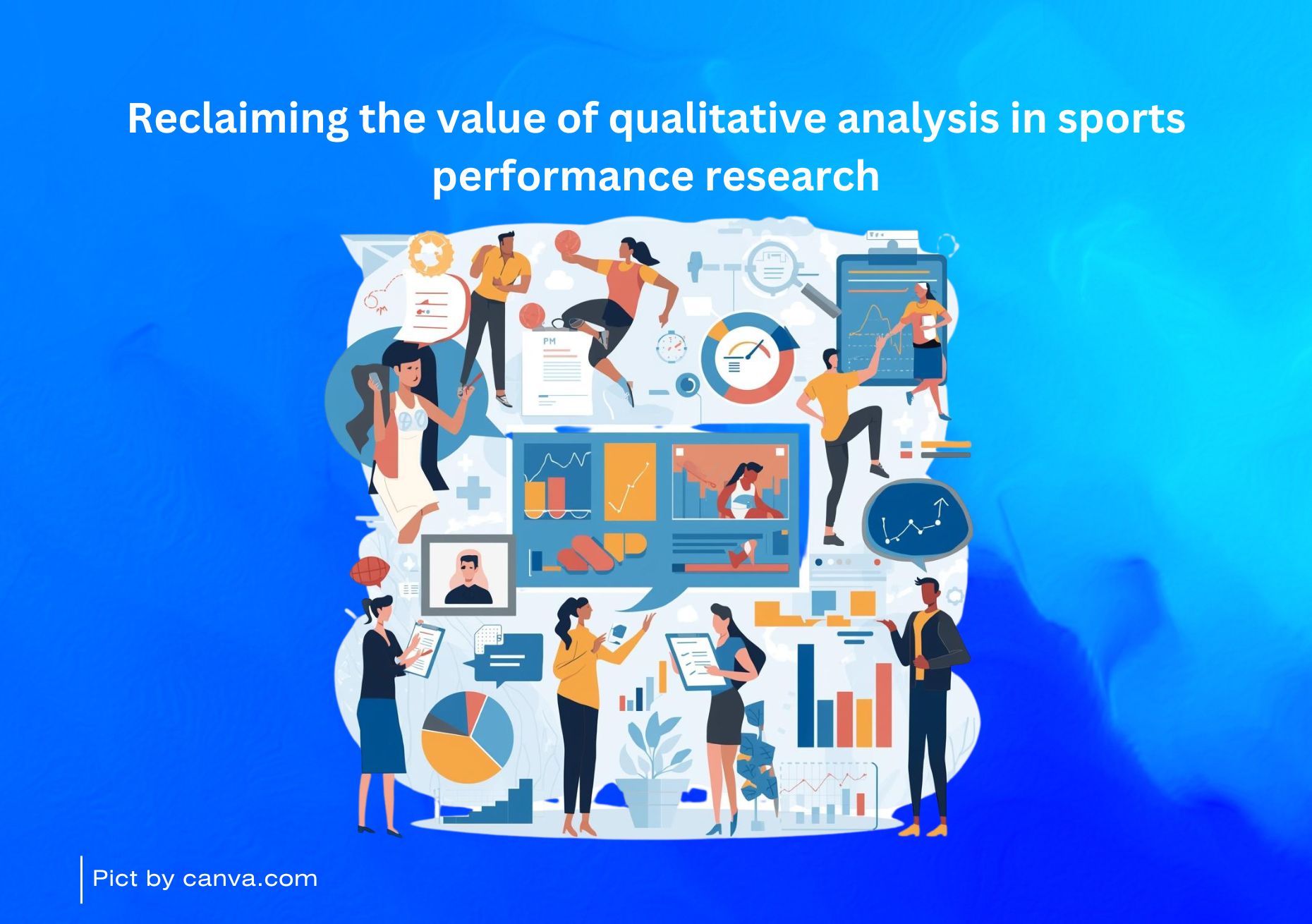
Reclaiming the value of qualitative analysis in sports performance research

Downloads
Abstract
Quantitative metrics and technology-driven approaches have reshaped sports performance analysis (SPA), yet they risk overshadowing the equally vital contribution of qualitative methods. This opinion paper highlights the value of qualitative analysis in capturing the complexity, context, and meaning of player and team behaviors, elements that numbers alone cannot explain. Drawing on video-based evaluations, case studies, and narrative reconstructions, qualitative approaches provide insights into tactical, psychological, and interactional dimensions of performance that are indispensable for bridging the science–practice gap. By integrating qualitative and quantitative perspectives, SPA can achieve a more balanced and applicable paradigm, ensuring that scientific research remains relevant to real-world coaching and athlete development. This paper calls for a renewed recognition of qualitative methods as a central pillar of SPA and invites further scholarly contributions to this evolving discussion.
Adler, R. H. (2022). Trustworthiness in qualitative research. Journal of Human Lactation, 38(4), 598-602. https://doi.org/10.1177/08903344221116620
Ahmed, S. K. (2024). The pillars of trustworthiness in qualitative research. Journal of Medicine, Surgery, and Public Health, 2, 100051. https://doi.org/10.1016/j.glmedi.2024.100051
Anguera, M. T., Camerino, O., Castañer, M., Sánchez-Algarra, P., & Onwuegbuzie, A. J. (2017). The specificity of observational studies in physical activity and sports sciences: moving forward in mixed methods research and proposals for achieving quantitative and qualitative symmetry. Frontiers in psychology, 8, 2196. https://doi.org/10.3389/fpsyg.2017.02196
Eakin, J. M., & Gladstone, B. (2020). “Value-adding” analysis: Doing more with qualitative data. International journal of qualitative methods, 19, 1609406920949333. https://doi.org/10.1177/1609406920949333
Halperin, I. (2018). Case studies in exercise and sport sciences: a powerful tool to bridge the science–practice gap. International journal of sports physiology and performance, 13(6), 824-825. https://doi.org/10.1123/ijspp.2018-0185
Lames, M. (2023). Performance analysis in game sports: Concepts and methods. Springer. https://doi.org/10.1007/978-3-031-07250-5
Lim, W. M. (2025). What is qualitative research? An overview and guidelines. Australasian Marketing Journal, 33(2), 199-229. https://doi.org/10.1177/14413582241264619
Mackenzie, R., & Cushion, C. (2013). Performance analysis in football: A critical review and implications for future research. Journal of sports sciences, 31(6), 639-676. https://doi.org/10.1080/02640414.2012.746720
Memmert, D. (2025). Editorial for Sports Performance section of Journal of Sports Sciences: Moving match analysis forward – Guidelines and perspectives. Journal of Sports Sciences, 1-8. https://doi.org/10.1080/02640414.2025.2535850
Mujika, I., Halson, S., Burke, L. M., Balagué, G., & Farrow, D. (2018). An integrated, multifactorial approach to periodization for optimal performance in individual and team sports. International journal of sports physiology and performance, 13(5), 538-561. https://doi.org/10.1123/ijspp.2018-0093
Mujika, I., Yamashita, D., & Solli, G. S. (2025). Writing high-quality case studies in sport science. International journal of sports physiology and performance, 1(aop), 1-4. https://doi.org/10.1123/ijspp.2025-0025
Mwita, K. (2022). Strengths and weaknesses of qualitative research in social science studies. Research in Business & Social Science, 11(6), 618-625. https://doi.org/10.20525/ijrbs.v11i6.1920
Nyman, A., Ekonoja, A., Kärkkäinen, T., & Szerovay, M. (2025). The Role of Video Technology in Football Coaching: An Integrative Review. International Sport Coaching Journal, 1(aop), 1-13. https://doi.org/0.1123/iscj.2024-0034
Plakias, S., Tsatalas, T., Betsios, X., & Giakas, G. (2025). A new era in soccer performance analysis research? Insight - Sports Science, 7(1), 741. https://doi.org/10.18282/iss741
Queirós, A., Faria, D., & Almeida, F. (2017). Strengths and limitations of qualitative and quantitative research methods. European journal of education studies, 3(9), 369-387. https://doi.org/10.5281/zenodo.887089
Wright, C., Atkins, S., & Jones, B. (2012). An analysis of elite coaches’ engagement with performance analysis services (match, notational analysis and technique analysis). International Journal of Performance Analysis in Sport, 12(2), 436-451. https://doi.org/10.1080/24748668.2012.11868609
Wright, C., Carling, C., Lawlor, C., & Collins, D. (2016). Elite football player engagement with performance analysis. International Journal of Performance Analysis in Sport, 16(3), 1007-1032. https://doi.org/10.1080/24748668.2016.11868945
Yang, P., Xu, R., & Le, Y. (2024). Factors influencing sports performance: A multi-dimensional analysis of coaching quality, athlete well-being, training intensity, and nutrition with self-efficacy mediation and cultural values moderation. Heliyon, 10(17). https://doi.org/10.1016/j.heliyon.2024.e36646
Zentgraf, K., Musculus, L., Reichert, L., Will, L., Roffler, A., Hacker, S., Hilpisch, C., Wiedenbrüg, K., Cermak, N., & Lenz, C. (2024). Advocating individual-based profiles of elite athletes to capture the multifactorial nature of elite sports performance. Scientific reports, 14(1), 26351. https://doi.org/10.1038/s41598-024-76977-8
Copyright (c) 2026 Spyridon Plakias

This work is licensed under a Creative Commons Attribution-ShareAlike 4.0 International License.