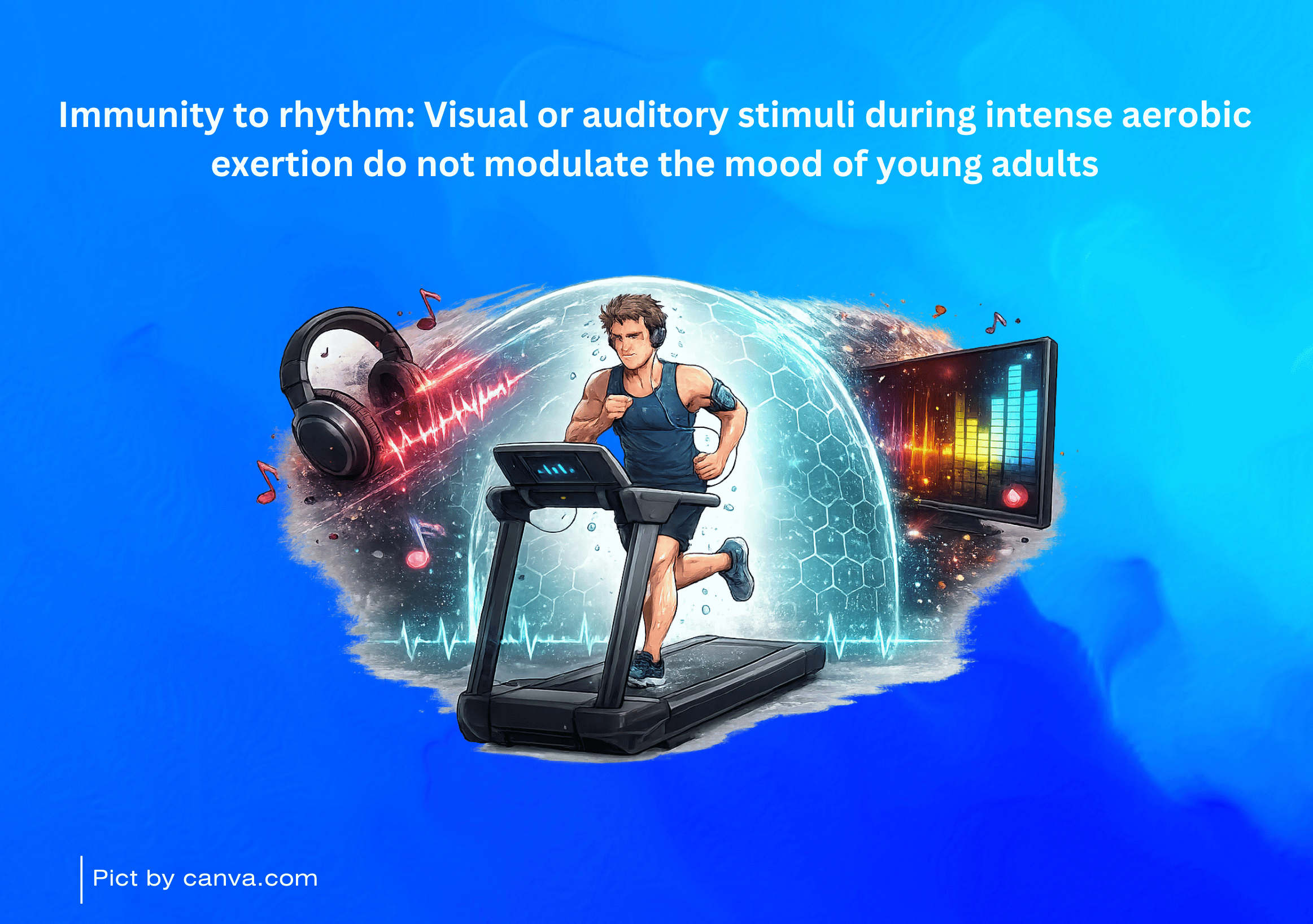
Immunity to rhythm: Visual or auditory stimuli during intense aerobic exertion do not modulate the mood of young adults

Downloads
Abstract
Background: High-intensity aerobic exercise can promote higher energy expenditure when compared to low and moderate-intensity exercise. However, vigorous exercise can negatively influence mood responses related to adherence. Auditory and audiovisual resources have been used to improve psychological variables during and after exercise.
Objectives: To analyze the influence of listening to music and watching video clips on mood responses of young adults after a high-intensity aerobic exercise session.
Methods: This is a Cross-Sectional Randomized Controlled Study in which fourteen male participants (23.4 ± 3.1 years; 26.2 ± 3.4 kg/m²) randomly performed exercise sessions on a cyclergometer, at an intensity of 10% above anaerobic threshold, in three situations: control (C), listening to music (M), and watching video clips (VC). At the end of each session, participants underwent 30 min of passive recovery. Mood responses were measured using Brunel’s Mood Scale (BRUMS) before exercise, immediately after exercise, and after recovery. Friedman’s and Wilcoxon’s tests were used, with a significance level of 5%.
Results: No statistical differences were found between conditions (C, C, and VC) for the dimensions confusion, fatigue, anger, tension, and vigor (p>0.05). A statistically significant difference was found for depression before exercise, with M higher than C and VC (p<0.05); however, no differences were observed after exercise or recovery.
Conclusions: Listening to music and/or watching video clips does not influence mood responses in young adults after high-intensity aerobic exercise on a cyclergometer.
Almeida, C. M. M., Araujo, F. D. S., Lima, E. V. D. C., De Souza, M. F., Sales, M. M., & De Moraes, J. F. V. N. (2021). Acute effects of listening to music and/or watching video clips on perceptual variables and performance during a high intensity exercise session. Journal of Physical Education and Sport, 21(6), 3455-3463. http://doi.org/10.7752/jpes.2021.06468
Amann, M. (2011). Central and peripheral fatigue: interaction during cycling exercise in humans. Medicine & Science in Sports & Exercise, 43(11), 2039-2045. https://doi.org/10.1249/MSS.0b013e31821f59ab
Bigliassi, M., Greca, J. P., Barreto-Silva, V., Chierotti, P., Oliveira, A. R. D., & Altimari, L. R. (2019). Effects of audiovisual stimuli on psychological and psychophysiological responses during exercise in adults with obesity. Journal of sports sciences, 37(5), 525-536. https://doi.org/10.1080/02640414.2018.1514139
Bigliassi, M., Santos, E., Kanthack, T., Bortolotti, H., & Altimari, L. (2012). Influência da música em variáveis psicofisiológicas durante um exercício submáximo em ciclossimulador. Revista Brasileira de Atividade Física & Saúde, 17(6), 532-542. http://dx.doi.org/10.12820/2317- 1634.2012v17n6p532
Bird, J. M., Karageorghis, C. I., Baker, S. J., & Brookes, D. A. (2019). Effects of music, video, and 360‐degree video on cycle ergometer exercise at the ventilatory threshold. Scandinavian journal of medicine & science in sports, 29(8), 1161-1173. https://doi.org/10.1111/sms.13453
Bueno, D. R., Marucci, M. D. F. N., Codogno, J. S., & Roediger, M. D. A. (2016). Os custos da inatividade física no mundo: estudo de revisão. Ciência & saúde coletiva, 21, 1001-1010. https://doi.org/10.1590/1413-81232015214.09082015
Camacho, J. M., Oliveira, B. R. R., & Maranhão, G. A. (2014). Efeito de dois tipos de prescrição de exercício físico aeróbio sobre variáveis relacionadas à adesão. Rev. bras. ciênc. mov, 22-29. https://doi.org/10.18511/rbcm.v22i1.3943
Chisholm, D. M., Collis, M. L., Kulak, L. L., Davenport, W., & Gruber, N. (1975). Physical activity readiness. BC Med J, 17(2), 375-8.
da Cruz Silva, T., Freire, G. L. M., Morais, O. S. G., & do Nascimento, J. R. D. A. (2019). Motivação, bem-estar e autoestima de praticantes de diferentes modalidades de exercício físico. Saúde e Pesquisa, 12(2), 359-366. https://doi.org/10.17765/2176-9206.2019v12n2p359-366
Ekkekakis, P. (2003). Pleasure and displeasure from the body: Perspectives from exercise. Cognition and Emotion, 17(2), 213–239. https://doi.org/10.1080/02699930302292
Ekkekakis, P., Parfitt, G., & Petruzzello, S. J. (2011). The pleasure and displeasure people feel when they exercise at different intensities: decennial update and progress towards a tripartite rationale for exercise intensity prescription. Sports medicine, 41(8), 641-671. https://doi.org/10.2165/11590680-000000000-00000
Enoka, R. M., & Duchateau, J. (2008). Muscle fatigue: what, why and how it influences muscle function. The Journal of physiology, 586(1), 11-23. https://doi.org/10.1113/jphysiol.2007.139477
Gandevia, S. C. (2001). Spinal and supraspinal factors in human muscle fatigue. Physiological reviews, 81(4), 1725-1789. https://doi.org/10.1152/physrev.2001.81.4.1725
Geraldes, A. A. R., Silva, W. B. D., Balikian, P., & Pereira, P. M. G. (2019). Effects of walking on the mood of physically active older people. Revista Brasileira de Medicina do Esporte, 25(1), 63-66. https://doi.org/10.1590/1517-869220192501193620
Giampá, S. Q. D. C., Souza, J. F. T. D., Mello, M. T. D., Tufik, S., Santos, R. V. T. D., & Antunes, H. K. M. (2018). Maximum effort training performed in hypoxia alters the mood profile. Revista Brasileira de Medicina do Esporte, 24, 440-445. https://doi.org/10.1590/1517-869220182406133712
Hayakawa, Y., Takada, K., Miki, H., & Tanaka, K. (2000). Effects of music on mood during bench stepping exercise. Perceptual and motor skills, 90(1), 307-314. https://doi.org/10.2466/pms.2000.90.1.307
Hutchinson, J. C., Karageorghis, C. I., & Jones, L. (2015). See hear: Psychological effects of music and music-video during treadmill running. Annals of Behavioral Medicine, 49(2), 199–211. https://doi.org/10.1007/s12160-014-9647-2
Jones, L., Karageorghis, C. I., & Ekkekakis, P. (2014). Can high-intensity exercise be more pleasant? Attentional dissociation using music and video. Journal of Sport and Exercise Psychology, 36(5), 528-541. https://doi.org/10.1123/jsep.2013-0251
Karageorghis, C. I., & Priest, D. L. (2012). Music in the exercise domain: a review and synthesis (Part I). International Review of Sport and Exercise Psychology, 5(1), 44–66. https://doi.org/10.1080/1750984X.2011.631026
Laux, R. C., Mattiello, G. F., & Corazza, S. T. (2018). Efeitos dos treinamentos metabólico e de força no estado de humor. ConScientiae Saúde, 17(3), 286-292. https://doi.org/10.5585/conssaude.v17n3.8275
Lovato, N., Loch, M., González, A., & Lopes, M. (2015). Assiduidade a programas de atividade física oferecidas por Unidades Básicas de Saúde: o discurso de participantes muito e pouco assíduos. Revista Brasileira de Atividade Física & Saúde, 20(2), 184-184. https://doi.org/10.12820/rbafs.v.20n2p184
Matsudo, S., Araújo, T., Matsudo, V., Andrade, D., Andrade, E., & Braggion, G. (2001). Questinário internacional de atividade f1sica (IPAQ): estudo de validade e reprodutibilidade no Brasil. Rev. bras. ativ. fís. saúde, 05-18. https://doi.org/10.12820/rbafs.v.6n2p5-18
Mazzeo, R. S., & Marshall, P. E. T. E. R. (1989). Influence of plasma catecholamines on the lactate threshold during graded exercise. Journal of applied physiology, 67(4), 1319-1322. https://doi.org/10.1152/jappl.1989.67.4.1319
Pedersen, B. K., & Saltin, B. (2015). Exercise as medicine–evidence for prescribing exercise as therapy in 26 different chronic diseases. Scandinavian Journal of Medicine & Science in Sports, 25, 1-72. https://doi.org/10.1111/sms.12581
Peluso, M. A. M., & De Andrade, L. H. S. G. (2005). Physical activity and mental health: the association between exercise and mood. Clinics, 60(1), 61-70. https://doi.org/10.1590/S1807-59322005000100012
Rech, C. R., Camargo, E. M. D., Araujo, P. A. B. D., Loch, M. R., & Reis, R. S. (2018). Perceived barriers to leisure-time physical activity in the Brazilian population. Revista Brasileira de Medicina do Esporte, 24, 303-309. https://doi.org/10.1590/1517-869220182404175052
Rohlfs, I. C. P. D. M., Rotta, T. M., Luft, C. D. B., Andrade, A., Krebs, R. J., & Carvalho, T. D. (2008). A Escala de Humor de Brunel (Brums): instrumento para detecção precoce da síndrome do excesso de treinamento. Revista Brasileira de Medicina do esporte, 14(3), 176-181. https://doi.org/10.1590/S1517-86922008000300003
Scherr, J., Wolfarth, B., Christle, J. W., Pressler, A., Wagenpfeil, S., & Halle, M. (2013). Associations between Borg’s rating of perceived exertion and physiological measures of exercise intensity. European Journal of Applied Physiology, 113(1), 147-155. https://doi.org/10.1007/s00421-012-2421-x
Souza, J. F. T. D., Giampá, S. Q. D. C., Lemos, V. D. A., Santos, S. A. D., Silva, E. T. D., De Mello, M. T., ... & Antunes, H. K. M. (2015). Exercise performed at hypoxia influences mood state and anxiety symptoms. Motriz: Revista de Educação Física, 21, 177-184. https://doi.org/10.1590/S1980-65742015000200008
Spriet, L. L. (2014). New insights into the interaction of carbohydrate and fat metabolism during exercise. Sports medicine, 44(Suppl 1), 87-96. https://doi.org/10.1007/s40279-014-0154-1
Steptoe, A., & Cox, S. (1988). Acute effects of aerobic exercise on mood. Health Psychology, 7(4), 329. https://doi.org/10.1037//0278-6133.7.4.329
Stork, M. J., Kwan, M. Y., Gibala, M. J., & Martin Ginis, K. A. (2015). Music enhances performance and perceived enjoyment of sprint interval exercise. Medicine & Science in Sports & Exercise, 47(5), 1052-1060. https://doi.org/10.1249/MSS.0000000000000494
Terry, P. C., Karageorghis, C. I., Curran, M. L., Martin, O. V., & Parsons-Smith, R. L. (2020). Effects of music in exercise and sport: A meta-analytic review. Psychological Bulletin, 146(2), 91. https://doi.org/10.1037/bul0000216
Thakare, A. E., Mehrotra, R., & Singh, A. (2017). Effect of music tempo on exercise performance and heart rate among young adults. International Journal of Physiology, Pathophysiology and Pharmacology, 9(2), 35. https://pubmed.ncbi.nlm.nih.gov/28533890/
Urhausen, A., Weiler, B., Coen, B., & Kindermann, W. (1994). Plasma catecholamines during endurance exercise of different intensities as related to the individual anaerobic threshold. European journal of applied physiology and occupational physiology, 69(1), 16-20. https://doi.org/10.1007/BF00867921
Zhang, Y., Li, J., & Wang, Y. (2025). Effects of acute exercise programs on heart rate variability and vascular function in sedentary college students: A randomized controlled trial. Medicine, 104(19), e42346. https://doi.org/10.1097/MD.0000000000042346
Copyright (c) 2026 Flavio de Souza Araujo, Camila Maria Menezes Almeida, Mariana Ferreira de Souza, Marcelo Magalhães Sales, José Fernando Vila Nova de Moraes

This work is licensed under a Creative Commons Attribution-ShareAlike 4.0 International License.