Performance determinants in tropical trail running: Race result analysis of the 5K and 10K Merapi Merbabu de Trail 2025

Downloads
Abstract
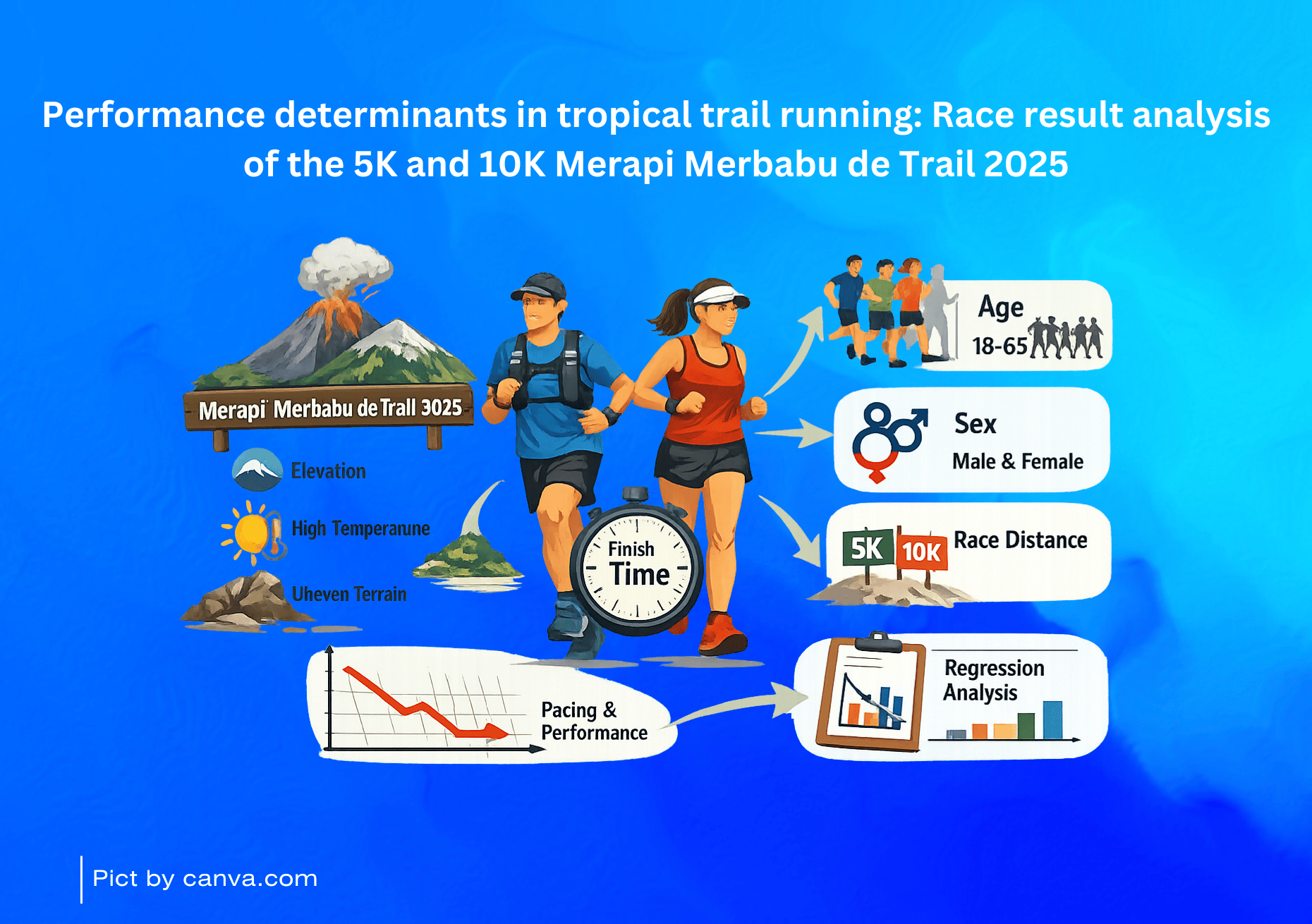
Objectives: This study aimed to examine the influence of race distance, sex, and age on trail running performance in the 5K and 10K categories of the Merapi Merbabu de Trail 2025.
Methods: A retrospective observational race result analysis was conducted using official race data from the Merapi Merbabu de Trail 2025. The study included 429 runners (5K: n = 144; 10K: n = 285), consisting of 275 male and 154 female participants. The primary outcome variable was finish time (in minutes), while the independent variables included race, distance, sex, and age. Statistical analyses were performed using SPSS version 26, including descriptive statistics, independent-samples t-tests, Cohen’s d effect sizes, and multiple linear regression to evaluate predictors of performance.
Results: Results showed a significant difference in performance between race distances. The mean finish time for the 5K category was 152.8 ± 44.3 minutes, while the 10K category averaged 306.1 ± 74.3 minutes (t = -26.68, p < 0.001, Cohen’s d = 2.50). Male runners completed the 10K race faster than female runners (293 vs. 345 minutes). Regression analysis indicated that finish time increased by approximately 2–3 minutes per year of age, indicating a progressive decline in performance with increasing age.
Conclusions: These findings indicate that race distance, sex, and age are significant determinants of trail running performance in tropical environments.
Barramuño-Medina, M., Aravena-Sagardia, P., Valdés-Badilla, P., Gálvez-García, G., Jiménez-Torres, S., & Pastén-Hidalgo, W. (2024). Acute effects of the short-foot exercise in runners with medial tibial stress syndrome: A quasi-experimental study. Physical Therapy in Sport, 70, 67–74. https://doi.org/10.1016/J.PTSP.2024.09.001
Bassett, A. J., Ahlmen, A., Rosendorf, J. M., Romeo, A. A., Erickson, B. J., & Bishop, M. E. (2020). The biology of sex and sport. JBJS reviews, 8(3), e0140. https://doi.org/10.2106/JBJS.RVW.19.00140
Coratella, G., Varesco, G., Rozand, V., Cuinet, B., Sansoni, V., Lombardi, G., Vernillo, G., & Mourot, L. (2024). Downhill running increases markers of muscle damage and impairs the maximal voluntary force production as well as the late phase of the rate of voluntary force development. European Journal of Applied Physiology, 124(6), 1875-1883. https://doi.org/10.1007/s00421-023-05412-z
Cumming, G. (2013). Understanding the new statistics: Effect sizes, confidence intervals, and meta-analysis. Routledge. https://doi.org/10.4324/9780203807002
DeSio, D. D., Snyder, K., Erickson, W., Galati, J., Otersen, K., & Campbell, S. C. (2025). Baseline Data: Sex Differences In Human Performance: 467. Medicine & Science in Sports & Exercise, 57(10S), 140-141. https://doi.org/10.1249/01.mss.0001155632.85281.44
Gimenez, P., Arnal, P. J., Samozino, P., Millet, G. Y., & Morin, J. B. (2014). Simulation of uphill/downhill running on a level treadmill using additional horizontal force. Journal of biomechanics, 47(10), 2517-2521. https://doi.org/10.1016/j.jbiomech.2014.04.012
Gutiérrez, H., Piedrafita, E., Bascuas, P. J., Arbonés, I., Berzosa, C., & Bataller-Cervero, A. V. (2025). Real-Time Performance Prediction in Long-Distance Trail Running: A Practical Model Based on Terrain Difficulty and Pacing Variability. Sports, 13(11), 385. https://doi.org/10.3390/sports13110385
Hale, C. (2014). Basic statistical reporting for articles published in biomedical journals: classic methods paper. International Journal of Nursing Studies, 52(1), 5-9. https://doi.org/10.1016/j.ijnurstu.2014.09.007
Harriss, D. J., MacSween, A., & Atkinson, G. (2019). Ethical standards in sport and exercise science research: 2020 update. International Journal of Sports Medicine, 40(13), 813-817. https://doi.org/10.1055/a-1015-3123
Hunter, S. K., & Senefeld, J. W. (2024). Sex differences in human performance. The Journal of Physiology, 602(17), 4129-4156. https://doi.org/10.1113/JP284198
Joyner, M. J., Hunter, S. K., & Senefeld, J. W. (2025). Evidence on sex differences in sports performance. Journal of Applied Physiology, 138(1), 274-281. https://doi.org/10.1152/japplphysiol.00615.2024
Lang, T. A., & Altman, D. G. (2015). Basic statistical reporting for articles published in biomedical journals: the “Statistical Analyses and Methods in the Published Literature” or the SAMPL Guidelines. International Journal of Nursing Studies, 52(1), 5-9. https://doi.org/10.1016/j.ijnurstu.2014.09.006
Lepers, R., & Stapley, P. J. (2016). Master athletes are extending the limits of human endurance. Frontiers in Physiology, 7, 613. https://doi.org/10.3389/fphys.2016.00613
Lepers, R., Stapley, P. J., & Cattagni, T. (2018). Variation of age-related changes in endurance performance between modes of locomotion in men: an analysis of master world records. International Journal of Sports Physiology and Performance, 13(3), 394-397. https://doi.org/10.1123/ijspp.2017-0222
Lu, Z., Suo, B., Deng, L., Wang, J., Fu, W., Zhong, Y., & Jin, J. (2025). A review of uphill and downhill running: biomechanics, physiology and modulating factors. Frontiers in Bioengineering and Biotechnology, 13, 1690023. https://doi.org/10.3389/fbioe.2025.1690023
Mallett, G., Schoenfeld, B., Purdom, T., & Galpin, A. (2025). Physiological factors that affect maximal oxygen uptake and lactate threshold during endurance training. Science & Sports, 40(1), 10-23. https://doi.org/10.1016/j.scispo.2023.09.007
Martín-Rodríguez, A., Gostian-Ropotin, L. A., Beltrán-Velasco, A. I., Belando-Pedreño, N., Simón, J. A., López-Mora, C., Navarro-Jiménez, E., Tornero-Aguilera, J. F., & Clemente-Suárez, V. J. (2024). Sporting mind: the interplay of physical activity and psychological health. Sports, 12(1), 37. https://doi.org/10.3390/sports12010037
McClelland, E. L., & Weyand, P. G. (2022). Sex differences in human running performance: smaller gaps at shorter distances? Journal of Applied Physiology, 133(4), 876-885. https://doi.org/10.1152/japplphysiol.00359.2022
Millet, G. P., Callovini, A., & Raberin, A. (2025). Sex-differences in Mountain Ultra-trail Performance: Look at the Scenery. Sports Medicine - Open, 11(1), 86. https://doi.org/10.1186/s40798-025-00894-x
Millet, G. Y., Hoffman, M. D., & Morin, J. B. (2012). Sacrificing economy to improve running performance - A reality in the ultramarathon? In Journal of Applied Physiology, 113(3), 507-509. https://doi.org/10.1152/japplphysiol.00016.2012
Minetti, A. E., Moia, C., Roi, G. S., Susta, D., & Ferretti, G. (2002). Energy cost of walking and running at extreme uphill and downhill slopes. Journal of Applied Physiology, 93(3), 1039-1046. https://doi.org/10.1152/japplphysiol.01177.2001
Mousavi, S. H., van Kouwenhove, L., Rajabi, R., Zwerver, J., & Hijmans, J. M. (2021). The effect of changing foot progression angle using real-time visual feedback on rearfoot eversion during running. PloS one, 16(2), e0246425. https://doi.org/10.1371/JOURNAL.PONE.0246425
Nybo, L., Rasmussen, P., & Sawka, M. N. (2014). Performance in the heat-physiological factors of importance for hyperthermia-induced fatigue. Comprehensive Physiology, 4(2), 657-689. https://doi.org/10.1002/cphy.c130012
Périard, J. D., Racinais, S., & Sawka, M. N. (2015). Adaptations and mechanisms of human heat acclimation: applications for competitive athletes and sports. Scandinavian Journal of Medicine & Science in Sports, 25, 20-38. https://doi.org/10.1111/sms.12408
Racinais, S., Alonso, J. M., Coutts, A. J., Flouris, A. D., Girard, O., González-Alonso, J., Hausswirth, C., Jay, O., Lee, J. K. W., Mitchell, N., Nassis, G. P., Nybo, L., Pluim, B. M., Roelands, B., Sawka, M. N., Wingo, J., & Périard, J. D. (2015). Consensus recommendations on training and competing in the heat. British Journal of Sports Medicine, 49(18), 6-19. https://doi.org/10.1111/sms.12467
Sawka, M. N., Leon, L. R., Montain, S. J., & Sonna, L. A. (2011). Integrated physiological mechanisms of exercise performance, adaptation, and maladaptation to heat stress. Comprehensive Physiology, 1(4), 1883-1928. https://doi.org/10.1002/cphy.c100082
Scheer, V., Tiller, N. B., Doutreleau, S., Khodaee, M., Knechtle, B., Pasternak, A., & Rojas-Valverde, D. (2022). Authors’ Response to: Comment on:“Potential Long-Term Health Problems Associated with Ultra-Endurance Running: A Narrative Review”. Sports Medicine, 52(4), 957-958. https://doi.org/10.1007/s40279-022-01647-6
Senefeld, J. W., & Hunter, S. K. (2024). Hormonal basis of biological sex differences in human athletic performance. Endocrinology, 165(5), bqae036. https://doi.org/10.1210/endocr/bqae036
Tanaka, H., & Seals, D. R. (2008). Endurance exercise performance in Masters athletes: age‐associated changes and underlying physiological mechanisms. The Journal of Physiology, 586(1), 55-63. https://doi.org/10.1113/jphysiol.2007.141879
Tiller, N. B., Elliott-Sale, K. J., Knechtle, B., Wilson, P. B., Roberts, J. D., & Millet, G. Y. (2021). Do sex differences in physiology confer a female advantage in ultra-endurance sport?. Sports medicine, 51(5), 895-915. https://doi.org/10.1007/s40279-020-01417-2
Vernillo, G., Giandolini, M., Edwards, W. B., Morin, J. B., Samozino, P., Horvais, N., & Millet, G. Y. (2017). Biomechanics and physiology of uphill and downhill running. Sports Medicine, 47(4), 615-629. https://doi.org/10.1007/s40279-016-0605-y
Copyright (c) 2026 Siti Baitul Mukarromah, Sugiarto Sugiarto, Gustiana Mega Anggita, Sri Agus Budi Santoso, Sangheon Park, Ambar Dwi Erawati, Rikha Liemiyah, Aziiz Mardanarian Rosdianto, Ronny Lesmana, Faisyal Syofian

This work is licensed under a Creative Commons Attribution-ShareAlike 4.0 International License.