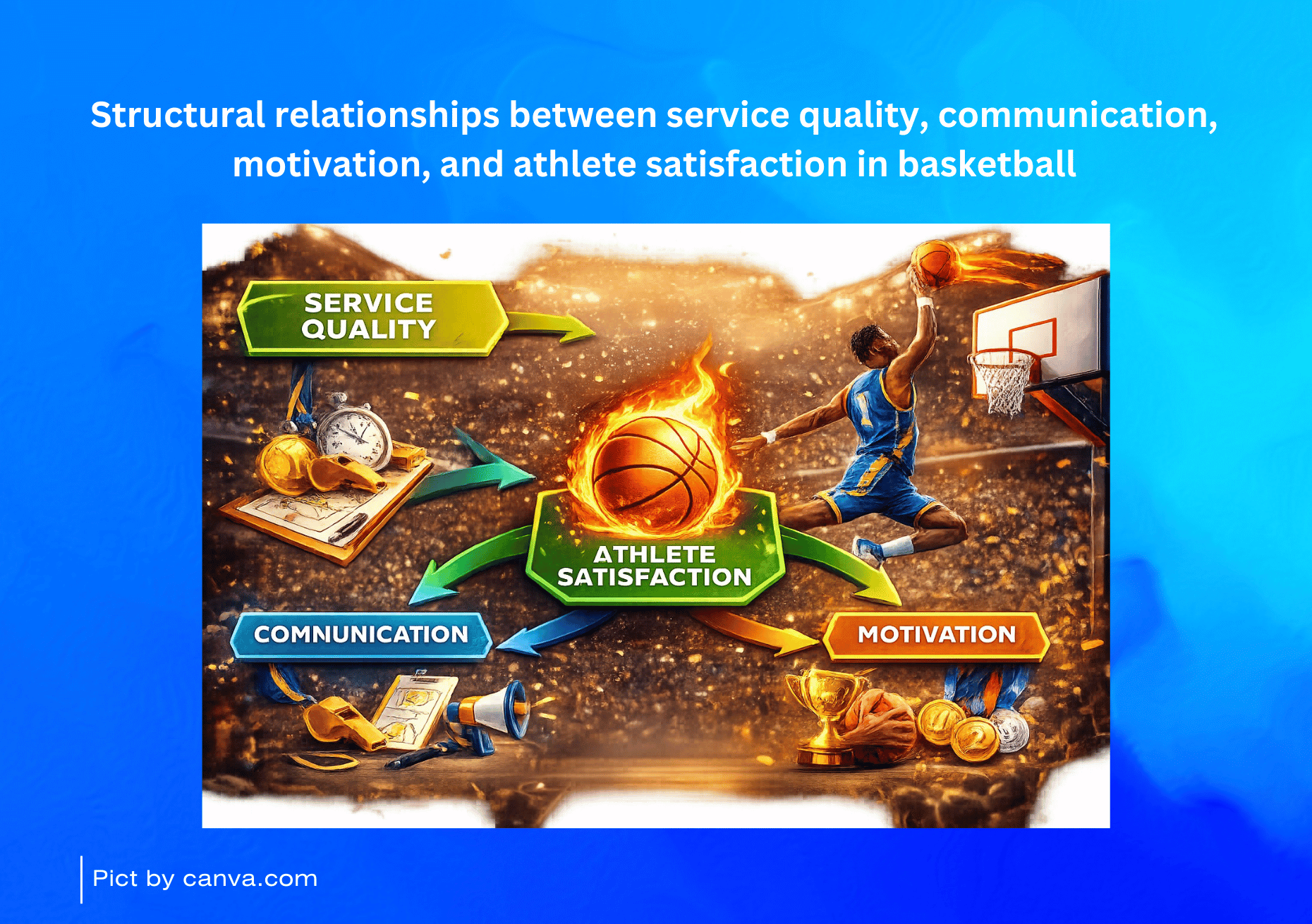
Structural relationships between service quality, communication, motivation, and athlete satisfaction in basketball
Indonesia

Downloads
Abstract
Background: Many basketball clubs aim to enhance athlete satisfaction through service quality, communication, and motivation; however, empirical evidence validating these factors as measurable constructs remains limited.
Objectives: This study examines whether these variables function as latent constructs influencing athlete satisfaction and validates their measurement structure using confirmatory factor analysis.
Methods: This study used a quantitative survey and included 263 basketball athletes from various clubs in Sidoarjo, comprising 110 males and 153 females. The participant characteristics focused on players still in the developmental stage who had been actively participating in club training programs for 3 to 6 months, with educational levels ranging from junior high school to college. Participants were selected using purposive sampling. Data were collected using a valid and reliable Likert-scale questionnaire and analyzed using Structural Equation Modeling (SEM) via AMOS 22.
Results: The results demonstrate that service quality (β=0.337, ????=0.000) and communication (β=0.439, ????=0.000) significantly enhance motivation. Furthermore, motivation significantly affects athlete satisfaction (β = 0.582, ???? = 0.000). Crucially, the analysis confirms that motivation mediates the relationship between service quality (indirect effect=0.139) and communication (indirect effect=0.240) on satisfaction.
Conclusions: Theoretically, this study confirms motivation as a vital psychological mediator linking managerial inputs to athlete satisfaction. In practice, the findings demonstrate that while high-quality physical facilities provide a necessary structural foundation, they must be integrated with effective, supportive coaching communication to optimally ignite athletes' intrinsic drive and maximize their overall club experience.Abdhi, M. I., Tomoliyus, Sukamti, E. R., Fauzi, Prabowo, T. A., Maulana, A., Habibie, M., Amalia, B., & Kasanrawali, A. (2024). The Effect of Service Quality on Achievement Motivation in Kurash Sport in Indonesia: Analysis Based on Category as Moderator. Retos, 57, 517–525. https://doi.org/10.47197/retos.v57.105998
Ain, E., Aznan, M., Khairulanwar, M., Yusof, M., Fikri, A., Kassim, M., Hafiz, A., Bakar, A., & Rosli, N. M. (2024). Association Between Service Quality and Motivation to Engage with Sports Facilities: A Study Among University Students. Malaysian Journal of Sport Science and Recreation, 20(1), 1–12. https://doi.org/10.24191/MJSSR.V20I1.960
Alguacil, M., Núñez-Pomar, J., Pérez-Campos, C., & Prado-Gascó, V. (2019). Perceived value, satisfaction and future intentions in sport servicesPutting congruence and brand trust in the equation – linear models vs QCA. Academia Revista Latinoamericana de Administracion, 32(4), 566–579. https://doi.org/10.1108/ARLA-04-2019-0099
Alkasasbeh, W. J., & Akroush, S. H. (2025). Sports motivation: a narrative review of psychological approaches to enhance athletic performance. Frontiers in Psychology, 16, 1645274. https://doi.org/10.3389/fpsyg.2025.1645274
Braz, D., Maia, C., Gouveia, É., Monteiro, D., Couto, N., & Sarmento, H. (2025). Passion, Motivation, and Well-Being in Young Footballers: A Systematic Review. Healthcare, 13(24), 3273. https://doi.org/10.3390/healthcare13243273
Carpentier, J., & Mageau, G. A. (2013). When change-oriented feedback enhances motivation, well-being and performance: A look at autonomy-supportive feedback in sport. Psychology of Sport and Exercise, 14(3), 423–435. https://doi.org/10.1016/j.psychsport.2013.01.003
Chelladurai, P., Riemer, H. A., Chelladurai, P., & Riemer, H. A. (1997). A Classification of Facets of Athlete Satisfaction. Journal of Sport Management, 11(2), 133–159. https://doi.org/10.1016/j.smr.2019.12.008
Choi, H., Jeong, Y., & Kim, S. K. (2020). The Relationship between Coaching Behavior and Athlete Burnout: Mediating Effects of Communication and the Coach–Athlete Relationship. International Journal of Environmental Research and Public Health 2020, Vol. 17, Page 8618, 17(22), 8618. https://doi.org/10.3390/ijerph17228618
Cranmer, G., Ash, E., Fontana, J. L., & Mikkilineni, S. D. (2020). Communication for the win: task benefits of coach confirmation in collegiate athletics. Communication Quarterly, 68(5), 539–559. https://doi.org/10.1080/01463373.2020.1850491
Filho, E., Dobersek, U., Gershgoren, L., Becker, B., & Tenenbaum, G. (2014). The cohesion–performance relationship in sport: a 10-year retrospective meta-analysis. Sport Sciences for Health 2014 10:3, 10(3), 165–177. https://doi.org/10.1007/s11332-014-0188-7
Griban, G., Vasylieva, S., Verbovskyi, I., Liashevych, A., Lupaina, I., Grechanyk, O., Temchenko, O., Vysochan, L., Skyrda, T., & Denysenko, A. (2022). Formation of professional and communicative competencies in future coaches in olympic and professional sports. Journal for Educators, Teachers and Trainers, 13(5), 145–161. https://doi.org/10.47750/jett.2022.13.05.014
Günel, İ., & Duyan, M. (2020). The Effect of Service Quality on Athlete Satisfaction: an Empirical Results from Sports Facilities of Public Organizations. European Journal of Management and Marketing Studies, 5(3). https://doi.org/10.46827/EJMMS.V5I3.830
Jin, H., Kim, S., Love, A., Jin, Y., & Zhao, J. (2022). Effects of leadership style on coach-athlete relationship, athletes’ motivations, and athlete satisfaction. Frontiers in Psychology, 13, 1012953. https://doi.org/10.3389/fpsyg.2022.1012953
Jowett, S. (2017). Coaching effectiveness: the coach–athlete relationship at its heart. Current Opinion in Psychology, 16, 154–158. https://doi.org/10.1016/j.copsyc.2017.05.006
Jowett, S., Do Nascimento-Júnior, J. R. A., Zhao, C., & Gosai, J. (2023). Creating the conditions for psychological safety and its impact on quality coach-athlete relationships. Psychology of Sport and Exercise, 65(2), 102363. https://doi.org/10.1016/j.psychsport.2022.102363
Ko, Y. J., & Pastore, D. L. (2005). A Hierarchical Model of Service Quality for the Recreational Sport Industry. Sport Marketing Quarterly, 14(2), 84–97. https://doi.org/10.1177/106169340501400203
Lee, S. Y. (2017). Service quality of sports centers and customer loyalty. Asia Pacific Journal of Marketing and Logistics, 29(4), 870–879. https://doi.org/10.1108/APJML-10-2016-0191
Liu, R., Wang, S., & Li, J. (2024). How coach leadership behavior influences athletes’ performance: the chain-mediated role of the coach-athlete relationship and psychological fatigue. Frontiers in Psychology, 15, 1500867. https://doi.org/10.3389/fpsyg.2024.1500867
Martínez-Rico, G., Pérez Campos, C., Huang, Y., & Kim, D. (2023). How Does Service Quality Improve Consumer Loyalty in Sports Fitness Centers? The Moderating Role of Sport Involvement. Sustainability 2023, Vol. 15, Page 12840, 15(17), 12840. https://doi.org/10.3390/su151712840
Melesse, G. G., Tegegne, Z. M., & Rani, S. (2024). Validation of the basic need satisfaction for sport scale in Ethiopian athletes. Frontiers in Sports and Active Living, 6. https://doi.org/10.3389/fspor.2024.1424151
Nugroho, N. P., Riyadi, D. N., & Haqiyah, A. (2025). Predictors of cardiorespiratory endurance in martial arts athletes: A path analysis of body composition, hemoglobin, and motivation. Physical Education and Sports: Studies and Research, 4(2), 83-94. https://doi.org/10.56003/pessr.v4i2.559
Parasuraman, A., Zeithaml, V. A., & Berry, L. L. (1990). SERVQUAL: Une échelle multi-items de mesure des perceptions de la qualité de service par les consommateurs. Recherche et Applications En Marketing (French Edition), 5(1), 19–42. https://doi.org/10.1177/076737019000500102
Pelletier, L. G., Rocchi, M. A., Vallerand, R. J., Deci, E. L., & Ryan, R. M. (2013). Validation of the revised sport motivation scale (SMS-II). https://doi.org/10.1016/j.psychsport.2012.12.002
Riemer, H. A., & Chelladurai, P. (2013). Athlete Satisfaction Questionnaire. PsycTESTS Dataset. https://doi.org/10.1037/t17708-000
Ryan, R. M., & Deci, E. L. (2000). Self-determination theory and the facilitation of intrinsic motivation, social development, and well-being. American Psychologist, 55(1), 68–78. https://doi.org/10.1037/0003-066X.55.1.68
Sousa, M., Gonçalves, C., Biscaia, R., & Carvalho, M. J. (2024). Service quality, satisfaction and behavioural intentions in sport child camps: participants and parents’ perspectives. International Journal of Sports Marketing and Sponsorship, 25(1), 18–41. https://doi.org/10.1108/IJSMS-10-2022-0183
Sullivan, P. A., & Sullivan, P. A. (1993). Communication Skills Training for Interactive Sports. The Sport Psychologist, 7(1), 79–91. https://doi.org/10.1123/tsp.7.1.79
Susila, R. F., Budiarti, R., & Sriwahyuniati, C. F. (2026). The Relationship Between Coach Communication and Coaching Competence and Athlete Satisfaction: The Mediating Role of Motivation Among Volleyball Athletes. International Journal of Multidisciplinary Research and Analysis, 9(2), 607-undefined. https://doi.org/10.47191/IJMRA/V9-I2-21
Vallerand, R. J. (2021). A Hierarchical Model of Intrinsic and Extrinsic Motivation for Sport and Physical Activity. Intrinsic Motivation and Self-Determination in Exercise and Sport, 255–280. https://doi.org/10.5040/9781718206632.ch-017
Van Yperen, N. W. (2025). Athletes’ basic psychological need satisfaction and autonomous motivation: differences between individual vs. team sports. Frontiers in Sports and Active Living, 7, 1592356. https://doi.org/10.3389/fspor.2025.1592356
Wekesser, M. M., Harris, B. S., Langdon, J., & Wilson, C. H. (2021). Coaches’ impact on youth athletes’ intentions to continue sport participation: The mediational influence of the coach–athlete relationship. International Journal of Sports Science & Coaching, 16(3), 490–499. https://doi.org/10.1177/1747954121991817
Zakaria, M. A., & Nurrachmad, L. (2025). The impact of coaching communication styles and training programs on novice tennis player satisfaction: A case study from Indonesia. Physical Education and Sports: Studies and Research, 4(2), 152-161. https://doi.org/10.56003/pessr.v4i2.603
Zhao, Y., Zhao, F., & Sun, C. (2024). Football team quality and fans’ attachment: investigating the mediating role of emotional satisfaction in changchun yatai football club (CYFC) fans. BMC Psychology 2024 12:1, 12(1), 452-. https://doi.org/10.1186/s40359-024-01943-y
Copyright (c) 2026 Fajar Gumilang H.M, Agung Nugroho, Rumpis Agus Sudarko, Fauzi Fauzi, Fajar Sriwahyuniati

This work is licensed under a Creative Commons Attribution-ShareAlike 4.0 International License.