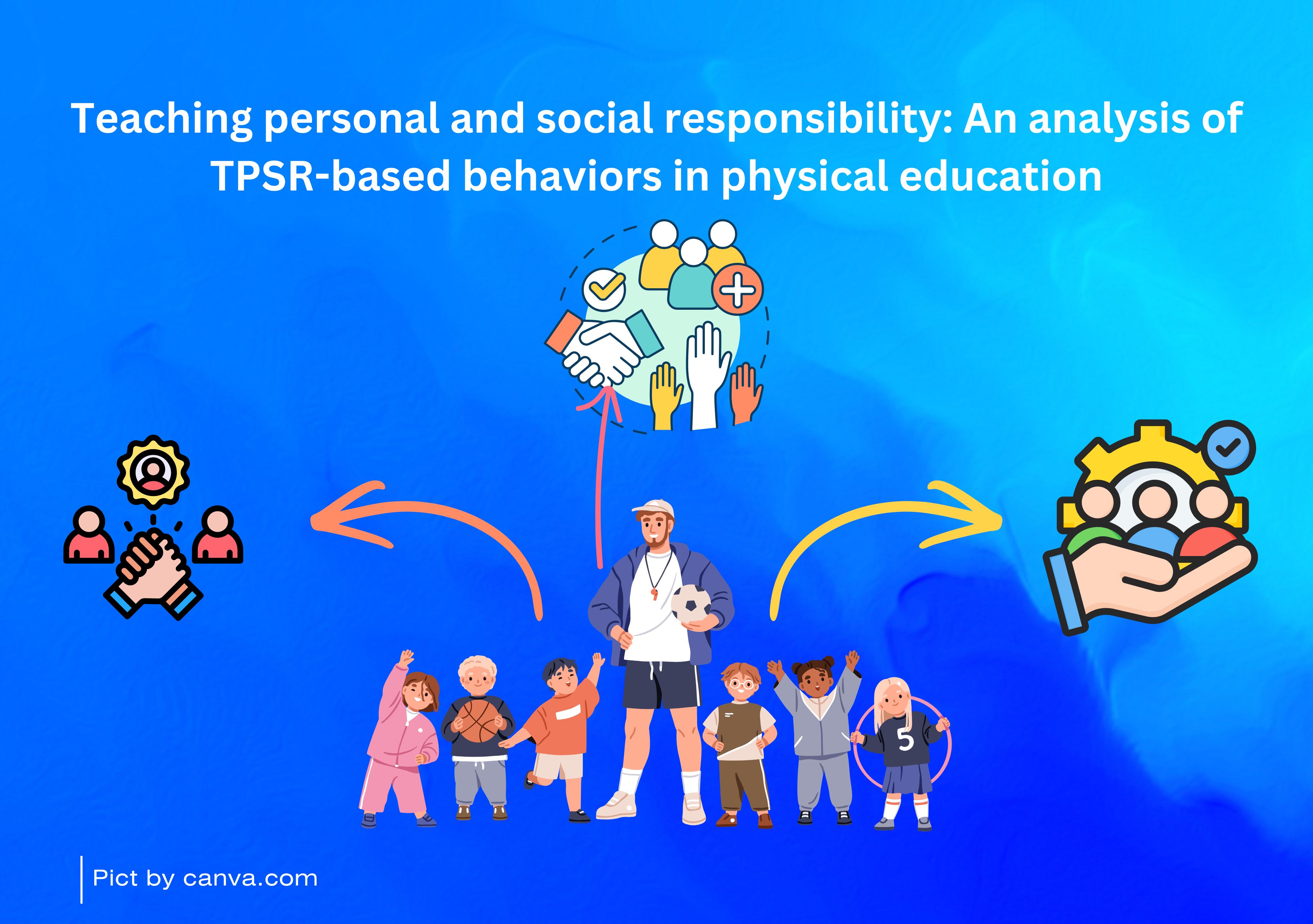
Teaching personal and social responsibility: An analysis of TPSR-based behaviors in physical education

Background: The rapid growth of online gaming among students has raised concerns regarding behavioral regulation, responsibility, and social interaction in educational contexts.
Objectives: This study aims to systematically review empirical research on the Teaching Personal and Social Responsibility (TPSR) model and student behavioral outcomes, and to explore its potential implications for online gaming and digital behavior contexts.
Methods: A literature review was conducted using SAGE Journals and Taylor & Francis Online databases, selected due to their strong coverage of peer-reviewed research relevant to physical education and pedagogy. The search covered publications from 2014 to 2024 using the keywords “TPSR” AND “student” AND “behavior” AND (“online game” OR “gaming”). Inclusion criteria were: (1) peer-reviewed international journal articles, (2) empirical or review studies addressing TPSR and student behavior, (3) student populations, and (4) publication within the last ten years. Articles that did not explicitly address TPSR-based behavioral outcomes were excluded. From 43 initial records, 4 articles met the inclusion criteria and were synthesized using narrative synthesis.
Results: The included studies primarily focused on TPSR implementation in physical education contexts, emphasizing behavioral responsibility, psychosocial mechanisms, and pedagogical approaches. Of the four studies, two employed quasi-experimental designs, one used survey methods, and one adopted a literature review approach. Overall, the findings indicate that TPSR-based learning is associated with improvements in personal and social responsibility, positive behavior regulation, and supportive learning climates, although direct evidence linking TPSR to online gaming behavior remains limited.
Conclusions: The findings suggest that TPSR offers a promising pedagogical framework for fostering responsible behavior and social regulation among students in the digital era.Downloads
Ahsan, M. (2015). Physical, verbal, anger and hostility aggressiveness in university’s physical education students. International Journal of Sports and Physical Education, 1(2), 20-23.
Baker, K., Scanlon, D., Tannehill, D., & Coulter, M. (2023). Teaching social justice through TPSR: Where do I start?. Journal of Physical Education, Recreation & Dance, 94(2), 11-18. https://doi.org/10.1080/07303084.2022.2146611
Carbonell, A. E. (2012). Applying the teaching personal and social responsibility model (TPSR) in Spanish schools context: Lesson learned. Ágora para la Educación Física y el Deporte, 14(2), 178-196. http://uvadoc.uva.es/handle/10324/23741
Hellison, D. (2015). Teaching physical and social responsibility through physical activity just what is the system. Physical Education and Sport Pedagogy, 83, 1-1.
Hellison, D., Hellison, D. R., Wright, P. M., Martinek, T. J., & Walsh, D. S. (2025). Teaching personal and social responsibility through physical activity. Human Kinetics. https://doi.org/10.4135/9781483332222.n302
Hsu, W. T., Pan, M., Shang, I. W., & Hsiao, C. H. (2022). The influence of integrating moral disengagement minimization strategies into teaching personal and social responsibility on Student positive and misbehaviors in physical education. SAGE Open, 12(4), 21582440221143359. https://doi.org/10.1177/21582440221143359
Juliantine, T., & Ramadhan, U. (2018). Developing Students' Social Responsibility and Behavior Through the TPSR Model in Physical Education. Journal of Sociotechnology, 17(3), 350–354. https://doi.org/10.5614/sostek.itbj.2018.17.3.2
Kumar, M. (2017). A Comparative Study of Intelligence among Sports Persons of Different Content Games. International Journal of Science and Research (IJSR), 6(1), 1262–1263. https://doi.org/10.21275/art20164373
Ministry of Education and Culture. (2014). Press Workshop: IMPLEMENTATION OF THE 2013 CURRICULUM. Presentation by the Minister of Education and Culture, Workshop (Pondok Cabe), January 14, 2014.
Mumtaz, E. F., Ragamustari, S. K., & Hirawan, F. B. (2021). The Impact of the E-Sport Curriculum Toward Online Game Addiction. TAZKIYA: Journal of Psychology, 9(1), 29–39. https://doi.org/10.15408/tazkiya.v9i1.19986
Novianti, R., & Garzia, M. (2020). Gadget Use in Children: New Challenges for Millennial Parents. Jurnal Obsesi: Journal of Early Childhood Education, 4(2), 1000. https://doi.org/10.31004/obsesi.v4i2.490
Nugraha, Y., & Danial, E. (2023, August). Core Curriculum Model for the Pancasila and Civic Education Study Program in the Industrial Revolution Era 4.0. In 4th Annual Civic Education Conference (ACEC 2022) (pp. 697-709). Atlantis Press. https://doi.org/10.2991/978-2-38476-096-1_74
Oktavec, F.L. (1934). Physical Education as a Character Builder. The Journal of Health and Physical Education, 5(6), 12–43. https://doi.org/10.1080/23267240.1934.10620751
PA, SM, JL, Á. S., D, HA, A, PP, & MA, TS (2025). The Effect of the Teaching Personal and Social Responsibility Model on Personal and Social Responsibility in Physical Education: A Systematic Review and Meta-Analysis. Quest, 77(2), 237–266. https://doi.org/10.1080/00336297.2024.2443937
Pallavicini, F., Ferrari, A., & Mantovani, F. (2018). Video games for well-being: A systematic review on the application of computer games for cognitive and emotional training in the adult population. Frontiers in psychology, 9, 407892. https://doi.org/10.3389/fpsyg.2018.02127
Pratiwi, A. D., & Nafessa, N. (2024). Hubungan Kecanduan Game dengan Gangguan Tidur Pada Remaja di MTsS Al-Washliyah 27 Sei Rampah. Jouska: Jurnal Ilmiah Psikologi, 3(1), 34-40. https://doi.org/10.31289/jsa.v3i1.3726
Salakhova, V. B., Sokolovskaya, I. E., Ulyanova, I. V., Karina, O. V., & Terekhova, A. I. (2019). Deviant behavior formation factors among students: aggressive behavior and internet risks. Práxis Educacional, 15(34), 683-694. https://doi.org/10.22481/praxisedu.v15i34.5800
Simonton, K. L., & Shiver, V. N. (2021). Examination of elementary students’ emotions and personal and social responsibility in physical education. European Physical Education Review, 27(4), 871-888. https://doi.org/10.1177/1356336X211001398
Toivonen, H. M., Wright, P. M., Hassandra, M., Hagger, M. S., Hankonen, N., Hirvensalo, M., ... & Lintunen, T. (2021). Training programme for novice physical activity instructors using Teaching Personal and Social Responsibility (TPSR) model: A programme development and protocol. International Journal of Sport and Exercise Psychology, 19(2), 159-178. https://doi.org/10.1080/1612197X.2019.1661268
Walsh, D. S., & Wright, P. M. (2016). The TPSR Alliance: A Community of Practice for Teaching, Research and Service. Journal of Physical Education, Recreation & Dance, 87(5), 35–38. https://doi.org/10.1080/07303084.2016.1157394
Woods, R. B., & Butler, B. N. (2025). Social issues in sport. Human Kinetics.
Zulkarnaen, I., Pawenrusi, E. P., Ayumar, A., & Bairsady, R. F. (2025). The Relationship between Online Game Addiction and Verbal Bullying in Adolescents at a Junior High School in Makassar. Pancasakti Journal Of Public Health Science And Research, 5(2), 278-284. https://doi.org/10.47650/pjphsr.v5i2.1872
Copyright (c) 2025 Rama Adha Septiana, Tite Juliantine

This work is licensed under a Creative Commons Attribution-ShareAlike 4.0 International License.