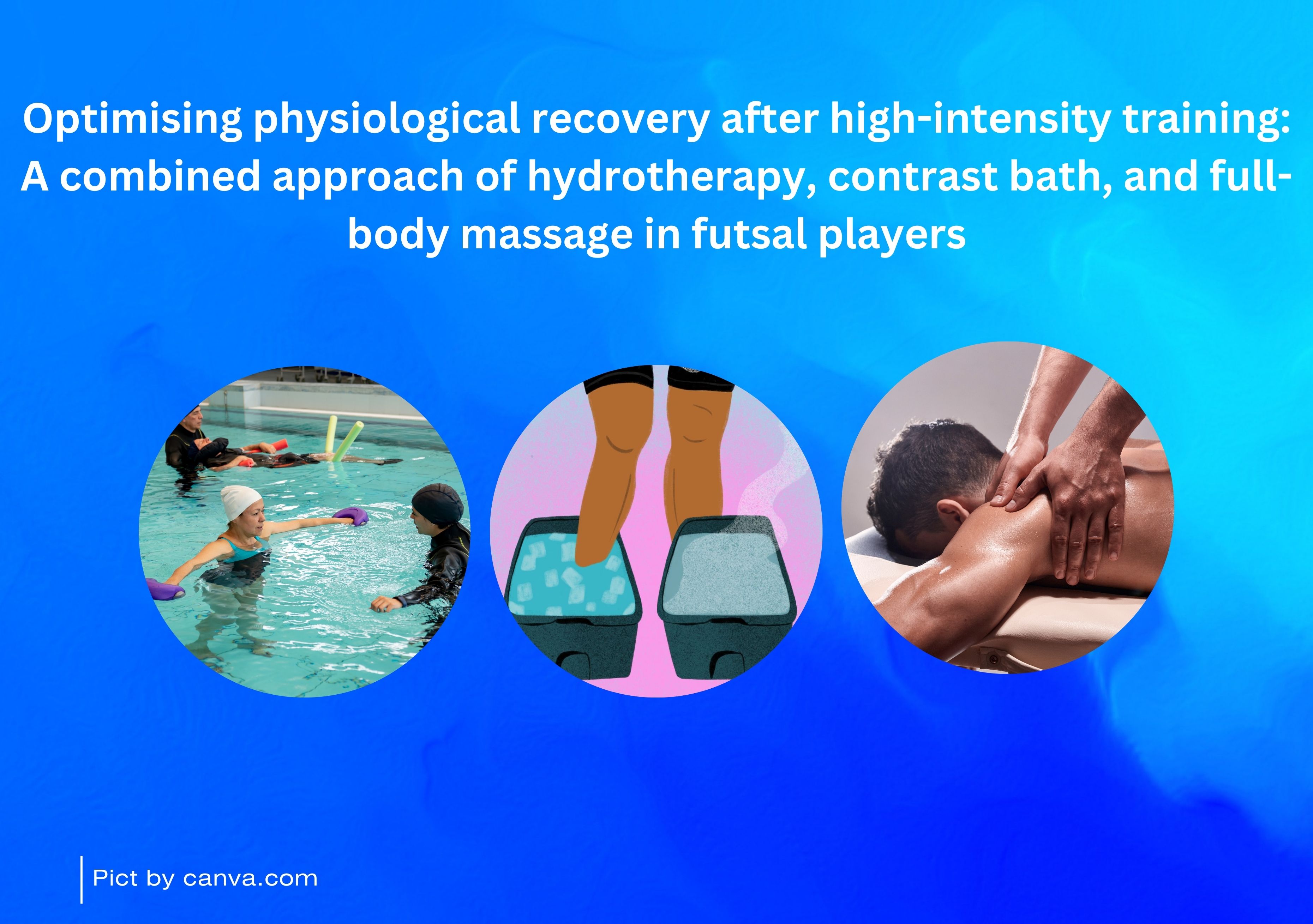
Optimising physiological recovery after high-intensity training: A combined approach of hydrotherapy, contrast bath, and full-body massage in futsal players

Downloads
Background: Efficient recovery after high-intensity interval training (HIIT) is crucial for maintaining optimal performance and minimizing the risk of injury.
Objectives: This study aims to analyze the effectiveness of combining hydrotherapy contrast baths and full-body massage in accelerating physiological recovery after a HIIT session, compared to the application of a single method.
Methods: This study employed a pre–post quasi-experimental design with three parallel groups (n = 45; 15 participants per group) to analyze the effectiveness of hydrotherapy combined with whole-body massage compared with each method applied separately. Participants were assigned to one of three conditions: (1) hydrotherapy contrast bath only, (2) full-body massage only, and (3) a combined intervention using both techniques. Physiological recovery was assessed using validated instruments, including heart rate monitors for heart rate recovery (HRR), portable lactate analysers for blood lactate concentration, and a visual analogue scale (VAS) for perceived muscle soreness. Data were analysed using the Shapiro–Wilk test, paired-sample t-test, and One-Way ANOVA.
Results: The findings demonstrated that the combined hydrotherapy–massage protocol resulted in greater improvements than the single-method groups, particularly in lactate reduction (e.g., -3.1 ± 0.8 mmol/L vs. - 1.9 ± 0.7 mmol/L and - 2.0 ± 0.6 mmol/L; p<0.05) and faster HRR. Participants in the combined group also reported significantly lower muscle soreness (p<0.05).
Conclusions: This suggests that integrating contrast bath hydrotherapy with full-body massage enhances circulation, accelerates metabolic waste clearance, and improves subjective recovery following HIIT. Future studies are recommended to include larger samples, compare different hydrotherapy temperatures, or examine long-term adaptations from repeated recovery sessions.Downloads
Aluculesei, A. C., Nistoreanu, P., Avram, D., & Nistoreanu, B. G. (2021). Past and future trends in medical spas: A co-word analysis. Sustainability, 13(17), 9646. https://doi.org/10.3390/Su13179646
Alves, A. R., Dias, R., Neiva, H. P., Marinho, D. A., Marques, M. C., Sousa, A. C., ... & Loureiro, N. (2021). High-intensity interval training upon cognitive and psychological outcomes in youth: a systematic review. International Journal of Environmental Research and Public Health, 18(10), 5344. https://doi.org/10.3390/Ijerph18105344
Arslan, E., Kilit, B., Clemente, F. M., Soylu, Y., Sögüt, M., Badicu, G., ... & Murawska-Cialowicz, E. (2021). The effects of exercise order on the psychophysiological responses, physical and technical performances of young soccer players: Combined small-sided games and high-intensity interval training. Biology, 10(11), 1180. https://doi.org/10.3390/Biology10111180
Atakan, M. M., Li, Y., Koşar, Ş. N., Turnagöl, H. H., & Yan, X. (2021). Evidence-based effects of high-intensity interval training on exercise capacity and health: A review with historical perspective. International journal of environmental research and public health, 18(13), 7201. https://doi.org/10.3390/Ijerph18137201
Benítez-Flores, S., Magallanes, C. A., Alberton, C. L., & Astorino, T. A. (2021). Physiological and psychological responses to three distinct exercise training regimens performed in an outdoor setting: acute and delayed response. Journal of functional morphology and kinesiology, 6(2), 44. https://doi.org/10.3390/Jfmk6020044
Benito, P. J., Alfaro-Magallanes, V. M., Rael, B., Castro, E. A., Romero-Parra, N., Rojo-Tirado, M. A., & Peinado, A. B. (2023). Effect of Menstrual Cycle Phase on the recovery process of high-intensity interval Exercise—A cross-sectional observational study. International journal of environmental research and public health, 20(4), 3266. https://doi.org/10.3390/Ijerph20043266
Bezuglov, E., Lazarev, A., Khaitin, V., Chegin, S., Tikhonova, A., Talibov, O., ... & Waśkiewicz, Z. (2021). The prevalence of use of various post-exercise recovery methods after training among elite endurance athletes. International journal of environmental research and public health, 18(21), 11698. https://doi.org/10.3390/Ijerph182111698
Bońska-Sikora, E. M., Klimek-Szczykutowicz, M., Michalak, M., Kulik-Siarek, K., & Wrzosek, M. (2024). Potential Possibilities of Using Peat, Humic Substances, and Sulfurous Waters in Cosmetology. Applied Sciences, 14(16), 6912. https://doi.org/10.3390/App14166912
Braun-Trocchio, R., Graybeal, A. J., Kreutzer, A., Warfield, E., Renteria, J., Harrison, K., ... & Shah, M. (2022). Recovery strategies in endurance athletes. Journal of Functional Morphology and Kinesiology, 7(1), 22. https://doi.org/10.3390/Jfmk7010022
Cabanas-Valdés, R., Calvo-Sanz, J., Serra-Llobet, P., Alcoba-Kait, J., González-Rueda, V., & Rodríguez-Rubio, P. R. (2021). The effectiveness of massage therapy for improving sequelae in post-stroke survivors. A systematic review and meta-analysis. International journal of environmental research and public health, 18(9), 4424. https://doi.org/10.3390/Ijerph18094424
Calleja-González, J., Altarriba-Bartes, A., Mielgo-Ayuso, J., Casals, M., Terrados, N. And Peña, J. (2021). Recovery Strategies For Sports Performance In The Spanish Professional Basketball League (Acb). Cultura, Ciencia Y Deporte, 16(49), 411– 424. https://doi.org/10.12800/CCD.V16I49.1643
Chang, W. Y., Wu, K. C., Yang, A. L., & Chen, Y. L. (2023). Simulated Altitude Training and Sport Performance: Protocols and Physiological Effects. Applied Sciences, 13(20), 11381. https://doi.org/10.3390/App132011381
Clemente-Suárez, V. J., Fuentes-García, J. P., Castro, M. A., Tornero-Aguilera, J. F., & Martínez-Guardado, I. (2024). The effect of acute physical fatigue on information processing, pain threshold and muscular performance. Applied Sciences, 14(5), 2036. https://doi.org/10.3390/App14052036
Costache, A. D., Maștaleru, A., Leon, M. M., Roca, M., Gavril, R. S., Cosău, D. E., ... & Mitu, F. (2024). High-intensity interval training vs. medium-intensity continuous training in cardiac rehabilitation programs: a narrative review. Medicina, 60(11), 1875. https://doi.org/10.3390/Medicina60111875
D’Andrea, A., Carbone, A., Ilardi, F., Pacileo, M., Savarese, C., Sperlongano, S., ... & Picano, E. (2022). Effects of high intensity interval training rehabilitation protocol after an acute coronary syndrome on myocardial work and atrial strain. Medicina, 58(3), 453. https://doi.org/10.3390/Medicina58030453
Davis, H.L., Alabed, S. And Chico, T.J.A. 2020. Effect Of Sports Massage On Performance And Recovery: A Systematic Review And Meta-Analysis. BMJ Open Sport & Exercise Medicine 6(1), E000614. https://doi.org/10.1136/Bmjsem-2019-000614
De Oliveira, F., Paz, G. A., Corrêa Neto, V. G., Alvarenga, R., Marques Neto, S. R., Willardson, J. M., & Miranda, H. (2023). Effects of different recovery modalities on delayed onset muscle soreness, recovery perceptions, and performance following a bout of high-intensity functional training. International journal of environmental research and public health, 20(4), 3461.https://doi.org/10.3390/Ijerph20043461
Deley, G., Cometti, C., Paizis, C., & Babault, N. (2021). Effects of Light Pedaling Added to Contrast Water Immersion for Recovery after Exhaustive Exercise. International Journal of Environmental Research and Public Health, 18(24), 13068. https://doi.org/10.3390/Ijerph182413068
García-Fernández, P., Cimadevilla, E., Guodemar-Pérez, J., Cañuelo-Márquez, A. M., Heredia-Elvar, J. R., Fernández-Rodríguez, T., ... & Maté-Muñoz, J. L. (2021). Muscle recovery after a single bout of functional fitness training. International Journal of Environmental Research and Public Health, 18(12), 6634. https://doi.org/10.3390/Ijerph18126634
Gaspar-Junior, J. J., Dellagrana, R. A., Barbosa, F. S., Anghinoni, A. P., Taciro, C., Carregaro, R. L., ... & Oliveira-Junior, S. A. (2022). Efficacy of different cold-water immersion temperatures on neuromotor performance in young athletes. Life, 12(5), 683. https://doi.org/10.3390/Life12050683
Goncalves, C., Parraca, J. A., Bravo, J., Abreu, A., Pais, J., Raimundo, A., & Clemente-Suarez, V. J. (2022). Influence of two exercise programs on heart rate variability, body temperature, central nervous system fatigue, and cortical arousal after a heart attack. International journal of environmental research and public health, 20(1), 199. https://doi.org/10.3390/Ijerph20010199
Hottenrott, L., Möhle, M., Feichtinger, S., Ketelhut, S., Stoll, O., & Hottenrott, K. (2022). Performance and recovery of well-trained younger and older athletes during different HIIT protocols. Sports, 10(1), 9. https://doi.org/10.3390/Sports10010009
Hottenrott, L., Möhle, M., Ide, A., Ketelhut, S., Stoll, O., & Hottenrott, K. (2021). Recovery from different high-intensity interval training protocols: comparing well-trained women and men. Sports, 9(3), 34. https://doi.org/10.3390/Sports9030034
Iliescu, M. G., Stanciu, L. E., Uzun, A. B., Cristea, A. E., Motoască, I., Irsay, L., ... & Ciortea, V. M. (2024). Assessment of integrative therapeutic methods for improving the quality of life and functioning in cancer patients—a systematic review. Journal of Clinical Medicine, 13(5), 1190. https://doi.org/10.3390/Jcm13051190
Kapusta, J., Kapusta, A., Babicki, M., & Irzmański, R. (2024). Evaluation of Peripheral Circulatory Changes Following Hydrotherapy and Controlled Physical Training in Patients with Atherosclerotic Lower Limb Ischemia. Life, 14(12), 1578. https://doi.org/10.3390/Life14121578
Leite, C. D., Zovico, P. V., Rica, R. L., Barros, B. M., Machado, A. F., Evangelista, A. L., ... & Bocalini, D. S. (2023). Exercise-induced muscle damage after a high-intensity interval exercise session: systematic review. International journal of environmental research and public health, 20(22), 7082. https://doi.org/10.3390/Ijerph20227082
Li, F., Song, Y., Cen, X., Sun, D., Lu, Z., Bíró, I., & Gu, Y. (2023, July). Comparative efficacy of vibration foam rolling and cold water immersion in amateur basketball players after a simulated load of basketball game. In Healthcare (Vol. 11, No. 15, p. 2178). MDPI. https://doi.org/10.3390/Healthcare11152178
Liu, W., Jiang, X., Yu, Z., Pang, K., Wang, J., & Peng, Y. (2023). Effects of a graphene heating device on fatigue recovery of biceps brachii. Bioengineering, 10(3), 381. https://doi.org/10.3390/Bioengineering10030381
Maccarone, M. C., Scanu, A., Coraci, D., & Masiero, S. (2023, June). The potential role of spa therapy in managing frailty in rheumatic patients: A scoping review. In Healthcare (Vol. 11, No. 13, p. 1899). MDPI. https://doi.org/10.3390/Healthcare11131899
Mauro, M., Sánchez-Alcaraz Martínez, B. J., Maietta Latessa, P., Marini, S., & Toselli, S. (2024). Long-term physiological adaptations induced by short-interval high-intensity exercises: an RCT comparing active and passive recovery. Journal of Functional Morphology and Kinesiology, 9(4), 229. https://doi.org/10.3390/Jfmk9040229
Mellado-Garcia, E., Díaz-Rodríguez, L., Cortes-Martin, J., Sanchez-Garcia, J. C., Piqueras-Sola, B., Higuero Macías, J. C., & Rodríguez-Blanque, R. (2024, February). Systematic reviews and synthesis without meta-analysis on hydrotherapy for pain control in labor. In Healthcare (Vol. 12, No. 3, p. 373). MDPI. https://doi.org/10.3390/Healthcare12030373
Mihajlovic, M., Cabarkapa, D., Cabarkapa, D. V., Philipp, N. M., & Fry, A. C. (2023). Recovery methods in basketball: a systematic review. Sports, 11(11), 230. https://doi.org/10.3390/Sports11110230
Molinaro, L., Taborri, J., Pauletto, D., Guerra, V., Molinaro, D., Sicari, G., ... & Rossi, S. (2023). Measuring the immediate effects of high-intensity functional training on motor, cognitive and physiological parameters in well-trained adults. Sensors, 23(8), 3937. https://doi.org/10.3390/S23083937
Montero-Almagro, G., Bernal-Utrera, C., Geribaldi-Doldán, N., Nunez-Abades, P., Castro, C., & Rodriguez-Blanco, C. (2024). Influence of high-intensity interval training on neuroplasticity markers in post-stroke patients: systematic review. Journal of Clinical Medicine, 13(7), 1985. https://doi.org/10.3390/Jcm13071985
Moretti, A., Gimigliano, F., Paoletta, M., Liguori, S., Toro, G., Aulicino, M., ... & Iolascon, G. (2021). Efficacy and effectiveness of physical agent modalities in complex regional pain syndrome type I: a scoping review. Applied Sciences, 11(4), 1857. https://doi.org/10.3390/App11041857
Nuuttila, O. P., Nummela, A., Häkkinen, K., Seipäjärvi, S., & Kyröläinen, H. (2021). Monitoring training and recovery during a period of increased intensity or volume in recreational endurance athletes. International Journal of Environmental Research and Public Health, 18(5), 2401. https://doi.org/10.3390/Ijerph18052401
Ortega-Collazos, E., Hinchado, M. D., Otero, E., López-Jurado, C. F., Gálvez, I., Legido, J. L., ... & Torres-Piles, S. (2024). Balneotherapy (Mud-Bath Therapy) with a Peloid Enriched with Rosmarinic Acid Enhances Clinical Outcomes and Innate Immune Benefits in Elderly Patients with Osteoarthritis: A Pilot Study. Applied Sciences, 14(24), 12017. https://doi.org/10.3390/App142412017
Ouertatani, Z., Selmi, O., Marsigliante, S., Aydi, B., Hammami, N., & Muscella, A. (2022). Comparison of the physical, physiological, and psychological responses of the high-intensity interval (HIIT) and small-sided games (SSG) training programs in young elite soccer players. International journal of environmental research and public health, 19(21), 13807.https://doi.org/10.3390/Ijerph192113807
Pawlowska, M., Mila-Kierzenkowska, C., Boraczyński, T., Boraczyński, M., Szewczyk-Golec, K., Sutkowy, P., ... & Woźniak, A. (2022). The influence of ambient temperature changes on the indicators of inflammation and oxidative damage in blood after submaximal exercise. Antioxidants, 11(12), 2445. https://doi.org/10.3390/Antiox11122445
Reis, I. L., Lopes, B., Sousa, P., Sousa, A. C., Caseiro, A. R., Mendonça, C. M., ... & Maurício, A. C. (2024). Equine musculoskeletal pathologies: clinical approaches and therapeutical perspectives—a review. Veterinary Sciences, 11(5), 190. https://doi.org/10.3390/Vetsci11050190
Rittenhouse, M., Khurana, S., Scholl, S., & Emerson, C. (2025). Examining the Influence of Omega-3 Fatty Acids on Performance, Recovery, and Injury Management for Health Optimization: A Systematic Review Focused on Military Service Members. Nutrients, 17(2), 307. https://doi.org/10.3390/Nu17020307
Rizvi, S. A., Einstein, G. P., Tulp, O. L., Sainvil, F., & Branly, R. (2022). Introduction to traditional medicine and their role in prevention and treatment of emerging and re-emerging diseases. Biomolecules, 12(10), 1442. https://doi.org/10.3390/Biom12101442
Rodríguez-Ruiz, Á., Arcos-Azubel, C., Ruiz-Pérez, M., Peinado, F. M., Mundo-López, A., Lara-Ramos, A., ... & Artacho-Cordón, F. (2024). The Benefits of an Integral HAMMAM Experience Combining Hydrotherapy and Swedish Massage on Pain, Subjective Well-Being and Quality of Life in Women with Endometriosis-Related Chronic Pelvic Pain: A Randomized Controlled Trial. Medicina, 60(10), 1677. https://doi.org/10.3390/Medicina60101677
Sanchez-Oliva, D., Esteban-Cornejo, I., Padilla-Moledo, C., Pérez-Bey, A., Veiga, Ó. L., Cabanas-Sánchez, V., & Castro-Pinero, J. (2020). Associations between physical activity and sedentary time profiles transitions and changes in well-being in youth: the UP&DOWN longitudinal study. Psychology of sport and exercise, 47, 101558. https://doi.org/10.1016/J.Psychsport.2019.101558
Schaun, G. Z., Orcy, R. B., & Del Vecchio, F. B. (2024). A Comparative Analysis of Acute Physiological and Perceptual Responses in Whole-Body and Ergometer-Based High-Intensity Interval Training Protocols. Sports, 12(6), 166. https://doi.org/10.3390/Sports12060166
Shandu, N. M., Mathunjwa, M. L., Shaw, B. S., & Shaw, I. (2022). Effects of high-intensity interval training and continuous aerobic training on health-fitness, health related quality of life, and psychological measures in college-aged smokers. International Journal of Environmental Research and Public Health, 20(1), 653. https://doi.org/10.3390/Ijerph20010653
Tognolo, L., Coraci, D., Fioravanti, A., Tenti, S., Scanu, A., Magro, G., ... & Masiero, S. (2022). Clinical impact of balneotherapy and therapeutic exercise in rheumatic diseases: A lexical analysis and scoping review. Applied Sciences, 12(15), 7379. https://doi.org/10.3390/App12157379
Yan, S., Kim, Y., & Choi, Y. (2022). Aerobic and anaerobic fitness according to high-intensity interval training frequency in youth soccer players in the last stage of rehabilitation. International journal of environmental research and public health, 19(23), 15573. https://doi.org/10.3390/Ijerph192315573
Zanoli, G., Albarova-Corral, I., Ancona, M., Grattagliano, I., Hotfiel, T., Iolascon, G., ... & Rodríguez Maruri, G. (2024). Current indications and future direction in heat therapy for musculoskeletal pain: A narrative review. Muscles, 3(3), 212-223. https://doi.org/10.3390/Muscles303001
Copyright (c) 2025 Afif Dwi Nugraha, Laily Mita Andriana, Muhamad Fauzi Antoni, Muhammad Labib Siena Ar Rasyid, Bhekti Lestari

This work is licensed under a Creative Commons Attribution-ShareAlike 4.0 International License.