Association between ADHD symptom severity and motor activity in preschool children: A cross-sectional study

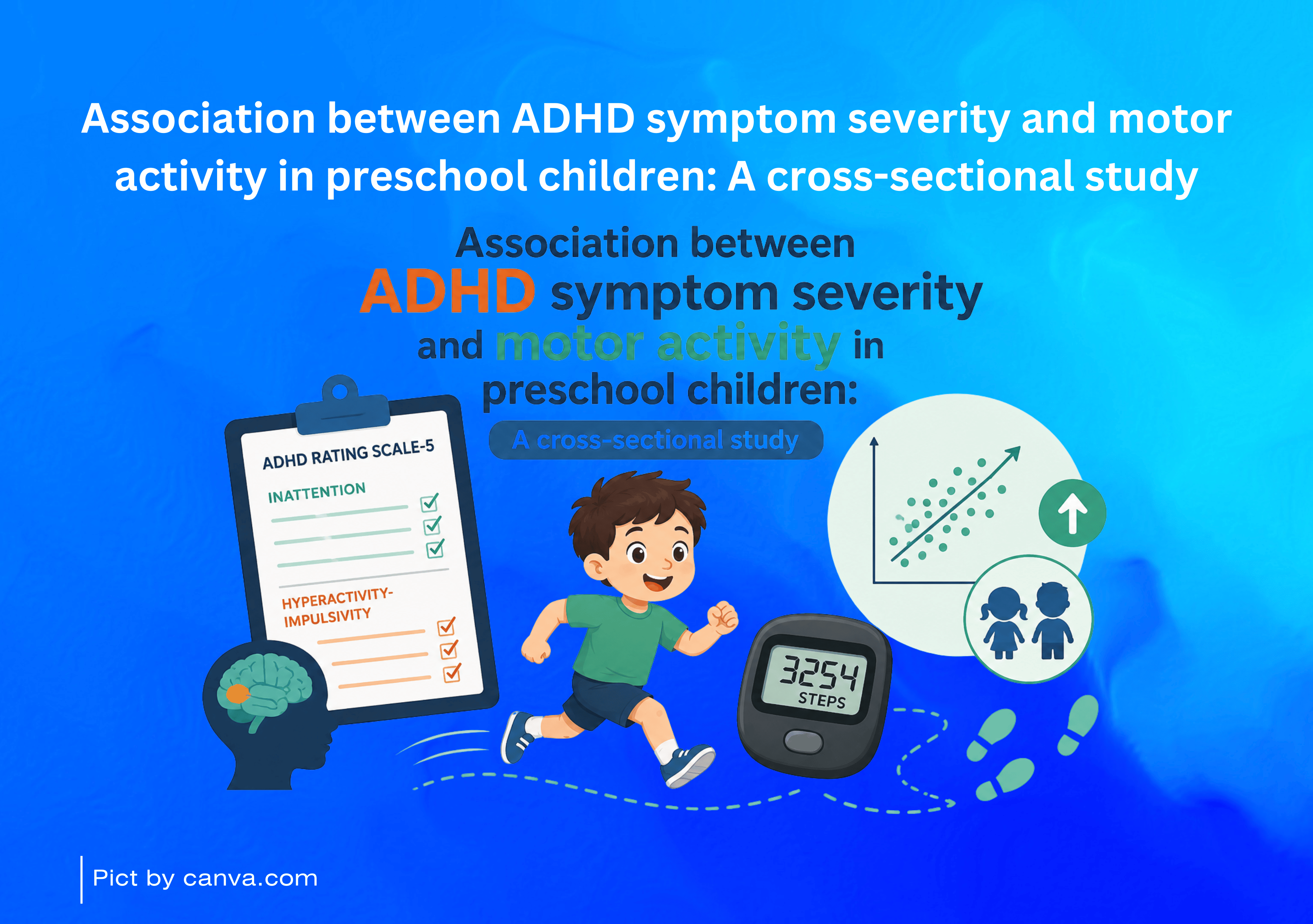
Background: Attention-deficit/hyperactivity disorder (ADHD) is a neurodevelopmental disorder characterized by inattention, hyperactivity, and impulsivity. Objective measurement of motor activity may complement parent-reported assessment of ADHD symptoms.
Objectives: This study aimed to examine the association between ADHD Rating Scale-5 scores and step counts, used as an objective indicator of motor activity, among children aged 4–6 years.
Methods: A cross-sectional observational study was conducted among 110 children aged 4–6 years selected through purposive sampling. ADHD symptoms were assessed using the parent-completed ADHD Rating Scale-5, while step counts were measured using a digital pedometer during a 15-minute school recess. Data normality was assessed using the Kolmogorov–Smirnov test. Pearson's product–moment correlation was used to examine the association between total ADHD Rating Scale-5 scores and step counts, whereas Spearman's rank correlation was used for the Inattention and Hyperactivity–Impulsivity domain scores.
Results: Total ADHD Rating Scale-5 scores showed a very strong positive correlation with step counts (r = .865, p < .001). At the domain level, Inattention scores showed a strong positive correlation with step counts (ρ = .756, p < .001), while Hyperactivity–Impulsivity scores showed a very strong positive correlation (ρ = .818, p < .001).
Conclusions: Higher ADHD symptom scores were strongly associated with higher motor activity, as indicated by step counts, among preschool children. Step-count measurement may provide a simple objective measure that complements parent-reported assessment of ADHD symptoms; however, it should not be interpreted as a diagnostic measure for ADHD.
Downloads
Adamou, M., Kehagias, A., & Antoniou, G. (2025). A mathematical framework for modelling the dynamic nature of ADHD symptoms. Frontiers in Psychiatry, 16, 1671764. https://doi.org/10.3389/fpsyt.2025.1671764
Best, J. R., & Miller, P. H. (2010). A developmental perspective on executive function. Child Development, 81(6), 1641-1660. https://doi.org/10.1111/j.1467-8624.2010.01499.x
Blanco-Martínez, N., González-Devesa, D., Ayán-Pérez, C., & Diz-Gómez, J. C. (2025). Differences in motor competence between children and adolescents with and without ADHD: findings from a systematic review and meta-analysis. Journal of Autism and Developmental Disorders, 1–15. https://doi.org/10.1007/s10803-025-07033-1
Curzon, M. M., Dick, A. S., Coccia, C., & Graziano, P. A. (2024). Exploring Differences in Physical Health in Young Children With and Without ADHD. Journal of Pediatric Psychology, 49(2), 120–130. https://doi.org/10.1093/jpepsy/jsad090
Dekkers, T. J., Rapport, M. D., Calub, C. A., Eckrich, S. J., & Irurita, C. (2021). ADHD and hyperactivity: The influence of cognitive processing demands on gross motor activity level in children. Child Neuropsychology, 27(1), 63-82. https://doi.org/10.1080/09297049.2020.1793924
DuPaul, G. J., Power, T. J., Anastopoulos, A. D., & Reid, R. (2016). ADHD rating scale? 5 for children and adolescents: checklists, norms, and clinical interpretation. Guilford Publications. https://doi.org/10.1037/t05638-000
Fang, C., Zhang, J., Zhou, T., Li, L., Lu, Y., Gao, Z., & Quan, M. (2020). Associations between daily step counts and physical fitness in preschool children. Journal of Clinical Medicine, 9(1), 163. https://doi.org/10.3390/jcm9010163
Feng, X., Li, R., & Wang, P. (2025). Behavior as a window to the mind—objective daily life assessment of attention and hyperactivity/impulsivity. European Child & Adolescent Psychiatry, 34(8), 2453–2462. https://doi.org/10.1007/s00787-025-02653-5
Fitriyani, F., Oktaviani, A. M., & Supena, A. (2023). Analisis Kemampuan Kognitif dan Perilaku Sosial pada Anak ADHD (Attention-Deficit Hyperactivity Disorder). Jurnal Basicedu, 7(1), 250–259. https://doi.org/10.31004/basicedu.v7i1.4331
Kofler, M. J., Soto, E. F., Rapport, M. D., & Whitehead, S. (2025). Ecological Validity of Clinic-Based Actigraphy for Assessing Hyperactivity in Clinically Evaluated Children with and without ADHD. Journal of Psychopathology and Behavioral Assessment, 47(2). https://doi.org/10.1007/s10862-025-10218-8
Kurniawan, R., Sanjaya, R. B. Y. R., & Rakhmawati, R. (2021). Teknologi game untuk pembelajaran bagi anak dengan ADHD: Tinjauan literatur. Jurnal Nasional Teknik Elektro dan Teknologi Informasi, 10(4), 346-353. https://doi.org/10.22146/jnteti.v10i4.2001
Lin, C. Y., Yang, A. L., & Su, C. T. (2013). Objective measurement of weekly physical activity and sensory modulation problems in children with attention deficit hyperactivity disorder. Research in Developmental Disabilities, 34(10), 3477–3486. https://doi.org/10.1016/j.ridd.2013.07.021
Mingkala, H. (2021). Pendampingan peran guru dan orang tua dalam mendidik anak hiperaktif serta cara menangani anak hiperaktif. Dikmas: Jurnal Pendidikan Masyarakat Dan Pengabdian, 1(1), 27-34. https://doi.org/10.22373/jrpm.v1i1.669
Naufal, A. F., Safitri, E. F., Nurulinsani, A., Susilo, T. E., Darojati, H. P. I., Pristianto, A., & Awanis, A. (2023). Hubungan Durasi Penggunaan Gadget Terhadap Gejala Attention Deficit Hyperactivity Disorder (ADHD). FISIO MU: Physiotherapy Evidences, 4(2), 152–160. https://doi.org/10.23917/fisiomu.v4i2.22133
Oliver, M., Schofield, G. M., Kolt, G. S., & Schluter, P. J. (2007). Pedometer accuracy in physical activity assessment of preschool children. Journal of Science and Medicine in Sport, 10(5), 303–310. https://doi.org/10.1016/j.jsams.2006.07.004
Rahmani, S. N. M., Kusumawicitra, T., & Karyani, U. (2022). Studi kasus anak dengan gangguan ADHD (Attention Dificit Hyperactivity Disorder) yang sedang menjalani terapi di pusat layanan disabilitas. In Seminar Nasional Psikologi.
Reetzke, R., Iosif, A. M., Hatch, B., de la Paz, L., Chuang, A., Ozonoff, S., & Miller, M. (2022). Patterns of objectively measured motor activity among infants developing ASD and concerns for ADHD. Journal of Child Psychology and Psychiatry and Allied Disciplines, 63(6), 663–673. https://doi.org/10.1111/jcpp.13504
Salari, N., Ghasemi, H., Abdoli, N., Rahmani, A., Shiri, M. H., Hashemian, A. H., Akbari, H., & Mohammadi, M. (2023). The global prevalence of ADHD in children and adolescents: a systematic review and meta-analysis. Italian Journal of Pediatrics, 49(1), 48. https://doi.org/10.1186/s13052-023-01456-1
Santrock, J. W., Sumiharti, Y., Sinaga, H., Damanik, J., & Chusairi, A. (2002). Life-Span Development (Perkembangan Masa Hidup Jilid 1.
Sarver, D. E., Rapport, M. D., Kofler, M. J., Raiker, J. S., & Friedman, L. M. (2015). Hyperactivity in Attention-Deficit/Hyperactivity Disorder (ADHD): Impairing Deficit or Compensatory Behavior? Journal of Abnormal Child Psychology, 43(7), 1219–1232. https://doi.org/10.1007/s10802-015-0011-1
Tanoyo, D. P. (2013). Diagnosis dan tata laksana attention deficit hyperactivity disorder. E-Journal Medika Udayana, 2(7), 1-19.
Taqfani, A. W., Dwilestasi, R., & Utami, P. (2023). Pengaruh Bermain Alat Permainan Edukatif (APE) Meronce Terhadap Perkembangan Motorik Halus Anak ADHD Di Tk Saymara Kartasura. Universitas Kusuma Husada Surakarta
Villalba-Heredia, L., Rodríguez, C., Santana, Z., Nuñez, J. C., & Méndez-Giménez, A. (2022). A cross-sectional study to measure physical activity with accelerometry in ADHD children according to presentations. Children, 10(1), 50. https://doi.org/10.3390/children10010050
Xu, Z., Zahradka, N., Ip, S., Koneshloo, A., Roemmich, R. T., Sehgal, S., Highland, K. B., & Searson, P. C. (2022). Evaluation of physical health status beyond daily step count using a wearable activity sensor. npj Digital Medicine, 5(1), 164. https://doi.org/10.1038/s41746-022-00696-5
Copyright (c) 2026 Adnan Faris Naufal, Chevanya Diva Titania Davinci, Anida Azkia Fitri

This work is licensed under a Creative Commons Attribution-ShareAlike 4.0 International License.