Functional movement patterns and bilateral asymmetry in badminton athletes: A Functional Movement Screen analysis at the Malang Regional Training Center

Background: Badminton involves repetitive unilateral overhead movements, rapid changes of direction, and explosive actions that may contribute to side-to-side differences in functional movement patterns.
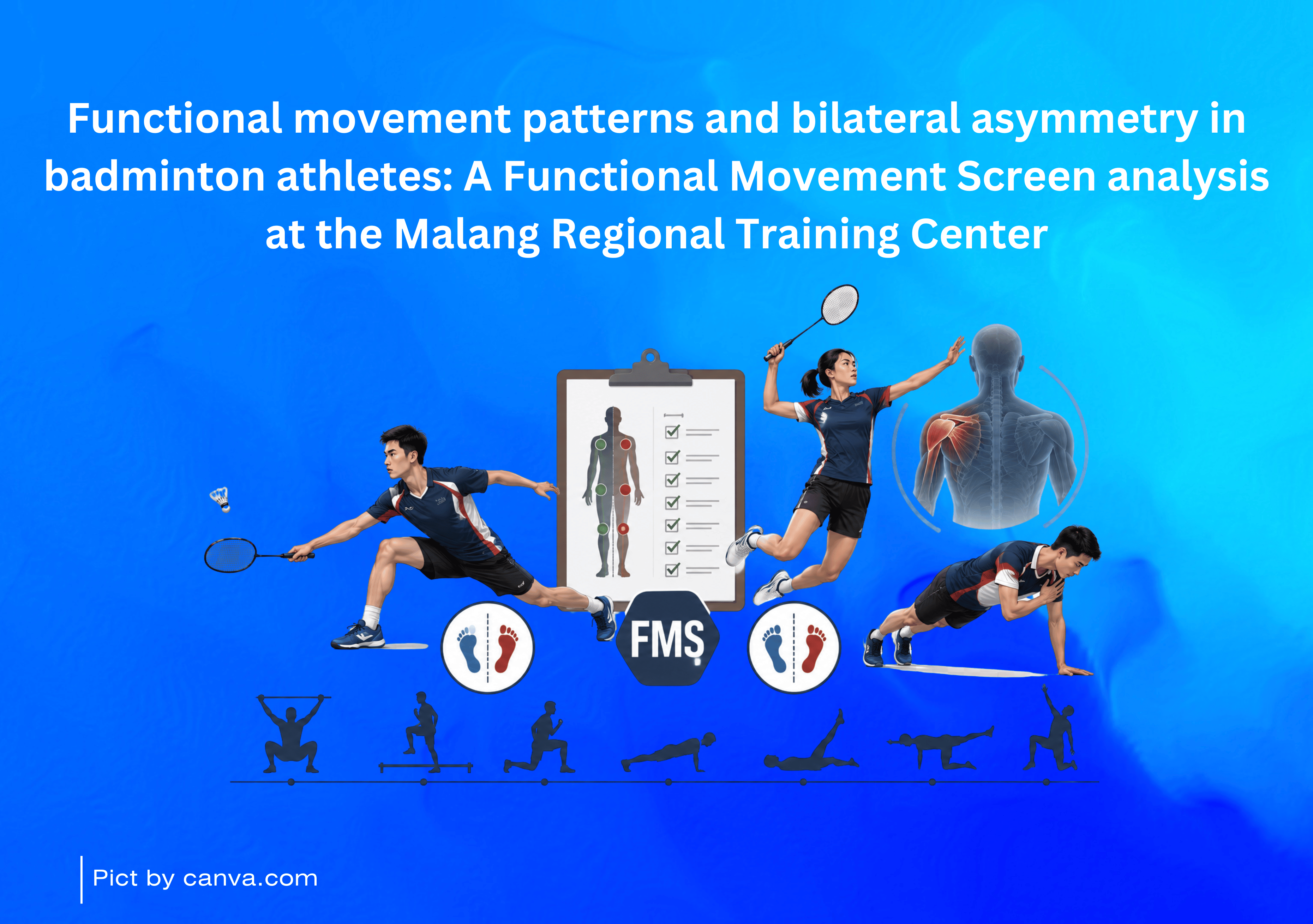
Objectives: This study aimed to describe functional movement patterns and bilateral asymmetry among badminton athletes at the Malang Regional Training Center using the Functional Movement Screen (FMS).
Methods: This cross-sectional study involved 16 sub-elite badminton athletes aged 15–20 years selected through purposive sampling. Functional movement was assessed using the seven-component FMS. Total scores were classified as high (≤14), moderate (15–17), or low (18–21) injury risk. Bilateral asymmetry was identified from differences between right- and left-side scores in five bilateral FMS components. Data were analyzed descriptively using means, standard deviations, frequencies, and percentages.
Results: Most athletes (62.5%, n = 10) were classified as having moderate injury risk, while 18.75% (n = 3) were classified as high risk and 18.75% (n = 3) as low risk. Shoulder Mobility showed the highest prevalence of bilateral asymmetry (100%, n = 16), followed by the In-Line Lunge and Rotary Stability (62.5%, n = 10 each), Hurdle Step (50.0%, n = 8), and Active Straight Leg Raise (43.75%, n = 7).
Conclusions: Bilateral functional movement asymmetry was common among badminton athletes, particularly in shoulder mobility, while most athletes were classified within the moderate injury-risk category. These findings support functional movement screening to identify movement limitations and inform individualized corrective exercise strategies.
Downloads
Bahr, R., & Krosshaug, T. (2005). Understanding injury mechanisms: A key component of preventing injuries in sport. British Journal of Sports Medicine, 39(6), 324–329. https://doi.org/10.1136/bjsm.2005.018341
Chen, C. (2023). Effect of functional training on hitting quality in badminton players. Revista Brasileira de Medicina do Esporte, 29, e2022_0616. https://doi.org/10.1590/1517-8692202329012022_0616
Cook, G., Burton, L., & Fields, K. (2011). The Functional Movement Screen and Exercise Progressions Manual. On Target Publications.
Cook, G., Burton, L., & Hoogenboom, B. (2006). Pre-participation screening: The use of fundamental movements as an assessment of function—Part 2. North American Journal of Sports Physical Therapy, 1(3), 132–139.
Couppé, C., Thorborg, K., Hansen, M., Fahlström, M., Bjordal, J. M., Nielsen, D., ... & Magnusson, S. P. (2014). Shoulder rotational profiles in young healthy elite female and male badminton players. Scandinavian Journal of Medicine & Science in Sports, 24(1), 122-128. https://doi.org/10.1111/j.1600-0838.2012.01480.x
Daffa, M. A., Anam, K., Setiowati, A., & Indardi, N. (2025). Prediksi cedera pesepakbola muda: Penggunaan functional movement screening. Journal of Sport Science and Fitness, 5(1), 29–37. https://doi.org/10.33292/sepakbola.v5i1.379
Dewi, C. S., Pudjijuniarto, Firmansyah, A., & Irawan, R. J. (2025). Eccentric hamstring strength profile and limb asymmetry in sub-elite female taekwondo athletes: Implications for injury prevention. Sport, Exercise, and Injury, 1(1), 70–79. https://doi.org/10.56003/sei.v1i1.574
Dorrel, B., Long, T., Shaffer, S., & Myer, G. D. (2018). The Functional Movement Screen as a predictor of injury in National Collegiate Athletic Association Division II athletes. Journal of Athletic Training, 53(1), 29–34. https://doi.org/10.4085/1062-6050-528-15
Efendi, C. K., & Rochmania, A. (2019). Cedera olahraga pada cabang olahraga bulutangkis (Studi pada Klub Bulutangkis FIFA BC Sidoarjo). Jurnal Prestasi Olahraga, 2(8), 139–147.
Fernandez-Fernandez, J., Lopez-Valenciano, A., Del Coso, J., Gallo-Salazar, C., Barbado, D., Sabido-Solana, R., ... & Cabello-Manrique, D. (2019). The effects of playing two consecutive matches in the shoulder rotational profiles of elite youth badminton players. Physical Therapy in Sport, 35, 56-62. https://doi.org/10.1016/j.ptsp.2018.11.004
Moreno-Pérez, V., Moreside, J., Barbado, D., & Vera-Garcia, F. J. (2015). Comparison of shoulder rotation range of motion in professional tennis players with and without history of shoulder pain. Manual Therapy, 20(2), 313-318. https://doi.org/10.1016/j.math.2014.10.008
Oktarisa, A., Syafriyanto, D., Indika, P. M., & Andria, Y. (2023). Functional movement screening: Deteksi dini risiko cedera olahraga atlet panjat tebing Kota Padang. Jurnal Ilmu Keolahragaan, 1(2), 6–11.
Pristianto, A., Susilo, T. E., & Setiyaningsih, R. (2018). Penerapan Functional Movement Screening (FMS) untuk Pencegahan Cidera Olahraga pada Komunitas Kalistenik Solo. In The 8th University Research Colloquium (pp. 267-271).
Ribeiro, R. N., & Costa, L. O. P. (2006). Epidemiologic analysis of injuries occurred during the 15th Brazilian Indoor Soccer (Futsal) Sub-20 Team Selection Championship. Revista Brasileira de Medicina do Esporte, 12(1), 1–5. https://doi.org/10.1590/S1517-86922006000100001
Sanjaya, A. D. P., Firmansyah, A., Hakim, A. A., & Bana, P. (2025). Eccentric hamstring strength and asymmetry in female handball athletes: A descriptive study. Sport, Exercise, and Injury, 1(1), 60–69. https://doi.org/10.56003/sei.v1i1.553
Sudirman, A., Mahyuddin, R., & Asyhari, H. (2021). Memahami faktor penyebab terjadinya cedera dalam permainan sepak bola. Jendela Olahraga, 6(2), 1–9. https://doi.org/10.26877/jo.v6i2.8273
Triplett, C. R., Dorrel, B. S., Symonds, M. L., Selland, C. A., & Daniel, D. (2021). Functional movement screen detected asymmetry and normative values among college-aged students. International Journal of Sports Physical Therapy, 16(2), 450–458. https://doi.org/10.26603/001c.19443
Wiriawan, O., Rusdiawan, A., Kusuma, D. A., Firmansyah, A., García-Jiménez, J. V., Zein, M. I., Pavlovic, R., Nowak, A. M., Susanto, N., & Pranoto, A. (2024). Unilateral hamstring muscle strengthening exercises can improve hamstring asymmetry and increase jumping performance in sub-elite badminton athletes. Retos, 54, 761–770. https://doi.org/10.47197/RETOS.V54.103783
Zein, M. I., & Sudarko, R. A. (2020). Penilaian muscle imbalance dengan metode functional movement screen pada atlet baseball sub-elite Indonesia. Jorpres (Jurnal Olahraga Prestasi), 15(2), 83–87. https://doi.org/10.21831/jorpres.v15i2.29516
Zhao, W., Wang, C., Bi, Y., & Chen, L. (2021). Effect of integrative neuromuscular training for injury prevention and sports performance of female badminton players. BioMed research international, 2021(1), 5555853. https://doi.org/10.1155/2021/5555853
Copyright (c) 2026 Avi Kholifatuz Zahro', Muhammad Atiq Noviudin Pritama

This work is licensed under a Creative Commons Attribution-ShareAlike 4.0 International License.