

Abstract
Background: Recognized globally as the fastest racket sport in the world, badminton demands exceptional acceleration and footwork skills for competitive success. However, many intermediate players often struggle to produce the explosive power needed for fast-paced rallies. To enhance these physical attributes, targeted training interventions, such as a hybrid regimen of plyometric and ladder drills, are often required.
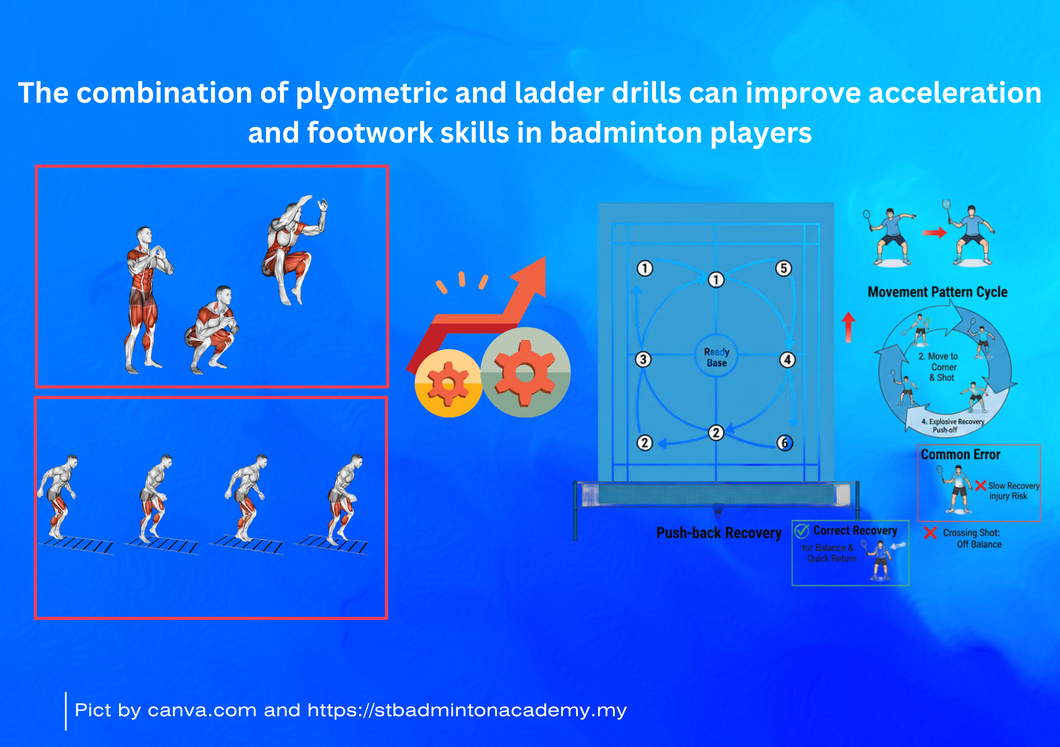
Objectives: This study aims to analyze the efficacy of integrating plyometric exercises with ladder drills in enhancing acceleration and footwork proficiency among badminton players.
Methods: This research employed a quasi-experimental design with a non-equivalent control group. Through purposive sampling, 24 male participants (aged 14-16 years) with at least 2 years of training experience, good health, and no history of recent injuries were selected. They were assigned to either the PLD Group (age: 15.00 ± 0.74 years; height: 162.00 ± 0.07 cm; weight: 50.58 ± 5.68 kg; BMI: 19.20 ± 0.88 kg/m²) or the CV Group (age: 15.00 ± 0.85 years; height: 162.08 ± 0.08 cm; weight: 51.75 ± 8.05 kg; BMI: 19.59 ± 1.56 kg/m²). The intervention spanned six weeks, with three sessions per week. Performance in acceleration was assessed using a 10-meter sprint, and footwork skills were assessed using the footwork skills test (Tohar version) pre- and post-intervention. Data analysis employed the Wilcoxon signed-rank and the Mann-Whitney tests.
Results: The Wilcoxon analysis indicated that both the PLD and CV Groups achieved improvements in acceleration and footwork skills (p<0.05). However, the Mann-Whitney test revealed a statistically significant difference between the two groups, with the PLD Group demonstrating superior gains in both acceleration (p<0.05) and footwork skills (p<0.05) compared to the CV Group.
Conclusions: Integrating plyometric training and ladder drills is an effective strategy for significantly improving acceleration and footwork skills in badminton players.
Keywords:
ARTICLE INFORMATION
LICENSE
Copyright (c) 2026 Muhammad Labib Siena Ar Rasyid, Oce Wiriawan, Afif Rusdiawan, Laily Mita Andriana, Enarnimas Dwi Ratna Damayanti

This work is licensed under a Creative Commons Attribution-ShareAlike 4.0 International License.
HOW TO CITE
Rasyid, M. L. S. A. , Wiriawan, O. , Rusdiawan, A. , Andriana, L. M. , & Damayanti, E. D. R. (2026). The combination of plyometric and ladder drills can improve acceleration and footwork skills in badminton players. Physical Education and Sports: Studies and Research, 5(1), 28-39. https://doi.org/10.56003/pessr.v5i1.669
DOWNLOADS
References
Alviana, S. I., Mintarto, E., & Hariyanto, A. (2020). The Effect of Exercise with Ladder Drill Slaloms and Carioca on Speed and Agility. International Journal for Educational and Vocational Studies, 1(8), 103-108. https://doi.org/10.29103/IJEVS.V2I1.2039
Bassa, E., Lola, A. C., Melliou, A., Prassa, M., Stavropoulou, G., Ziogas, N., Bassa, E., Lola, A. C., Melliou, A., Prassa, M., Stavropoulou, G., & Ziogas, N. (2024). Agility Ladder Training Combined With Plyometric or Multidirectional Speed Drills: Short-Term Adaptations on Jump, Speed, and Change of Direction Performance in Young Female Volleyball Players. Pediatric Exercise Science, 36(4), 248–257. https://doi.org/10.1123/pes.2024-0024
Booth, M. A., & Orr, R. (2016). Effects of plyometric training on sports performance. Strength and Conditioning Journal, 38(1), 30–37. https://doi.org/10.1519/SSC.0000000000000183
Chandra, S., Sharma, A., Malhotra, N., Rizvi, M. R., & Kumari, S. (2023). Effects of Plyometric Training on the Agility, Speed, and Explosive Power of Male Collegiate Badminton Players. Journal of Lifestyle Medicine, 13(1), 52-58. https://doi.org/10.15280/JLM.2023.13.1.52
Chandrakumar, N., & Ramesh, C. (2015). Effect of ladder drill and SAQ training on speed and agility among sports club badminton players. International Journal of Applied Research, 1(12), 527–529. https://www.allresearchjournal.com/archives/?year=2015&vol=1&issue=12&part=H&ArticleId=1129
Chiu, Y. L., Tsai, C. L., Sung, W. H., & Tsai, Y. J. (2020). Feasibility of smartphone-based badminton footwork performance assessment system. Sensors, 20(21), 6035. https://doi.org/10.3390/S20216035
Davies, G., Riemann, B. L., & Manske, R. (2015). Current Concepts of Plyometric Exercise. International Journal of Sports Physical Therapy, 10(6), 760–786. https://pubmed.ncbi.nlm.nih.gov/26618058/
Dos’Santos, T., McBurnie, A., Thomas, C., Jones, P. A., & Harper, D. (2022). Attacking Agility Actions: Match Play Contextual Applications with Coaching and Technique Guidelines. Strength and Conditioning Journal, 44(5), 102–118. https://doi.org/10.1519/SSC.0000000000000697
Duchateau, J., & Amiridis, I. G. (2023). Plyometric Exercises: Optimizing the Transfer of Training Gains to Sport Performance. Exercise and Sport Sciences Reviews, 51(4), 117–127. https://doi.org/10.1249/JES.0000000000000320
Erdogan, C. (2020). Improvement of physical training by performance-enhancing substances. Acta Physiologica, 230(1), e13517. https://doi.org/10.1111/APHA.13517;WGROUP:STRING:PUBLICATION
Gepfert, M., Gołaś, A., Roczniok, R., Walencik, J., Węgrzynowicz, K., & Zając, A. (2025). Impact of an Eight-Week Plyometric Training Intervention on Neuromuscular Performance, Musculotendinous Stiffness, and Directional Speed in Elite Polish Badminton Athletes. Journal of Functional Morphology and Kinesiology, 10(3), 304. https://doi.org/10.3390/JFMK10030304
Gomez, M. A., Leicht, A. S., Rivas, F., & Furley, P. (2020). Long rallies and next rally performances in elite men’s and women’s badminton. PLOS ONE, 15(3), e0229604. https://doi.org/10.1371/JOURNAL.PONE.0229604
Ihsan, F., Nasrulloh, A., Nugroho, S., & Kozina, Z. (2024). Optimizing Physical Conditioning Programs for Badminton Athletes: A Comprehensive Review of Training Strategies - A Systematic Review. Retos, 54, 488–498. https://doi.org/10.47197/retos.v54.103208
Krakan, I., Milanovic, L., & Belcic, I. (2020). Effects of Plyometric and Repeated Sprint Training on Physical Performance. Sports, 8(7), 91. https://doi.org/10.3390/SPORTS8070091
Kuo, K. P., Liao, C. C., & Kao, C. C. (2022). Improving Special Ability Performance of Badminton Players through a Visual Reaction Training System. Healthcare, 10(8), 1454. https://doi.org/10.3390/HEALTHCARE10081454
Kurniawan, R. S., Fahmi, D. A., & Setiyawan, S. (2025). Impact of plyometric training using step-up and lateral box jumps on the improvement of leg muscle power in youth school futsal athletes. Physical Education and Sports: Studies and Research, 4(2), 212–221. https://doi.org/10.56003/pessr.v4i2.611
Kusuma, L. S. W., & Aminullah, A. (2019). Pengaruh Latihan Footwork Berbasis Teknologi Terhadap Kelincahan dan Daya Tahan Sekolah Atlet Pb. Lyansa 2019. JUPE : Jurnal Pendidikan Mandala, 4(5), 13–20. https://doi.org/10.58258/JUPE.V4I5.824
Li, S., Kempe, M., Brink, M., & Lemmink, K. (2024). Effectiveness of recovery strategies after training and competition in endurance athletes: an umbrella review. Sports Medicine-Open, 10(1), 55. https://doi.org/10.1186/s40798-024-00724-6
Lockie, R. G., Murphy, A. J., Schultz, A. B., Knight, T. J., & De Jonge, X. A. K. J. (2012). The effects of different speed training protocols on sprint acceleration kinematics and muscle strength and power in field sport athletes. Journal of Strength and Conditioning Research, 26(6), 1539–1550. https://doi.org/10.1519/JSC.0b013e318234e8a0
Lockie, R. G., Schultz, A. B., Callaghan, S. J., Jeffriess, M. D., & Berry, S. P. (2013). Reliability and Validity of a New Test of Change-of-Direction Speed for Field-Based Sports: the Change-of-Direction and Acceleration Test (CODAT). Journal of Sports Science and Medicine, 12(1), 88–96. https://www.jssm.org/jssm-12-88.xml-Fulltext
Madsen, C. M., Karlsen, A., & Nybo, L. (2015). Novel speed test for evaluation of badminton-specific movements. Journal of Strength and Conditioning Research, 29(5), 1203–1210. https://doi.org/10.1519/JSC.0000000000000635
Malwanage, K. T., Senadheera, V. V., & Dassanayake, T. L. (2022). Effect of balance training on footwork performance in badminton: An interventional study. PLOS ONE, 17(11), e0277775. https://doi.org/10.1371/JOURNAL.PONE.0277775
Marwan, I., Wahidah, I., Rahmat, A. A., & Rohayati, N. (2024). Pengaruh Latihan Ladder Drill Terhadap Kelincahan Dan Kecepatan. Journal of SPORT (Sport, Physical Education, Organization, Recreation, and Training), 8(3), 1008–1021. https://doi.org/10.37058/sport.v8i3.13215
Matias, C. N., Toselli, S., Monteiro, C. P., & Campa, F. (2022). Editorial: New Training Strategies and Evaluation Methods for Improving Health and Physical Performance. International Journal of Environmental Research and Public Health, 19(10), 5855. https://doi.org/10.3390/IJERPH19105855
Milon, A. G. (2014). Study Regarding The Complexity of Physical Training in Badminton. GYMNASIUM, 15(1), 262. https://gymnasium.ub.ro/journal/article/view/192
Nagano, Y., Sasaki, S., Higashihara, A., & Ichikawa, H. (2020). Movements with greater trunk accelerations and their properties during badminton games. Sports Biomechanics, 19(3), 342–352. https://doi.org/10.1080/14763141.2018.1478989
Padrón-Cabo, A., Rey, E., Kalén, A., & Costa, P. B. (2020). Effects of Training with an Agility Ladder on Sprint, Agility, and Dribbling Performance in Youth Soccer Players. Journal of Human Kinetics, 73(1), 219-228. https://doi.org/10.2478/HUKIN-2019-0146
Phomsoupha, M., Ibrahime, S., Heugas, A.-M., & Laffaye, G. (2019). Physiological, neuromuscular and perceived exertion responses in badminton games. International Journal of Racket Sports Science, 1(1), 16–25. https://doi.org/10.30827/DIGIBUG.57323
Phomsoupha, M., & Laffaye, G. (2020). Multiple Repeated-Sprint Ability Test With Four Changes of Direction For Badminton Players (Part 2): Predicting Skill Level With Anthropometry, Strength, Shuttlecock, and Displacement Velocity. Journal of Strength and Conditioning Research, 34(1), 203–211. https://doi.org/10.1519/JSC.0000000000002397
Pryer, M. E., Cronin, J., Neville, J., & Uthoff, A. (2025). Kinematics and kinetics of pick-up acceleration. International Journal of Sports Science & Coaching, 20(6), 2796-2804. https://doi.org/10.1177/17479541251350474
Putra Pratama, A., Rini Sukamti, E., Suhartini, B., Puji Astuti, R., Setiawati, U., Srikandi, P., & Yudhistira, D. (2024). Reaction Lights-Based Shadow Training Model: Effect On Agility Of Deaf Badminton Players. Pakistan Journal of Life and Social Sciences, 22(2), 22443–22450. https://doi.org/10.57239/PJLSS-2024-22.2.001592
Putu, N., Wijayanti, N., Saputro, D. P., Fernandes, O., & Febri, R. (2021). Ladder drill portable: Agility tools for sports. Journal Sport Area, 6(1), 98–108. https://doi.org/10.25299/SPORTAREA.2021.VOL6(2).5912
Rachman, A., Ramadhan, H. M., & Yannor, L. (2024). The Effect of Ladder Drill Side Right in Training on Increasing the Agility of the Futsal Team of SMKN 1 Kandangan. Journal Coaching Education Sports, 5(2), 297–308. https://doi.org/10.31599/2V771D91
Rahadhi, D. S., Kusdinar, Y., Awwaludin, P. N., & Mulyana, M. (2025). The effect of resistance band training on the forehand smash speed of youth male badminton singles players. Physical Education and Sports: Studies and Research, 4(1), 60–70. https://doi.org/10.56003/pessr.v4i1.524
Rasyid, M. L. S. A., Wiriawan, O., Siantoro, G., Kusuma, D. A., & Rusdiawan, A. (2023). Combination of plyometric and ladder drill: Its impact on improving speed, agility, and leg muscle power in badminton. Jurnal SPORTIF : Jurnal Penelitian Pembelajaran, 9(2), 290–309. https://doi.org/10.29407/JS_UNPGRI.V9I2.20468
Shedge, S. S., Ramteke, S. U., & Jaiswal, P. R. (2024). Optimizing Agility and Athletic Proficiency in Badminton Athletes Through Plyometric Training: A Review. Cureus, 16(1), e52596. https://doi.org/10.7759/CUREUS.52596
Sivamani, S., Kumar, P., & Thilagam, P. K. (2022). The Basic Facts of Badminton Game: An Overview. Asian Pacific Journal of Health Sciences, 9(4), 100–102. https://doi.org/10.21276/APJHS.2022.9.4S.45
Trofin, P. F., Martinas, F. P., Muntianu, V. A., & Tanasa, A. R. (2022). The Opinion of Practitioners on the Biomotor Characteristics Necessary for Practicing High-Performance Sports. Bulletin of the Transilvania University of Braşov. Series IX: Sciences of Human Kinetics, 60–68. https://doi.org/10.31926/BUT.SHK.2022.15.64.1.7
Valldecabres, R., Casal, C. A., Chiminazzo, J. G. C., & de Benito, A. M. (2020). Players’ On-Court Movements and Contextual Variables in Badminton World Championship. Frontiers in Psychology, 11, 508842. https://doi.org/10.3389/FPSYG.2020.01567/BIBTEX
Yu, L., & Mohamad, N. I. (2022). Development of Badminton-specific Footwork Training from Traditional Physical Exercise to Novel Intervention Approaches. Physical Activity and Health, 6(1), 219–225. https://doi.org/10.5334/PAAH.207
Zhang, Q., Dellal, A., Chamari, K., Igonin, P. H., Martin, C., & Hautier, C. (2022). The influence of short sprint performance, acceleration, and deceleration mechanical properties on change of direction ability in soccer players—A cross-sectional study. Frontiers in Physiology, 13, 1027811. https://doi.org/10.3389/FPHYS.2022.1027811
Zhou, J., & Xu, Y. (2023). Effects of Ladder Training on The Mobility of Volleyball Players. Revista Brasileira de Medicina Do Esporte, 29, e2022_0575. https://doi.org/10.1590/1517-8692202329012022_0575




















