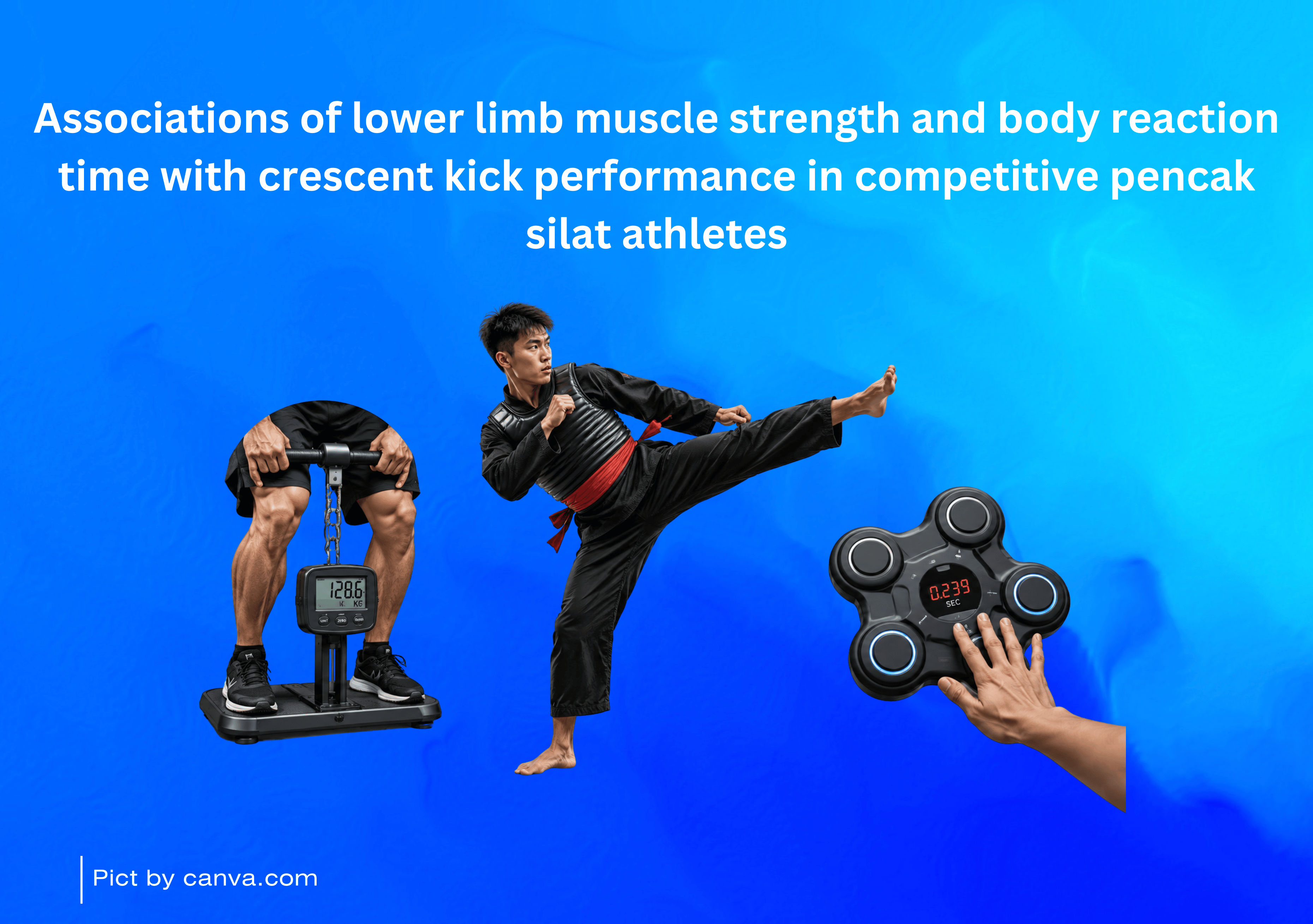
Associations of lower limb muscle strength and body reaction time with crescent kick performance in competitive pencak silat athletes

Background: Crescent kick performance is an important technical component of competitive pencak silat and may be associated with physical capacities such as lower limb muscle strength and reaction time. However, evidence regarding the relationships of these physical characteristics with crescent kick performance remains limited.
Objectives: This study aimed to examine the associations of lower limb muscle strength and body reaction time with crescent kick performance among competitive pencak silat athletes.
Methods: This quantitative correlational study involved 30 competitive pencak silat athletes (age: 19.8 ± 2.1 years; height: 168.4 ± 6.3 cm; body mass: 61.7 ± 8.2 kg; body mass index: 21.7 ± 2.3 kg/m²) recruited using total sampling. Lower limb muscle strength was assessed using a leg dynamometer, body reaction time using a reaction timer, and crescent kick performance using a 10-second crescent kick test. Data were analyzed using descriptive statistics, Pearson correlation, and multiple correlation analysis, with statistical significance set at p < .05.
Results: Lower limb muscle strength was positively associated with crescent kick performance (r = 0.734, p < .001), whereas body reaction time was negatively associated with crescent kick performance (r = -0.739, p < .001), indicating that shorter reaction times were associated with better kick performance. Multiple correlation analysis showed a strong combined association of lower limb muscle strength and body reaction time with crescent kick performance (R = 0.754, R² = 0.568, p < .001). Together, these variables accounted for 56.8% of the variance in crescent kick performance.
Conclusions: Greater lower limb muscle strength and shorter body reaction time were associated with better crescent kick performance among competitive pencak silat athletes. These findings highlight the relevance of muscular strength and neuromuscular responsiveness to crescent kick performance and may inform physical conditioning programs for pencak silat athletes. Further studies with larger samples and additional biomechanical, physiological, and technical measures are needed to better understand the factors associated with crescent kick performance.
Downloads
Apollaro, G., Panascì, M., Ouergui, I., Falcó, C., Franchini, E., Ruggeri, P., & Faelli, E. (2024). Influence of body composition and muscle power performance on multiple frequency speed of kick test in taekwondo athletes. Sports, 12(12), 322. https://doi.org/10.3390/sports12120322
Cano, L. A., Gerez, G. D., García, M. S., Albarracín, A. L., Farfán, F. D., & Fernández-Jover, E. (2024). Decision-making time analysis for assessing processing speed in athletes during motor reaction tasks. Sports, 12(6), 151. https://doi.org/10.3390/sports12060151
Ervilha, U. F., Fernandes, F. D. M., Souza, C. C. D., & Hamill, J. (2020). Reaction time and muscle activation patterns in elite and novice athletes performing a taekwondo kick. Sports biomechanics, 19(5), 665-677. https://doi.org/10.1080/14763141.2018.1515244
Faro, H., Lima, L. A. D., Silva, R. D. M., Mortatti, A. L., & Machado, D. G. S. (2025). Development and reliability of test to measure perceptual-motor performance in combat sports: The Striking Reaction Time Task (SRTT). Revista de Artes Marciales Asiáticas, 20(1), 77–92. https://doi.org/10.18002/rama.v20i1.2505
Ihsan, N., Hidayat, R., Damrah, Neldi, H., Sepriadi, & Muslimin. (2022). The contribution of leg muscle explosive power, agility, and self-confidence on sickle kick performance. International Journal of Human Movement and Sports Sciences, 10(4), 683–688. https://doi.org/10.13189/saj.2022.100408
Ilahi, B. R., Okilanda, A., Raibowo, S., Yarmani, Sugihartono, T., Syafrial, Nopiyanto, Y. E., Hiasa, F., Ihsan, N., & Putra, J. (2023). The effect of resistance bands rubber spring exercise on the front kick speed of adolescent pencak silat women. International Journal of Human Movement and Sports Sciences, 11(2), 418–423. https://doi.org/10.13189/saj.2023.110219
Kabadayı, M., Karadeniz, S., Yılmaz, A. K., Karaduman, E., Bostancı, Ö., Akyildiz, Z., Clemente, F. M., & Silva, A. F. (2022). Effects of Core Training in Physical Fitness of Youth Karate Athletes: A Controlled Study Design. International Journal of Environmental Research and Public Health, 19(10), 5816. https://doi.org/10.3390/ijerph19105816
Karo-Karo, A. A. P., Rahayu, T., Setyawati, H., Mukarromah, S. B., & Syaifullah, R. (2023). Analysis of Pencak Silat Techniques Using a Biomechanical Approach: Systematic Literature Review. Physical Education Theory and Methodology, 23(6), 947-953. https://doi.org/10.17309/tmfv.2023.6.18
Kusuma, M. N. H. (2023). Investigating The Causative Factor Of Musculoskeletal. Physical Education Theory and Methodology, 7989, 185–191. https://doi.org/10.17309/tmfv.2023.2.05
Lubis, J., Haqiyah, A., Robianto, A., Ihsanti, S. I., Wardoyo, H., Ginanjar, S., Irawan, A. A., Sumartiningsih, S., Setiawan, I., Lubis, R. A., Sanjaya, K. H., & Kusumandari, D. E. (2024). The effect of six-week plyometric, functional, and interval trainings on body composition, power, and kicking speed in male Pencak Silat university athletes. International Journal of Disabilities Sports and Health Sciences, 7(Special Issue 1), 46–53. https://doi.org/10.33438/ijdshs.1371605
Lubis, J., Thongdaeng, N., Haqiyah, A., Sukur, A., Abidin, D., Ayu Irawan, A., Sumartiningsih, S., & Hanief, Y. N. (2022). The Effect of Five-Week Aerobic Interval Training on The Body Composition of Pencak Silat Elite Athletes. International Journal of Kinesiology and Sports Science, 10(2), 16-24. https://doi.org/10.7575/aiac.ijkss.v.10n.2p.16
Moreira, P. V. S., Falco, C., Menegaldo, L. L., Goethel, M. F., De Paula, L. V., & Gonçalves, M. (2021). Are isokinetic leg torques and kick velocity reliable predictors of competitive level in taekwondo athletes?. PloS one, 16(6), e0235582. https://doi.org/10.1371/journal.pone.0235582
Nugroho, G. (2017). The effect of repetition training method on PPLP Dispora Riau Pencak Silat athletes' crescent kick speed. IOP Conference Series: Materials Science and Engineering, 180, 012163. https://doi.org/10.1088/1757-899X/180/1/012163
Ojeda-Aravena, A., Herrera-Valenzuela, T., Valdés-Badilla, P., Báez-San Martín, E., Thapa, R. K., & Ramirez-Campillo, R. (2023). A systematic review with meta-analysis on the effects of plyometric-jump training on the physical fitness of combat sport athletes. Sports, 11(2), 33. https://doi.org/10.3390/sports11020033
Subekti, N., Hidayatullah, M. F., Syaifullah, R., Setiyadi, N. A., & Warthadi, A. N. (2025). The effect of four-week high-intensity interval training on increasing physical fitness and specific speed in young Pencak Silat athletes. SPORT TK-EuroAmerican Journal of Sport Sciences, 14, 37. https://doi.org/10.6018/sportk.574961
Subekti, N., Sistiasih, V. S., Syaukani, A. A., & Fatoni, M. (2020). Kicking ability in pencak silat, reviewed from eye-foot coordination, speed, and ratio of limb length-body height. Journal of Human Sport and Exercise, 15(Proc2), S453–S461. https://doi.org/10.14198/jhse.2020.15.Proc2.36
Suwirman. (2021). Instrument speed endurance test of pencak silat athletes. International Journal of Human Movement and Sports Sciences, 9(6), 1447–1452. https://doi.org/10.13189/saj.2021.090641
Copyright (c) 2026 Jery Setiawan, Siti Baitul Mukarromah

This work is licensed under a Creative Commons Attribution-ShareAlike 4.0 International License.