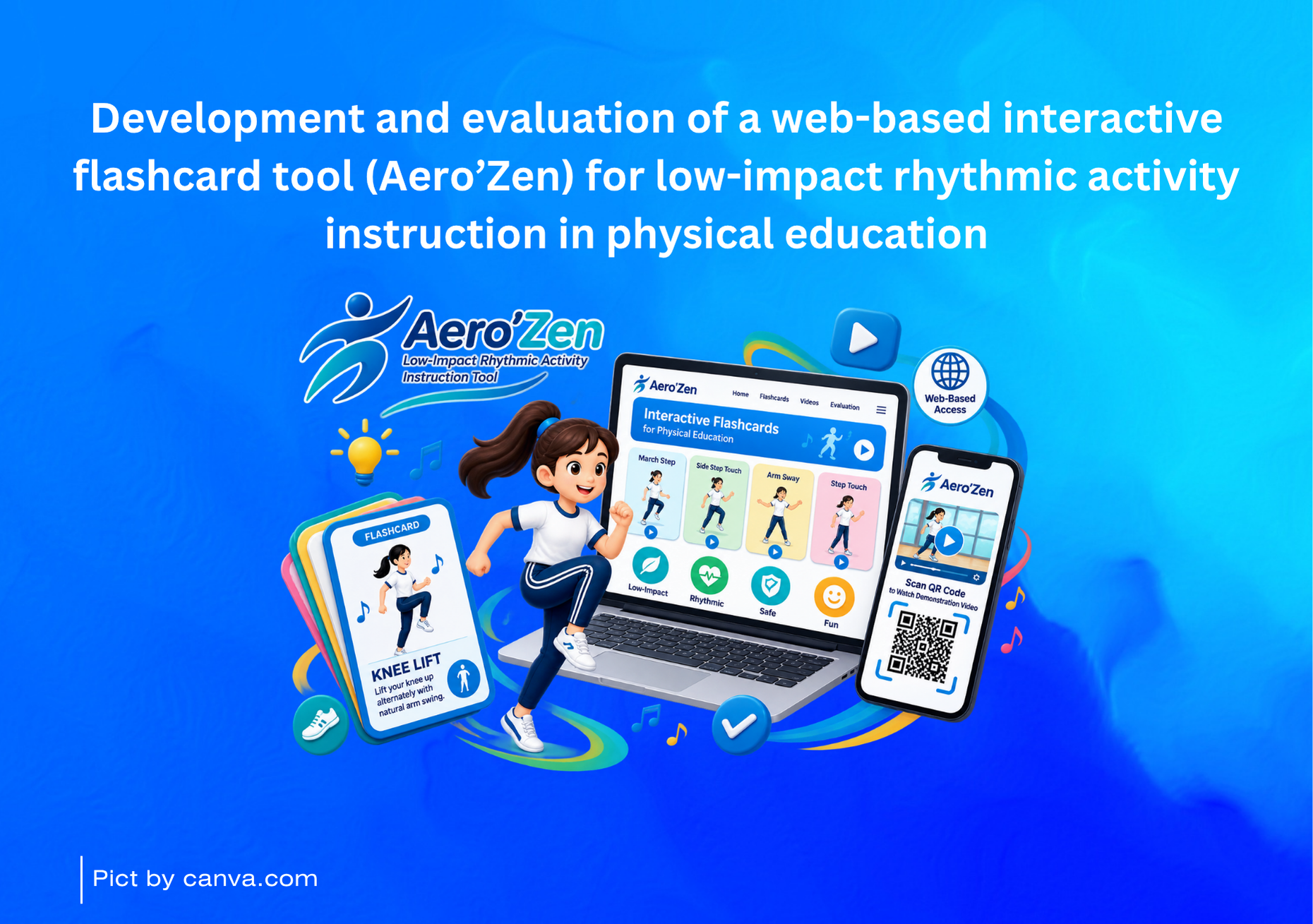
Development and evaluation of a web-based interactive flashcard tool (Aero’Zen) for low-impact rhythmic activity instruction in physical education

Downloads
Background: Teaching rhythmic activities in physical education continues to face challenges due to the limited availability of visual learning aids that demonstrate movements systematically, repeatedly, and accessibly.
Objectives: This study aimed to develop and evaluate Aero’Zen, a web-based interactive flashcard tool integrating movement illustrations, QR codes, and demonstration videos for basic low-impact rhythmic activities.
Methods: This research and development study employed the ADDIE model. Following product development and expert validation, learning outcomes were evaluated using a one-group pretest–posttest pre-experimental design involving 30 tenth-grade students at SMK Negeri 2 Semarang. Product feasibility was assessed by media experts, subject matter experts, and a physical education practitioner. Pretest and posttest scores were analyzed using the Shapiro–Wilk test for normality and paired-samples t-tests, with the significance level set at α = .05.
Results: Aero’Zen was rated highly suitable by media experts (95.75%), subject matter experts (94.50%), and a physical education practitioner (88.75%). Mean scores increased from 75.40 to 89.97 in the cognitive domain, from 28.80 to 32.77 in the affective domain, and from 19.87 to 32.00 in the psychomotor domain. Paired-samples t-tests revealed significant differences between pretest and posttest scores across all three domains (all p < .001).
Conclusions: Aero’Zen is a highly suitable web-based learning medium with the potential to support students’ cognitive, affective, and psychomotor learning outcomes, including movement coordination and performance, in low-impact rhythmic activities. Its integrated flashcards, QR-code access, and demonstration videos provide a flexible resource for repeated and independent learning. Future studies should use randomized controlled trials with larger and more diverse samples to strengthen causal inference and generalizability.
Downloads
Annastasyya, A., & Fathurrahman, M. (2024). Development of QR Code-Based Flash Card Media to Improve Learning Outcomes of Grade IV Students. Studies in Learning and Teaching, 5(2), 502-512. https://doi.org/10.46627/silet.v5i2.457
Cavanagh, T. M., & Kiersch, C. (2023). Using commonly-available technologies to create online multimedia lessons through the application of the Cognitive Theory of Multimedia Learning. Educational technology research and development, 71(3), 1033-1053. https://doi.org/10.1007/s11423-022-10181-1
Dewi, M. L. K., & Zuhdi, U. (2023). Pengembangan Media QR-Card Materi Sistem Pencernaan Untuk Siswa Sekolah Dasar. Jurnal Penelitian Pendidikan Guru Sekolah Dasar, 11(4), 824-833. https://ejournal.unesa.ac.id/index.php/jurnal-penelitian-pgsd/article/view/53167
Etikan, I., Musa, S. A., & Alkassim, R. S. (2016). Comparison of convenience sampling and purposive sampling. American Journal of Theoretical and Applied Statistics, 5(1), 1-4. https://doi.org/10.11648/j.ajtas.20160501.11
Fahmi, D. A., Herlambang, T., & Wiyanto, A. (2025). Enhancing student athlete performance through an innovative aerobic gymnastics choreography model: evidence from Central Java. Journal Sport Area, 10(2), 215-225. https://doi.org/10.25299/sportarea.2025.vol10(2).19177
Garrett, J., Chak, C., Bullock, T., & Giesbrecht, B. (2024). A systematic review and Bayesian meta-analysis provide evidence for an effect of acute physical activity on cognition in young adults. Communications Psychology, 2(1), 82. https://doi.org/10.1038/s44271-024-00124-2
Habibzadeh, F. (2024). Data distribution: normal or abnormal?. Journal of Korean Medical Science, 39(3). https://doi.org/10.3346/jkms.2024.39.e35
Han, Y., Syed Ali, S. K. B., & Ji, L. (2022). Use of observational learning to promote motor skill learning in physical education: A systematic review. International Journal of Environmental Research and Public Health, 19(16), 10109. https://doi.org/10.3390/ijerph191610109
Jastrow, F., Greve, S., Thumel, M., Diekhoff, H., & Süßenbach, J. (2022). Digital technology in physical education: a systematic review of research from 2009 to 2020. German Journal of Exercise and Sport Research, 52(4), 504-528. https://doi.org/10.1007/s12662-022-00848-5
Kerimbayev, N., Umirzakova, Z., Shadiev, R., & Jotsov, V. (2023). A student-centered approach using modern technologies in distance learning: a systematic review of the literature. Smart Learning Environments, 10(1), 61. https://doi.org/10.1186/s40561-023-00280-8
Knoke, C., Woll, A., & Wagner, I. (2024). Health promotion in physical education through digital media: A systematic literature review. German Journal of Exercise and Sport Research, 54(2), 276-290. https://doi.org/10.1007/s12662-023-00932-4
Kresnapati, P., Royana, I. F., & Hadi, H. (2026). Development of an Augmented Reality (AR)-Based Adaptive Physical Education Learning Module to Improve the Motor Skills of Deaf Children. In 8th International Conference on Education and Social Science Research (ICESRE 2025) (pp. 4-12). Atlantis Press. https://doi.org/10.2991/978-2-38476-543-0_2
Le, H. H., & Luong, T. D. (2023). Using flashcard-based techniques to improve students’ vocabulary retention. Vietnam Journal of Education, 7(3), 313-325. https://doi.org/10.52296/vje.2023.336
Masrukhan, I., Utomo, A. W. B., & Septianingrum, K. (2025). Pengembangan Media Pembelajaran PJOK Berbasis Permainan “Parkour Kids” di Sekolah Dasar Fase A untuk Meningkatkan Kemampuan Motorik Kasar Siswa MI Islamiyah Babadan. Jurnal Ilmiah Global Education, 6(2), 722-736. https://doi.org/10.55681/jige.v6i2.3829
Mayer, R. E. (2024). The past, present, and future of the cognitive theory of multimedia learning. Educational Psychology Review, 36(1), 8. https://doi.org/10.1007/s10648-023-09842-1
Mishra, P., Pandey, C. M., Singh, U., Gupta, A., Sahu, C., & Keshri, A. (2019). Descriptive statistics and normality tests for statistical data. Annals of Cardiac Anaesthesia, 22(1), 67. https://doi.org/10.4103/aca.ACA_157_18
Pujiyanto, G. Y., Royana, I. F., & Wibisana, M. I. N. (2025). Development and evaluation of an Android-based multimedia application to promote healthy lifestyles in physical education: A study at State Junior High School 29 Semarang. Physical Education and Sports: Studies and Research, 4(2), 162-174. https://doi.org/10.56003/pessr.v4i2.607
Ren, Y., Chu, J., Zhang, Z., & Luo, B. (2024). Research on the effect of different aerobic activity on physical fitness and executive function in primary school students. Scientific Reports, 14(1), 7956. https://doi.org/10.1038/s41598-024-58009-7
Rismayanthi, C., Zein, M. I., Mulyawan, R., Nurfadhila, R., Prasetyawan, R. R., & Antoni, M. S. (2022). The effect of low impact aerobic exercise on increasing physical fitness for the elderly. Jurnal Keolahragaan, 10(1), 137-146. https://doi.org/10.21831/jk.v10i1.48743
Sagita, D. A., & Hidayah, R. (2025). Pengaruh Media Flashcard Berbarcode Terhadap Kemampuan Literasi Sains Dalam Pembelajaran Ipas Peserta Didik Kelas V Sdn Se-Gugus Wonoboyo Kabupaten Kebumen Tahun Ajaran 2024/2025. Kalam Cendekia: Jurnal Ilmiah Kependidikan, 13(3), 1-12. https://doi.org/10.20961/jkc.v13i3.101414
Saputro, S., & Sunarno, W. (2021). The implementation of research-based learning model in the basic science concepts course in improving analytical thinking skills. European Journal of Educational Research, 10(3), 1051-1062. https://doi.org/10.12973/eu-jer.10.3.1051
Spatioti, A. G., Kazanidis, I., & Pange, J. (2022). A comparative study of the ADDIE instructional design model in distance education. Information, 13(9), 402. https://doi.org/10.3390/info13090402
Wong, J. T., & Hughes, B. S. (2023). Leveraging learning experience design: digital media approaches to influence motivational traits that support student learning behaviors in undergraduate online courses. Journal of Computing in Higher Education, 35(3), 595-632. https://doi.org/10.1007/s12528-022-09342-1
Yusoff, M. S. B. (2019). ABC of content validation and content validity index calculation. Education in Medicine Journal, 11(2), 49-54. https://doi.org/10.21315/eimj2019.11.2.6
Zhao, M., Lu, X., Zhang, Q., Zhao, R., Wu, B., Huang, S., & Li, S. (2024). Effects of exergames on student physical education learning in the context of the artificial intelligence era: a meta-analysis. Scientific Reports, 14(1), 7115. https://doi.org/10.1038/s41598-024-57357-8
Copyright (c) 2026 Zenny Ni'matul Ulya, Donny Anhar Fahmi, Ibnu Fatkhu Royana

This work is licensed under a Creative Commons Attribution-ShareAlike 4.0 International License.