Examining the mediating role of perceived psychosocial support in the relationship between sport grit and psychological well-being among high school student-athletes

Downloads
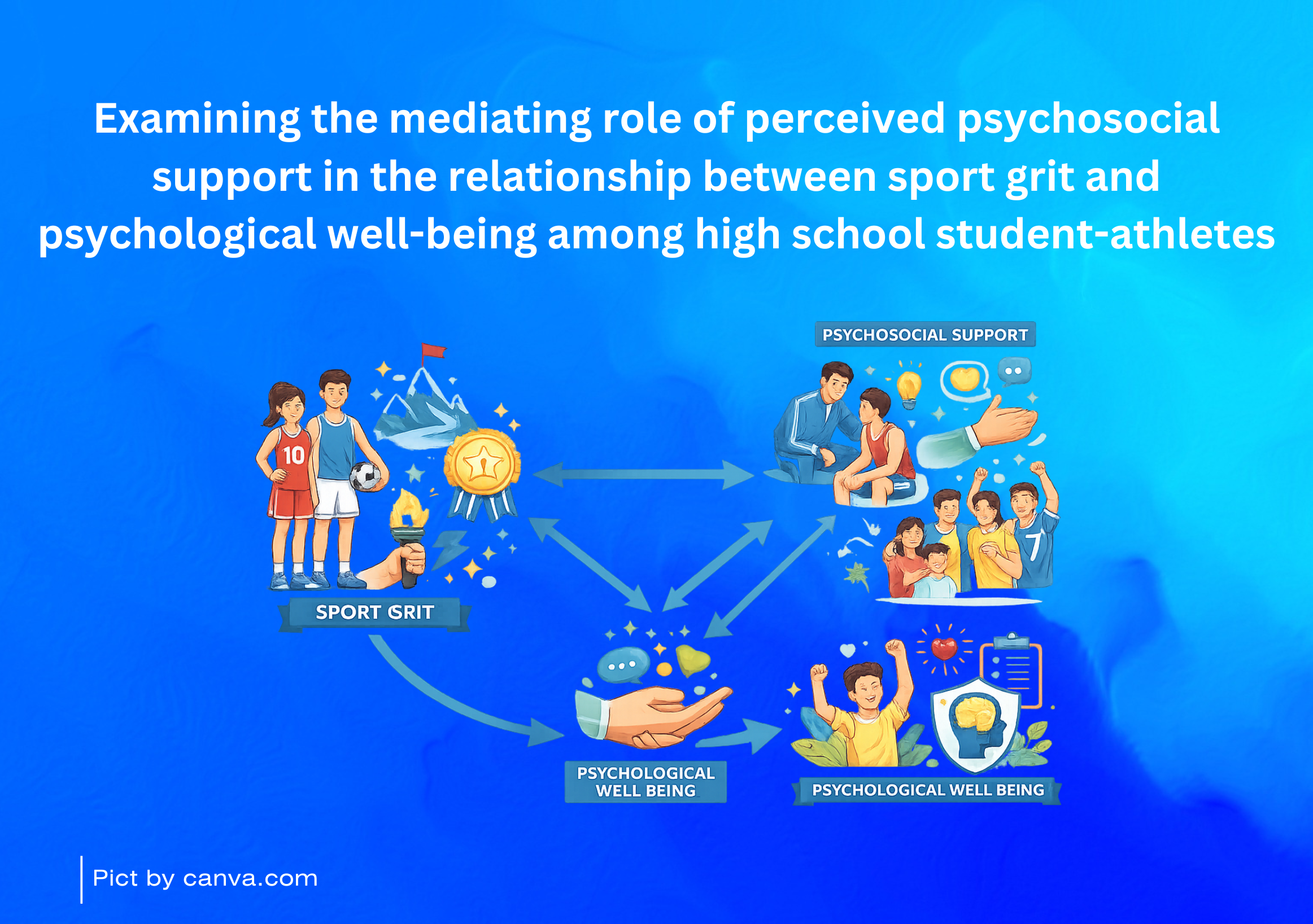
Background: Psychological well-being is essential for student-athletes because they must simultaneously cope with competitive sport demands and academic responsibilities. Although both sport grit and perceived psychosocial support have been associated with positive psychological outcomes, the mediating role of psychosocial support in the relationship between sport grit and psychological well-being remains insufficiently understood.
Objectives: This study examined whether perceived psychosocial support mediates the relationship between sport grit and psychological well-being among high school student-athletes.
Methods: A quantitative cross-sectional correlational design with a mediation analysis framework was employed. A total of 362 high school student-athletes from the first district of La Union, Philippines, participated using total enumeration sampling. Data were collected using standardized questionnaires assessing sport grit, psychological well-being, and perceived psychosocial support. Descriptive statistics, regression analysis, and bias-corrected bootstrap mediation analysis (5,000 resamples) were performed using JASP.
Results: Student-athletes reported high levels of sport grit, psychological well-being, and perceived psychosocial support. Sport grit significantly and positively predicted psychological well-being, whereas it did not significantly predict perceived psychosocial support. Perceived psychosocial support demonstrated a significant but negative association with psychological well-being. Furthermore, the indirect effect of sport grit on psychological well-being through perceived psychosocial support was not statistically significant, indicating the absence of a mediating effect.
Conclusions: Sport grit is an important direct psychological resource associated with psychological well-being among high school student-athletes. Although perceived psychosocial support contributes to athletes' psychological functioning, it does not explain the relationship between sport grit and psychological well-being. These findings highlight the importance of strengthening athletes' internal psychological resources while maintaining supportive sport environments.
Downloads
Alberto, N. R. I., Eala, M. A. B., Constantino-Hernandez, A. B. D., Manlongat, K. D., & Ly-Uson, J. T. (2021). Mental health care for athletes in the Philippines. The Lancet Psychiatry, 8(12), 1034. https://doi.org/10.1016/S2215-0366(21)00432-6
Blando, M. K. (2024). The Moderating Effects of Social Support on Athletic Identity and Student-Athletes’ Psychological Well-being. Dissertation. De La Salle University, Manila.
Chu, T. L. (Alan), & Zhang, T. (2019). The roles of coaches, peers, and parents in athletes' basic psychological needs: A mixed-studies review. International Journal of Sports Science & Coaching, 14(4), 569–588. https://doi.org/10.1177/1747954119858458
Clark, K. N., & Malecki, C. K. (2019). Academic Grit Scale: Psychometric properties and associations with achievement and life satisfaction. Journal of School Psychology, 72, 49–66. https://doi.org/10.1016/j.jsp.2018.12.001
Cormier, D. L., Dunn, J. G. H., & Dunn, J. C. (2021). Examining the domain specificity of grit in sport. Journal of Sport and Exercise Psychology, 43(3), 227–238. https://doi.org/10.1123/jsep.2020-0175
Cormier, D. L., Ferguson, L. J., Gyurcsik, N. C., Briere, J. L., Dunn, J. G., & Kowalski, K. C. (2024). Grit in sport: A scoping review. International Review of Sport and Exercise Psychology, 17(1), 1-38. https://doi.org/10.1080/1750984X.2021.1934887
Cormier, D. L., Jørgensen, H., Ferguson, L. J., Gyurcsik, N. C., Briere, J. L., & Kowalski, K. C. (2025). Constructing a grounded theory of grit in sport: understanding the development and outcomes of long-term passion and perseverance in competitive athletes. Qualitative Research in Sport, Exercise and Health, 17(2), 155-171. https://doi.org/10.1080/2159676X.2024.2432653
Datu, J. A. D. (2021). Beyond passion and perseverance: Review and future research initiatives on the science of grit. Frontiers in Psychology, 11, 545526. https://doi.org/10.3389/fpsyg.2020.545526
Duckworth, A. L., Peterson, C., Matthews, M. D., & Kelly, D. R. (2007). Grit: Perseverance and passion for long-term goals. Journal of Personality and Social Psychology, 92(6), 1087–1101. https://psycnet.apa.org/doi/10.1037/0022-3514.92.6.1087
Duckworth, A. L., & Gross, J. J. (2014). Self-control and grit: Related but separable determinants of success. Current Directions in Psychological Science, 23(5), 319–325. https://doi.org/10.1177/0963721414541462
Eather, N., Wade, L., Pankowiak, A., & Eime, R. (2023). The impact of sports participation on mental health and social outcomes in adults: a systematic review and the ‘Mental Health through Sport’conceptual model. Systematic Reviews, 12(1), 102. https://doi.org/10.1186/s13643-023-02264-8
Freeman, P., & Rees, T. (2022). Social support and performance in sport: A review and conceptual framework. International Review of Sport and Exercise Psychology, 15(1), 123–149. https://doi.org/10.1080/1750984X.2020.1828724
From, C., Sörman, D. E., & Hansson, P. (2021). Grit and perseverance among athletes: Associations with motivation and well-being. Frontiers in Psychology, 12, 783–792. https://doi.org/10.3389/fpsyg.2021.783
Graupensperger, S., Benson, A. J., Kilmer, J. R., & Evans, M. B. (2020). Social (un) distancing: Teammate interactions, athletic identity, and mental health of student-athletes during the COVID-19 pandemic. Journal of Adolescent Health, 67(5), 662-670. https://doi.org/10.1016/j.jadohealth.2020.08.001
Gray, H. M., Moran, R. N., Elder, E., Wilkerson, A., Chaney, E., Gilmore-Childress, G., & Wallace, J. (2023). Grit, athlete burnout, and well-being in female collegiate student-athletes. Journal of Athletic Training, 58(10), 796-802. https://doi.org/10.4085/1062-6050-0121.23
Hagiwara, G., Tsunokawa, T., Iwatsuki, T., Shimozono, H., & Kawazura, T. (2021). Relationships among student-athletes’ identity, mental health, and social support in Japanese student-athletes during the COVID-19 pandemic. International Journal of Environmental Research and Public Health, 18(13), 7032. https://doi.org/10.3390/ijerph18137032
Harwood, C. G., & Knight, C. J. (2015). Parenting in youth sport: A position paper on parenting expertise. Psychology of Sport and Exercise, 16, 24–35. https://doi.org/10.1016/j.psychsport.2014.03.001
Henriksen, K., Schinke, R., Moesch, K., McCann, S., Parham, William D., Larsen, C. H., & Terry, P. (2019). Consensus Statement on Improving the Mental Health of High Performance Athletes. International Journal of Sport and Exercise Psychology, 18(5), 1–8. https://doi.org/10.1080/1612197x.2019.1570473
Hou, X.-L., Becker, N., Hu, T.-Q., Koch, M., Xi, J.-Z., & Mõttus, R. (2022). Do grittier people have greater subjective well-being? A meta-analysis. Personality and Social Psychology Bulletin, 48(12), 1701–1716. https://doi.org/10.1177/01461672211053453
Kegelaers, J., Wylleman, P., Defruyt, S., Praet, L., Stambulova, N., Torregrossa, M., Kenttä, G., & De Brandt, K. (2024). The mental health of student-athletes: A systematic scoping review. International Review of Sport and Exercise Psychology, 17(2), 848–881. https://doi.org/10.1080/1750984X.2022.2095657
Kinderman, P., Schwannauer, M., Pontin, E., & Tai, S. (2011). BBC well-being scale. PsycTESTS Dataset. https://doi.org/10.1037/t29219-000
Kuettel, A., & Larsen, C. H. (2020). Risk and protective factors for mental health in elite athletes: A scoping review. International Review of Sport and Exercise Psychology, 13(1), 1–35. https://doi.org/10.1080/1750984x.2019.1689574
Lee, K. H., & Oh, K. R. (2025). The effect of grit on psychological well-being in collegiate athletes: the moderating role of social support. Frontiers in Sports and Active Living, 7, 1711128. https://doi.org/10.3389/fspor.2025.1711128
Lundqvist, C. (2022). Well-being in competitive sports—The role of motivation and psychological resources. Sports Medicine, 52(3), 435–447. https://doi.org/10.1007/s40279-021-01572-7
Luo, J., Du, R., Wang, X., & Luo, L. (2025). The relationship between social support and mental health in athletes: a systematic review and meta-analysis. Frontiers in Psychology, 16, 1642886. https://doi.org/10.3389/fpsyg.2025.1642886
Maciel, L. F. P., Krapp do Nascimento, R., Milistetd, M., Vieira do Nascimento, J., & Folle, A. (2021). Systematic review of social influences in sport: Family, coach and teammate support. Apunts Educación Física y Deportes, 145, 39–52. https://doi.org/10.5672/apunts.2014-0983.es.(2021/3).145.06
Nothnagle, E. A., & Knoester, C. (2025). Sport participation and the development of grit. Leisure Sciences, 47(2), 225-242. https://doi.org/10.1080/01490400.2022.2090037
Stambulova, N. B., & Wylleman, P. (2019). Psychology of athletes' dual careers: A state-of-the-art critical review of the European discourse. Psychology of Sport and Exercise, 42, 74–88. https://doi.org/10.1016/j.psychsport.2018.11.013
Copyright (c) 2026 Daphne Scott Fernandez, Kahreen Lou Mondina

This work is licensed under a Creative Commons Attribution-ShareAlike 4.0 International License.