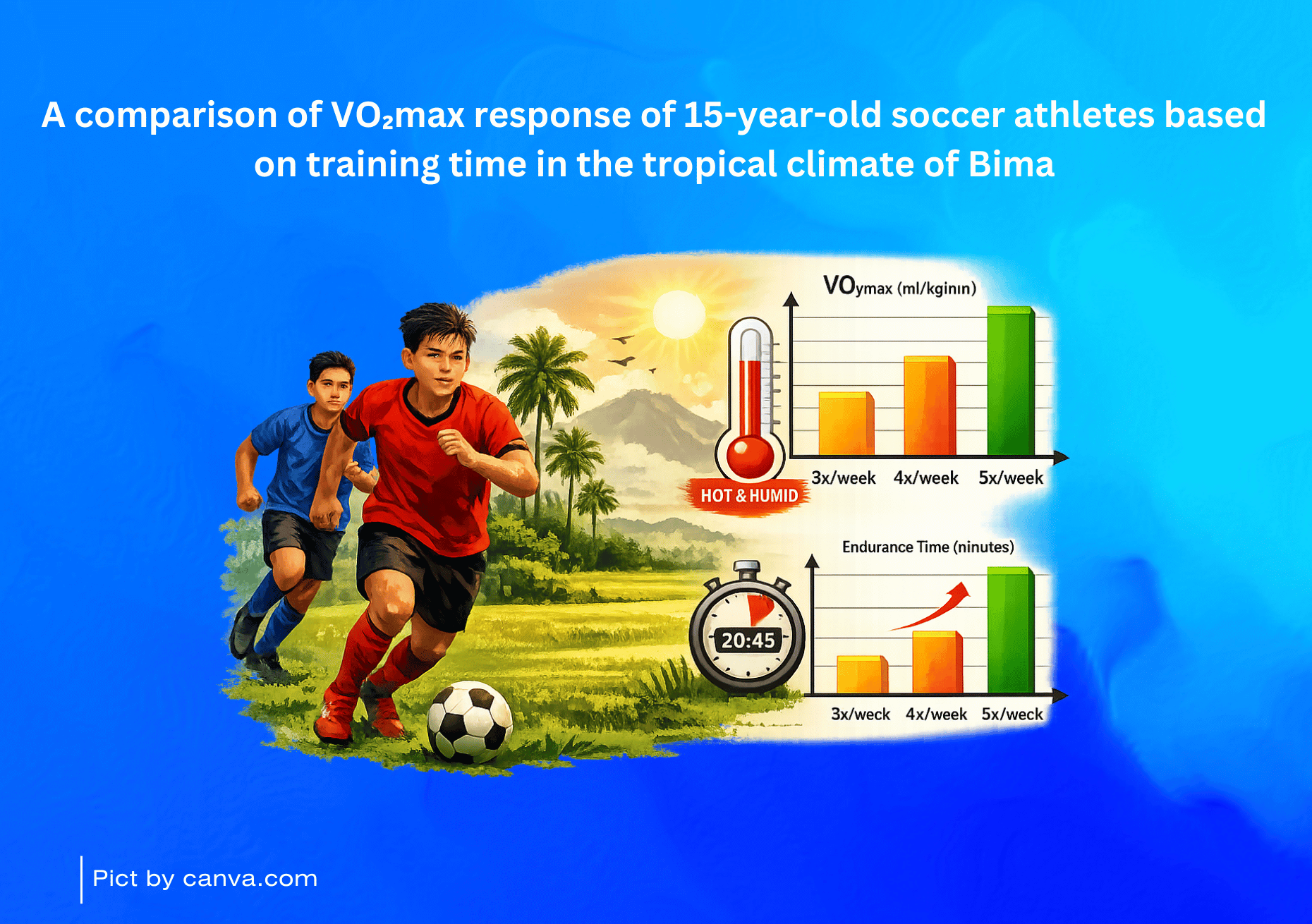
A comparison of VO₂max response of 15-year-old soccer athletes based on training time in the tropical climate of Bima

Downloads
Abstract
Background: VO₂max is the primary indicator of a soccer athlete's aerobic capacity, but in tropical climates like Bima, high temperatures and humidity can affect VO₂max achievement. Hence, the timing of training is an important factor to consider.
Objectives: This study aims to analyze differences in VO₂max across training times (morning and afternoon) in 15-year-old youth soccer athletes from the Bima Football Association (PERSSEBI).
Methods: The study used a quantitative, comparative, cross-sectional observational design. The study subjects were 45 athletes (age 15.31±0.46; height 163.12±4.35 cm; weight 55.28±3.67 kg; and body mass index (BMI) 20.78±1.18 kg/m²) from the Bima Football Association (PERSEBI), selected by purposive sampling, and divided into morning (n=23) and afternoon (n=22) training groups. VO₂max was measured using a multistage fitness test (Bleep Test). Data analysis included descriptive statistics, the Shapiro–Wilk normality test, the Levene homogeneity test, and the independent-samples t-test at a significance level of 0.05, using IBM SPSS 25.
Results: The descriptive analysis showed that the average VO₂max of the morning group was 43.78 ± 2.34 ml/kg/minute, higher than that of the afternoon group (42.91 ± 2.29 ml/kg/minute). The results of the independent sample t-test showed that there was a significant difference in VO₂max between the two groups with a t value = 2.14 with df = 43 and a significant p value = 0.04 (p < 0.05) with an average difference of 0.87 ml/kg/minute indicating that the morning exercise group had a higher Vo2max value than the afternoon exercise group.
Conclusions: These findings suggest that training time contributes to differences in athletes' VO₂max values in tropical environments, with morning training resulting in higher performance than afternoon training. Therefore, scheduling training that accounts for environmental conditions is crucial for optimizing athletes' VO₂max.
Altmann, S., Forcher, L., Ruf, L., Beavan, A., Groß, T., Lussi, P., Hartel, S. (2021). Match-related physical performance in professional soccer: Position or player specific. PLoS ONE, 16(9), 22–24. https://doi.org/10.1371/journal.pone.0256695
Ansori, M. K., Sudarko, R. A., Primasoni, N., Widodo, H., & Anggraeni, E. (2024). Effect of small-sided game versus high-intensity interval training method in increasing anaerobic endurance in youth football athletes (15-17 years). Pedagogy of Physical Culture and Sports, 28(5), 353–359. https://doi.org/10.15561/26649837.2024.0503
Apriantono, T., Herman, I., Juniarsyah, A. D., Hasan, M. F., Ihsani, S. I., Hidayat, I. I., Hindawan, I. (2020). The effect of temperature and humidity on VO2max of PPLP athletes in Java, Indonesia. Sportif : Jurnal Penelitian Pembelajaran, 6(1), 59–68. https://doi.org/10.29407/js_unpgri.v6i1.13872
Bahtra, R., Crisari, S., Dinata, W. W., Susanto, N., & Andria, Y. (2023). VO 2 Max in Soccer Players : Comparison of Interval Training and Continuous Running. JOSSAE (Journal of Sport Science and Education), 8(1), 46–53. https://doi.org/10.26740/jossae.v8n1.p46-53
Bassett, D. R., & Howley, E. T. (2023). Limiting factors for maximum oxygen uptake and determinants of endurance performance. Medicine and Science in Sports and Exercise, 32(1), 70–84. https://doi.org/10.1097/00005768-200001000-00012
Clemente, F. M., Moran, J., Ramirez-campillo, R., Beato, M., Verlag, G. T., Sciences, E., Ireland, N. (2023). Endurance Performance Adaptations between SSG and HIIT in Soccer Players : A Meta-analysis Authors. International Journal of Sports Medicine, 45(3), 183–209. https://doi.org/10.1055/a-2171-3255
Crandall, C. G., & Johnson, J. M. (2023). The cardiovascular challenge of exercising in the heat. The Journal of Physiology, 586(1), 45–53. https://doi.org/10.1113/jphysiol.2007.142158
Feng, D., Li, L., Xu, Q., & Li, T. (2024). Heliyon Evaluating the impact of a combined aerobic and strength training intervention on the physical performance of male Chinese People ’ s Liberation Army air force pilots. Heliyon, 10(11), 32177. https://doi.org/10.1016/j.heliyon.2024.e32177
Firdaus, F., & Irfan, I. (2023). The Effect of Bocce Games on the Physical Fitness of Children with Grahita SLB AL-GIFARI During the Covid-19 Pandemic. Journal of Physical and Outdoor Education, 5(1), 27–36. https://doi.org/10.37742/jpoe.v5i1.200
Hanief, Y. N., Sumartiningsih, S., Rahayu, S., & Setyawati, H. (2025). Neuromuscular hamstring profile based on strength imbalance as a basis for injury prevention in youth football players. Indonesian Journal of Research in Physical Education, Sport, and Health (IJRPESH), 3(2), 107–115. https://doi.org/10.17977/um086v3i22025p107-115
Hudain, M. A. (2024). Journal Sport Area Aerobic training as an approach to increasing VO2max in amateur football athletes. Jurnal Sport Area, 9(2),207–216. https://doi.org/10.25299/sportarea.2024.vol9(2).15338
Inzaghi, M F, Sulastio, A, & Aspa, A. P. (2025). Pengaruh Latihan Interval Training terhadap Peningkatan VO2Max Siswa Sekolah Sepak Bola (SSB) Prima Taruna U-15 Kabupaten Indragiri Hulu. Journal Sport Science Indonesia, 4(2), 48–58. https://doi.org/10.31258/jassi.4.2.48-58
Kuswoyo, D. D., & L. (2023). The effects of high-intensity interval training (HIIT) in improving VO2 max football student activity unit, University of Musamus. Enfermería Clínica, 30, 507-511. https://doi.org/10.1016/j.enfcli.2019.10.130
Luetkens, J. A., Voigt, M., Faron, A., Isaak, A., Mesropyan, N., Dabir, D., Thomas, D. (2023). Influence of hydration status on cardiovascular magnetic resonance myocardial T1 and T2 relaxation time assessment: An intraindividual study in healthy subjects. Journal of Cardiovascular Magnetic Resonance, 22(1), 63. https://doi.org/10.1186/s12968-020-00661-9
Ma, X., Cao, Z., Zhu, Z., Chen, X., & Wen, D. (2023). Heliyon Review article VO 2 max ( VO 2 peak ) in elite athletes under high-intensity interval training : A meta-analysis. Heliyon, 9(6), e16663. https://doi.org/10.1016/j.heliyon.2023.e16663
Maunder, E., Plews, D. J., Wallis, G. A., Brick, M. J., Wee-, W. B. L., Chang, L., Kilding, A. E. (2021). Temperate performance and metabolic adaptations following endurance training performed under environmental heat stress. Physiological Reports, 9(9), 1–14. https://doi.org/10.14814/phy2.14849
Melin, A. K., Areta, J. L., Heikura, I. A., Stellingwerff, T., Torstveit, M. K., & Hackney, A. C. (2024). Direct and indirect impact of low energy availability on sports performance. Scandinavian Journal of Medicine and Science in Sports, 34(1), 1–23. https://doi.org/10.1111/sms.14327
Nybo, L., Rasmussen, P., & Sawka, M. N. (2024). Performance in the heat—physiological factors of importance for hyperthermia‐induced fatigue. Comprehensive Physiology, 4(2), 657–689. https://doi.org/10.1002/j.2040-4603.2014.tb00554
Pelletier, C. A., Pousette, A., Ward, K., Keahey, R., Fox, G., Allison, S., Faulkner, G. (2023). Implementation of Physical Activity Interventions in Rural , Remote , and Northern Communities : A Scoping Review. INQUIRY: The Journal of Health Care Organization, Provision, and Financing, 57, 0046958020935662. https://doi.org/10.1177/0046958020935662
Périard, J. D., Eijsvogels, T. M., & Daanen, H. A. (2021). Exercise Under Heat Stress : Thermoregulation, Hydration, Performance Implications, and Mitigation Strategies Exercise Under Heat Stress : Thermoregulation , Hydration. Physiological Reviews, 101(4), 1873–1979. https://doi.org/10.1152/physrev.00038.2021
Plakias, S., Tsatalas, T., Mina, M. A., Kokkotis, C., Flouris, A. D., & Giakas, G. (2024). The Impact of Heat Exposure on the Health and Performance of Soccer Players : A Narrative Review and Bibliometric Analysis. Sports, 12(9), 1–14. https://doi.org/10.3390/sports12090249
Prembanyu, P. H., & Wiyanto, A. (2025). Impact of five-cone and ladder drill training on agility among U15 football athletes, 4, 266–274. https://doi.org/10.56003/pessr.v4i3.613
Sawka, M. N., Leon, L. R., Montain, S. J., & Sonna, L. A. (2022). Integrated physiological mechanisms of exercise performance, adaptation, and maladaptation to heat stress. Comprehensive Physiology, 1(4), 1883–1928. https://doi.org/10.1002/j.2040-4603.2011.tb00385
Simanjuntak, V., Rahayu, T., & Yudhistira, D. (2022). Analysis of Body Mass Index and Physical Condition of Martial Athletes in West Kalimantan Province: Study towards PON 2021. International Journal of Human Movement and Sports Sciences, 10(4), 768–774. https://doi.org/10.13189/saj.2022.100417
Sitompul, S. R., Yulianingsih, I., & Fajriansyah, M. N. S. (2025). The Impact of HIIT type II on endurance optimization in young amateur futsal players. Jurnal SPORTIF : Jurnal Penelitian Pembelajaran, 11(1), 32–49. https://doi.org/10.29407/js_unpgri.v11i1.24780
So, C. L., Cheung, C. Y., Zheng, Y. P., Kwok, M. Y., Man, Y. K., Mok, T., Ng, S. M. (2024). Effect of moderate-intensity aquatic treadmill exercise on cognitive function and cerebral blood flow for healthy older adults. Experimental Gerontology, 197(9), 112–605. https://doi.org/10.1016/j.exger.2024.112605
Zoila, F., Filannino, F. M., Panaro, M. A., Sannicandro, I., Cianciulli, A., & Porro, C. (2025). Enhancing active aging through exercise : a comparative study of high-intensity interval training and continuous aerobic training benefits. Frontiers in Aging, 2(6), 1–14. https://doi.org/10.3389/fragi.2025.1493827
Copyright (c) 2026 Firdaus Firdaus, Taty Hartati, Rabwan Satriawan, Shutan Arieq Shandi, Nor Fazila Abd Malek

This work is licensed under a Creative Commons Attribution-ShareAlike 4.0 International License.