
Search
Search Results
##search.searchResults.foundPlural##
-

Examining the mediating role of perceived psychosocial support in the relationship between sport grit and psychological well-being among high school student-athletes
Daphne Scott Fernandez1, Kahreen Lou Mondina21. Saint Louis College La Union,Saint Louis College La Union , PH2. Saint Louis College La Union,Saint Louis College La Union , PH2026-08-01|page 182-195AbstractBackground: Psychological well-being is essential for student-athletes because they must simultaneously cope with competitive sport demands and academic responsibilities. Although both sport grit and perceived psychosocial support have been associated with positive psychological outcomes, the mediating role of psychosocial support in the relationship between sport grit and psychological well-being remains insufficiently understood.
Objectives: This study examined whether perceived psychosocial support mediates the relationship between sport grit and psychological well-being among high school student-athletes.
Methods: A quantitative cross-sectional correlational design with a mediation analysis framework was employed. A total of 362 high school student-athletes from the first district of La Union, Philippines, participated using total enumeration sampling. Data were collected using standardized questionnaires assessing sport grit, psychological well-being, and perceived psychosocial support. Descriptive statistics, regression analysis, and bias-corrected bootstrap mediation analysis (5,000 resamples) were performed using JASP.
Results: Student-athletes reported high levels of sport grit, psychological well-being, and perceived psychosocial support. Sport grit significantly and positively predicted psychological well-being, whereas it did not significantly predict perceived psychosocial support. Perceived psychosocial support demonstrated a significant but negative association with psychological well-being. Furthermore, the indirect effect of sport grit on psychological well-being through perceived psychosocial support was not statistically significant, indicating the absence of a mediating effect.
Conclusions: Sport grit is an important direct psychological resource associated with psychological well-being among high school student-athletes. Although perceived psychosocial support contributes to athletes' psychological functioning, it does not explain the relationship between sport grit and psychological well-being. These findings highlight the importance of strengthening athletes' internal psychological resources while maintaining supportive sport environments.
APA Citation StyleFernandez, D. S. , & Mondina, K. L. (2026). Examining the mediating role of perceived psychosocial support in the relationship between sport grit and psychological well-being among high school student-athletes. Physical Education and Sports: Studies and Research, 182-195. https://doi.org/10.56003/pessr.v5i2.725 -

The relationship between arm length and body mass index (BMI) with turbo-throwing performance in elementary school students
Awaliyah Riskyta Putri1, Siti Nurrochmah21. State University of Malang , ID2. State University of Malang , ID2025-07-01|page 115-124AbstractBackground: This research is motivated by insufficient scientific research that specifically examines the relationship between arm length and Body Mass Index (BMI) on turbo throwing performance in elementary school students, especially in preparation for the National Student Sports Olympics (O2SN).
Objectives: This study examines the relationship between arm length and BMI and the turbo-throwing performance of sixth-grade students of State Elementary School Bunulrejo 1 Malang in preparation for the National Student Sports Olympics (O2SN) in 2025.
Methods: The method used is a quantitative descriptive design with a correlational study. The study population comprised 71 male students, with a sample of 45 male students. The research instrument was a turbo-throwing basic motion performance test, arm length measurement, and Body Mass Index (BMI) measurement. The analysis technique uses inferential statistics in the form of multiple correlation analysis, which is complemented by multiple regression analysis.
Results: The results were obtained using inferential statistics through multiple correlation analysis. The results of the multiple correlation test obtained a coefficient value = 0.723 and Sig. P = 0.001 < a = 0.05, and the contribution of the variable effectiveness of arm's length to turbo-throwing performance is 46.3%, while BMI is 5.9%, so the variables arm length and BMI provide an effective contribution of 52.2%.
Conclusions: Arm length and BMI significantly influence turbo-throwing performance. Arm length is the most dominant factor. These results can be a reference for teachers and coaches when selecting O2SNs and coaching athletes at the basic education level. Future researchers are expected to examine other variables that have not been studied to provide a more comprehensive picture of turbo-throwing performance.
APA Citation StylePutri, A. R. , & Nurrochmah, S. (2025). The relationship between arm length and body mass index (BMI) with turbo-throwing performance in elementary school students. Physical Education and Sports: Studies and Research, 115-124. https://doi.org/10.56003/pessr.v4i2.563 -

The effect of peer teaching and think pair share on rhythmic gymnastics learning outcomes
Muhammad Lutfi Hasan1, Ibnu Fatkhu Royana2, Utvi Hinda Zhannisa31. Universitas PGRI Semarang , ID2. Universitas PGRI Semarang , ID3. Universitas PGRI Semarang , ID2025-08-14|page 195-203AbstractBackground: Rhythmic gymnastics plays a vital role in developing students' motor skills, coordination, and rhythm, yet many still face challenges in mastering movement concepts.
Objectives: This study compared the effectiveness of Peer Teaching and Think Pair Share (TPS) cooperative learning models in improving rhythmic gymnastics learning outcomes.
Methods: A quasi-experimental design with a two-group pretest–posttest was conducted on 68 eighth-grade students (male and female) at State Junior High School 4 Semarang, divided into Peer Teaching (n=34) and TPS (n=34) groups. Learning outcomes were assessed using a validated rhythmic gymnastics performance test, and data were analyzed descriptively with gain score calculation.
Results: The TPS group achieved a greater improvement in posttest scores (from 67.21 to 79.59; +18.41%) compared to the Peer Teaching group (from 79.18 to 79.85; +0.85%). These results indicate that TPS enhances students' understanding, coordination, and engagement in rhythmic gymnastics learning.
Conclusions: TPS is recommended for physical education teachers to improve performance, particularly for students with lower initial skills. Further studies should explore its long-term effects and retention.
APA Citation StyleHasan, M. L. , Royana, I. F. , & Zhannisa, U. H. (2025). The effect of peer teaching and think pair share on rhythmic gymnastics learning outcomes. Physical Education and Sports: Studies and Research, 195-203. https://doi.org/10.56003/pessr.v4i2.619 -

Improving martial arts education through gamified learning: The case of Pencak Silat with Quizizz
M. Gusti Ariadi1, Wahyu Indra Bayu2, Soleh Solahuddin31. Sriwijaya University , ID2. Sriwijaya University , ID3. Sriwijaya University , ID2025-08-09|page 186-194AbstractBackground: The use of digital media in learning is an innovative effort to improve the quality of the teaching and learning process, including in physical education, particularly in the subject of Pencak Silat
Objectives: This study aims to determine the effect of using the Quizizz application on the learning outcomes of Pencak Silat among students at Public Senior High School 1 Indralaya Selatan.
Methods: This research was conducted using a quantitative approach. The design used is a one-group pretest-posttest design. In this design, students are given a pretest before treatment, followed by a learning treatment using Quizizz media. After the treatment is completed, a posttest is administered. The population in this study consists of all 11th-grade students at Senior High School 1 Indralaya Selatan, totaling 149 students. From that population, a simple random sample of 30 students will be taken to serve as the research sample. The research instruments include a cognitive test in the form of multiple-choice questions and a psychomotor test in the form of basic pencak silat technique practice. Then the data were analyzed using the Shapiro-Wilk normality test to ensure data distribution, followed by a paired sample t-test using IBM SPSS Statistics version 30.0.0.0 (172) software.
Results: The analysis shows a significant increase in pretest to posttest scores, both in cognitive aspects (from an average of 37.87 to 58.83) and psychomotor aspects (from an average of 5.43 to 8.70). In the paired sample t-test, the significance value showed <0.001, indicating a significant effect of Quizizz media on students' learning outcomes.
Conclusions: This research concludes that the Quizizz application effectively enhances the understanding of concepts and fundamental movement skills of pencak silat in a fun and interactive way.
APA Citation StyleAriadi, M. G. , Bayu, W. I. , & Solahuddin, S. (2025). Improving martial arts education through gamified learning: The case of Pencak Silat with Quizizz. Physical Education and Sports: Studies and Research, 186-194. https://doi.org/10.56003/pessr.v4i2.579 -
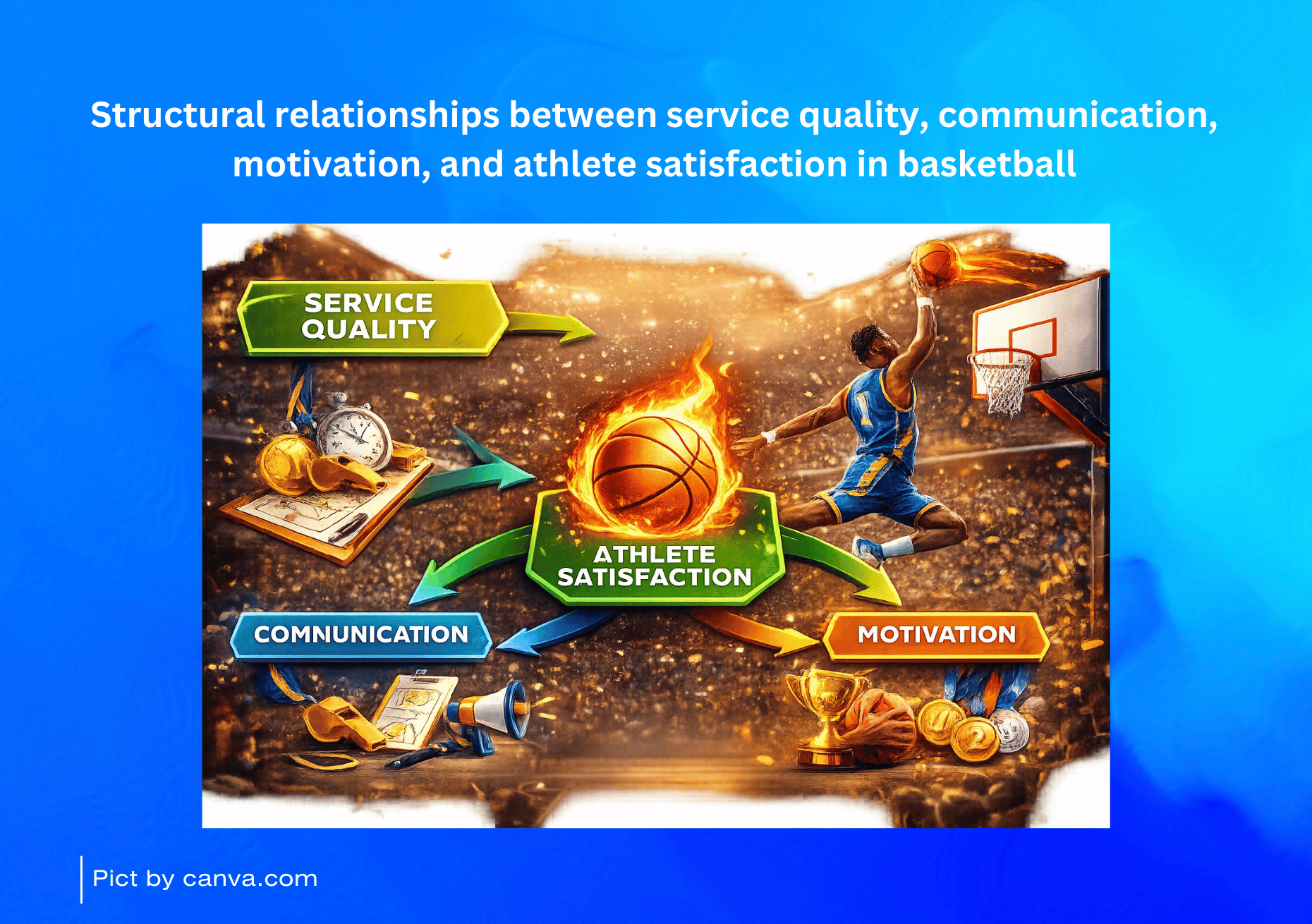
Structural relationships between service quality, communication, motivation, and athlete satisfaction in basketball Indonesia
Fajar Gumilang H.M1, Agung Nugroho2, Rumpis Agus Sudarko3, Fauzi Fauzi4, Fajar Sriwahyuniati51. Yogyakarta State University , ID2. Yogyakarta State University , ID3. Yogyakarta State University , ID4. Yogyakarta State University , ID5. Yogyakarta State University , ID2026-04-09|page 113-124AbstractBackground: Many basketball clubs aim to enhance athlete satisfaction through service quality, communication, and motivation; however, empirical evidence validating these factors as measurable constructs remains limited.
Objectives: This study examines whether these variables function as latent constructs influencing athlete satisfaction and validates their measurement structure using confirmatory factor analysis.
Methods: This study used a quantitative survey and included 263 basketball athletes from various clubs in Sidoarjo, comprising 110 males and 153 females. The participant characteristics focused on players still in the developmental stage who had been actively participating in club training programs for 3 to 6 months, with educational levels ranging from junior high school to college. Participants were selected using purposive sampling. Data were collected using a valid and reliable Likert-scale questionnaire and analyzed using Structural Equation Modeling (SEM) via AMOS 22.
Results: The results demonstrate that service quality (β=0.337, ????=0.000) and communication (β=0.439, ????=0.000) significantly enhance motivation. Furthermore, motivation significantly affects athlete satisfaction (β = 0.582, ???? = 0.000). Crucially, the analysis confirms that motivation mediates the relationship between service quality (indirect effect=0.139) and communication (indirect effect=0.240) on satisfaction.
Conclusions: Theoretically, this study confirms motivation as a vital psychological mediator linking managerial inputs to athlete satisfaction. In practice, the findings demonstrate that while high-quality physical facilities provide a necessary structural foundation, they must be integrated with effective, supportive coaching communication to optimally ignite athletes' intrinsic drive and maximize their overall club experience.APA Citation StyleH.M, F. G. , Nugroho, A. , Sudarko, R. A. , Fauzi, F. , & Sriwahyuniati, F. (2026). Structural relationships between service quality, communication, motivation, and athlete satisfaction in basketball: Indonesia. Physical Education and Sports: Studies and Research, 113-124. https://doi.org/10.56003/pessr.v5i1.691 -

Out-of-Field Public Senior High School Teachers: Competencies in Teaching Physical Education
John Clark Martos Mesias11. Burauen Comprehensive National High School, Leyte Division , PH2022-10-28|page 123-135AbstractBackground: Making sure that Physical Education (PE) classes are staffed with qualified and trained PE teacher is the most indispensable ingredient to a quality PE program. Only certified PE teachers should be given the accountability of teaching the skills and giving instruction that our young people need to adopt and maintain a physically active routine.
Objectives: The purpose of this qualitative study was to draw out the lived experiences of out-of-field public Senior High School teachers on teaching Physical Education, identify the trainings and seminars’ relevant to their professional development and advancement.
Methods: Through the descriptive narrative method, 22 out-of-field public senior high school teachers who were teaching PE from Areas 2A and 2B in Leyte Division served as participants and results derived from the interviews were coded and transcribed to come up with themes and sub-themes that follows: content knowledge with sub-themes; mastery of skills taught, sports-related trainings and dance pedagogy; pedagogical skills with sub-themes promotion of cooperative learning, stimulation of assigning leaders per group activities, inclusion of appropriate assessment tool or rubrics, and assurance of learners’ safety.
Results: The study confirms that mastery of subject discipline is essential to a teacher. Teaching PE subjects is more than the theory; it delves more on skills demonstration and acquisition. If teachers are expert in the field they teach, they can demonstrate the skills, clearly answer students’ questions, and lessen the workload as they have but minor adjustment as far as the subject matter is concerned.
Conclusion: This study confirms that mastery of the content is essential in the teaching-learning process. Teaching PE subjects is not all about imparting the content of the subject theoretically; it more on skills demonstration and acquisition.
APA Citation StyleMesias, J. C. M. (2022). Out-of-Field Public Senior High School Teachers: Competencies in Teaching Physical Education. Physical Education and Sports: Studies and Research, 123-135. https://doi.org/10.56003/pessr.v1i2.137

1 - 6 of 6 items




















