
Search
Search Results
##search.searchResults.foundPlural##
-


Unveiling the digital gym: A phenomenological dive into online physical education pedagogy
Princes Lloyda Peralta11. Saint Louis College , PH2025-04-04|page 15-31AbstractBackground: The COVID-19 pandemic necessitated a rapid shift to online learning, posing significant challenges for traditionally hands-on subjects like Physical Education (PE). Limited student engagement, digital accessibility issues, and the need for pedagogical adaptation became major concerns for PE instructors.
Objectives: This study aims to explore the lived experiences of PE instructors in adapting to online instruction, identifying the strategies, challenges, and innovations they employed to maintain instructional effectiveness.
Methods: A qualitative research design utilizing Interpretative Phenomenological Analysis (IPA) was adopted to gain deep insights into instructors’ experiences. Purposive sampling was used to select seven PE instructors from urban and rural institutions, ensuring diverse teaching contexts. Data were collected through semi-structured interviews, and thematic analysis was conducted to identify key adaptation strategies.
Results: Five major themes emerged from the findings: (1) Adaptation to Online Instruction, where instructors restructured their teaching approaches to accommodate digital platforms; (2) Effective Use of Digital Tools, emphasizing the role of online resources in enhancing instructional delivery; (3) Innovative Approaches to Engagement, detailing gamification techniques and interactive pedagogies; (4) Equitable Access Strategies, addressing disparities in internet connectivity and learning resources; and (5) Assessment of Success and Progress, highlighting novel evaluation methods tailored for online PE instruction. These themes collectively form the "Navigating Instructional Delivery Through Innovation, Technology, Engagement, and Equity" framework.
Conclusions: The study provides valuable insights into how PE instructors have innovatively adapted to online learning, ensuring student engagement and equitable access to education. The findings offer implications for policy-making, teacher training programs, and the future integration of technology in PE instruction. Future research should explore student perspectives and the long-term impact of digital PE on learning outcomes.
APA Citation StylePeralta, P. L. (2025). Unveiling the digital gym: A phenomenological dive into online physical education pedagogy. Physical Education and Sports: Studies and Research, 15-31. https://doi.org/10.56003/pessr.v4i1.474 -
Teaching personal and social responsibility: An analysis of TPSR-based behaviors in physical education
Rama Adha Septiana1, Tite Juliantine21. Indonesia University of Education , ID2. Indonesia University of Education , ID2025-12-30|page 332-343AbstractBackground: The rapid growth of online gaming among students has raised concerns regarding behavioral regulation, responsibility, and social interaction in educational contexts.
Objectives: This study aims to systematically review empirical research on the Teaching Personal and Social Responsibility (TPSR) model and student behavioral outcomes, and to explore its potential implications for online gaming and digital behavior contexts.
Methods: A literature review was conducted using SAGE Journals and Taylor & Francis Online databases, selected due to their strong coverage of peer-reviewed research relevant to physical education and pedagogy. The search covered publications from 2014 to 2024 using the keywords “TPSR” AND “student” AND “behavior” AND (“online game” OR “gaming”). Inclusion criteria were: (1) peer-reviewed international journal articles, (2) empirical or review studies addressing TPSR and student behavior, (3) student populations, and (4) publication within the last ten years. Articles that did not explicitly address TPSR-based behavioral outcomes were excluded. From 43 initial records, 4 articles met the inclusion criteria and were synthesized using narrative synthesis.
Results: The included studies primarily focused on TPSR implementation in physical education contexts, emphasizing behavioral responsibility, psychosocial mechanisms, and pedagogical approaches. Of the four studies, two employed quasi-experimental designs, one used survey methods, and one adopted a literature review approach. Overall, the findings indicate that TPSR-based learning is associated with improvements in personal and social responsibility, positive behavior regulation, and supportive learning climates, although direct evidence linking TPSR to online gaming behavior remains limited.
Conclusions: The findings suggest that TPSR offers a promising pedagogical framework for fostering responsible behavior and social regulation among students in the digital era.APA Citation StyleSeptiana, R. A. , & Juliantine, T. (2025). Teaching personal and social responsibility: An analysis of TPSR-based behaviors in physical education. Physical Education and Sports: Studies and Research, 332-343. https://doi.org/10.56003/pessr.v4i3.647 -

Fun game–based learning improves gross motor skills in early primary school children
Ahmad Muttaqin Darussalam1, Sugiharto Sugiharto2, Sapto Adi31. State University of Malang , ID2. State University of Malang , ID3. State University of Malang , ID2025-11-23|page 236-249AbstractBackground: Children who face difficulties in gross motor skill development may withdraw from physical activities, experience low self-esteem, and suffer from social anxiety. Physical education plays a vital role in fostering gross motor development, especially when delivered through enjoyable and engaging activities such as fun games.
Objectives: This study aimed to investigate the impact of fun game–based learning on the development of gross motor skills in early primary school children.
Methods: The study employed a quasi-experimental design with a non-equivalent control group. A total of 36 second-grade students from SDIT Mutiara Hati in Malang participated in this study. Participants were assigned to one of three groups: a control group, a group-based fun games intervention, and an individual-based fun games intervention. The interventions were implemented three times a week for 30 minutes over a period of seven weeks. Gross motor skills were measured before and after the intervention using the Test of Gross Motor Development–Third Edition (TGMD-3), a reliable and validated instrument. Data were analyzed using homogeneity and normality tests, paired-sample t-tests, one-way ANOVA, and Tukey's HSD post hoc tests, with a significance level set at p < 0.05 (SPSS version 25).
Results: Both the individual and group fun game–based learning interventions produced significant improvements in gross motor skills compared with the control group (p < 0.05). Moreover, a significant difference was found between the two intervention types, indicating that the mode of fun game delivery influences outcomes (p < 0.05).
Conclusions: Fun game–based learning, whether delivered individually or in groups, effectively enhances gross motor skills among early primary school children. Additionally, individual fun game–based learning demonstrated a significantly greater improvement compared to group-based learning.APA Citation StyleDarussalam, A. M. , Sugiharto, S. , & Adi, S. (2025). Fun game–based learning improves gross motor skills in early primary school children. Physical Education and Sports: Studies and Research, 236-249. https://doi.org/10.56003/pessr.v4i3.613 -
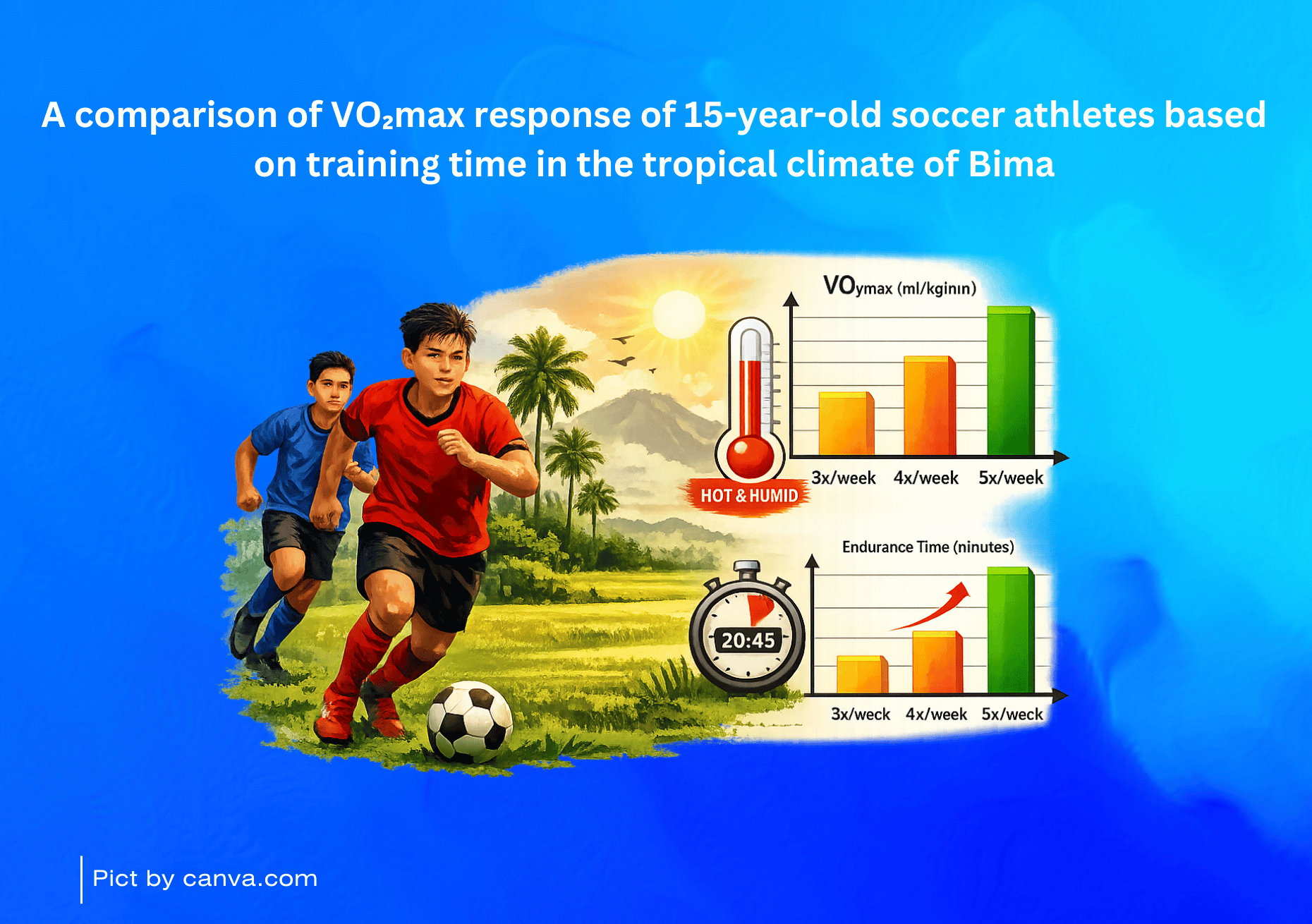
A comparison of VO₂max response of 15-year-old soccer athletes based on training time in the tropical climate of Bima
Firdaus Firdaus1, Taty Hartati2, Rabwan Satriawan3, Shutan Arie Shandi4, Nor Fazila Abd Malek51. Department of Physical Education, STKIP Taman Siswa Bima , ID2. Department of History, STKIP Taman Siswa Bima , ID3. Department of Physical Education, STKIP Taman Siswa Bima , ID4. Department of Physical Education, STKIP Taman Siswa Bima , ID5. Faculty of Sports Science and Coaching, Sultan Idris Education University , MY2026-04-14|page 125-134AbstractBackground: VO₂max is the primary indicator of a soccer athlete's aerobic capacity, but in tropical climates like Bima, high temperatures and humidity can affect VO₂max achievement. Hence, the timing of training is an important factor to consider.
Objectives: This study aims to analyze differences in VO₂max across training times (morning and afternoon) in 15-year-old youth soccer athletes from the Bima Football Association (PERSSEBI).
Methods: The study used a quantitative, comparative, cross-sectional observational design. The study subjects were 45 athletes (age 15.31±0.46; height 163.12±4.35 cm; weight 55.28±3.67 kg; and body mass index (BMI) 20.78±1.18 kg/m²) from the Bima Football Association (PERSEBI), selected by purposive sampling, and divided into morning (n=23) and afternoon (n=22) training groups. VO₂max was measured using a multistage fitness test (Bleep Test). Data analysis included descriptive statistics, the Shapiro–Wilk normality test, the Levene homogeneity test, and the independent-samples t-test at a significance level of 0.05, using IBM SPSS 25.
Results: The descriptive analysis showed that the average VO₂max of the morning group was 43.78 ± 2.34 ml/kg/minute, higher than that of the afternoon group (42.91 ± 2.29 ml/kg/minute). The results of the independent sample t-test showed that there was a significant difference in VO₂max between the two groups with a t value = 2.14 with df = 43 and a significant p value = 0.04 (p < 0.05) with an average difference of 0.87 ml/kg/minute indicating that the morning exercise group had a higher Vo2max value than the afternoon exercise group.
Conclusions: These findings suggest that training time contributes to differences in athletes' VO₂max values in tropical environments, with morning training resulting in higher performance than afternoon training. Therefore, scheduling training that accounts for environmental conditions is crucial for optimizing athletes' VO₂max.
APA Citation StyleFirdaus, F. , Hartati, T. , Satriawan, R. , Shandi, S. A. , & Malek, N. F. A. (2026). A comparison of VO₂max response of 15-year-old soccer athletes based on training time in the tropical climate of Bima. Physical Education and Sports: Studies and Research, 125-134. https://doi.org/10.56003/pessr.v5i1.709

1 - 4 of 4 items




















