Search
Search Results
##search.searchResults.foundPlural##
-

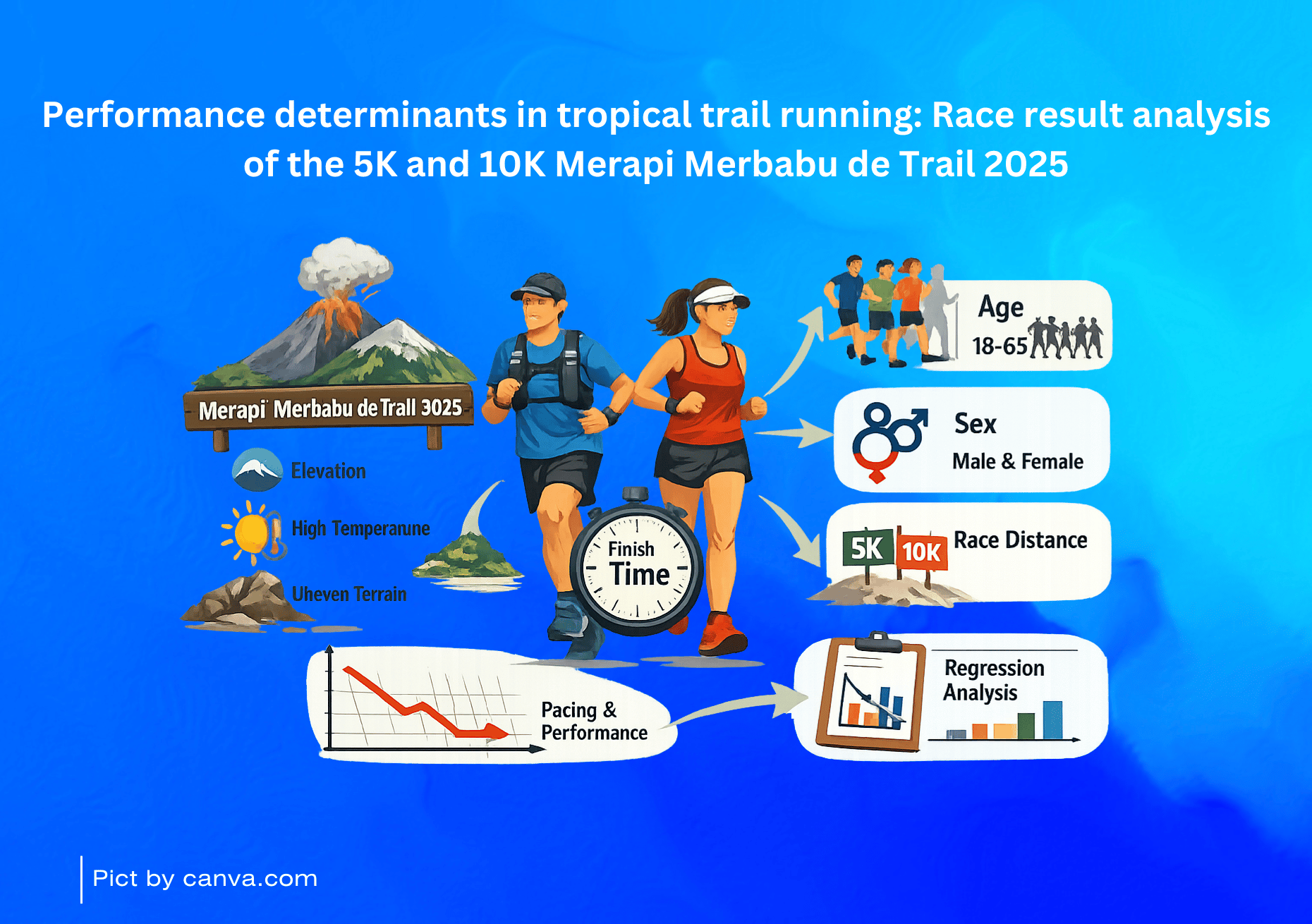
Performance determinants in tropical trail running: Race result analysis of the 5K and 10K Merapi Merbabu de Trail 2025
Siti Baitul Mukarromah1, Sugiarto Sugiarto2, Gustiana Mega Anggita3, Sri Agus Budi Santoso4, Sangheon Park5, Ambar Dwi Erawati6, Rikha Liemiyah7, Aziiz Mardanarian Rosdianto8, Ronny Lesmana9, Faisyal Syofian101. State University of Semarang , ID2. State University of Semarang , ID3. State University of Semarang , ID4. Tarra Adventure, Boyolali Regency, Central Java Province , ID5. Korea Institute of Sport Science, Seoul , KR6. Widya Husada Semarang University , ID7. Universitas Dian Nuswantoro , ID8. Universitas Padjajaran , ID9. Universitas Padjajaran , ID10. Sultan Agung Islamic University , ID2026-04-03|page 82-92AbstractBackground: The limited research on the determinants of performance in short-distance trail running in tropical environments is a major problem in understanding the influence of environmental conditions on runners' performance and pacing strategies.
Objectives: This study aimed to examine the influence of race distance, sex, and age on trail running performance in the 5K and 10K categories of the Merapi Merbabu de Trail 2025.
Methods: A retrospective observational race result analysis was conducted using official race data from the Merapi Merbabu de Trail 2025. The study included 429 runners (5K: n = 144; 10K: n = 285), consisting of 275 male and 154 female participants. The primary outcome variable was finish time (in minutes), while the independent variables included race, distance, sex, and age. Statistical analyses were performed using SPSS version 26, including descriptive statistics, independent-samples t-tests, Cohen’s d effect sizes, and multiple linear regression to evaluate predictors of performance.
Results: Results showed a significant difference in performance between race distances. The mean finish time for the 5K category was 152.8 ± 44.3 minutes, while the 10K category averaged 306.1 ± 74.3 minutes (t = -26.68, p < 0.001, Cohen’s d = 2.50). Male runners completed the 10K race faster than female runners (293 vs. 345 minutes). Regression analysis indicated that finish time increased by approximately 2–3 minutes per year of age, indicating a progressive decline in performance with increasing age.
Conclusions: These findings indicate that race distance, sex, and age are significant determinants of trail running performance in tropical environments.APA Citation StyleMukarromah, S. B. , Sugiarto, S. , Anggita, G. M. , Santoso, S. A. B. , Park, S. , Erawati, A. D. , Liemiyah, R. , Rosdianto, A. M. , Lesmana, R. , & Syofian, F. (2026). Performance determinants in tropical trail running: Race result analysis of the 5K and 10K Merapi Merbabu de Trail 2025. Physical Education and Sports: Studies and Research, 82-92. https://doi.org/10.56003/pessr.v5i1.699 -
Examining the mediating role of perceived psychosocial support in the relationship between sport grit and psychological well-being among high school student-athletes
Daphne Scott Fernandez1, Kahreen Lou Mondina21. Saint Louis College La Union,Saint Louis College La Union , PH2. Saint Louis College La Union,Saint Louis College La Union , PH2026-08-01|page 182-195AbstractBackground: Psychological well-being is essential for student-athletes because they must simultaneously cope with competitive sport demands and academic responsibilities. Although both sport grit and perceived psychosocial support have been associated with positive psychological outcomes, the mediating role of psychosocial support in the relationship between sport grit and psychological well-being remains insufficiently understood.
Objectives: This study examined whether perceived psychosocial support mediates the relationship between sport grit and psychological well-being among high school student-athletes.
Methods: A quantitative cross-sectional correlational design with a mediation analysis framework was employed. A total of 362 high school student-athletes from the first district of La Union, Philippines, participated using total enumeration sampling. Data were collected using standardized questionnaires assessing sport grit, psychological well-being, and perceived psychosocial support. Descriptive statistics, regression analysis, and bias-corrected bootstrap mediation analysis (5,000 resamples) were performed using JASP.
Results: Student-athletes reported high levels of sport grit, psychological well-being, and perceived psychosocial support. Sport grit significantly and positively predicted psychological well-being, whereas it did not significantly predict perceived psychosocial support. Perceived psychosocial support demonstrated a significant but negative association with psychological well-being. Furthermore, the indirect effect of sport grit on psychological well-being through perceived psychosocial support was not statistically significant, indicating the absence of a mediating effect.
Conclusions: Sport grit is an important direct psychological resource associated with psychological well-being among high school student-athletes. Although perceived psychosocial support contributes to athletes' psychological functioning, it does not explain the relationship between sport grit and psychological well-being. These findings highlight the importance of strengthening athletes' internal psychological resources while maintaining supportive sport environments.
APA Citation StyleFernandez, D. S. , & Mondina, K. L. (2026). Examining the mediating role of perceived psychosocial support in the relationship between sport grit and psychological well-being among high school student-athletes. Physical Education and Sports: Studies and Research, 182-195. https://doi.org/10.56003/pessr.v5i2.725 -

A Modern Pedagogical Approach in The Subject of Physical Education
Ferdinando Cereda11. The Catholic University of the Sacred Heart in Milan , IT2023-10-31|page 126-141AbstractBackground: The pedagogical paradigm (PP) is a complex framework encompassing various pedagogical elements integral to the instructional and educational process. These paradigms manifest in diverse forms without entirely replacing their precursor frameworks, as they are built upon established principles and concepts. Understanding the architectural structure of each paradigm is crucial in distinguishing these pedagogical models.
Objective: This exposition aims to provide a rationale for the integration of the pedagogical paradigm within the realm of PE.
Methods: In the literature review, the EBSCO database was utilized via SPORTDiscus. This theoretical review draws upon various scholarly sources, including Taylor and Francis, ERIC, Scopus, Google Scholar These repositories provide a global perspective, with the majority of references selected from the decade leading up to the onset of the pandemic.
Results: The literature analysis reveals the intricate nature of pedagogical paradigms and their importance in the field of PE. It underscores the need for instructors to adapt their teaching approaches to meet the specific needs of students based on their age and developmental stage. The integration of the pedagogical paradigm within PE is proposed as a valuable concept to enhance the quality of physical education programs.
Conclusion: The incorporation of the PP into the domain of PE holds promise for improving the effectiveness of PE instruction. This review, based on a thorough examination of pertinent literature, highlights the relevance of PP in adapting teaching methodologies to suit the diverse needs of students. While this study does not provide empirical evidence, it lays the theoretical groundwork for future research and practical applications in the field of PE. Further investigations and practical implementations are warranted to assess the feasibility and benefits of incorporating PP within PE instruction.
APA Citation StyleCereda, F. (2023). A Modern Pedagogical Approach in The Subject of Physical Education. Physical Education and Sports: Studies and Research, 126-141. https://doi.org/10.56003/pessr.v2i2.265 -
The Effect of Project Based Learning Assisted with Flashcards towards Students’ Learning Outcomes in Learning Pencak Silat
I Gede Suwiwa1, I Ketut Budaya Astra2, I Ketut Yoda3, I Made Satyawan41. Ganesha University of Education , ID2. Ganesha University of Education , ID3. Ganesha University of Education , ID4. Ganesha University of Education , ID2023-10-31|page 72-82AbstractBackground: Motion-based learning, especially Pencak Silat material taught at the Senior High School level always presents challenges for Physical Education (PE) Teachers.
Objectives: This study aimed to investigate the effect of project-based learning assisted with flashcards on students’ learning outcomes in learning Pencak Silat.
Methods: Quasi-experimental was used as a research design by conducting pretest and posttest. There were 312 eleventh-grade students in this study, which was conducted at Senior High School of Laboratorium Universitas Pendidikan Ganesha (Undiksha) and Senior High School 1 Sukasada. A simple random sampling technique was performed to select the sample of this study. One hundred twenty students were chosen as a research sample and divided into experimental and control groups. The data were collected by conducting pre-tests and post-tests. The instrument used in this study was the basic attitudes test of Pencak Silat. The collected data were analyzed quantitatively through inferential statistics (independent sample t-test) with the assistance of SPSS 22.
Results: The results showed a significant difference between the post-test gained by the experimental group treated by project-based learning assisted with flashcards and the control group treated by conventional education. Sig proved it. (2-tailed) the post-test data was 0.01, indicating that the significant value was less than 0.05 as consideration. The effect size found through the calculation of Eta Squared proposed by Cohen was 0.08, categorized as a high level.
Conclusion: It could be concluded that there was an effect of project-based learning assisted with flashcards towards students’ learning outcomes in learning Pencak Silat since this study is focused on learning.
APA Citation StyleSuwiwa, I. G. , Astra, I. K. B. , Yoda, I. K. , & Satyawan, I. M. (2023). The Effect of Project Based Learning Assisted with Flashcards towards Students’ Learning Outcomes in Learning Pencak Silat. Physical Education and Sports: Studies and Research, 72-82. https://doi.org/10.56003/pessr.v2i2.235