
Search
Search Results
##search.searchResults.foundPlural##
-

Impact of five-cone and ladder drill training on agility among U15 football athletes
Pupuh Harya Prembanyu1, Agus Wiyanto2, Setiyawan Setiyawan31. Universitas PGRI Semarang , ID2. Universitas PGRI Semarang , ID3. Universitas PGRI Semarang , ID2025-11-26|page 266-274AbstractBackground: Although it may seem simple, soccer has complex characteristics, which is why many children are attracted to training at soccer schools. Agility is a crucial aspect of the game, as it enables a player to move quickly, evade opponents, and control the ball effectively. At the Pemalang Regency Bina Talenta Soccer School (SSB), agility training is not conducted optimally and has not been implemented systematically with effective methods. Therefore, exercises such as the five-cone and ladder drills need to be implemented to improve player agility more effectively.
Objectives: This study aims to examine the impact of five-cone and ladder drill training on the agility of U15 football athletes.
Methods: This study used a quantitative descriptive method with a quasi-experimental approach. The experimental design was a pretest-posttest in two groups. The sampling technique used was purposive sampling with 20 players participating in a four-week training program. The instrument to measure agility was the Illinois Agility Test, with a validity level of r = 0.87. The measurement data were analyzed using a difference test with the help of SPSS software version 29.0.
Results: The five-cone drill and the ladder drill had a significant effect on agility, as both exercises had a significance value of <0.05. The five-cone drill was more effective than the ladder drill. This was due to the difference in scores between the five-cone drill, which increased by 1.04, and the ladder drill, which increased by 0.84.
Conclusions: Both training methods are effective in improving agility and can be integrated into school-based football training programs. Furthermore, the results of implementing these methods can enhance player performance and provide a valuable source of new knowledge for future researchers on agility in SSB players.
APA Citation StylePrembanyu, P. H. , Wiyanto, A. , & Setiyawan, S. (2025). Impact of five-cone and ladder drill training on agility among U15 football athletes. Physical Education and Sports: Studies and Research, 266-274. https://doi.org/10.56003/pessr.v4i3.633 -

An analysis of anxiety levels among volleyball athletes during a provincial inter-club tournament in Jakarta, Indonesia
Rea Rizkita Raga1, Yunita Lasma21. Universitas Islam 45 Bekasi , ID2. Universitas Islam 45 Bekasi , ID2025-07-27|page 175-185AbstractBackground: Competitive anxiety is a key psychological factor that can significantly affect an athlete's performance. In volleyball, high-pressure situations often lead to anxiety, potentially hindering players' ability to perform optimally.
Objectives: This study aims to assess the levels of anxiety experienced by volleyball athletes competing in the Special Capital Region Jakarta Inter-Club Provincial Championship.
Methods: A descriptive quantitative design was used, with data collected through a survey involving 70 volleyball athletes. The instrument used was a 35-item anxiety questionnaire categorized into two phases: before the match (18 items) and during the match (17 items). Responses were measured using a 5-point Likert scale. Validity testing confirmed all items were valid, and the instrument showed high reliability (α = 0.954), as analyzed using SPSS 23.
Results: During the match, 35.7% of athletes experienced high anxiety, while 64.3% showed low anxiety. Prior to the match, 44.3% reported high anxiety and 55.7% reported low anxiety. Overall, 36.6% of athletes showed high anxiety levels, while 61.4% displayed low levels. These results indicate that most athletes have relatively good emotional regulation abilities in competitive situations.
Conclusions: The study underscores the critical role of psychological readiness in athletic performance. Coaches and policymakers are encouraged to integrate structured mental training programs into athlete development. Future research should explore variables contributing to anxiety, such as playing position, competitive experience, and demographic factors like age and gender.
APA Citation StyleRaga, R. R. , & Lasma, Y. (2025). An analysis of anxiety levels among volleyball athletes during a provincial inter-club tournament in Jakarta, Indonesia. Physical Education and Sports: Studies and Research, 175-185. https://doi.org/10.56003/pessr.v4i2.605 -
Associations of lower limb muscle strength and body reaction time with crescent kick performance in competitive pencak silat athletes
Jery Setiawan1, Siti Baitul Mukarromah21. State University of Semarang , ID2. State University of Semarang , ID2026-08-17|page 208-219AbstractBackground: Crescent kick performance is an important technical component of competitive pencak silat and may be associated with physical capacities such as lower limb muscle strength and reaction time. However, evidence regarding the relationships of these physical characteristics with crescent kick performance remains limited.
Objectives: This study aimed to examine the associations of lower limb muscle strength and body reaction time with crescent kick performance among competitive pencak silat athletes.
Methods: This quantitative correlational study involved 30 competitive pencak silat athletes (age: 19.8 ± 2.1 years; height: 168.4 ± 6.3 cm; body mass: 61.7 ± 8.2 kg; body mass index: 21.7 ± 2.3 kg/m²) recruited using total sampling. Lower limb muscle strength was assessed using a leg dynamometer, body reaction time using a reaction timer, and crescent kick performance using a 10-second crescent kick test. Data were analyzed using descriptive statistics, Pearson correlation, and multiple correlation analysis, with statistical significance set at p < .05.
Results: Lower limb muscle strength was positively associated with crescent kick performance (r = 0.734, p < .001), whereas body reaction time was negatively associated with crescent kick performance (r = -0.739, p < .001), indicating that shorter reaction times were associated with better kick performance. Multiple correlation analysis showed a strong combined association of lower limb muscle strength and body reaction time with crescent kick performance (R = 0.754, R² = 0.568, p < .001). Together, these variables accounted for 56.8% of the variance in crescent kick performance.
Conclusions: Greater lower limb muscle strength and shorter body reaction time were associated with better crescent kick performance among competitive pencak silat athletes. These findings highlight the relevance of muscular strength and neuromuscular responsiveness to crescent kick performance and may inform physical conditioning programs for pencak silat athletes. Further studies with larger samples and additional biomechanical, physiological, and technical measures are needed to better understand the factors associated with crescent kick performance.
APA Citation StyleSetiawan, J. , & Mukarromah, S. B. (2026). Associations of lower limb muscle strength and body reaction time with crescent kick performance in competitive pencak silat athletes. Physical Education and Sports: Studies and Research, 208-219. https://doi.org/10.56003/pessr.v5i2.762 -
Effectiveness of adding single leg hop training to wobble board training in improving dynamic balance and lower limb explosive power in 13–14-year-old basketball players: A randomized controlled trial
Lanang Imam Herlambang1, I Made Muliarta2, Wahyuddin Wahyuddin31. Master's Program in Sport Physiology, Faculty of Medicine, Universitas Udayana , ID2. Master's Program in Sport Physiology, Faculty of Medicine, Universitas Udayana , ID3. Faculty of Physiotherapy, Universitas Esa Unggul , ID2026-09-07|page 248-263AbstractBackground: Dynamic balance and lower-limb explosive power are important for youth basketball performance. Wobble board training may improve postural control, while single leg hop exercises may provide additional benefits through dynamic unilateral loading. However, evidence regarding their combined effects in adolescent basketball players remains limited.
Objective: To determine whether adding single leg hop training to wobble board training produces greater improvements in dynamic balance and lower-limb explosive power than wobble board training alone in 13–14-year-old basketball players.
Methods: This randomized controlled trial included 40 players randomly allocated (1:1) to wobble board training (control; n = 20) or combined wobble board and single leg hop training (experimental; n = 20). Both groups trained for six weeks, three 30-minute sessions per week. Dynamic balance (primary outcome) and lower-limb explosive power (secondary outcome) were assessed using the Y-Balance Test (YBT) and Vertical Jump Test (VJT), respectively. Within- and between-group changes were analysed using paired- and independent-samples t-tests (α = 0.05).
Results: All participants completed the intervention. Both groups improved significantly in YBT and VJT performance (p < 0.001). The experimental group showed greater improvements in YBT (mean change: 15.32 vs 5.23 cm; mean difference = 10.08 cm; 95% CI [7.73, 12.43]; p < 0.001; d = 2.75) and VJT (5.75 vs 0.82 cm; mean difference = 4.94 cm; 95% CI [4.22, 5.66]; p < 0.001; d = 4.41).
Conclusion: Adding single leg hop training to wobble board training produced greater improvements in dynamic balance and lower-limb explosive power. However, the findings do not establish an isolated single-leg-hop effect or injury-prevention benefit.
APA Citation StyleHerlambang, L. I. , Muliarta, I. M. , & Wahyuddin, W. (2026). Effectiveness of adding single leg hop training to wobble board training in improving dynamic balance and lower limb explosive power in 13–14-year-old basketball players: A randomized controlled trial. Physical Education and Sports: Studies and Research, 248-263. https://journal.rezkimedia.or.id/pes/article/view/760 -
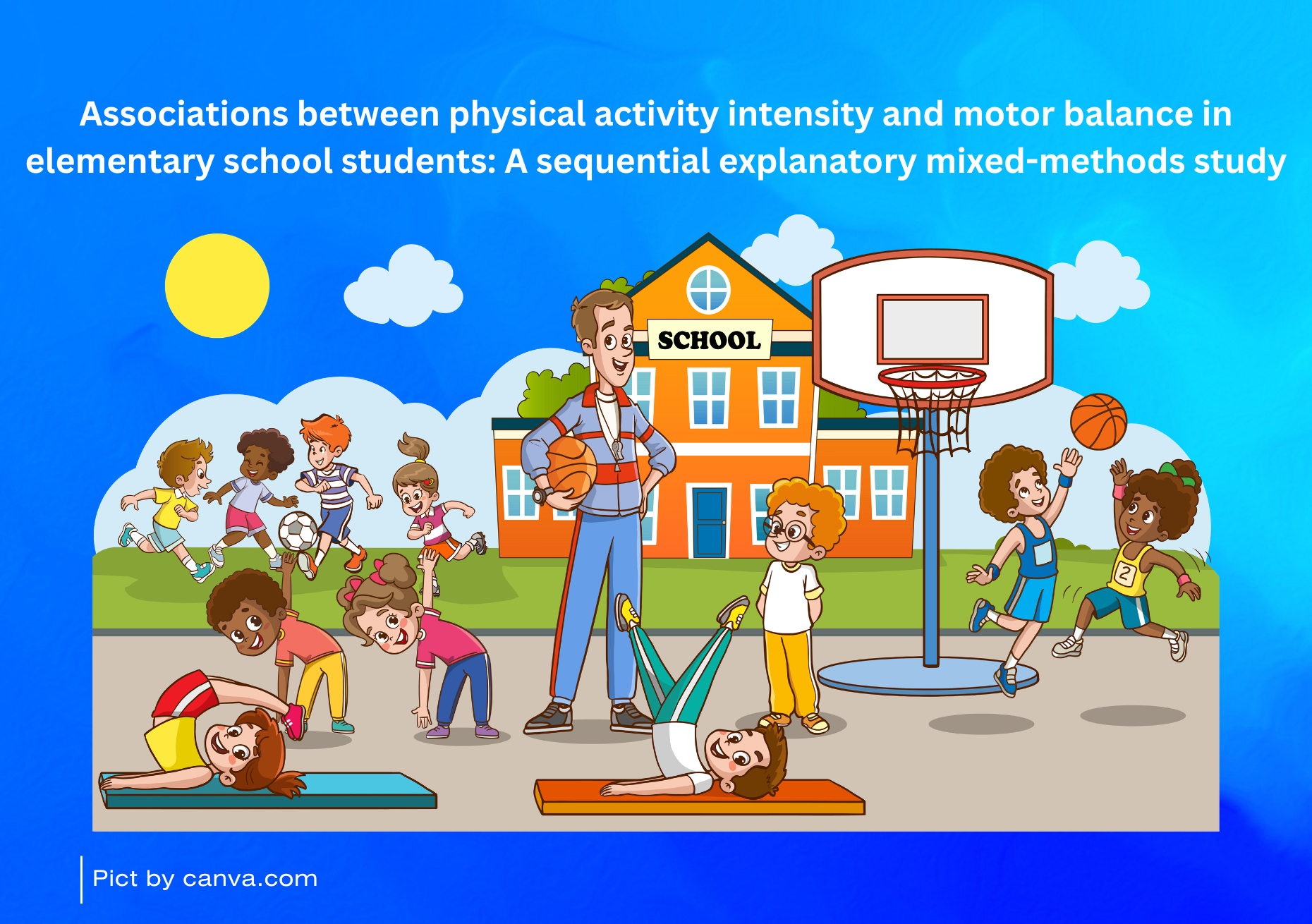
Associations between physical activity intensity and motor balance in elementary school students: A sequential explanatory mixed-methods study
Fahrurrohman Firdaus1, Indra Safari2, Rizal Ahmad Fauzi31. Indonesian University of Education , ID2. Indonesian University of Education , ID3. Indonesian University of Education , ID2026-04-01|page 47-56AbstractBackground: Children in primary school are becoming more sedentary due to advances in digital technology, which may reduce their physical activity levels. The development of motor skills, especially balance, which is an essential feature of children's motor abilities, can be impacted by a lack of physical activity.
Objectives: This study aimed to examine the association between physical activity intensity and motor balance in elementary school students.
Methods: This study used a sequential explanatory mixed-methods design. The quantitative phase involved 50 students selected using saturated sampling, while the qualitative phase involved teachers and students selected purposively. Physical activity intensity was measured using the Physical Activity Questionnaire for Older Children (PAQ-C), while motor balance was assessed using the Balance Beam Test. Quantitative data were analyzed using Spearman's rank correlation, and qualitative data were analyzed using thematic analysis in NVivo.
Results: With a correlation coefficient of r = 0.687 and p < 0.05, the analysis demonstrated a strong, substantial positive link between motor balance levels and physical activity intensity. The intensity of physical activity accounted for 47.2% of motor balance. Qualitative research revealed that students with high levels of physical activity were more likely to engage in active play, such as running outside, cycling, and soccer, which, in turn, indirectly improve balance and postural stability.
Conclusions: This study demonstrates that physical activity intensity plays an important role in the development of motor balance among elementary school students. These findings highlight the importance of integrating active movement-based learning strategies in physical education programs.
APA Citation StyleFirdaus, F. , Safari, I. , & Fauzi, R. A. (2026). Associations between physical activity intensity and motor balance in elementary school students: A sequential explanatory mixed-methods study. Physical Education and Sports: Studies and Research, 47-56. https://doi.org/10.56003/pessr.v5i1.706 -
The Relationship of Sports Participation in Academic Performance among College of Arts and Sciences Varsity Players
John Michael Aquino1, Mary Grace Reyes21. Laguna State Polytechnic University , PH2. Laguna State Polytechnic University , PH2022-09-10|page 107-122AbstractBackground: Sports are featured in the curriculums of state universities and colleges (SUCs). The Laguna State Polytechnic University (LSPU) shines in sports competition throughout Region IV, and the College of Arts and Sciences (CAS) varsity athletes are actively engaging in this sports competition. Nevertheless, during the previous decade, the CAS had been routinely rated third to fifth in intramurals.
Objectives: The researcher wish to ascertain the embodiment of CAS student athletes' experiences in sports involvement and academic performances to discover the significance of participation in sports and academic performance of students. The findings serve as the foundation for crafting Student Intervention Program.
Methods: The descriptive survey approach was used to a total of 30 varsity players in CAS from the 5 programs. The Cronbach alpha was utilized to assess the overall consistency of the self-made instrument and was carried out to CAS students belong to the varsity team using an internet web service.
Results: It was established that the student-athletes felt that all the assertions were evaluated as great in the university, especially in CAS, indicating satisfaction with the university's operations. Consequently, athletes excel in both athletics and academics.
Conclusion: It was notably that CAS varsity players were deemed to be great by the student-athletes. Respondents were happy with the university's procedures as viewed and experienced in prior sports competitions held not just within the LSPU System but also at the Regional STRASUC or even National SCUAA. Students participating in sports are much more likely to excel academically.
APA Citation StyleAquino, J. M. , & Reyes, M. G. (2022). The Relationship of Sports Participation in Academic Performance among College of Arts and Sciences Varsity Players. Physical Education and Sports: Studies and Research, 107-122. https://doi.org/10.56003/pessr.v1i2.129





















