
Search
Search Results
##search.searchResults.foundPlural##
-


A critical analysis of the disconnection between science and practice in weight training
Ferdinando Cereda11. The Catholic University of the Sacred Heart in Milan , IT2025-04-07|page 46-59AbstractBackground: Resistance training (RT) has emerged as a powerful tool for health promotion, with substantial scientific evidence supporting its beneficial effects across multiple physiological systems and psychological domains. Despite this robust knowledge base, a significant disconnection persists between scientific evidence and practical implementation in both clinical and everyday settings.
Objectives: This study aims to critically examine this science-practice gap by analyzing common misconceptions surrounding RT and proposing strategies to enhance knowledge translation.
Methods: Through a narrative review of scientific literature from PubMed, Scopus, and Google Scholar, the research synthesizes evidence regarding RT's scientifically validated benefits, prevalent myths, and effective communication approaches.
Results: Findings show a concerning lack of scientific awareness among practitioners and end-users. Persistent misconceptions, such as "RT reduces flexibility" and "plant-based proteins are inferior for muscle hypertrophy," continue to circulate despite contradictory evidence.
Conclusions: Improved scientific communication via targeted educational programs, digital platforms, and collaboration between researchers and policymakers is urgently needed to bridge this gap and maximize RT’s public health impact.
APA Citation StyleCereda, F. (2025). A critical analysis of the disconnection between science and practice in weight training. Physical Education and Sports: Studies and Research, 46-59. https://doi.org/10.56003/pessr.v4i1.499 -
A domain-specific peer-review checklist for sport science journals: Translating a conceptual framework into practice
Spyridon Plakias11. University of Thessaly , GR2026-08-01|page 172-181AbstractThe peer-review process plays a central role in ensuring the quality and credibility of scientific research; however, it remains characterized by variability, limited standardization, and a lack of domain-specific evaluation criteria. These limitations are particularly evident in sport science, a multidisciplinary field involving complex, context-dependent, and applied performance data. Although several guidelines for peer-review exist, they are often either generic or tailored to specific domains, limiting their applicability to sport science research. The aim of the present study was to develop a comprehensive, domain-specific reviewer checklist for sport science journals. Building on a previously proposed conceptual framework of publishable research, the checklist operationalizes key dimensions of manuscript evaluation into structured criteria, spanning editorial screening, conceptual foundation, methodological and analytical rigor, research transparency, scientific communication, and scientific and practical impact. In addition, the framework integrates both hierarchical and iterative elements of the peer-review process, conceptualizing manuscript evaluation as a cyclical process that begins and concludes with editorial decision-making. The proposed checklist provides a structured and contextually relevant tool to support reviewers in conducting more consistent and transparent evaluations, while assisting editors in decision-making and offering authors clearer expectations. Although not yet empirically validated, the proposed framework represents a step toward improving the quality, consistency, and contextual relevance of peer-review in sport science.
APA Citation StylePlakias, S. (2026). A domain-specific peer-review checklist for sport science journals: Translating a conceptual framework into practice. Physical Education and Sports: Studies and Research, 172-181. https://doi.org/10.56003/pessr.v5i2.741 -
Improving physical self-perception and health-related fitness through gamification in physical education: A cluster randomized controlled trial
Ferdinando Cereda11. The Catholic University of the Sacred Heart in Milan , IT2026-03-08|page 7-27AbstractBackground: The global decline in adolescent physical activity necessitates pedagogical innovation to counter disengagement. Traditional norm-referenced physical education (PE) often alienates less skilled students, whereas gamification offers a promising criterion-referenced strategy to enhance motivation and learning.
Objectives: This study investigated the efficacy of a 12-week gamified didactic intervention on perceived physical self-concept, health-related fitness, and physical activity enjoyment among high school students.
Methods: A two-arm, parallel-group, cluster randomized controlled trial (Cluster-RCT) was conducted with 210 Italian adolescents (mean age 15.4 ± 0.9 years) nested within 10 intact classes (average cluster size = 21). Intact classes were randomised to an experimental group (gamified ‘MoveQuest’ module, k = 5) or a control group (traditional direct instruction, k = 5). Data were collected using the Revised Physical Self-Perception Profile (PSPP-R-IT), the ALPHA-FIT test battery, and the Physical Activity Enjoyment Scale (PACES). Following a per-protocol analytical approach, Linear mixed models (LMMs) were employed to analyse the data, accounting for the nested structure of the educational setting and handling cluster-level variance intraclass correlation coefficients (ICCs). Significance levels were interpreted considering the multiplicity of outcomes.
Results: Significant group × time interactions were observed, with the gamified group demonstrating superior improvements in sports competence (d = 0.65), physical self-worth (d = 0.58), and enjoyment (d = 0.82) compared to the control group. Physiologically, the experimental group showed significantly greater gains in cardiorespiratory fitness (V̇O₂ max) and agility, while body attractiveness remained stable in both groups.
Conclusions: Gamified didactics significantly enhance psychological engagement and specific motor performance parameters by prioritising individual progress over social comparison. This approach represents a valuable pedagogical tool for fostering physical literacy in secondary PE.APA Citation StyleCereda, F. (2026). Improving physical self-perception and health-related fitness through gamification in physical education: A cluster randomized controlled trial. Physical Education and Sports: Studies and Research, 7-27. https://doi.org/10.56003/pessr.v5i1.677 -
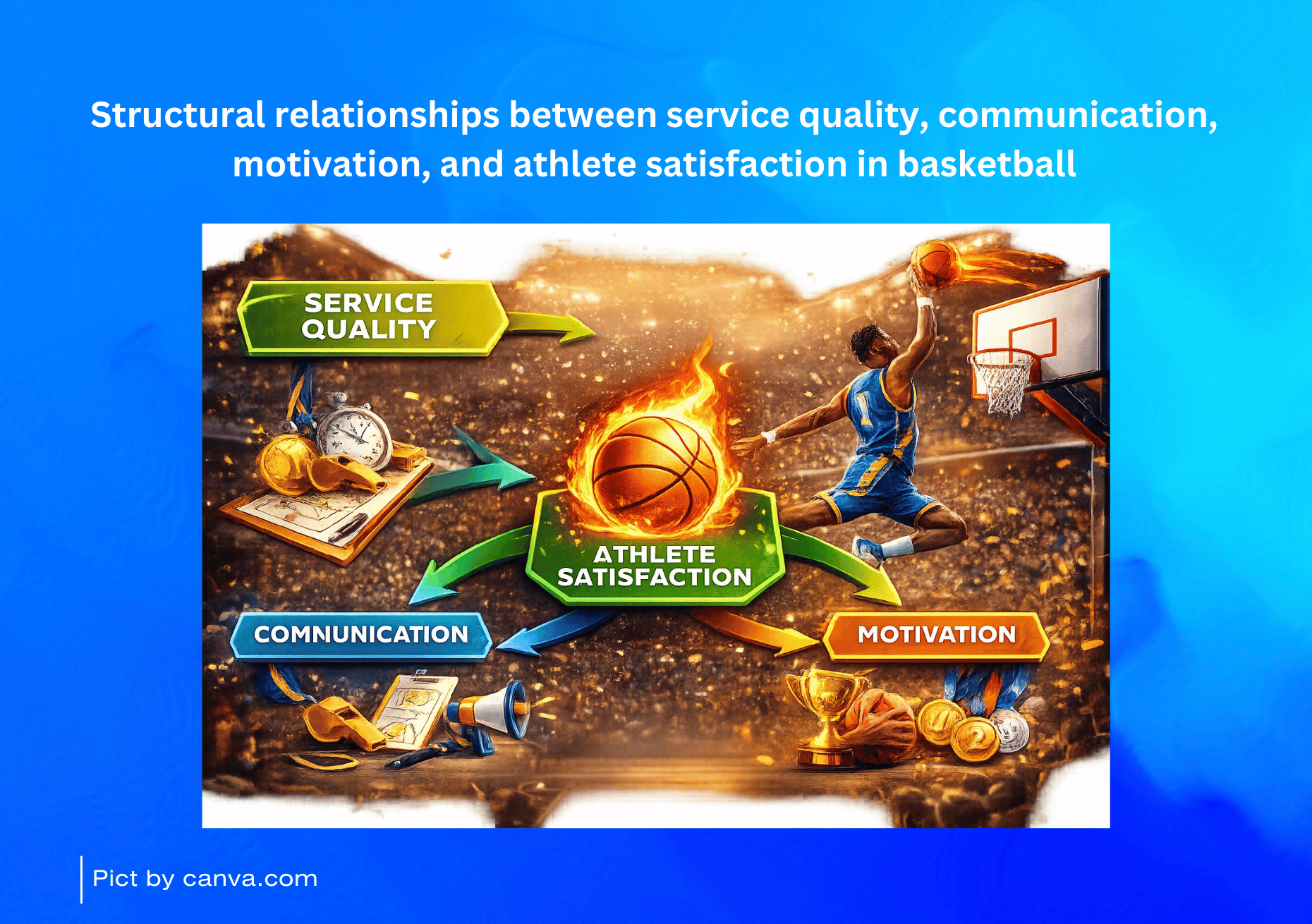
Structural relationships between service quality, communication, motivation, and athlete satisfaction in basketball Indonesia
Fajar Gumilang H.M1, Agung Nugroho2, Rumpis Agus Sudarko3, Fauzi Fauzi4, Fajar Sriwahyuniati51. Yogyakarta State University , ID2. Yogyakarta State University , ID3. Yogyakarta State University , ID4. Yogyakarta State University , ID5. Yogyakarta State University , ID2026-04-09|page 113-124AbstractBackground: Many basketball clubs aim to enhance athlete satisfaction through service quality, communication, and motivation; however, empirical evidence validating these factors as measurable constructs remains limited.
Objectives: This study examines whether these variables function as latent constructs influencing athlete satisfaction and validates their measurement structure using confirmatory factor analysis.
Methods: This study used a quantitative survey and included 263 basketball athletes from various clubs in Sidoarjo, comprising 110 males and 153 females. The participant characteristics focused on players still in the developmental stage who had been actively participating in club training programs for 3 to 6 months, with educational levels ranging from junior high school to college. Participants were selected using purposive sampling. Data were collected using a valid and reliable Likert-scale questionnaire and analyzed using Structural Equation Modeling (SEM) via AMOS 22.
Results: The results demonstrate that service quality (β=0.337, ????=0.000) and communication (β=0.439, ????=0.000) significantly enhance motivation. Furthermore, motivation significantly affects athlete satisfaction (β = 0.582, ???? = 0.000). Crucially, the analysis confirms that motivation mediates the relationship between service quality (indirect effect=0.139) and communication (indirect effect=0.240) on satisfaction.
Conclusions: Theoretically, this study confirms motivation as a vital psychological mediator linking managerial inputs to athlete satisfaction. In practice, the findings demonstrate that while high-quality physical facilities provide a necessary structural foundation, they must be integrated with effective, supportive coaching communication to optimally ignite athletes' intrinsic drive and maximize their overall club experience.APA Citation StyleH.M, F. G. , Nugroho, A. , Sudarko, R. A. , Fauzi, F. , & Sriwahyuniati, F. (2026). Structural relationships between service quality, communication, motivation, and athlete satisfaction in basketball: Indonesia. Physical Education and Sports: Studies and Research, 113-124. https://doi.org/10.56003/pessr.v5i1.691 -
Perceptions of the sports community toward gymnastics achievement in Semarang City
Unique Mierdha Denata Winarko1, Said Junaidi21. State University of Semarang , ID2. State University of Semarang , ID2026-01-05|page 355-362AbstractBackground: Gymnastics is a fundamental sport that supports physical fitness development and long-term athletic performance through complex physical demands such as strength, flexibility, balance, coordination, and explosive power. However, its development as an achievement sport often receives limited structural and institutional support at the local level.
Objectives: : This study aimed to analyze the perceptions of the sports community toward gymnastics achievements in Semarang City and to identify discrepancies between conceptual support and perceived developmental conditions.
Methods: A quantitative descriptive survey design was employed involving 60 respondents from the sports community, including sport science students, physical education teachers, and sports practitioners. Data were collected using a validated and reliable closed-ended questionnaire measuring three perception indicators: acceptance, understanding, and appraisal of gymnastics as an achievement sport. Responses were assessed using a four-point Likert scale. Data analysis was conducted using descriptive statistics alongside validity and reliability testing.
Results: Item-level analysis indicated positive perceptions, with mean scores ranging from 3.05 to 3.79, reflecting strong recognition of gymnastics’ value and potential. However, classification of total perception scores showed that 58.33% of respondents rated the current condition of gymnastics development as very poor. This contrast highlights a clear gap between conceptual appreciation and perceived realities, particularly regarding infrastructure availability, coaching quality, and competition opportunities.
Conclusions: The sports community in Semarang City demonstrates strong conceptual support for gymnastics as an achievement sport, yet perceives substantial limitations in its practical development. Strengthening facilities, coaching systems, and competitive structures is essential to transform positive perceptions into sustainable athletic performance.APA Citation StyleWinarko, U. M. D. , & Junaidi, S. (2026). Perceptions of the sports community toward gymnastics achievement in Semarang City. Physical Education and Sports: Studies and Research, 355-362. https://doi.org/10.56003/pessr.v4i3.609 -
Examining the mediating role of perceived psychosocial support in the relationship between sport grit and psychological well-being among high school student-athletes
Daphne Scott Fernandez1, Kahreen Lou Mondina21. Saint Louis College La Union,Saint Louis College La Union , PH2. Saint Louis College La Union,Saint Louis College La Union , PH2026-08-01|page 182-195AbstractBackground: Psychological well-being is essential for student-athletes because they must simultaneously cope with competitive sport demands and academic responsibilities. Although both sport grit and perceived psychosocial support have been associated with positive psychological outcomes, the mediating role of psychosocial support in the relationship between sport grit and psychological well-being remains insufficiently understood.
Objectives: This study examined whether perceived psychosocial support mediates the relationship between sport grit and psychological well-being among high school student-athletes.
Methods: A quantitative cross-sectional correlational design with a mediation analysis framework was employed. A total of 362 high school student-athletes from the first district of La Union, Philippines, participated using total enumeration sampling. Data were collected using standardized questionnaires assessing sport grit, psychological well-being, and perceived psychosocial support. Descriptive statistics, regression analysis, and bias-corrected bootstrap mediation analysis (5,000 resamples) were performed using JASP.
Results: Student-athletes reported high levels of sport grit, psychological well-being, and perceived psychosocial support. Sport grit significantly and positively predicted psychological well-being, whereas it did not significantly predict perceived psychosocial support. Perceived psychosocial support demonstrated a significant but negative association with psychological well-being. Furthermore, the indirect effect of sport grit on psychological well-being through perceived psychosocial support was not statistically significant, indicating the absence of a mediating effect.
Conclusions: Sport grit is an important direct psychological resource associated with psychological well-being among high school student-athletes. Although perceived psychosocial support contributes to athletes' psychological functioning, it does not explain the relationship between sport grit and psychological well-being. These findings highlight the importance of strengthening athletes' internal psychological resources while maintaining supportive sport environments.
APA Citation StyleFernandez, D. S. , & Mondina, K. L. (2026). Examining the mediating role of perceived psychosocial support in the relationship between sport grit and psychological well-being among high school student-athletes. Physical Education and Sports: Studies and Research, 182-195. https://doi.org/10.56003/pessr.v5i2.725

1 - 6 of 6 items




















