Skip to main content Skip to main navigation menu Skip to site footer
header
  • Home
  • Issues
    • Current
    • Archives
  • Articles in Press
  • ABOUT
    • Ownership and Management
    • About the Journal
    • Publication Frequency
    • Editorial Masthead
    • Journal History
    • About This Publishing System
    • Contact
  • AUTHORS
    • Submissions
    • Aim and Scope
    • Author Fee
    • Author Guidelines
    • Data and Reproducibility
    • Authorship Credit (Contributor Roles Taxonomy)
    • Ethical Clearance
  • REVIEW
    • Reviewers
    • Guidelines for Reviewers
    • Peer Review Process
  • ETHICS
    • Publication Ethics
    • Plagiarism Policy
    • AI Policy
    • Conflict of Interest Policy
    • Allegations of Misconduct
    • Complaints and Appeals
    • Post-Publication Discussions and Corrections
    • Retraction & Correction
  • POLICIES
    • Open Access Policy
    • Copyright Notice
    • Licensing Terms
    • Archiving Policy
    • Repository Policy
    • Advertising Policy
    • Direct Marketing
    • Crossmark Policy
  • METRICS
    • Indexing
    • Citedness in Scopus
    • Citedness in Web of Science
    • Visitors (Statcounter)
    • Visitors (Matomo)
    • DORA Statement
  • Register
  • Login
  1. Home /
  2. Search

Search

Advanced filters
Published After
Published Before

Search Results

##search.searchResults.foundPlural##
  • Open Access
    1-6

    Reclaiming the value of qualitative analysis in sports performance research

    Spyridon Plakias1
    1. Department of Physical Education and Sport Science, University of Thessaly , GR
    2026-03-03
    doi https://doi.org/10.56003/pessr.v5i1.672
    Creative Commons Attribution-ShareAlike License OPEN ACCESS
    Published Online: 03 March 2026
    |
    page 1-6
    Abstract

    Quantitative metrics and technology-driven approaches have reshaped sports performance analysis (SPA), yet they risk overshadowing the equally vital contribution of qualitative methods. This opinion paper highlights the value of qualitative analysis in capturing the complexity, context, and meaning of player and team behaviors, elements that numbers alone cannot explain. Drawing on video-based evaluations, case studies, and narrative reconstructions, qualitative approaches provide insights into tactical, psychological, and interactional dimensions of performance that are indispensable for bridging the science–practice gap. By integrating qualitative and quantitative perspectives, SPA can achieve a more balanced and applicable paradigm, ensuring that scientific research remains relevant to real-world coaching and athlete development. This paper calls for a renewed recognition of qualitative methods as a central pillar of SPA and invites further scholarly contributions to this evolving discussion.

    APA Citation Style
    Plakias, S. (2026). Reclaiming the value of qualitative analysis in sports performance research. Physical Education and Sports: Studies and Research, 1-6. https://doi.org/10.56003/pessr.v5i1.672
  • Open Access

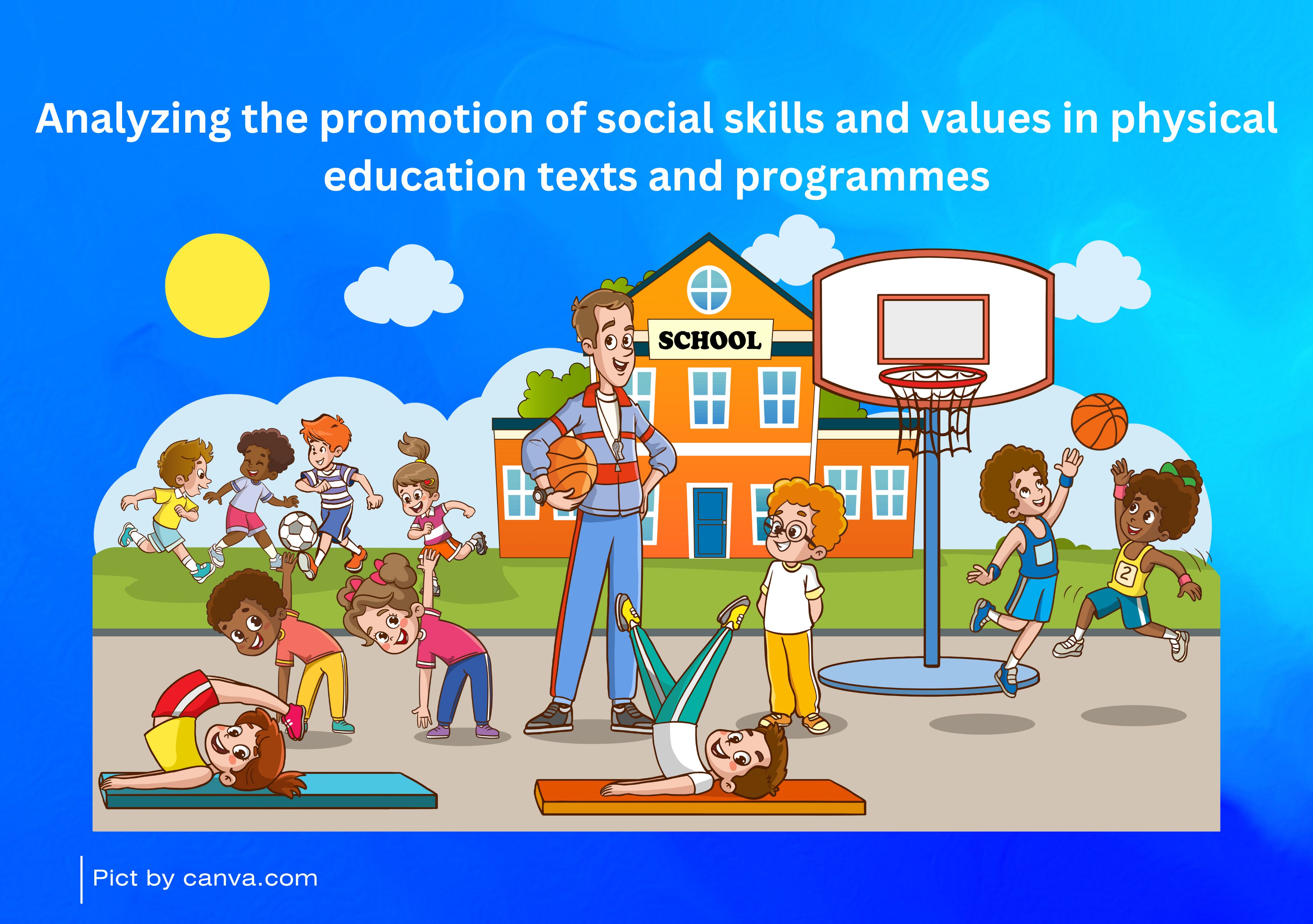
    Analyzing the promotion of social skills and values in physical education texts and programmes

    Loubna Belabbes1, Omar Ben Rakaa2, Moulay Smail Hafidi Alaoui3
    1. Mohammed-V University , MA
    2. Hassan II University of Casablanca , MA
    3. Mohammed-V University , MA
    2025-12-12
    doi https://doi.org/10.56003/pessr.v4i3.493
    Creative Commons Attribution-ShareAlike License OPEN ACCESS
    Published Online: 12 December 2025
    |
    page 275-290
    Abstract

    Background: Global education systems increasingly emphasize holistic development by integrating social skills and ethical values into curricula, with physical education playing a central role in shaping students' cognitive, emotional, and civic competencies.

    Objectives: This study examines how educational programs and policy documents promote social skills (e.g., empathy, communication, collaboration, autonomy) and ethical principles, with particular attention to the contribution of physical education in fostering academic achievement and responsible citizenship.

    Methods: A structured literature review was conducted, applying predefined eligibility criteria and guided by socio-emotional learning and self-determination theory. Forty-five academic and institutional texts (published between 2013 and 2023), including frameworks from UNESCO and the Moroccan Ministry of Education, as well as programs such as PATHS and Second Step, were analyzed across diverse linguistic and cultural contexts, with a primary focus on Morocco.

    Results: Communication (11.11%; 5/45), autonomy (8.89%; 4/45), and cooperation (8.89%; 4/45) emerged as the most frequently emphasized competencies in both Moroccan and international curricula. Physical education was found to reinforce resilience, leadership, and collaborative skills, whereas empathy (4.44%; 2/45) remained underrepresented—reflecting the prevailing prioritization of technical rather than socio-emotional competencies. Implementation remains constrained by structural barriers, including limited resources and cultural misalignment, despite the legislative support of Morocco's framework law 51-17.

    Conclusions: Embedding social skills within physical education supports students' holistic development. Achieving meaningful implementation requires: (1) short-term alignment of system-level policies and teacher training, and (2) long-term cultural adaptation of programs supported by measurable monitoring indicators.
    APA Citation Style
    Belabbes, L. , Ben Rakaa, O. , & Alaoui, M. S. H. (2025). Analyzing the promotion of social skills and values in physical education texts and programmes. Physical Education and Sports: Studies and Research, 275-290. https://doi.org/10.56003/pessr.v4i3.493

1 - 2 of 2 items

Make a Submission

Make a Submission

accreditation

ACCREDITATION
NATIONALLY ACCREDITED
SINTA 3
Accreditation Rank 3
Accredited by the
Ministry of Higher Education,
Science and Technology

Republic of Indonesia
Decree No. 10/C/C3/DT.05.00/2025
VIEW ACCREDITATION DECREE
Accreditation Validity
Vol. 1 No. 2 (2022) – Vol. 6 No. 1 (2027)

template

SUBMISSION FILES

Download and prepare all three documents before submitting your manuscript.

W ARTICLE TEMPLATE DOWNLOAD FILE → ✓ AUTHOR STATEMENT DOWNLOAD FILE → T TITLE PAGE DOWNLOAD FILE →

All three documents are required for manuscript submission.

index

INDEXING & ABSTRACTING

SINTA Dimensions Crossref ANVUR GARUDA ISSN Portal Google Scholar Scilit ASCI Database Leiden University Library University of Liverpool Library Harvard Library OpenAlex

citedness

CITEDNESS
Citedness in Scopus Citedness in Web of Science
GOOGLE SCHOLAR CITATIONS
View Google Scholar Profile ›

incollaborationfull

IN COLLABORATION WITH
IAPES Collaborating Institution

visitorflag

VISITORS
PESSR Flag Counter
Web Analytics View Statcounter Statistics
Matomo Analytics

Keywords

Publisher

CV. Rezki Media

CV. Rezki Media is an academic publishing institution dedicated to disseminating scholarly knowledge through quality peer-reviewed journals, ethical publishing practices, and open access scholarly communication.

CV. Rezki Media Logo

License & Access

Creative Commons Attribution-ShareAlike 4.0

This work is licensed under a Creative Commons Attribution-ShareAlike 4.0 International License .

Open Access Journal

This journal provides immediate open access to its content on the principle that making research freely available to the public supports a greater global exchange of knowledge.

Secretariat

Jl. Raya Bendorejo, RT.18/RW.09, Nglembu, Bendorejo, Kec. Pogalan, Trenggalek Regency, East Java 66371, Indonesia.

Phone:
+62 856-1778-812

Email:
support@rezkimedia.or.id

Website:
www.rezkimedia.or.id

CV. Rezki Media

  • ✦ Physical Education and Sports: Studies and Research (PESSR)
  • ✦ Darmabakti: Jurnal Pengabdian kepada Masyarakat
  • ✦ Public Health and Occupational Safety Journal (PHOSJ)
  • ✦ Sport, Exercise, and Injury (SEI)
  • ✦ Journal of Artificial Intelligence in Education & Learning Innovation (JAIELI)

Content is professionally managed by the respective Journal Editorial Teams. 
The User Interface (UI/UX) is customized and enhanced by CV. Rezki Media .
The journals are powered by Open Journal Systems - Public Knowledge Project (OJS PKP).

More information about the publishing system, Platform and Workflow by OJS/PKP.