
Search
Search Results
##search.searchResults.foundPlural##
-

Perceptions of the sports community toward gymnastics achievement in Semarang City
Unique Mierdha Denata Winarko1, Said Junaidi21. State University of Semarang , ID2. State University of Semarang , ID2026-01-05|page 355-362AbstractBackground: Gymnastics is a fundamental sport that supports physical fitness development and long-term athletic performance through complex physical demands such as strength, flexibility, balance, coordination, and explosive power. However, its development as an achievement sport often receives limited structural and institutional support at the local level.
Objectives: : This study aimed to analyze the perceptions of the sports community toward gymnastics achievements in Semarang City and to identify discrepancies between conceptual support and perceived developmental conditions.
Methods: A quantitative descriptive survey design was employed involving 60 respondents from the sports community, including sport science students, physical education teachers, and sports practitioners. Data were collected using a validated and reliable closed-ended questionnaire measuring three perception indicators: acceptance, understanding, and appraisal of gymnastics as an achievement sport. Responses were assessed using a four-point Likert scale. Data analysis was conducted using descriptive statistics alongside validity and reliability testing.
Results: Item-level analysis indicated positive perceptions, with mean scores ranging from 3.05 to 3.79, reflecting strong recognition of gymnastics’ value and potential. However, classification of total perception scores showed that 58.33% of respondents rated the current condition of gymnastics development as very poor. This contrast highlights a clear gap between conceptual appreciation and perceived realities, particularly regarding infrastructure availability, coaching quality, and competition opportunities.
Conclusions: The sports community in Semarang City demonstrates strong conceptual support for gymnastics as an achievement sport, yet perceives substantial limitations in its practical development. Strengthening facilities, coaching systems, and competitive structures is essential to transform positive perceptions into sustainable athletic performance.APA Citation StyleWinarko, U. M. D. , & Junaidi, S. (2026). Perceptions of the sports community toward gymnastics achievement in Semarang City. Physical Education and Sports: Studies and Research, 355-362. https://doi.org/10.56003/pessr.v4i3.609 -

The impact of coaching communication styles and training programs on novice tennis player satisfaction: A case study from Indonesia
Mohammad Aldi Zakaria1, Limpad Nurrachmad21. State University of Semarang , ID2. State University of Semarang , ID2025-07-17|page 152-161AbstractBackground: The satisfaction of beginner tennis players is often influenced by coaches' communication styles and the structure of training programs.
Objectives: This study analyzed the effects of coaching communication style and training program design on player satisfaction at Club First Tennis.
Methods: A quantitative, descriptive-associative approach was used with 50 beginner players in regular training sessions. Data were collected using a Likert-scale questionnaire covering coach communication style, training program design, and player satisfaction. Statistical analyses included validity and reliability tests, normality checks, and Spearman's rank correlation due to non-parametric data.
Results: Results showed strong, significant relationships between coaching communication and player satisfaction (r = 0.615, p < 0.05), as well as between training programs and satisfaction (r = 0.620, p < 0.05). These findings indicate that supportive and adaptive communication and well-structured training enhance athlete satisfaction and engagement.
Conclusions: The study highlights the importance of integrating effective communication and program planning in coaching beginner athletes. Future studies are encouraged to explore additional influencing factors such as intrinsic motivation or external support, and to involve larger sample sizes for broader generalizability.
APA Citation StyleZakaria, M. A. , & Nurrachmad, L. (2025). The impact of coaching communication styles and training programs on novice tennis player satisfaction: A case study from Indonesia. Physical Education and Sports: Studies and Research, 152-161. https://doi.org/10.56003/pessr.v4i2.603 -
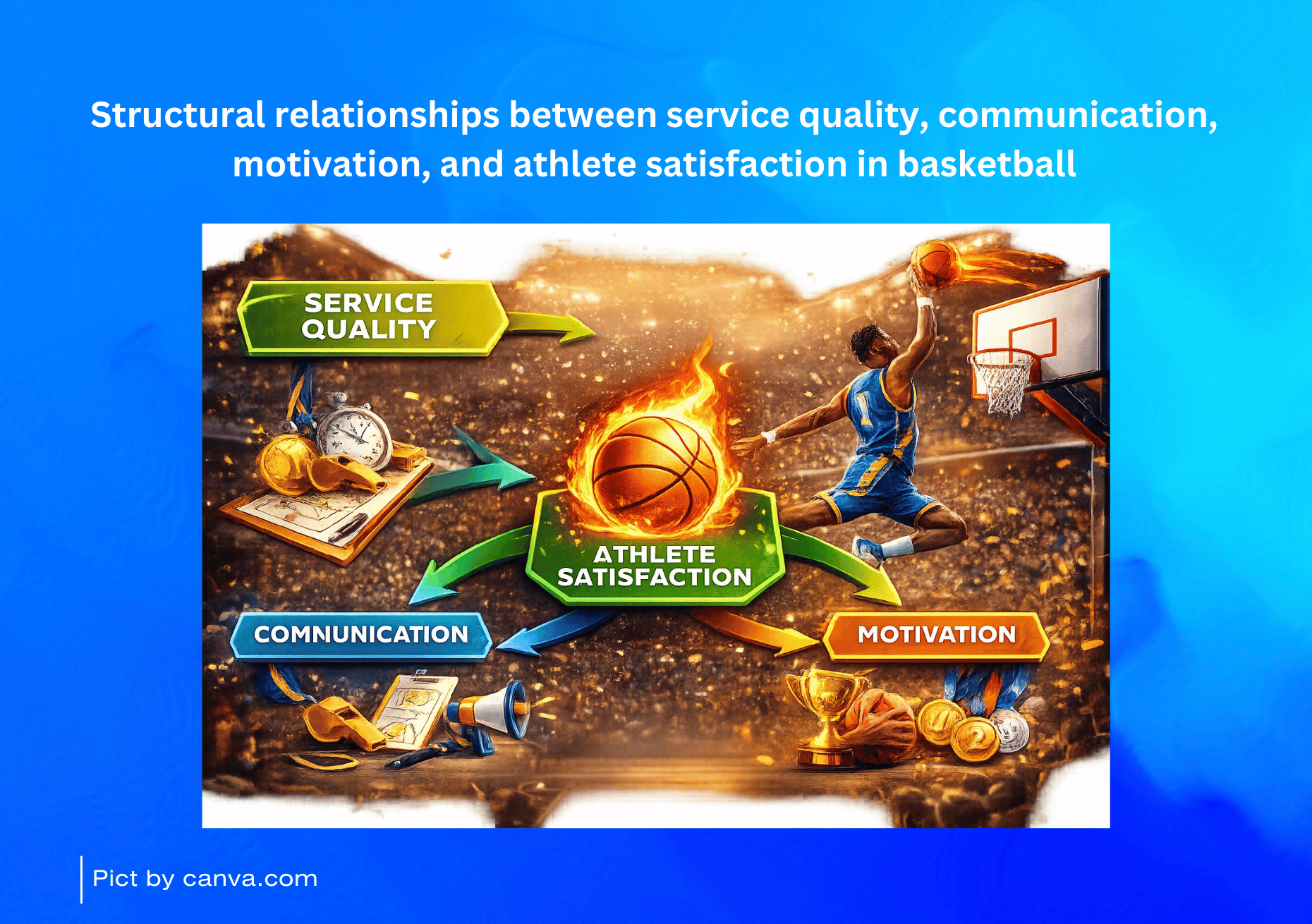
Structural relationships between service quality, communication, motivation, and athlete satisfaction in basketball Indonesia
Fajar Gumilang H.M1, Agung Nugroho2, Rumpis Agus Sudarko3, Fauzi Fauzi4, Fajar Sriwahyuniati51. Yogyakarta State University , ID2. Yogyakarta State University , ID3. Yogyakarta State University , ID4. Yogyakarta State University , ID5. Yogyakarta State University , ID2026-04-09|page 113-124AbstractBackground: Many basketball clubs aim to enhance athlete satisfaction through service quality, communication, and motivation; however, empirical evidence validating these factors as measurable constructs remains limited.
Objectives: This study examines whether these variables function as latent constructs influencing athlete satisfaction and validates their measurement structure using confirmatory factor analysis.
Methods: This study used a quantitative survey and included 263 basketball athletes from various clubs in Sidoarjo, comprising 110 males and 153 females. The participant characteristics focused on players still in the developmental stage who had been actively participating in club training programs for 3 to 6 months, with educational levels ranging from junior high school to college. Participants were selected using purposive sampling. Data were collected using a valid and reliable Likert-scale questionnaire and analyzed using Structural Equation Modeling (SEM) via AMOS 22.
Results: The results demonstrate that service quality (β=0.337, ????=0.000) and communication (β=0.439, ????=0.000) significantly enhance motivation. Furthermore, motivation significantly affects athlete satisfaction (β = 0.582, ???? = 0.000). Crucially, the analysis confirms that motivation mediates the relationship between service quality (indirect effect=0.139) and communication (indirect effect=0.240) on satisfaction.
Conclusions: Theoretically, this study confirms motivation as a vital psychological mediator linking managerial inputs to athlete satisfaction. In practice, the findings demonstrate that while high-quality physical facilities provide a necessary structural foundation, they must be integrated with effective, supportive coaching communication to optimally ignite athletes' intrinsic drive and maximize their overall club experience.APA Citation StyleH.M, F. G. , Nugroho, A. , Sudarko, R. A. , Fauzi, F. , & Sriwahyuniati, F. (2026). Structural relationships between service quality, communication, motivation, and athlete satisfaction in basketball: Indonesia. Physical Education and Sports: Studies and Research, 113-124. https://doi.org/10.56003/pessr.v5i1.691 -

Weightlifting coaches' and athletes' understanding of injury prevention programs: a case study of Lumajang and Malang
Muhammad Izzan Atmagara1, Yulingga Nanda Hanief21. State University of Malang , ID2. State University of Malang , ID2025-09-21|page 222-235AbstractBackground: Weightlifting is a high-intensity sport with a high risk of injuries due to improper technique, insufficient warm-up, and excessive training loads.
Objectives: This study explores the understanding, strategies, and barriers of weightlifting coaches and athletes in Lumajang District and Malang City related to implementing injury prevention programs in performance sports.
Methods: This study used a qualitative case study approach. Participants were selected using purposive sampling, consisting of weightlifting coaches with at least one year of experience and athletes who had trained and competed at the regional level. Data were collected through interviews, observations, and document analysis, while data were analyzed using the Miles and Huberman model, including reduction, presentation, and conclusion.
Results: The results showed that coaches and athletes emphasized dynamic warm-ups, core and back strengthening exercises, and correct lifting techniques as the main strategies to prevent injuries. However, limitations in facilities, literature access, and training variety were identified as barriers to implementing optimal injury prevention programs.
Conclusions: This study concludes that effective injury prevention in weightlifting requires structured warm-up routines, individualized training programs, and adequate supporting equipment. Strengthening coaches’ knowledge and providing better facilities are crucial to minimize injuries and enhance athlete performance.APA Citation StyleAtmagara, M. I. , & Hanief, Y. N. (2025). Weightlifting coaches' and athletes' understanding of injury prevention programs: a case study of Lumajang and Malang. Physical Education and Sports: Studies and Research, 222-235. https://doi.org/10.56003/pessr.v4i2.601 -
Development and evaluation of a web-based interactive flashcard tool (Aero’Zen) for low-impact rhythmic activity instruction in physical education
Zenny Ni'matul Ulya1, Donny Anhar Fahmi2, Ibnu Fatkhu Royana31. Department of Physical Education, Faculty of Social Sciences and Physical Education, Universitas PGRI Semarang , ID2. Department of Physical Education, Faculty of Social Sciences and Physical Education, Universitas PGRI Semarang , ID3. Department of Physical Education, Faculty of Social Sciences and Physical Education, Universitas PGRI Semarang , ID2026-08-31|page 233-247AbstractBackground: Teaching rhythmic activities in physical education continues to face challenges due to the limited availability of visual learning aids that demonstrate movements systematically, repeatedly, and accessibly.
Objectives: This study aimed to develop and evaluate Aero’Zen, a web-based interactive flashcard tool integrating movement illustrations, QR codes, and demonstration videos for basic low-impact rhythmic activities.
Methods: This research and development study employed the ADDIE model. Following product development and expert validation, learning outcomes were evaluated using a one-group pretest–posttest pre-experimental design involving 30 tenth-grade students at SMK Negeri 2 Semarang. Product feasibility was assessed by media experts, subject matter experts, and a physical education practitioner. Pretest and posttest scores were analyzed using the Shapiro–Wilk test for normality and paired-samples t-tests, with the significance level set at α = .05.
Results: Aero’Zen was rated highly suitable by media experts (95.75%), subject matter experts (94.50%), and a physical education practitioner (88.75%). Mean scores increased from 75.40 to 89.97 in the cognitive domain, from 28.80 to 32.77 in the affective domain, and from 19.87 to 32.00 in the psychomotor domain. Paired-samples t-tests revealed significant differences between pretest and posttest scores across all three domains (all p < .001).
Conclusions: Aero’Zen is a highly suitable web-based learning medium with the potential to support students’ cognitive, affective, and psychomotor learning outcomes, including movement coordination and performance, in low-impact rhythmic activities. Its integrated flashcards, QR-code access, and demonstration videos provide a flexible resource for repeated and independent learning. Future studies should use randomized controlled trials with larger and more diverse samples to strengthen causal inference and generalizability.
APA Citation StyleUlya, Z. N. , Fahmi, D. A. , & Royana, I. F. (2026). Development and evaluation of a web-based interactive flashcard tool (Aero’Zen) for low-impact rhythmic activity instruction in physical education. Physical Education and Sports: Studies and Research, 233-247. https://doi.org/10.56003/pessr.v5i2.761

1 - 5 of 5 items




















