
Search
Search Results
##search.searchResults.foundPlural##
-

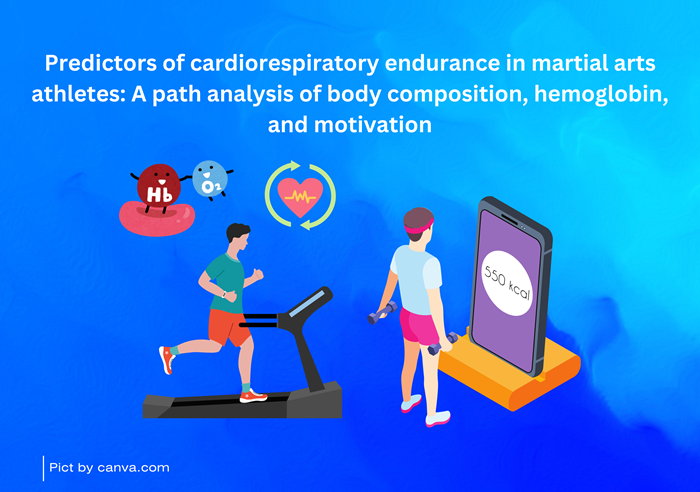
Predictors of cardiorespiratory endurance in martial arts athletes: A path analysis of body composition, hemoglobin, and motivation
Novanto Ponco Nugroho 1, Dani Nur Riyadi2, Aridhotul Haqiyah31. Universitas Islam 45 Bekasi , ID2. Universitas Islam 45 Bekasi , ID3. Universitas Islam 45 Bekasi , ID2025-07-01|page 83-94AbstractBackground: Cardiorespiratory endurance is vital to athletic performance, particularly in sports requiring sustained physical exertion such as martial arts.
Objectives: This study examined the predictive roles of body composition (BMI), hemoglobin concentration, and motivation on cardiorespiratory endurance among university-level martial arts athletes.
Methods: Using a quantitative path analysis design, data were collected from 20 purposively selected martial arts athletes who regularly trained. Cardiorespiratory endurance was assessed via the multistage fitness test, BMI was calculated using standard anthropometric measures, hemoglobin was measured using the Harenz scale, and motivation was evaluated with a validated Likert-scale questionnaire.
Results: The analysis showed that BMI (ρ = 0.705, t = 3.071, p = 0.007) and hemoglobin concentration (ρ = 0.946, t = 4.672, p < 0.001) had significant positive effects on cardiorespiratory endurance. Motivation, however, did not have a significant direct effect (ρ = 0.087, t = 0.853, p = 0.203). Additionally, BMI correlated positively with both hemoglobin (ρ = 0.923, p < 0.001) and motivation (ρ = 0.670, p = 0.034), suggesting indirect effects through physiological mechanisms.
Conclusions: The findings underscore that physiological indicators, specifically BMI and hemoglobin, are more critical predictors of aerobic capacity than psychological factors like motivation in this athletic population. Due to sport-specific demands, these results may not be generalizable to non-martial arts athletes. Future studies should incorporate additional mediators such as training intensity and account for potential self-report bias in motivation assessments.
APA Citation StyleNugroho , N. P. , Riyadi, D. N. , & Haqiyah, A. (2025). Predictors of cardiorespiratory endurance in martial arts athletes: A path analysis of body composition, hemoglobin, and motivation. Physical Education and Sports: Studies and Research, 83-94. https://doi.org/10.56003/pessr.v4i2.559 -

The association between healthy dietary habits and physical fitness among junior high school students: A rural school case study
Moch. Yunus1, Yulingga Nanda Hanief2, Muhammad Putra Ramadhan3, Erika Ayu Sylvianingrum41. State University of Malang , ID2. State University of Malang , ID3. State University of Malang , ID4. State University of Malang , ID2025-12-30|page 344-354AbstractBackground: The health conditions of the community, particularly in relation to the physical fitness of junior high school students, require serious attention, especially in rural areas that differ significantly from urban areas. Previous research findings on dietary patterns and physical fitness still show inconsistent results.
Objectives: This study aims to investigate the relationship between healthy eating habits and physical fitness among junior high school students residing in rural areas.
Methods: This study used a quantitative design with a cross-sectional approach. The research subjects consisted of 27 students from public junior high schools in rural areas, selected through a balanced stratified random sampling process that involved all grade levels. Eating habits were measured using a 24-hour food recall, as it is an effective method for monitoring food intake over a short period. Physical fitness was measured using the Nusantara Student Fitness Test (TKPN), a national standard instrument. Data analysis was performed using descriptive statistics, Spearman's correlation, and linear regression.
Results: Most of the study participants were underweight with varied eating patterns. The analysis results showed no significant relationship between physical fitness and healthy eating patterns, as indicated by a correlation coefficient of 0.061 and a p-value of 0.764. The small effect size suggests that eating patterns did not have a significant impact on fitness levels in this group of participants.
Conclusions: The study shows that rural junior high school students achieve their physical fitness through exercise and their exercise-rest patterns and their inherited characteristics rather than their diet.APA Citation StyleYunus, M. , Hanief, Y. N. , Ramadhan, M. P. , & Sylvianingrum, E. A. (2025). The association between healthy dietary habits and physical fitness among junior high school students: A rural school case study. Physical Education and Sports: Studies and Research, 344-354. https://doi.org/10.56003/pessr.v4i3.665 -

Low-impact specialized pilates is better than low intensity steady state for increasing fitness level
Laily Mita Andriana1, Kunjung Ashadi2, Fransisca Januarumi Marhaendra Wijaya3, Muhamad Fauzi Antoni41. Universitas Negeri Surabaya , ID2. Universitas Negeri Surabaya , ID3. Universitas Negeri Surabaya , ID4. Universitas Negeri Surabaya , ID2025-07-13|page 139-151AbstractBackground: Elderly individuals with disabilities often face challenges in maintaining physical fitness, highlighting the need for effective and appropriate exercise methods tailored to their limitations.
Objectives: This study compares the effectiveness of low-impact specialized Pilates and Low-Intensity Steady-State (LISS) exercise in improving fitness levels among older adults with mild to moderate disabilities. The unique advantage of Pilates in enhancing balance and core strength is presented as a novel contribution.
Methods: A quasi-experimental design with pre-test and post-test assessments was employed, involving 40 elderly participants with disabilities divided into two intervention groups over 8 weeks. Participants were selected through purposive sampling based on the inclusion criteria of 60–75 years with mild to moderate disabilities. Fitness levels were assessed using the Senior Fitness Test, which evaluates muscular strength, balance, flexibility, and aerobic capacity.
Results: Data analysis was conducted using the Shapiro–Wilk test, paired sample t-test, and independent sample t-test. The results demonstrated that the low-impact specialized Pilates group showed significant improvements in core strength, balance, and flexibility, whereas the LISS group exhibited greater improvements in aerobic capacity.
Conclusions: In conclusion, low-impact specialized Pilates is more effective in enhancing overall fitness among elderly individuals with disabilities. Therefore, it is recommended as a suitable exercise modality for rehabilitation and health maintenance programs to improve this population's quality of life and functional independence.
APA Citation StyleAndriana, L. M. , Ashadi, K. , Wijaya, F. J. M. , & Antoni, M. F. (2025). Low-impact specialized pilates is better than low intensity steady state for increasing fitness level. Physical Education and Sports: Studies and Research, 139-151. https://doi.org/10.56003/pessr.v4i2.575 -

Body Composition Analysis Junior Basketball Players
Nur Luthfiatus Solikah1, Heri Wahyudi2, Achmad Widodo3, Awang Firmansyah4, Jagat Shine Muarif5, Asep Aziz Muslim61. Universitas Negeri Surabaya , ID2. Universitas Negeri Surabaya , ID3. Universitas Negeri Surabaya , ID4. Universitas Negeri Surabaya , ID5. Universitas Negeri Surabaya , ID6. Universitas Negeri Surabaya , ID2024-10-25|page 126-136AbstractBackground: Athletes must maintain top physical condition to compete, with body composition a crucial indicator. Skeletal muscle mass and body fat are related to performance, with a lower fat percentage increasing physical ability. Nutritional needs also play a role, where athletes consume carbohydrates for 60-70% of their energy. These factors are essential for optimal performance and overall health.
Objectives: This study aimed to investigate the body composition of junior basketball athletes regarding gender.
Methods: This study employed a rigorous cross-sectional research design to analyze the body composition measurements of elite athletes and junior basketball players. The participants were carefully selected based on age, injury history, national-level achievements, and recent injury training. A total of 24 junior basketball athletes, evenly split between elite junior male and female athletes, participated in the test. The data was meticulously analyzed using Minitab software and the T-test to determine gender differences, ensuring the validity and reliability of the results.
Results: The athletes were aged 16-17, weighing 50-65 kg to 95-108 kg. They had BMI characteristics of 8.3% underweight, 79.2% normal, 12.5% overweight, and 0% obese. Significant differences were found in body composition characteristics for each gender. The T-test results show significant differences between the variables with a P value <0.05.
Conclusion: They indicate that female basketball athletes tend to have a higher fat percentage, while male athletes typically possess significantly greater muscle mass. These insights can be instrumental in developing gender-specific training and nutrition programs, thereby enhancing the performance and health of junior basketball athletes.
APA Citation StyleSolikah, N. L. , Wahyudi, H. , Widodo, A. , Firmansyah, A. , Muarif, J. S. , & Muslim, A. A. (2024). Body Composition Analysis Junior Basketball Players. Physical Education and Sports: Studies and Research, 126-136. https://doi.org/10.56003/pessr.v3i2.382 -
Immunity to rhythm: Visual or auditory stimuli during intense aerobic exertion do not modulate the mood of young adults
Flavio de Souza Araujo1, Camila Maria Menezes Almeida2, Mariana Ferreira de Souza3, Marcelo Magalhães Sales4, José Fernando Vila Nova de Moraes51. Federal University of Vale do São Francisco , BR2. Federal University of Vale do São Francisco , BR3. Federal University of Vale do São Francisco , BR4. State University of Goiás , BR5. Universidade Federal do Vale do São Francisco (UNIVASF) , BR2026-04-26|page 160-171AbstractBackground: High-intensity aerobic exercise can promote higher energy expenditure when compared to low and moderate-intensity exercise. However, vigorous exercise can negatively influence mood responses related to adherence. Auditory and audiovisual resources have been used to improve psychological variables during and after exercise.
Objectives: To analyze the influence of listening to music and watching video clips on mood responses of young adults after a high-intensity aerobic exercise session.
Methods: This is a Cross-Sectional Randomized Controlled Study in which fourteen male participants (23.4 ± 3.1 years; 26.2 ± 3.4 kg/m²) randomly performed exercise sessions on a cyclergometer, at an intensity of 10% above anaerobic threshold, in three situations: control (C), listening to music (M), and watching video clips (VC). At the end of each session, participants underwent 30 min of passive recovery. Mood responses were measured using Brunel’s Mood Scale (BRUMS) before exercise, immediately after exercise, and after recovery. Friedman’s and Wilcoxon’s tests were used, with a significance level of 5%.
Results: No statistical differences were found between conditions (C, C, and VC) for the dimensions confusion, fatigue, anger, tension, and vigor (p>0.05). A statistically significant difference was found for depression before exercise, with M higher than C and VC (p<0.05); however, no differences were observed after exercise or recovery.
Conclusions: Listening to music and/or watching video clips does not influence mood responses in young adults after high-intensity aerobic exercise on a cyclergometer.
APA Citation StyleAraujo, F. D. S. , Almeida, C. M. M. , Souza, M. F. D. , Sales, M. M. , & Moraes, J. F. V. N. D. (2026). Immunity to rhythm: Visual or auditory stimuli during intense aerobic exertion do not modulate the mood of young adults. Physical Education and Sports: Studies and Research, 160-171. https://doi.org/10.56003/pessr.v5i1.702

1 - 5 of 5 items




















