
Search
Search Results
##search.searchResults.foundPlural##
-

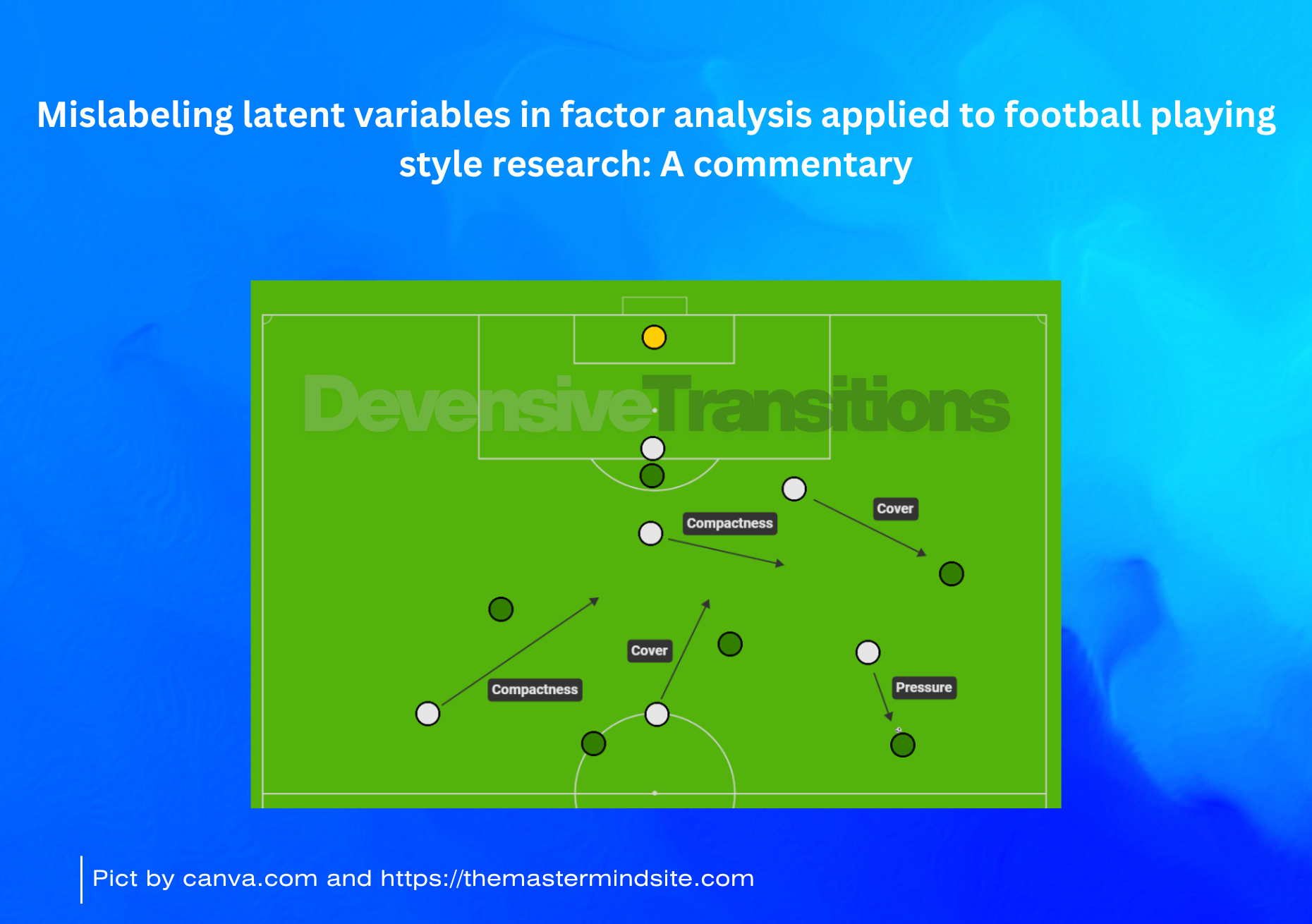
Mislabeling latent variables in factor analysis applied to football playing style research: A commentary
Spyridon Plakias11. Department of Physical Education and Sports, University of Thessaly , GR2026-03-25|page 40-46AbstractThe application of exploratory factor analysis and principal component analysis (PCA) has become increasingly prevalent in football analytics, offering a robust framework for identifying and quantifying playing styles. By condensing a large set of performance indicators into factors, these techniques provide valuable insights into tactical patterns. However, a persistent challenge lies in the subjective labeling of these factors, which can lead to ambiguous or misleading interpretations. This commentary highlights the issue of mislabeling latent variables in football playing style research, drawing on examples from recent studies to illustrate how inaccurate labels can distort both theoretical understanding and practical applications. The implications of poor labeling extend beyond academic discourse, potentially affecting coaches and analysts who rely on data-driven insights for tactical planning. To address these challenges, we propose best practice recommendations emphasizing conceptual clarity, standardized terminology, and expert validation. Accurate and consistent factor labeling is essential to ensure the reliability, comparability, and practical relevance of findings in the evolving field of football performance analysis.
APA Citation StylePlakias, S. (2026). Mislabeling latent variables in factor analysis applied to football playing style research: A commentary. Physical Education and Sports: Studies and Research, 40-46. https://doi.org/10.56003/pessr.v5i1.693 -

Reclaiming the value of qualitative analysis in sports performance research
Spyridon Plakias11. Department of Physical Education and Sport Science, University of Thessaly , GR2026-03-03|page 1-6AbstractQuantitative metrics and technology-driven approaches have reshaped sports performance analysis (SPA), yet they risk overshadowing the equally vital contribution of qualitative methods. This opinion paper highlights the value of qualitative analysis in capturing the complexity, context, and meaning of player and team behaviors, elements that numbers alone cannot explain. Drawing on video-based evaluations, case studies, and narrative reconstructions, qualitative approaches provide insights into tactical, psychological, and interactional dimensions of performance that are indispensable for bridging the science–practice gap. By integrating qualitative and quantitative perspectives, SPA can achieve a more balanced and applicable paradigm, ensuring that scientific research remains relevant to real-world coaching and athlete development. This paper calls for a renewed recognition of qualitative methods as a central pillar of SPA and invites further scholarly contributions to this evolving discussion.
APA Citation StylePlakias, S. (2026). Reclaiming the value of qualitative analysis in sports performance research. Physical Education and Sports: Studies and Research, 1-6. https://doi.org/10.56003/pessr.v5i1.672 -
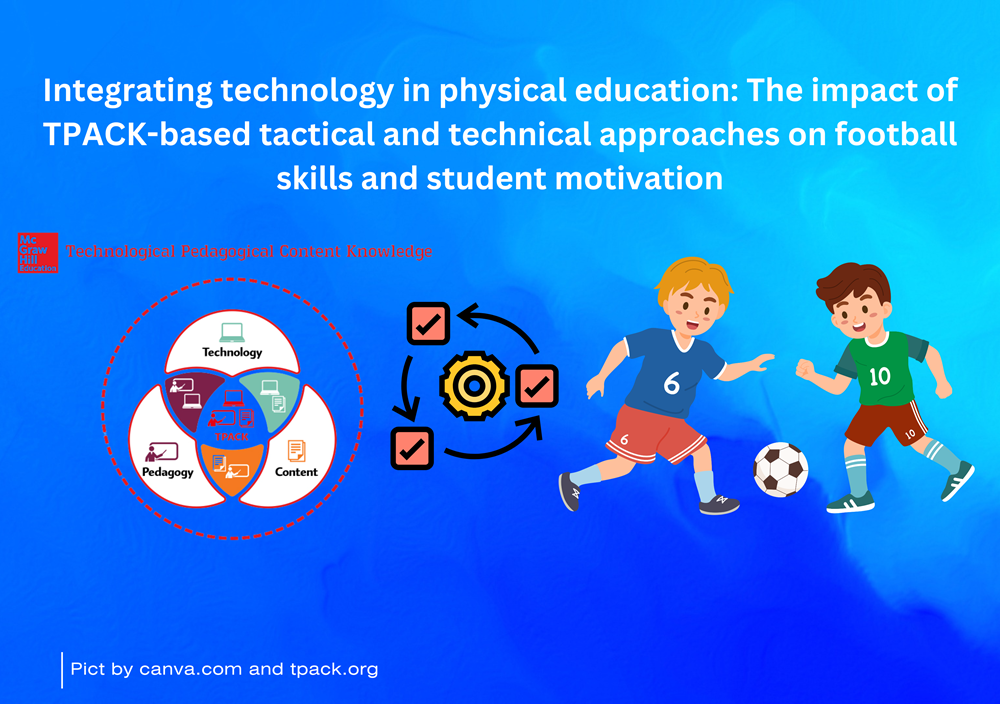
Integrating technology in physical education: The impact of TPACK-based tactical and technical approaches on football skills and student motivation
Defri Mulyana1, Adang Suherman2, Komarudin Komarudin3, Bambang Abduljabar4, Fegie Rizkia Mulyana51. Indonesia University of Education , ID2. Indonesia University of Education , ID3. Indonesia University of Education , ID4. Indonesia University of Education , ID5. Siliwangi University , ID2025-05-14|page 71-82AbstractBackground: Motivation and skill development are vital in physical education, particularly football. Tactical learning emphasizes decision-making and game understanding, while technical learning focuses on mastering fundamental skills.
Objectives: This study aimed to analyze the impact of a TPACK-based tactical and technical learning approach on student motivation and football skill acquisition among high school students in Tasikmalaya.
Methods: The study applied the TPACK framework—integrating Technological, Pedagogical, and Content Knowledge—in designing the learning model. Using an experimental method with a pre-test–post-test design, 30 students were divided into two groups. Motivation was assessed via a Likert-scale questionnaire, while football skills (passing, heading, dribbling, shooting, and playing ability) were evaluated through standardized tests. Data were analyzed using paired and independent t-tests with a significance level of p < 0.05.
Results: The technical approach significantly enhanced basic football skills, notably heading (t = 8.47) and shooting (t = 8.29), proving its effectiveness in improving fundamental competencies. Conversely, the tactical approach showed a notable increase in student motivation (t = 4.98) and playing ability (t = 5.94), reflecting its strength in fostering strategic understanding and engagement. TPACK integration further reinforced both approaches through effective use of technology.
Conclusions: The study highlights the importance of combining tactical and technical approaches to promote holistic student development. Continued research is needed to explore the long-term effects and potential of integrating diverse technological tools in physical education.
APA Citation StyleMulyana, D. , Suherman, A. , Komarudin, K. , Abduljabar, B. , & Mulyana, F. R. (2025). Integrating technology in physical education: The impact of TPACK-based tactical and technical approaches on football skills and student motivation. Physical Education and Sports: Studies and Research, 71-82. https://doi.org/10.56003/pessr.v4i1.523 -
Examining the mediating role of perceived psychosocial support in the relationship between sport grit and psychological well-being among high school student-athletes
Daphne Scott Fernandez1, Kahreen Lou Mondina21. Saint Louis College La Union,Saint Louis College La Union , PH2. Saint Louis College La Union,Saint Louis College La Union , PH2026-08-01|page 182-195AbstractBackground: Psychological well-being is essential for student-athletes because they must simultaneously cope with competitive sport demands and academic responsibilities. Although both sport grit and perceived psychosocial support have been associated with positive psychological outcomes, the mediating role of psychosocial support in the relationship between sport grit and psychological well-being remains insufficiently understood.
Objectives: This study examined whether perceived psychosocial support mediates the relationship between sport grit and psychological well-being among high school student-athletes.
Methods: A quantitative cross-sectional correlational design with a mediation analysis framework was employed. A total of 362 high school student-athletes from the first district of La Union, Philippines, participated using total enumeration sampling. Data were collected using standardized questionnaires assessing sport grit, psychological well-being, and perceived psychosocial support. Descriptive statistics, regression analysis, and bias-corrected bootstrap mediation analysis (5,000 resamples) were performed using JASP.
Results: Student-athletes reported high levels of sport grit, psychological well-being, and perceived psychosocial support. Sport grit significantly and positively predicted psychological well-being, whereas it did not significantly predict perceived psychosocial support. Perceived psychosocial support demonstrated a significant but negative association with psychological well-being. Furthermore, the indirect effect of sport grit on psychological well-being through perceived psychosocial support was not statistically significant, indicating the absence of a mediating effect.
Conclusions: Sport grit is an important direct psychological resource associated with psychological well-being among high school student-athletes. Although perceived psychosocial support contributes to athletes' psychological functioning, it does not explain the relationship between sport grit and psychological well-being. These findings highlight the importance of strengthening athletes' internal psychological resources while maintaining supportive sport environments.
APA Citation StyleFernandez, D. S. , & Mondina, K. L. (2026). Examining the mediating role of perceived psychosocial support in the relationship between sport grit and psychological well-being among high school student-athletes. Physical Education and Sports: Studies and Research, 182-195. https://doi.org/10.56003/pessr.v5i2.725 -
Performance anxiety among student table tennis players
Yumna Wahyuningsih1, Ibnu Fatkhu Royana2, Galih Dwi Pradipta31. Universitas PGRI Semarang , ID2. Universitas PGRI Semarang , ID3. Universitas PGRI Semarang , ID2025-12-18|page 318-331AbstractBackground: Anxiety is a common psychological factor that significantly affects athletic performance, especially in competitive settings. Student-athletes face dual pressures from academic responsibilities and athletic commitments, making them vulnerable to performance anxiety that can impair focus, concentration, and decision-making.
Objectives: This study aims to analyze performance anxiety among table tennis athletes in the Student Activity Unit (UKM) of Universitas PGRI Semarang and to examine differences in performance evaluation outcomes based on sources from internal and external factors.
Methods: A comparative quantitative design with a cross-sectional approach was used. Fifty athletes participated (n=25 assessed by internal factors, n=25 assessed by external factors). Anxiety/performance was measured using a self-report questionnaire consisting of 15 Likert-scale items (1-5 scale) validated by three sport psychology experts. Data were analyzed using one-way ANOVA after confirming normality (Shapiro-Wilk test) and homogeneity (Levene's test).
Results: The internal group had a higher mean score (M = 3.64, SD = 0.86) compared to the external group (M = 3.07, SD = 0.86). ANOVA revealed a statistically significant difference, F(1,48) = 4.92, p = 0.031, η² = 0.093, with an estimated Cohen's d of approximately 0.66, indicating a medium effect size. These findings indicate that anxiety factors affect athletes' performance, with internal factors tending to score higher than external factors.
Conclusions: This study concludes that anxiety affects the performance of table tennis athletes in the Student Activity Unit (UKM) at Universitas PGRI Semarang. Specifically, internal factors such as self-confidence and perfectionism have been proven to have a greater impact than external factors.APA Citation StyleWahyuningsih, Y. , Royana, I. F. , & Pradipta, G. D. (2025). Performance anxiety among student table tennis players. Physical Education and Sports: Studies and Research, 318-331. https://doi.org/10.56003/pessr.v4i3.618

1 - 5 of 5 items




















