
Search
Search Results
##search.searchResults.foundPlural##
-

The effect of championship participation on training intensity and motivation of Pencak Silat student athletes at Semarang State University, Indonesia
Achmad Alif Firmansyah1, Nanang Indardi21. State University of Semarang , ID2. State University of Semarang , ID2025-08-15|page 204-211AbstractBackground: Consistent training and high enthusiasm are the keys to an athlete's success in achieving optimal performance. However, among Pencak Silat athletes at Semarang State University (UNNES), there is a decrease in training intensity and enthusiasm when there is no championship agenda.
Objectives: The purpose of this study is to analyze the effect of participation in a championship on the training intensity and motivation of Semarang State University Pencak Silat athletes.
Methods: This study used a pre-post design with the same subjects (n = 30) and an explanatory quantitative approach to determine the effect of championship participation on training intensity and motivation. Data were collected using a Likert scale questionnaire that has been tested for validity and reliability (α = 0.872). Data analysis was performed using a paired t-test using SPSS.
Results: The results showed a significant increase in training intensity from a mean ± SD of 3.12 ± 0.54 (pre) to 3.78 ± 0.49 (post), and training motivation from 3.05 ± 0.61 (pre) to 3.85 ± 0.55 (post), with t(29) = 5.62 and 6.03, respectively, p = 0.004. Cohen's d effect sizes of 1.03 (intensity) and 1.10 (motivation) indicate significant effects.
Conclusions: These findings indicate that participation in championships is a significant external motivator in improving the quality of athletes' training. Therefore, championships can be a coaching strategy to maintain sustainable training motivation, a practical implication that this study has clearly demonstrated.
APA Citation StyleFirmansyah, A. A. , & Indardi, N. (2025). The effect of championship participation on training intensity and motivation of Pencak Silat student athletes at Semarang State University, Indonesia. Physical Education and Sports: Studies and Research, 204-211. https://doi.org/10.56003/pessr.v4i2.620 -
Impact of plyometric training using step-up and lateral box jumps on the improvement of leg muscle power in youth school futsal athletes
Risky Sandy Kurniawan1, Donny Anhar Fahmi2, Setiyawan Setiyawan31. Universitas PGRI Semarang , ID2. Universitas PGRI Semarang , ID3. Universitas PGRI Semarang , ID2025-08-15|page 212-221AbstractBackground: Futsal is a high-intensity sport that requires leg muscle power, especially in aerial duels, anticipating the ball, and performing powerful kicks. Limited jumping ability can reduce leg muscle power and overall performance.
Objectives: This study aims to test the impact of plyometric training using step-up and lateral box jumps on the improvement of leg muscle power in youth school futsal athletes.
Methods: A quasi-experimental single-group pretest-posttest design was conducted with 40 male participants over a four-week plyometric training program. Leg muscle power was measured using a vertical jump test before and after the intervention. Data were analyzed using a t-test with the assistance of SPSS.
Results: Both step-up and lateral box jumps significantly increased leg muscle power (p < 0.05). The step-up group showed an average increase of 4.20 cm, while the lateral box jump group showed an average increase of 3.45 cm, with no statistically significant difference (p = 0.326).
Conclusions: Both training methods effectively enhance leg muscle power and can be integrated into school-based futsal training programs to improve performance.
APA Citation StyleKurniawan, R. S. , Fahmi, D. A. , & Setiyawan, S. (2025). Impact of plyometric training using step-up and lateral box jumps on the improvement of leg muscle power in youth school futsal athletes. Physical Education and Sports: Studies and Research, 212-221. https://doi.org/10.56003/pessr.v4i2.611 -

The impact of coaching communication styles and training programs on novice tennis player satisfaction: A case study from Indonesia
Mohammad Aldi Zakaria1, Limpad Nurrachmad21. State University of Semarang , ID2. State University of Semarang , ID2025-07-17|page 152-161AbstractBackground: The satisfaction of beginner tennis players is often influenced by coaches' communication styles and the structure of training programs.
Objectives: This study analyzed the effects of coaching communication style and training program design on player satisfaction at Club First Tennis.
Methods: A quantitative, descriptive-associative approach was used with 50 beginner players in regular training sessions. Data were collected using a Likert-scale questionnaire covering coach communication style, training program design, and player satisfaction. Statistical analyses included validity and reliability tests, normality checks, and Spearman's rank correlation due to non-parametric data.
Results: Results showed strong, significant relationships between coaching communication and player satisfaction (r = 0.615, p < 0.05), as well as between training programs and satisfaction (r = 0.620, p < 0.05). These findings indicate that supportive and adaptive communication and well-structured training enhance athlete satisfaction and engagement.
Conclusions: The study highlights the importance of integrating effective communication and program planning in coaching beginner athletes. Future studies are encouraged to explore additional influencing factors such as intrinsic motivation or external support, and to involve larger sample sizes for broader generalizability.
APA Citation StyleZakaria, M. A. , & Nurrachmad, L. (2025). The impact of coaching communication styles and training programs on novice tennis player satisfaction: A case study from Indonesia. Physical Education and Sports: Studies and Research, 152-161. https://doi.org/10.56003/pessr.v4i2.603 -
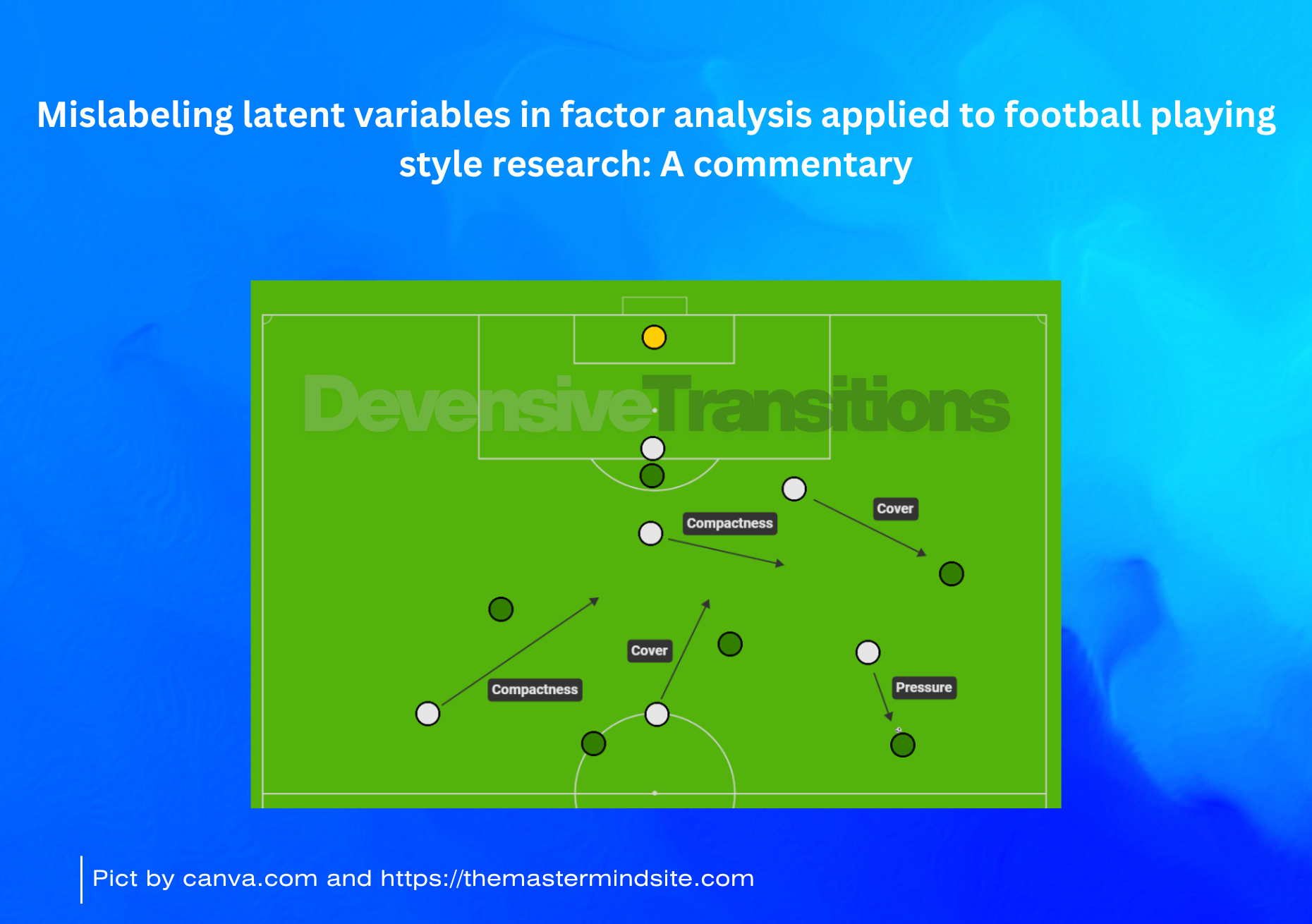
Mislabeling latent variables in factor analysis applied to football playing style research: A commentary
Spyridon Plakias11. Department of Physical Education and Sports, University of Thessaly , GR2026-03-25|page 40-46AbstractThe application of exploratory factor analysis and principal component analysis (PCA) has become increasingly prevalent in football analytics, offering a robust framework for identifying and quantifying playing styles. By condensing a large set of performance indicators into factors, these techniques provide valuable insights into tactical patterns. However, a persistent challenge lies in the subjective labeling of these factors, which can lead to ambiguous or misleading interpretations. This commentary highlights the issue of mislabeling latent variables in football playing style research, drawing on examples from recent studies to illustrate how inaccurate labels can distort both theoretical understanding and practical applications. The implications of poor labeling extend beyond academic discourse, potentially affecting coaches and analysts who rely on data-driven insights for tactical planning. To address these challenges, we propose best practice recommendations emphasizing conceptual clarity, standardized terminology, and expert validation. Accurate and consistent factor labeling is essential to ensure the reliability, comparability, and practical relevance of findings in the evolving field of football performance analysis.
APA Citation StylePlakias, S. (2026). Mislabeling latent variables in factor analysis applied to football playing style research: A commentary. Physical Education and Sports: Studies and Research, 40-46. https://doi.org/10.56003/pessr.v5i1.693 -

Unveiling the digital gym: A phenomenological dive into online physical education pedagogy
Princes Lloyda Peralta11. Saint Louis College , PH2025-04-04|page 15-31AbstractBackground: The COVID-19 pandemic necessitated a rapid shift to online learning, posing significant challenges for traditionally hands-on subjects like Physical Education (PE). Limited student engagement, digital accessibility issues, and the need for pedagogical adaptation became major concerns for PE instructors.
Objectives: This study aims to explore the lived experiences of PE instructors in adapting to online instruction, identifying the strategies, challenges, and innovations they employed to maintain instructional effectiveness.
Methods: A qualitative research design utilizing Interpretative Phenomenological Analysis (IPA) was adopted to gain deep insights into instructors’ experiences. Purposive sampling was used to select seven PE instructors from urban and rural institutions, ensuring diverse teaching contexts. Data were collected through semi-structured interviews, and thematic analysis was conducted to identify key adaptation strategies.
Results: Five major themes emerged from the findings: (1) Adaptation to Online Instruction, where instructors restructured their teaching approaches to accommodate digital platforms; (2) Effective Use of Digital Tools, emphasizing the role of online resources in enhancing instructional delivery; (3) Innovative Approaches to Engagement, detailing gamification techniques and interactive pedagogies; (4) Equitable Access Strategies, addressing disparities in internet connectivity and learning resources; and (5) Assessment of Success and Progress, highlighting novel evaluation methods tailored for online PE instruction. These themes collectively form the "Navigating Instructional Delivery Through Innovation, Technology, Engagement, and Equity" framework.
Conclusions: The study provides valuable insights into how PE instructors have innovatively adapted to online learning, ensuring student engagement and equitable access to education. The findings offer implications for policy-making, teacher training programs, and the future integration of technology in PE instruction. Future research should explore student perspectives and the long-term impact of digital PE on learning outcomes.
APA Citation StylePeralta, P. L. (2025). Unveiling the digital gym: A phenomenological dive into online physical education pedagogy. Physical Education and Sports: Studies and Research, 15-31. https://doi.org/10.56003/pessr.v4i1.474 -

Predictors of cardiorespiratory endurance in martial arts athletes: A path analysis of body composition, hemoglobin, and motivation
Novanto Ponco Nugroho 1, Dani Nur Riyadi2, Aridhotul Haqiyah31. Universitas Islam 45 Bekasi , ID2. Universitas Islam 45 Bekasi , ID3. Universitas Islam 45 Bekasi , ID2025-07-01|page 83-94AbstractBackground: Cardiorespiratory endurance is vital to athletic performance, particularly in sports requiring sustained physical exertion such as martial arts.
Objectives: This study examined the predictive roles of body composition (BMI), hemoglobin concentration, and motivation on cardiorespiratory endurance among university-level martial arts athletes.
Methods: Using a quantitative path analysis design, data were collected from 20 purposively selected martial arts athletes who regularly trained. Cardiorespiratory endurance was assessed via the multistage fitness test, BMI was calculated using standard anthropometric measures, hemoglobin was measured using the Harenz scale, and motivation was evaluated with a validated Likert-scale questionnaire.
Results: The analysis showed that BMI (ρ = 0.705, t = 3.071, p = 0.007) and hemoglobin concentration (ρ = 0.946, t = 4.672, p < 0.001) had significant positive effects on cardiorespiratory endurance. Motivation, however, did not have a significant direct effect (ρ = 0.087, t = 0.853, p = 0.203). Additionally, BMI correlated positively with both hemoglobin (ρ = 0.923, p < 0.001) and motivation (ρ = 0.670, p = 0.034), suggesting indirect effects through physiological mechanisms.
Conclusions: The findings underscore that physiological indicators, specifically BMI and hemoglobin, are more critical predictors of aerobic capacity than psychological factors like motivation in this athletic population. Due to sport-specific demands, these results may not be generalizable to non-martial arts athletes. Future studies should incorporate additional mediators such as training intensity and account for potential self-report bias in motivation assessments.
APA Citation StyleNugroho , N. P. , Riyadi, D. N. , & Haqiyah, A. (2025). Predictors of cardiorespiratory endurance in martial arts athletes: A path analysis of body composition, hemoglobin, and motivation. Physical Education and Sports: Studies and Research, 83-94. https://doi.org/10.56003/pessr.v4i2.559 -

The effect of peer teaching and think pair share on rhythmic gymnastics learning outcomes
Muhammad Lutfi Hasan1, Ibnu Fatkhu Royana2, Utvi Hinda Zhannisa31. Universitas PGRI Semarang , ID2. Universitas PGRI Semarang , ID3. Universitas PGRI Semarang , ID2025-08-14|page 195-203AbstractBackground: Rhythmic gymnastics plays a vital role in developing students' motor skills, coordination, and rhythm, yet many still face challenges in mastering movement concepts.
Objectives: This study compared the effectiveness of Peer Teaching and Think Pair Share (TPS) cooperative learning models in improving rhythmic gymnastics learning outcomes.
Methods: A quasi-experimental design with a two-group pretest–posttest was conducted on 68 eighth-grade students (male and female) at State Junior High School 4 Semarang, divided into Peer Teaching (n=34) and TPS (n=34) groups. Learning outcomes were assessed using a validated rhythmic gymnastics performance test, and data were analyzed descriptively with gain score calculation.
Results: The TPS group achieved a greater improvement in posttest scores (from 67.21 to 79.59; +18.41%) compared to the Peer Teaching group (from 79.18 to 79.85; +0.85%). These results indicate that TPS enhances students' understanding, coordination, and engagement in rhythmic gymnastics learning.
Conclusions: TPS is recommended for physical education teachers to improve performance, particularly for students with lower initial skills. Further studies should explore its long-term effects and retention.
APA Citation StyleHasan, M. L. , Royana, I. F. , & Zhannisa, U. H. (2025). The effect of peer teaching and think pair share on rhythmic gymnastics learning outcomes. Physical Education and Sports: Studies and Research, 195-203. https://doi.org/10.56003/pessr.v4i2.619





















