
Search
Search Results
##search.searchResults.foundPlural##
-

Associations of lower limb muscle strength and body reaction time with crescent kick performance in competitive pencak silat athletes
Jery Setiawan1, Siti Baitul Mukarromah21. State University of Semarang , ID2. State University of Semarang , ID2026-08-17|page 208-219AbstractBackground: Crescent kick performance is an important technical component of competitive pencak silat and may be associated with physical capacities such as lower limb muscle strength and reaction time. However, evidence regarding the relationships of these physical characteristics with crescent kick performance remains limited.
Objectives: This study aimed to examine the associations of lower limb muscle strength and body reaction time with crescent kick performance among competitive pencak silat athletes.
Methods: This quantitative correlational study involved 30 competitive pencak silat athletes (age: 19.8 ± 2.1 years; height: 168.4 ± 6.3 cm; body mass: 61.7 ± 8.2 kg; body mass index: 21.7 ± 2.3 kg/m²) recruited using total sampling. Lower limb muscle strength was assessed using a leg dynamometer, body reaction time using a reaction timer, and crescent kick performance using a 10-second crescent kick test. Data were analyzed using descriptive statistics, Pearson correlation, and multiple correlation analysis, with statistical significance set at p < .05.
Results: Lower limb muscle strength was positively associated with crescent kick performance (r = 0.734, p < .001), whereas body reaction time was negatively associated with crescent kick performance (r = -0.739, p < .001), indicating that shorter reaction times were associated with better kick performance. Multiple correlation analysis showed a strong combined association of lower limb muscle strength and body reaction time with crescent kick performance (R = 0.754, R² = 0.568, p < .001). Together, these variables accounted for 56.8% of the variance in crescent kick performance.
Conclusions: Greater lower limb muscle strength and shorter body reaction time were associated with better crescent kick performance among competitive pencak silat athletes. These findings highlight the relevance of muscular strength and neuromuscular responsiveness to crescent kick performance and may inform physical conditioning programs for pencak silat athletes. Further studies with larger samples and additional biomechanical, physiological, and technical measures are needed to better understand the factors associated with crescent kick performance.
APA Citation StyleSetiawan, J. , & Mukarromah, S. B. (2026). Associations of lower limb muscle strength and body reaction time with crescent kick performance in competitive pencak silat athletes. Physical Education and Sports: Studies and Research, 208-219. https://doi.org/10.56003/pessr.v5i2.762 -
Effectiveness of adding single leg hop training to wobble board training in improving dynamic balance and lower limb explosive power in 13–14-year-old basketball players: A randomized controlled trial
Lanang Imam Herlambang1, I Made Muliarta2, Wahyuddin Wahyuddin31. Master's Program in Sport Physiology, Faculty of Medicine, Universitas Udayana , ID2. Master's Program in Sport Physiology, Faculty of Medicine, Universitas Udayana , ID3. Faculty of Physiotherapy, Universitas Esa Unggul , ID2026-09-07|page 248-263AbstractBackground: Dynamic balance and lower-limb explosive power are important for youth basketball performance. Wobble board training may improve postural control, while single leg hop exercises may provide additional benefits through dynamic unilateral loading. However, evidence regarding their combined effects in adolescent basketball players remains limited.
Objective: To determine whether adding single leg hop training to wobble board training produces greater improvements in dynamic balance and lower-limb explosive power than wobble board training alone in 13–14-year-old basketball players.
Methods: This randomized controlled trial included 40 players randomly allocated (1:1) to wobble board training (control; n = 20) or combined wobble board and single leg hop training (experimental; n = 20). Both groups trained for six weeks, three 30-minute sessions per week. Dynamic balance (primary outcome) and lower-limb explosive power (secondary outcome) were assessed using the Y-Balance Test (YBT) and Vertical Jump Test (VJT), respectively. Within- and between-group changes were analysed using paired- and independent-samples t-tests (α = 0.05).
Results: All participants completed the intervention. Both groups improved significantly in YBT and VJT performance (p < 0.001). The experimental group showed greater improvements in YBT (mean change: 15.32 vs 5.23 cm; mean difference = 10.08 cm; 95% CI [7.73, 12.43]; p < 0.001; d = 2.75) and VJT (5.75 vs 0.82 cm; mean difference = 4.94 cm; 95% CI [4.22, 5.66]; p < 0.001; d = 4.41).
Conclusion: Adding single leg hop training to wobble board training produced greater improvements in dynamic balance and lower-limb explosive power. However, the findings do not establish an isolated single-leg-hop effect or injury-prevention benefit.
APA Citation StyleHerlambang, L. I. , Muliarta, I. M. , & Wahyuddin, W. (2026). Effectiveness of adding single leg hop training to wobble board training in improving dynamic balance and lower limb explosive power in 13–14-year-old basketball players: A randomized controlled trial. Physical Education and Sports: Studies and Research, 248-263. https://journal.rezkimedia.or.id/pes/article/view/760 -
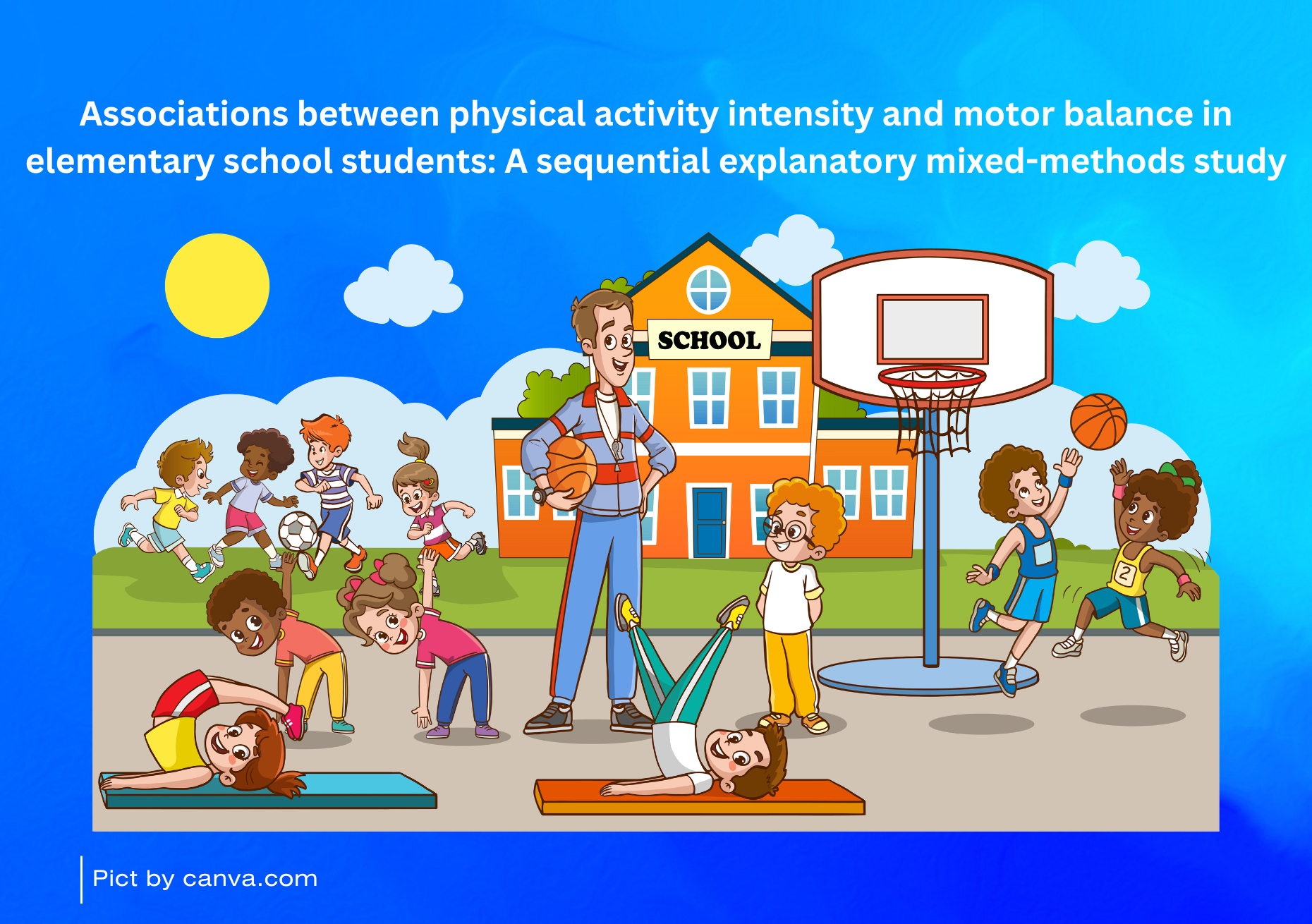
Associations between physical activity intensity and motor balance in elementary school students: A sequential explanatory mixed-methods study
Fahrurrohman Firdaus1, Indra Safari2, Rizal Ahmad Fauzi31. Indonesian University of Education , ID2. Indonesian University of Education , ID3. Indonesian University of Education , ID2026-04-01|page 47-56AbstractBackground: Children in primary school are becoming more sedentary due to advances in digital technology, which may reduce their physical activity levels. The development of motor skills, especially balance, which is an essential feature of children's motor abilities, can be impacted by a lack of physical activity.
Objectives: This study aimed to examine the association between physical activity intensity and motor balance in elementary school students.
Methods: This study used a sequential explanatory mixed-methods design. The quantitative phase involved 50 students selected using saturated sampling, while the qualitative phase involved teachers and students selected purposively. Physical activity intensity was measured using the Physical Activity Questionnaire for Older Children (PAQ-C), while motor balance was assessed using the Balance Beam Test. Quantitative data were analyzed using Spearman's rank correlation, and qualitative data were analyzed using thematic analysis in NVivo.
Results: With a correlation coefficient of r = 0.687 and p < 0.05, the analysis demonstrated a strong, substantial positive link between motor balance levels and physical activity intensity. The intensity of physical activity accounted for 47.2% of motor balance. Qualitative research revealed that students with high levels of physical activity were more likely to engage in active play, such as running outside, cycling, and soccer, which, in turn, indirectly improve balance and postural stability.
Conclusions: This study demonstrates that physical activity intensity plays an important role in the development of motor balance among elementary school students. These findings highlight the importance of integrating active movement-based learning strategies in physical education programs.
APA Citation StyleFirdaus, F. , Safari, I. , & Fauzi, R. A. (2026). Associations between physical activity intensity and motor balance in elementary school students: A sequential explanatory mixed-methods study. Physical Education and Sports: Studies and Research, 47-56. https://doi.org/10.56003/pessr.v5i1.706 -

The Relationship of Sports Participation in Academic Performance among College of Arts and Sciences Varsity Players
John Michael Aquino1, Mary Grace Reyes21. Laguna State Polytechnic University , PH2. Laguna State Polytechnic University , PH2022-09-10|page 107-122AbstractBackground: Sports are featured in the curriculums of state universities and colleges (SUCs). The Laguna State Polytechnic University (LSPU) shines in sports competition throughout Region IV, and the College of Arts and Sciences (CAS) varsity athletes are actively engaging in this sports competition. Nevertheless, during the previous decade, the CAS had been routinely rated third to fifth in intramurals.
Objectives: The researcher wish to ascertain the embodiment of CAS student athletes' experiences in sports involvement and academic performances to discover the significance of participation in sports and academic performance of students. The findings serve as the foundation for crafting Student Intervention Program.
Methods: The descriptive survey approach was used to a total of 30 varsity players in CAS from the 5 programs. The Cronbach alpha was utilized to assess the overall consistency of the self-made instrument and was carried out to CAS students belong to the varsity team using an internet web service.
Results: It was established that the student-athletes felt that all the assertions were evaluated as great in the university, especially in CAS, indicating satisfaction with the university's operations. Consequently, athletes excel in both athletics and academics.
Conclusion: It was notably that CAS varsity players were deemed to be great by the student-athletes. Respondents were happy with the university's procedures as viewed and experienced in prior sports competitions held not just within the LSPU System but also at the Regional STRASUC or even National SCUAA. Students participating in sports are much more likely to excel academically.
APA Citation StyleAquino, J. M. , & Reyes, M. G. (2022). The Relationship of Sports Participation in Academic Performance among College of Arts and Sciences Varsity Players. Physical Education and Sports: Studies and Research, 107-122. https://doi.org/10.56003/pessr.v1i2.129 -
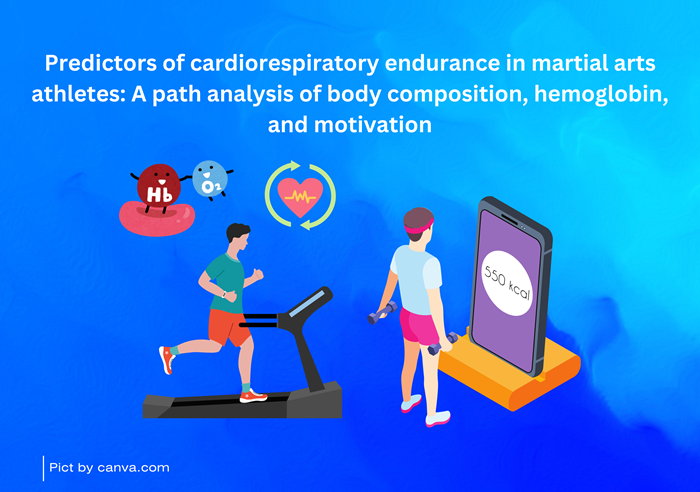
Predictors of cardiorespiratory endurance in martial arts athletes: A path analysis of body composition, hemoglobin, and motivation
Novanto Ponco Nugroho 1, Dani Nur Riyadi2, Aridhotul Haqiyah31. Universitas Islam 45 Bekasi , ID2. Universitas Islam 45 Bekasi , ID3. Universitas Islam 45 Bekasi , ID2025-07-01|page 83-94AbstractBackground: Cardiorespiratory endurance is vital to athletic performance, particularly in sports requiring sustained physical exertion such as martial arts.
Objectives: This study examined the predictive roles of body composition (BMI), hemoglobin concentration, and motivation on cardiorespiratory endurance among university-level martial arts athletes.
Methods: Using a quantitative path analysis design, data were collected from 20 purposively selected martial arts athletes who regularly trained. Cardiorespiratory endurance was assessed via the multistage fitness test, BMI was calculated using standard anthropometric measures, hemoglobin was measured using the Harenz scale, and motivation was evaluated with a validated Likert-scale questionnaire.
Results: The analysis showed that BMI (ρ = 0.705, t = 3.071, p = 0.007) and hemoglobin concentration (ρ = 0.946, t = 4.672, p < 0.001) had significant positive effects on cardiorespiratory endurance. Motivation, however, did not have a significant direct effect (ρ = 0.087, t = 0.853, p = 0.203). Additionally, BMI correlated positively with both hemoglobin (ρ = 0.923, p < 0.001) and motivation (ρ = 0.670, p = 0.034), suggesting indirect effects through physiological mechanisms.
Conclusions: The findings underscore that physiological indicators, specifically BMI and hemoglobin, are more critical predictors of aerobic capacity than psychological factors like motivation in this athletic population. Due to sport-specific demands, these results may not be generalizable to non-martial arts athletes. Future studies should incorporate additional mediators such as training intensity and account for potential self-report bias in motivation assessments.
APA Citation StyleNugroho , N. P. , Riyadi, D. N. , & Haqiyah, A. (2025). Predictors of cardiorespiratory endurance in martial arts athletes: A path analysis of body composition, hemoglobin, and motivation. Physical Education and Sports: Studies and Research, 83-94. https://doi.org/10.56003/pessr.v4i2.559 -

Psychosocial predictors of academic achievement in physical education among Indonesian university students: Testing the mediating role of mental toughness
Muhad Fatoni1, Agam Akhmad Syaukani2, Pungki Indarto3, Imron Nugroho Saputro4, Ismi Husniyah Musyfiroh51. Muhammadiyah University of Surakarta , ID2. University of Technology Malaysia , MY3. Muhammadiyah University of Surakarta , ID4. Muhammadiyah University of Surakarta , ID5. Muhammadiyah University of Surakarta , ID2025-12-12|page 291-301AbstractBackground: Academic performance in this context is conceptualized holistically, encompassing the integration of cognitive, affective, psychomotor, and physical achievements. Grounded in Self-Determination Theory and Social Cognitive Theory, the study posits that physical activity interest and social skills serve as predictors of both mental toughness and academic outcomes.
Objectives: This study examines the mediating role of mental toughness in the relationship between physical activity interest, social skills, and academic performance among university students enrolled in physical education programs.
Methods: A quantitative approach was employed, involving the administration of structured questionnaires to 235 active students. Data were analyzed using Structural Equation Modeling with a Partial Least Squares approach to assess construct validity and the relationships among variables.
Results: The results reveal that interest in physical activity and social skills has a significant influence on both mental toughness and academic performance. However, mental toughness did not serve as a substantial mediator within the proposed model.
Conclusions: These findings underscore the critical direct roles of affective and social factors in predicting academic success in physical education contexts. Theoretically, this study clarifies the functional position of mental toughness, while practically, it promotes the development of instructional strategies that enhance intrinsic motivation and collaborative skills within physical education curricula.APA Citation StyleFatoni, M. , Syaukani, A. A. , Indarto, P. , Saputro, I. N. , & Musyfiroh, I. H. (2025). Psychosocial predictors of academic achievement in physical education among Indonesian university students: Testing the mediating role of mental toughness. Physical Education and Sports: Studies and Research, 291-301. https://doi.org/10.56003/pessr.v4i3.624





















