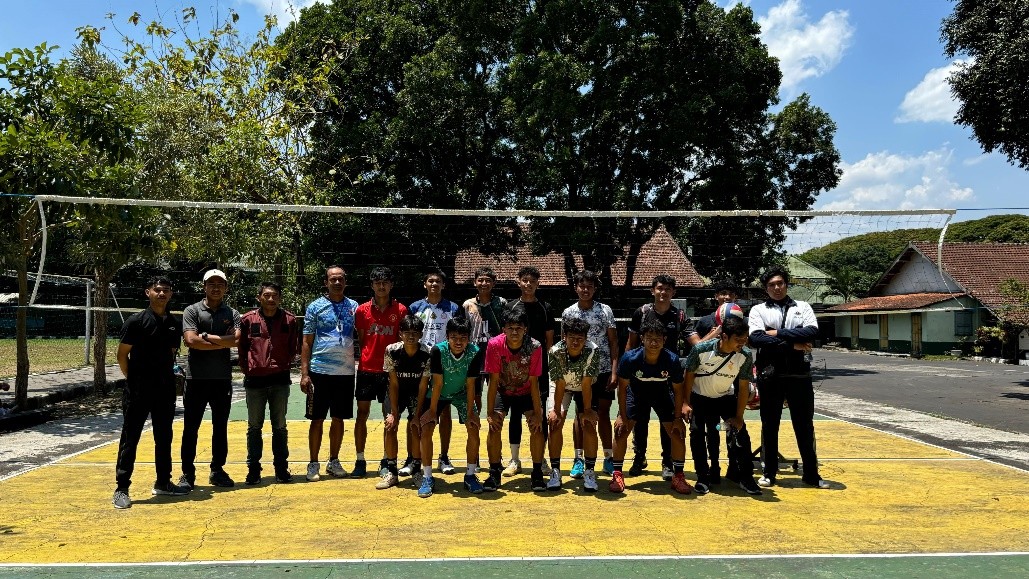
Evaluasi keterampilan bermain bola voli sebagai upaya pembinaan atlet muda di Klub Bahana Muda
Assessment of volleyball skills as part of the development of young athletes at the Bahana Muda Club

##submission.downloads##
Abstrak
Evaluasi performa secara periodik merupakan fondasi utama dalam mendukung peningkatan prestasi atlet, terutama pada cabang olahraga yang menuntut kemampuan teknis tinggi seperti bola voli. Evaluasi berbasis data menjadi instrumen penting untuk mengidentifikasi kekuatan dan kelemahan atlet secara objektif, serta sebagai dasar perumusan program latihan yang terarah. Program pengabdian kepada masyarakat ini bertujuan untuk mengevaluasi keterampilan bermain bola voli melalui pengukuran keterampilan teknis atlet di Klub Bahana Muda Kota Malang. Kegiatan ini melibatkan 20 atlet putra yang telah memiliki pengalaman bertanding dalam ajang Pekan Olahraga Provinsi (Porprov), dan dilaksanakan dengan pendekatan partisipatif. Serangkaian tes keterampilan yang digunakan meliputi tes passing, service, dan smash/spike. Hasil pengukuran menunjukkan bahwa sebagian besar atlet berada dalam kategori sedang (40%), diikuti kategori kurang (30%), dan hanya satu atlet yang menempati kategori sangat baik. Temuan ini menunjukkan adanya kesenjangan performa antar-atlet yang memerlukan intervensi pelatihan yang lebih individual dan terstruktur. Selain menghasilkan data awal mengenai performa atlet, kegiatan ini juga memberikan manfaat dalam meningkatkan kesadaran pelatih akan pentingnya evaluasi berbasis data dalam proses pembinaan. Kesimpulannya, asesmen performa yang dilakukan dalam program pengabdian ini memberikan gambaran objektif mengenai kesiapan teknis atlet dan berpotensi menjadi dasar untuk penyusunan program latihan yang adaptif dan berkelanjutan. Oleh karena itu, disarankan agar kegiatan evaluatif seperti ini dilakukan secara berkala untuk memantau perkembangan dan memastikan kesinambungan peningkatan performa atlet.
Abstract
Periodic performance evaluation is the primary foundation for improving athlete performance, especially in sports that demand high technical abilities, such as volleyball. Data-based evaluation is an important instrument for objectively identifying the strengths and weaknesses of athletes, as well as the basis for formulating targeted training programs. This community service program aims to evaluate volleyball playing skills by measuring the technical skills of athletes at the Bahana Muda Club in Malang City. This activity involved 20 male athletes who had experience competing in the Provincial Sports Week (Porprov) event and was carried out with a participatory approach. Several skill tests include passing, service, and smash/spike tests. The measurement results showed that most athletes were in the moderate category (40%), followed by the deficient category (30%), and only one athlete occupied the excellent category. These findings indicate that performance gaps between athletes require more individualized and structured training interventions. In addition to producing preliminary data on athlete performance, this activity also benefits coaches' awareness of the importance of data-based evaluation in coaching. In conclusion, the performance assessment carried out in this service program provides an objective picture of the athlete's technical readiness. It can become the basis for preparing an adaptive and sustainable training program. Therefore, it is recommended that evaluative activities like this be carried out regularly to monitor progress and ensure the continuity of athlete performance improvement.
Aini, K. (2021). Improving passing skills on volleyball using target games approach. Journal Sport Area, 6(1), 22–28. https://doi.org/10.25299/sportarea.2021.vol6(1).5288
Artazila, S. Z. N., & Adi, S. (2024). Analysis of Badminton Techniques Smash Using a Biomechanical Approach: Systematic Literature Review. JUMORA: Jurnal Moderasi Olahraga, 4(2), 232–241. https://doi.org/10.53863/mor.v4i2.1474
Bompa, T. O., & Buzzichelli, C. (2019). Periodization-: theory and methodology of training. Human kinetics. https://doi.org/10.5040/9781718225435
Cahyati, N., Huda, B. P., Munabil, M. R., Rahman, A. A., & Suherman, A. (2025). Analisis Keterbatasan Sarana dan Prasarana Dalam Faktor Pendukung Prestasi Klub Bola Voli Villor. Jurnal Pendidikan Jasmani Kesehatan Dan Rekreasi (Penjaskesrek), 12(1), 126–135. https://doi.org/10.46368/jpjkr.v12i1.3316
Crowcroft, S., Slattery, K., McCleave, E., & Coutts, A. J. (2020). Do athlete monitoring tools improve a coach’s understanding of performance change? International Journal of Sports Physiology and Performance, 15(6), 847–852. https://doi.org/10.1123/ijspp.2019-0338
Fuchs, P. X., Fusco, A., Bell, J. W., von Duvillard, S. P., Cortis, C., & Wagner, H. (2020). Effect of differential training on female volleyball spike-jump technique and performance. International Journal of Sports Physiology and Performance, 15(7), 1019–1025. https://doi.org/10.1123/ijspp.2019-0488
Gabbett, T. J., Nassis, G. P., Oetter, E., Pretorius, J., Johnston, N., Medina, D., Rodas, G., Myslinski, T., Howells, D., & Beard, A. (2017). The athlete monitoring cycle: a practical guide to interpreting and applying training monitoring data. In British journal of sports medicine (Vol. 51, Issue 20, pp. 1451–1452). BMJ Publishing Group Ltd and British Association of Sport and Exercise Medicine. https://doi.org/10.1136/bjsports-2016-097298
Hariadi, I., & Hanief, Y. N. (2023). The effect of plyometric training on improving smash ability in volleyball athletes: meta-analysis study. Jurnal Pendidikan Jasmani (JPJ), 4(1), 57–72. https://doi.org/10.55081/jpj.v4i1.921
Hendry, D. T., Ford, P. R., Williams, A. M., & Hodges, N. J. (2015). Five evidence-based principles of effective practice and instruction. In Routledge handbook of sport expertise (pp. 414–429). Routledge. https://doi.org/10.4324/9781315776675-36
Hughes, M., & Franks, I. (2007). The essentials of performance analysis: an introduction. Routledge. https://doi.org/10.4324/9780203938065
Jëol, M., Terrien, M., & Chanavat, N. (2024). Challenges, risks, and development opportunities for amateur sports clubs: the case of French handball clubs. Managing Sport and Leisure, 1–17. https://doi.org/10.1080/23750472.2024.2305909
Kumar, D. (2023). A comparative study on effects of strength and plyometric training to improve performance in an open hand volley ball serve and spike. International Journal of Physical Education, Sports and Health, 10(4), 17–24. https://doi.org/10.22271/kheljournal.2023.v10.i4a.3003
Lindsey, I., & Adams, A. (2013). Sport development and community development. In Routledge handbook of sport policy (pp. 264–274). Routledge. https://doi.org/10.4324/9780203885581
Ma’mun, A., Anggorowati, R., Risma, R., Slamet, S., & Anira, A. (2022). An Historical Overview of the Culture of Sports in Indonesia: Global Issues and Challenges for Future Indonesian Sports Development Policies. Asian Journal of Sport History & Culture, 1(2), 161–182. https://doi.org/10.1080/27690148.2022.2119091
Maula, A. R., & Amrulloh, A. (2024). Pembinaan Prestasi Olahraga Bola Voli Di Klub Satria Sejati Kota Semarang Tahun 2024. Journal of SPORT (Sport, Physical Education, Organization, Recreation, and Training), 8(2), 449–472. https://doi.org/10.37058/sport.v8i2.11943
Medeiros, A. I. A., Palao, J. M., Marcelino, R., & Mesquita, I. (2014). Systematic review on sports performance in beach volleyball from match analysis. Revista Brasileira de Cineantropometria & Desempenho Humano, 16(06), 698–708. https://doi.org/10.5007/1980-0037.2014v16n6p698
Noreddine, Z., Djamel, M., Houcine, B., & Mohammed, S. (2016). The Effect of the Contrastive Training Using Weights and Plyometrics on the Development of the Vertical Jump Ability to Improve the Performance of the Smash for Volleyball Players. Eur. J. Phys. Educ. Sport, 11(1), 24–30. https://doi.org/10.13187/ejpe.2016.11.24
O’Donoghue, P. (2014). An introduction to performance analysis of sport. Routledge. https://doi.org/10.1080/23750472.2024.2305909
Palmizal, P., & Setiawan, I. B. (2024). Sosialisasi Pemahaman Manajemen Pengelolaan Organisasi Olahraga: Studi Kasus pada Cabang Bola Voli di Club IVOSBA Desa Sungai Bulian, Kabupaten Merangin, Provinsi Jambi Tahun 2023. Jurnal Pengabdian Kepada Masyarakat Bina Darma, 4(1), 93–98. https://doi.org/10.33557/pengabdian.v4i1.2984
Pasaribu, A. M. N. (2024). The Effect of Plyometric Training Program on Increasing Vertical Jump Ability in Volleyball Players. Journal Coaching Education Sports, 5(1), 169–176. https://doi.org/10.31599/jces.v5i1.3685
Passos, P., Araújo, D., & Volossovitch, A. (2017). Performance analysis in team sports. Routledge, Taylor & Francis Group London, UK: https://doi.org/10.4324/9781315739687
Pratama, H. G., Imandaqurani, D., Santoso, D. A., Candra, A. T., & Pratama, I. G. (2024). Effects of Plyometric Exercise of Adolescent Male Volleyball Athletes: A Systemic Review. Pamukkale Journal of Sport Sciences, 15(2), 399–415. https://doi.org/10.54141/psbd.1458129
Rasyono, R., & Sukendro, S. (2023). The Management Of Achievement Coaching At The Amateur Volleyball Club. Journal Management of Sport, 2(1), 28–34. https://doi.org/10.55081/jmos.v2i1.2119
Strange, M., & Carlson, P. (2018). Data-driven training and coaching system and method. Google Patents.
Hak Cipta (c) 2025 Mahesa Dwi Chandra, Usamah Daffa Inzaghi

Artikel ini berlisensiCreative Commons Attribution-ShareAlike 4.0 International License.