
Search
Search Results
##search.searchResults.foundPlural##
-

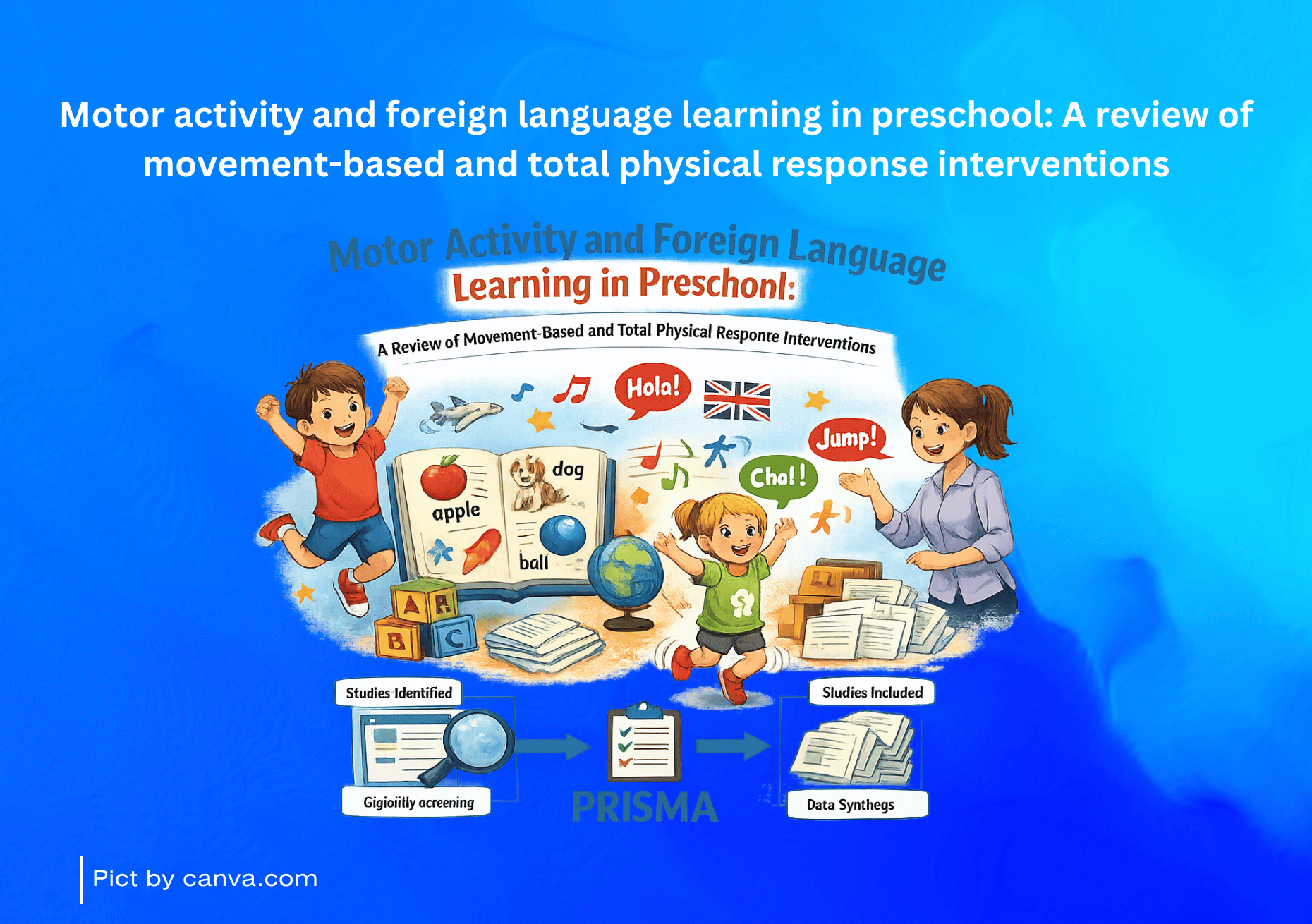
Motor activity and foreign language learning in preschool: A review of movement-based and total physical response interventions
Manuela Valentini1, Nausicaa Simone2, Alessandro Beretta31. Department of Humanities, University of Urbino Carlo Bo , IT2. Department of Humanities, University of Urbino Carlo Bo , IT3. Department of Humanities, University of Urbino Carlo Bo , IT2026-04-02|page 93-105AbstractBackground: Movement may support early foreign-language learning through embodied learning, but the preschool evidence base is fragmented.
Objective: To review empirical studies on movement-based and Total Physical Response (TPR) interventions for foreign-language learning in preschool children.
Method: This study employed a systematic review design based on PRISMA 2020 guidelines, involving database searches and citation tracking to identify empirical studies on movement-based and Total Physical Response (TPR) interventions in preschool foreign-language learning. Studies were screened using predefined eligibility criteria and appraised using the Mixed Methods Appraisal Tool (MMAT). Data from eligible studies were extracted and synthesized narratively due to methodological heterogeneity.
Results: Eight studies met the inclusion criteria. Across stronger controlled studies, semantically integrated movement generally produced more favorable vocabulary and verbal memory outcomes than sedentary teaching or less integrated movement. Evidence focused specifically on TPR was positive in terms of engagement and short-term learning, but methodologically heterogeneous and less robust.
Conclusion: Current preschool evidence supports the promise of integrated movement-based language teaching, particularly when movement is tightly aligned with instructional content. However, the evidence base remains small, largely limited to vocabulary-related outcomes, and further rigorous preschool trials are needed to clarify optimal implementation and the distinct contribution of TPR.APA Citation StyleValentini, M. , Simone, N. , & Beretta, A. (2026). Motor activity and foreign language learning in preschool: A review of movement-based and total physical response interventions. Physical Education and Sports: Studies and Research, 93-105. https://doi.org/10.56003/pessr.v5i1.694 -
Development and evaluation of a web-based interactive flashcard tool (Aero’Zen) for low-impact rhythmic activity instruction in physical education
Zenny Ni'matul Ulya1, Donny Anhar Fahmi2, Ibnu Fatkhu Royana31. Department of Physical Education, Faculty of Social Sciences and Physical Education, Universitas PGRI Semarang , ID2. Department of Physical Education, Faculty of Social Sciences and Physical Education, Universitas PGRI Semarang , ID3. Department of Physical Education, Faculty of Social Sciences and Physical Education, Universitas PGRI Semarang , ID2026-08-31|page 233-247AbstractBackground: Teaching rhythmic activities in physical education continues to face challenges due to the limited availability of visual learning aids that demonstrate movements systematically, repeatedly, and accessibly.
Objectives: This study aimed to develop and evaluate Aero’Zen, a web-based interactive flashcard tool integrating movement illustrations, QR codes, and demonstration videos for basic low-impact rhythmic activities.
Methods: This research and development study employed the ADDIE model. Following product development and expert validation, learning outcomes were evaluated using a one-group pretest–posttest pre-experimental design involving 30 tenth-grade students at SMK Negeri 2 Semarang. Product feasibility was assessed by media experts, subject matter experts, and a physical education practitioner. Pretest and posttest scores were analyzed using the Shapiro–Wilk test for normality and paired-samples t-tests, with the significance level set at α = .05.
Results: Aero’Zen was rated highly suitable by media experts (95.75%), subject matter experts (94.50%), and a physical education practitioner (88.75%). Mean scores increased from 75.40 to 89.97 in the cognitive domain, from 28.80 to 32.77 in the affective domain, and from 19.87 to 32.00 in the psychomotor domain. Paired-samples t-tests revealed significant differences between pretest and posttest scores across all three domains (all p < .001).
Conclusions: Aero’Zen is a highly suitable web-based learning medium with the potential to support students’ cognitive, affective, and psychomotor learning outcomes, including movement coordination and performance, in low-impact rhythmic activities. Its integrated flashcards, QR-code access, and demonstration videos provide a flexible resource for repeated and independent learning. Future studies should use randomized controlled trials with larger and more diverse samples to strengthen causal inference and generalizability.
APA Citation StyleUlya, Z. N. , Fahmi, D. A. , & Royana, I. F. (2026). Development and evaluation of a web-based interactive flashcard tool (Aero’Zen) for low-impact rhythmic activity instruction in physical education. Physical Education and Sports: Studies and Research, 233-247. https://doi.org/10.56003/pessr.v5i2.761 -

Promoting gender responsiveness in teaching physical education
Ryan Cazel Lalog11. Batangas State University , PH2025-04-04|page 1-14AbstractBackground: Implementing gender policies in physical education at Batangas State University remains moderate, with challenges in ensuring gender-responsive and equitable activities for male and female students. Issues such as students' self-confidence, self-perception, and limited gender mainstreaming strategies and resources hinder the development of a more inclusive learning environment.
Objectives: This study examined gender policy implementation, the use of strategies and resources in various physical education activities, differences in male and female instructors' assessments, challenges in gender mainstreaming, and the development of gender-responsive activities.
Methods: A descriptive research method was used, collecting data from 105 university physical education instructors (77 males, 28 females) through a researcher-made survey questionnaire.
Results: Findings revealed that gender policies were moderately implemented (mean score: 3.47), while both male (3.67) and female (3.63) instructors highly utilized strategies and resources in physical fitness, rhythmic activities, individual and dual sports, and team sports. No significant differences were observed in male and female educators' assessments, indicating shared perspectives on gender mainstreaming.
Conclusions: The study emphasizes the need for more vigorous policy enforcement and improvements in sports-related content to enhance gender inclusivity. Addressing self-confidence, self-perception, and individual differences is crucial for fostering equitable learning experiences. Universities should provide continuous professional development for PE instructors on gender-sensitive teaching strategies. Future research should explore the long-term impact of gender-responsive approaches on student engagement, performance, and overall well-being in physical education.
APA Citation StyleLalog, R. C. (2025). Promoting gender responsiveness in teaching physical education. Physical Education and Sports: Studies and Research, 1-14. https://doi.org/10.56003/pessr.v4i1.392

1 - 3 of 3 items




















