
Search
Search Results
##search.searchResults.foundPlural##
-

Examining the mediating role of perceived psychosocial support in the relationship between sport grit and psychological well-being among high school student-athletes
Daphne Scott Fernandez1, Kahreen Lou Mondina21. Saint Louis College La Union,Saint Louis College La Union , PH2. Saint Louis College La Union,Saint Louis College La Union , PH2026-08-01|page 182-195AbstractBackground: Psychological well-being is essential for student-athletes because they must simultaneously cope with competitive sport demands and academic responsibilities. Although both sport grit and perceived psychosocial support have been associated with positive psychological outcomes, the mediating role of psychosocial support in the relationship between sport grit and psychological well-being remains insufficiently understood.
Objectives: This study examined whether perceived psychosocial support mediates the relationship between sport grit and psychological well-being among high school student-athletes.
Methods: A quantitative cross-sectional correlational design with a mediation analysis framework was employed. A total of 362 high school student-athletes from the first district of La Union, Philippines, participated using total enumeration sampling. Data were collected using standardized questionnaires assessing sport grit, psychological well-being, and perceived psychosocial support. Descriptive statistics, regression analysis, and bias-corrected bootstrap mediation analysis (5,000 resamples) were performed using JASP.
Results: Student-athletes reported high levels of sport grit, psychological well-being, and perceived psychosocial support. Sport grit significantly and positively predicted psychological well-being, whereas it did not significantly predict perceived psychosocial support. Perceived psychosocial support demonstrated a significant but negative association with psychological well-being. Furthermore, the indirect effect of sport grit on psychological well-being through perceived psychosocial support was not statistically significant, indicating the absence of a mediating effect.
Conclusions: Sport grit is an important direct psychological resource associated with psychological well-being among high school student-athletes. Although perceived psychosocial support contributes to athletes' psychological functioning, it does not explain the relationship between sport grit and psychological well-being. These findings highlight the importance of strengthening athletes' internal psychological resources while maintaining supportive sport environments.
APA Citation StyleFernandez, D. S. , & Mondina, K. L. (2026). Examining the mediating role of perceived psychosocial support in the relationship between sport grit and psychological well-being among high school student-athletes. Physical Education and Sports: Studies and Research, 182-195. https://doi.org/10.56003/pessr.v5i2.725 -
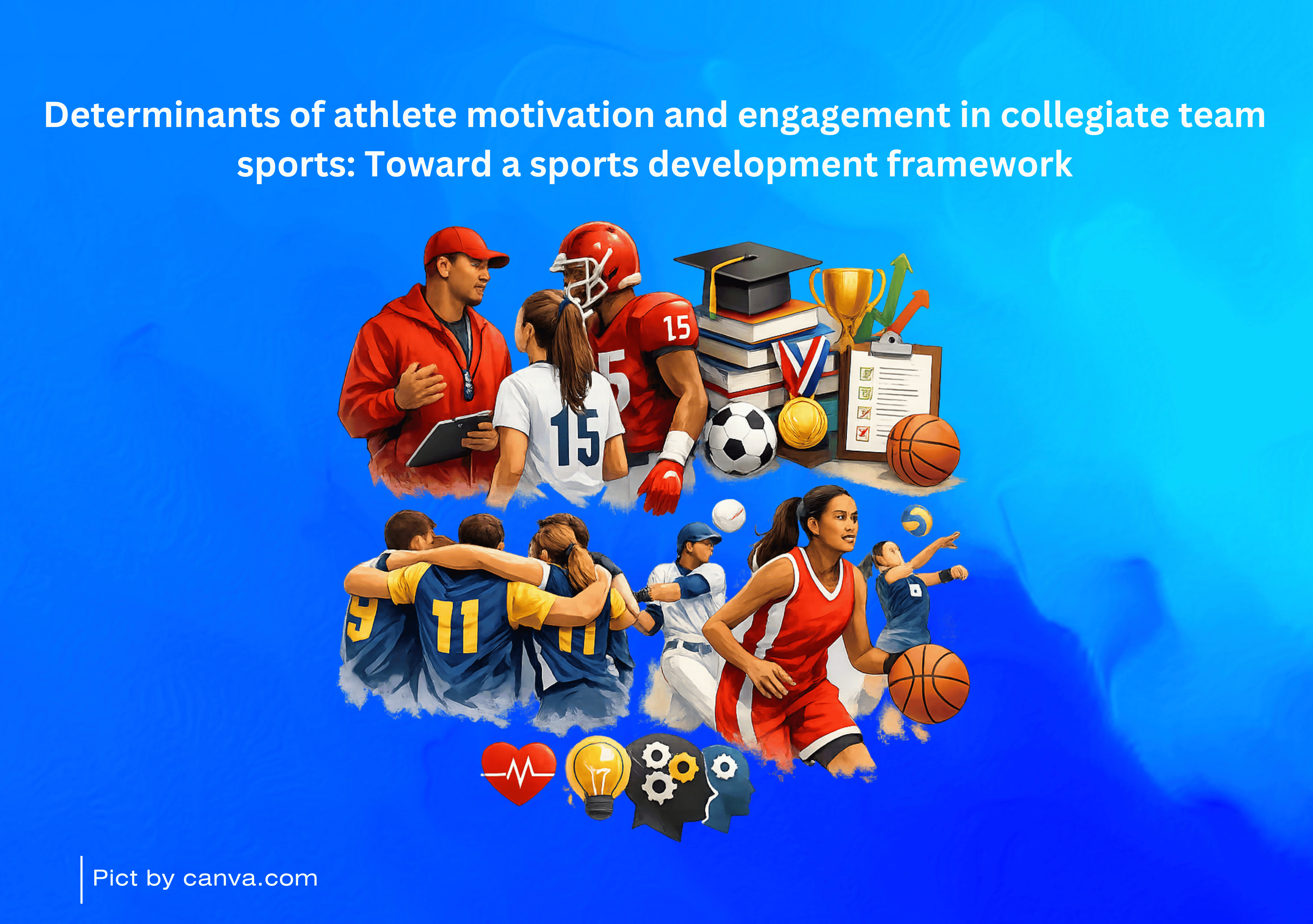
Determinants of athlete motivation and engagement in collegiate team sports: Toward a sports development framework
Teejay D. Panganiban1, Samboy Nabor21. Batangas State University TNEU JPLPC-Malvar , PH2. University of Perpetual Help System Dalta Las Piñas , PH2026-04-14|page 147-159AbstractBackground: Athlete motivation and sustained engagement are essential for retention in collegiate sports programs; however, the institutional and environmental factors that influence these outcomes remain underexplored.
Objectives: This study aimed to examine the determinants of athlete motivation and engagement in collegiate team sports using a Self-Determination Theory perspective, with engagement serving as a proxy for retention behavior.
Methods: A mixed-methods design was employed involving 75 collegiate student-athletes representing basketball, volleyball (men and women), baseball, and softball teams. Quantitative data were collected using a validated, researcher-developed questionnaire based on Self-Determination Theory and analyzed using descriptive statistics, Pearson's correlation, multiple regression, and Structural Equation Modeling (SEM). In contrast, qualitative data were analyzed using thematic analysis.
Results: Findings revealed that organizational commitment (M = 3.42) and environmental support (M = 3.47) were rated very high, while incentives and facilities were rated high. All program components were significantly associated with athlete engagement (p < .05). Regression analysis showed that environmental support (β = .36) and perceived support (β = .31) were the strongest predictors, explaining 68% of the variance (R² = 0.68). SEM results indicated a good model fit (CFI = 0.95; RMSEA = 0.061).
Conclusions: Qualitative findings highlighted intrinsic motivations, such as passion and belonging, as well as extrinsic motivators, including scholarships and rewards, alongside barriers, including financial delays, academic conflicts, and burnout. The study concludes that environmental and perceived support are the primary determinants of athlete engagement, emphasizing the critical role of competence-supportive environments in sustaining motivation and improving athlete retention.
APA Citation StylePanganiban, T. D. , & Nabor, S. (2026). Determinants of athlete motivation and engagement in collegiate team sports: Toward a sports development framework. Physical Education and Sports: Studies and Research, 147-159. https://doi.org/10.56003/pessr.v5i1.718 -
Psychosocial predictors of academic achievement in physical education among Indonesian university students: Testing the mediating role of mental toughness
Muhad Fatoni1, Agam Akhmad Syaukani2, Pungki Indarto3, Imron Nugroho Saputro4, Ismi Husniyah Musyfiroh51. Muhammadiyah University of Surakarta , ID2. University of Technology Malaysia , MY3. Muhammadiyah University of Surakarta , ID4. Muhammadiyah University of Surakarta , ID5. Muhammadiyah University of Surakarta , ID2025-12-12|page 291-301AbstractBackground: Academic performance in this context is conceptualized holistically, encompassing the integration of cognitive, affective, psychomotor, and physical achievements. Grounded in Self-Determination Theory and Social Cognitive Theory, the study posits that physical activity interest and social skills serve as predictors of both mental toughness and academic outcomes.
Objectives: This study examines the mediating role of mental toughness in the relationship between physical activity interest, social skills, and academic performance among university students enrolled in physical education programs.
Methods: A quantitative approach was employed, involving the administration of structured questionnaires to 235 active students. Data were analyzed using Structural Equation Modeling with a Partial Least Squares approach to assess construct validity and the relationships among variables.
Results: The results reveal that interest in physical activity and social skills has a significant influence on both mental toughness and academic performance. However, mental toughness did not serve as a substantial mediator within the proposed model.
Conclusions: These findings underscore the critical direct roles of affective and social factors in predicting academic success in physical education contexts. Theoretically, this study clarifies the functional position of mental toughness, while practically, it promotes the development of instructional strategies that enhance intrinsic motivation and collaborative skills within physical education curricula.APA Citation StyleFatoni, M. , Syaukani, A. A. , Indarto, P. , Saputro, I. N. , & Musyfiroh, I. H. (2025). Psychosocial predictors of academic achievement in physical education among Indonesian university students: Testing the mediating role of mental toughness. Physical Education and Sports: Studies and Research, 291-301. https://doi.org/10.56003/pessr.v4i3.624

1 - 3 of 3 items




















