
Search
Search Results
##search.searchResults.foundPlural##
-

Association between ADHD symptom severity and motor activity in preschool children: A cross-sectional study
Adnan Faris Naufal1, Chevanya Diva Titania Davinci2, Anida Azkia Fitri31. Department of Physiotherapy, Faculty of Health Science, Universitas Muhammadiyah Surakarta , ID2. Department of Physiotherapy, Faculty of Health Science, Universitas Muhammadiyah Surakarta , ID3. Department of Physiotherapy, Faculty of Health Science, Universitas Muhammadiyah Surakarta , ID2026-08-24|page 220-232AbstractBackground: Attention-deficit/hyperactivity disorder (ADHD) is a neurodevelopmental disorder characterized by inattention, hyperactivity, and impulsivity. Objective measurement of motor activity may complement parent-reported assessment of ADHD symptoms.
Objectives: This study aimed to examine the association between ADHD Rating Scale-5 scores and step counts, used as an objective indicator of motor activity, among children aged 4–6 years.
Methods: A cross-sectional observational study was conducted among 110 children aged 4–6 years selected through purposive sampling. ADHD symptoms were assessed using the parent-completed ADHD Rating Scale-5, while step counts were measured using a digital pedometer during a 15-minute school recess. Data normality was assessed using the Kolmogorov–Smirnov test. Pearson's product–moment correlation was used to examine the association between total ADHD Rating Scale-5 scores and step counts, whereas Spearman's rank correlation was used for the Inattention and Hyperactivity–Impulsivity domain scores.
Results: Total ADHD Rating Scale-5 scores showed a very strong positive correlation with step counts (r = .865, p < .001). At the domain level, Inattention scores showed a strong positive correlation with step counts (ρ = .756, p < .001), while Hyperactivity–Impulsivity scores showed a very strong positive correlation (ρ = .818, p < .001).
Conclusions: Higher ADHD symptom scores were strongly associated with higher motor activity, as indicated by step counts, among preschool children. Step-count measurement may provide a simple objective measure that complements parent-reported assessment of ADHD symptoms; however, it should not be interpreted as a diagnostic measure for ADHD.
APA Citation StyleNaufal, A. F. , Davinci, C. D. T. , & Fitri, A. A. (2026). Association between ADHD symptom severity and motor activity in preschool children: A cross-sectional study. Physical Education and Sports: Studies and Research, 220-232. https://doi.org/10.56003/pessr.v5i2.777 -
Association between SDQ-TR-assessed hyperactivity symptoms and step count during school activities in school-aged children
Najwa Citamajida1, Adnan Faris Naufal21. Faculty of Health Science, Universitas Muhammadiyah Surakarta , ID2. Faculty of Health Science, Universitas Muhammadiyah Surakarta , ID2026-09-07|page 264-275AbstractBackground: Hyperactivity is a core symptom of attention-deficit/hyperactivity disorder (ADHD) and may manifest as increased motor activity. Objectively measured step count may provide information about ambulatory movement associated with hyperactivity symptoms, while developmental differences may also influence movement patterns in children.
Objective: To examine the association between hyperactivity symptom severity and step count during school activities and to compare step count and hyperactivity scores between children aged 5 and 12 years.
Methods: This cross-sectional study included 40 children (20 males and 20 females) aged 5 and 12 years from two schools in Surakarta, Indonesia, recruited using total sampling. Hyperactivity symptoms were assessed using the hyperactivity/inattention subscale of the Strengths and Difficulties Questionnaire Teacher Report (SDQ-TR), while step count was objectively measured using a Maxfit pedometer during one school day. Spearman's rank correlation, independent-samples t-tests, and Mann–Whitney U tests were used for statistical analysis.
Results: Hyperactivity scores were strongly and positively correlated with step count (rₛ = 0.918, p < 0.001). Step count differed significantly between the age groups (p = 0.041), with higher values observed among 5-year-old children than among 12-year-old children. In contrast, hyperactivity scores did not differ significantly between the two age groups (p = 0.701).
Conclusion: Higher hyperactivity symptom severity was associated with greater step count during school activities. Step count differed between the two age groups, whereas hyperactivity scores did not. These findings suggest that objectively measured ambulatory movement and hyperactivity symptoms may capture related but developmentally distinct aspects of children's behaviour.
APA Citation StyleCitamajida, N. , & Naufal, A. F. (2026). Association between SDQ-TR-assessed hyperactivity symptoms and step count during school activities in school-aged children. Physical Education and Sports: Studies and Research, 264-275. https://journal.rezkimedia.or.id/pes/article/view/778 -
Enhancing locomotor skills in preschoolers through play jump rope
Nancy Trisari Schiff1, Andy Supriady21. Sekolah Tinggi Keguruan dan Ilmu Pendidikan (STKIP) Pasundan , ID2. Sekolah Tinggi Keguruan dan Ilmu Pendidikan (STKIP) Pasundan , ID2026-04-14|page 135-146AbstractBackground: Fundamental Motor Skills (FMS), particularly in the Locomotor Skills domain, are an essential prerequisite for lifelong physical participation. However, the dominance of a sedentary lifestyle threatens young children's mastery of these skills.
Objectives: This study aims to test and prove the effectiveness of the jump rope play intervention program in improving locomotor skills in 5–6-year-old children.
Methods: This research uses a quasi-experimental one-group pretest-posttest design. The sample consisted of 19 males and 11 females, for a total of 30 children. Locomotor skills are measured objectively using the Locomotor subtest of the Test of Gross Motor Development-2 (TGMD-2). The Jump Rope Game intervention was implemented in a structured manner over 8 weeks (3 sessions/week). The data were analyzed using the Paired-Samples T-Test.
Results: The research results show a highly significant improvement in locomotor skills scores after the intervention. The average score increased from 23.30 on the pretest to 27.87 on the posttest, reflecting a 19.61% increase. The paired-samples t-test yielded a p-value of 0.000 (p<0.05), confirming that the difference between the two measurements was statistically significant.
Conclusions: Jump rope games have proven to be an effective, efficient, and enjoyable intervention for significantly improving young children's locomotor skills. This research recommends integrating inexpensive, easily accessible play-based activities into the early childhood education curriculum as a practical strategy to support physical literacy and address basic movement deficits.
APA Citation StyleSchiff, N. T. , & Supriady, A. (2026). Enhancing locomotor skills in preschoolers through play jump rope. Physical Education and Sports: Studies and Research, 135-146. https://doi.org/10.56003/pessr.v5i1.652 -
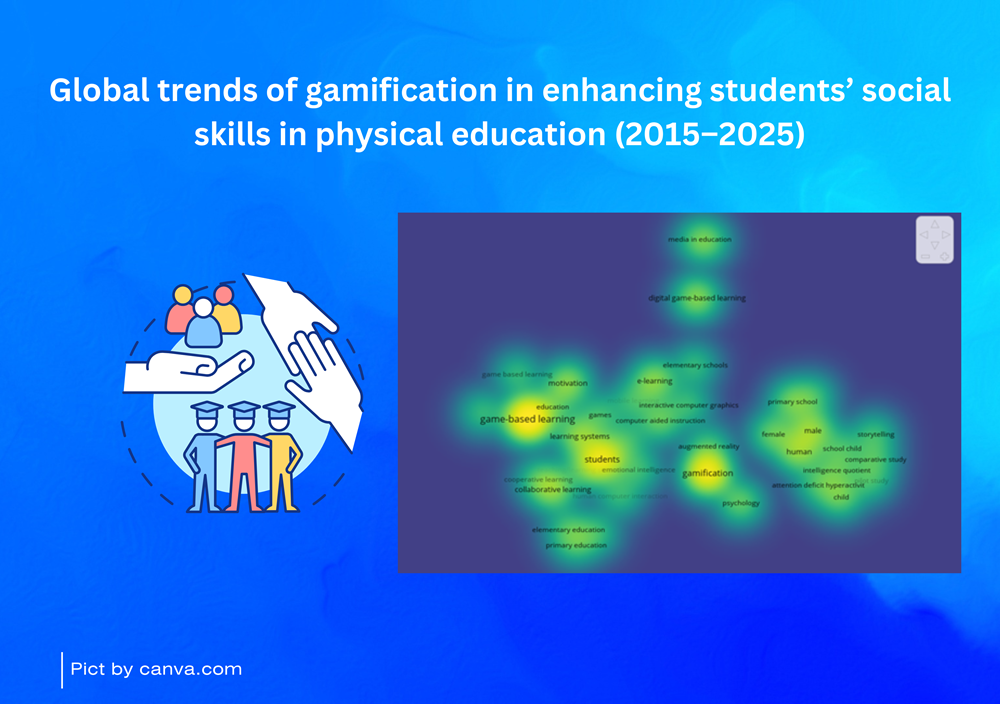
Global trends of gamification in enhancing students’ social skills in physical education (2015–2025)
Rajip Mustafillah Rusdiyanto1, Ari Wibowo Kurniawan21. State University of Malang , ID2. State University of Malang , ID2025-07-01|page 125-138AbstractBackground: The development of digital technology has triggered a more interactive learning transformation through gamification, namely using game elements to increase students' motivation, engagement, and social skills, such as cooperation, communication, empathy, and problem solving.
Objectives: This study aims to analyze global research trends on gamification in enhancing students' social skills, particularly in physical education, through a bibliometric analysis from 2015 to 2025.
Methods: This study employed a bibliometric design. Data were retrived from the Scopus database on April 22, 2025, using specific keywords: (gamification OR gamified learning OR game-base-based learning) AND ("physical education" OR "PE class" OR "sport education") AND (social skills" OR "social competence" OR "social interaction") AND (elementary school" OR "primary school" OR "midle school" OR "junior high school" OR "high school" OR "secondary school" From an initial 120 documents, 47 met the inclusion criteria. VOSViewer was used to analyze keyword co-occurrence, visualize trends, and identify thematic clusters by completely counting on all keywords with at least two documents per author.
Results: 47 relevant articles were identified, with publication peaking in 2020. Keyword analysis revealed five main thematic clusters: gamification in education, digital game-based learning, collaborative learning, emerging technologies, and motivation. The most frequent keywords were game-based learning (n=12), gamification (n=9), and students (n=8). The University of Patras emerged as the most productive institution, while the leading journal was the International Journal of Learning, Teaching and Educational Research.
Conclusions: Although research on gamification has grown significantly, its application in physical education remains underexplored. This study reveals a gap in leveraging gamification to develop students' social skills in physical education. Future research should focus on integrating gamification in this context while considering sociocultural and technological factors to ensure inclusive and effective implementation.
APA Citation StyleRusdiyanto, R. M. , & Kurniawan, A. W. (2025). Global trends of gamification in enhancing students’ social skills in physical education (2015–2025). Physical Education and Sports: Studies and Research, 125-138. https://doi.org/10.56003/pessr.v4i2.598

1 - 4 of 4 items




















