
Search
Search Results
##search.searchResults.foundPlural##
-


Development and evaluation of an Android-based multimedia application to promote healthy lifestyles in physical education: A study at State Junior High School 29 Semarang
Galang Yusuf Pujiyanto1, Ibnu Fatkhu Royana2, Muh. Isna Nurdin Wibisana31. Universitas PGRI Semarang , ID2. Universitas PGRI Semarang , ID3. Universitas PGRI Semarang , ID2025-07-23|page 162-174AbstractBackground: The integration of interactive, technology-based media in Physical Education, particularly for teaching health-related content, remains limited despite its potential to enhance student engagement and learning outcomes.
Objectives: This study aims to address this gap by developing and evaluating the effectiveness of an Android-based multimedia learning application, "Healthy Habits," designed to support the delivery of healthy lifestyle materials in Physical Education, Sports, and Health (Physical Education) subjects at the junior high school level.
Methods: The research employed a research and development (R&D) approach, involving expert validation from media and content specialists and usability trials with teachers and students.
Results: Validation results indicated a "Good" rating from the material expert (average score: 4.05) and a "Very Good" rating from the media expert (average score: 4.24), confirming the application's content quality and technical feasibility. Teacher evaluations also yielded a "Good" rating (average score: 4.07). Student trials produced positive responses, with small group testing receiving a "Very Good" rating (average score: 3.29), which increased to 4.23 ("Very Good") in large group testing. An effectiveness test assessing cognitive, affective, and psychomotor learning outcomes showed an average score of 85.6%, categorized as "Very Good." These findings demonstrate the feasibility and effectiveness of "Healthy Habits" as a digital learning tool for promoting healthy lifestyles in secondary school students.
Conclusions: The application offers practical value for educators and curriculum developers seeking to integrate mobile technology into Physical Education. Future studies are encouraged to explore the implementation of this application in varied educational contexts and its potential integration across other subject areas.
APA Citation StylePujiyanto, G. Y. , Royana, I. F. , & Wibisana, M. I. N. (2025). Development and evaluation of an Android-based multimedia application to promote healthy lifestyles in physical education: A study at State Junior High School 29 Semarang. Physical Education and Sports: Studies and Research, 162-174. https://doi.org/10.56003/pessr.v4i2.607 -

The association between healthy dietary habits and physical fitness among junior high school students: A rural school case study
Moch. Yunus1, Yulingga Nanda Hanief2, Muhammad Putra Ramadhan3, Erika Ayu Sylvianingrum41. State University of Malang , ID2. State University of Malang , ID3. State University of Malang , ID4. State University of Malang , ID2025-12-30|page 344-354AbstractBackground: The health conditions of the community, particularly in relation to the physical fitness of junior high school students, require serious attention, especially in rural areas that differ significantly from urban areas. Previous research findings on dietary patterns and physical fitness still show inconsistent results.
Objectives: This study aims to investigate the relationship between healthy eating habits and physical fitness among junior high school students residing in rural areas.
Methods: This study used a quantitative design with a cross-sectional approach. The research subjects consisted of 27 students from public junior high schools in rural areas, selected through a balanced stratified random sampling process that involved all grade levels. Eating habits were measured using a 24-hour food recall, as it is an effective method for monitoring food intake over a short period. Physical fitness was measured using the Nusantara Student Fitness Test (TKPN), a national standard instrument. Data analysis was performed using descriptive statistics, Spearman's correlation, and linear regression.
Results: Most of the study participants were underweight with varied eating patterns. The analysis results showed no significant relationship between physical fitness and healthy eating patterns, as indicated by a correlation coefficient of 0.061 and a p-value of 0.764. The small effect size suggests that eating patterns did not have a significant impact on fitness levels in this group of participants.
Conclusions: The study shows that rural junior high school students achieve their physical fitness through exercise and their exercise-rest patterns and their inherited characteristics rather than their diet.APA Citation StyleYunus, M. , Hanief, Y. N. , Ramadhan, M. P. , & Sylvianingrum, E. A. (2025). The association between healthy dietary habits and physical fitness among junior high school students: A rural school case study. Physical Education and Sports: Studies and Research, 344-354. https://doi.org/10.56003/pessr.v4i3.665 -
Enhancing locomotor skills in preschoolers through play jump rope
Nancy Trisari Schiff1, Andy Supriady21. Sekolah Tinggi Keguruan dan Ilmu Pendidikan (STKIP) Pasundan , ID2. Sekolah Tinggi Keguruan dan Ilmu Pendidikan (STKIP) Pasundan , ID2026-04-14|page 135-146AbstractBackground: Fundamental Motor Skills (FMS), particularly in the Locomotor Skills domain, are an essential prerequisite for lifelong physical participation. However, the dominance of a sedentary lifestyle threatens young children's mastery of these skills.
Objectives: This study aims to test and prove the effectiveness of the jump rope play intervention program in improving locomotor skills in 5–6-year-old children.
Methods: This research uses a quasi-experimental one-group pretest-posttest design. The sample consisted of 19 males and 11 females, for a total of 30 children. Locomotor skills are measured objectively using the Locomotor subtest of the Test of Gross Motor Development-2 (TGMD-2). The Jump Rope Game intervention was implemented in a structured manner over 8 weeks (3 sessions/week). The data were analyzed using the Paired-Samples T-Test.
Results: The research results show a highly significant improvement in locomotor skills scores after the intervention. The average score increased from 23.30 on the pretest to 27.87 on the posttest, reflecting a 19.61% increase. The paired-samples t-test yielded a p-value of 0.000 (p<0.05), confirming that the difference between the two measurements was statistically significant.
Conclusions: Jump rope games have proven to be an effective, efficient, and enjoyable intervention for significantly improving young children's locomotor skills. This research recommends integrating inexpensive, easily accessible play-based activities into the early childhood education curriculum as a practical strategy to support physical literacy and address basic movement deficits.
APA Citation StyleSchiff, N. T. , & Supriady, A. (2026). Enhancing locomotor skills in preschoolers through play jump rope. Physical Education and Sports: Studies and Research, 135-146. https://doi.org/10.56003/pessr.v5i1.652 -

Promoting gender responsiveness in teaching physical education
Ryan Cazel Lalog11. Batangas State University , PH2025-04-04|page 1-14AbstractBackground: Implementing gender policies in physical education at Batangas State University remains moderate, with challenges in ensuring gender-responsive and equitable activities for male and female students. Issues such as students' self-confidence, self-perception, and limited gender mainstreaming strategies and resources hinder the development of a more inclusive learning environment.
Objectives: This study examined gender policy implementation, the use of strategies and resources in various physical education activities, differences in male and female instructors' assessments, challenges in gender mainstreaming, and the development of gender-responsive activities.
Methods: A descriptive research method was used, collecting data from 105 university physical education instructors (77 males, 28 females) through a researcher-made survey questionnaire.
Results: Findings revealed that gender policies were moderately implemented (mean score: 3.47), while both male (3.67) and female (3.63) instructors highly utilized strategies and resources in physical fitness, rhythmic activities, individual and dual sports, and team sports. No significant differences were observed in male and female educators' assessments, indicating shared perspectives on gender mainstreaming.
Conclusions: The study emphasizes the need for more vigorous policy enforcement and improvements in sports-related content to enhance gender inclusivity. Addressing self-confidence, self-perception, and individual differences is crucial for fostering equitable learning experiences. Universities should provide continuous professional development for PE instructors on gender-sensitive teaching strategies. Future research should explore the long-term impact of gender-responsive approaches on student engagement, performance, and overall well-being in physical education.
APA Citation StyleLalog, R. C. (2025). Promoting gender responsiveness in teaching physical education. Physical Education and Sports: Studies and Research, 1-14. https://doi.org/10.56003/pessr.v4i1.392 -
Development and evaluation of a web-based interactive flashcard tool (Aero’Zen) for low-impact rhythmic activity instruction in physical education
Zenny Ni'matul Ulya1, Donny Anhar Fahmi2, Ibnu Fatkhu Royana31. Department of Physical Education, Faculty of Social Sciences and Physical Education, Universitas PGRI Semarang , ID2. Department of Physical Education, Faculty of Social Sciences and Physical Education, Universitas PGRI Semarang , ID3. Department of Physical Education, Faculty of Social Sciences and Physical Education, Universitas PGRI Semarang , ID2026-08-31|page 233-247AbstractBackground: Teaching rhythmic activities in physical education continues to face challenges due to the limited availability of visual learning aids that demonstrate movements systematically, repeatedly, and accessibly.
Objectives: This study aimed to develop and evaluate Aero’Zen, a web-based interactive flashcard tool integrating movement illustrations, QR codes, and demonstration videos for basic low-impact rhythmic activities.
Methods: This research and development study employed the ADDIE model. Following product development and expert validation, learning outcomes were evaluated using a one-group pretest–posttest pre-experimental design involving 30 tenth-grade students at SMK Negeri 2 Semarang. Product feasibility was assessed by media experts, subject matter experts, and a physical education practitioner. Pretest and posttest scores were analyzed using the Shapiro–Wilk test for normality and paired-samples t-tests, with the significance level set at α = .05.
Results: Aero’Zen was rated highly suitable by media experts (95.75%), subject matter experts (94.50%), and a physical education practitioner (88.75%). Mean scores increased from 75.40 to 89.97 in the cognitive domain, from 28.80 to 32.77 in the affective domain, and from 19.87 to 32.00 in the psychomotor domain. Paired-samples t-tests revealed significant differences between pretest and posttest scores across all three domains (all p < .001).
Conclusions: Aero’Zen is a highly suitable web-based learning medium with the potential to support students’ cognitive, affective, and psychomotor learning outcomes, including movement coordination and performance, in low-impact rhythmic activities. Its integrated flashcards, QR-code access, and demonstration videos provide a flexible resource for repeated and independent learning. Future studies should use randomized controlled trials with larger and more diverse samples to strengthen causal inference and generalizability.
APA Citation StyleUlya, Z. N. , Fahmi, D. A. , & Royana, I. F. (2026). Development and evaluation of a web-based interactive flashcard tool (Aero’Zen) for low-impact rhythmic activity instruction in physical education. Physical Education and Sports: Studies and Research, 233-247. https://doi.org/10.56003/pessr.v5i2.761 -
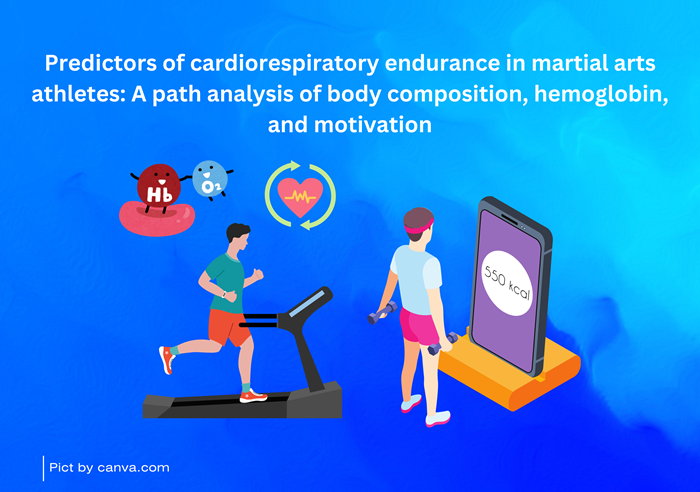
Predictors of cardiorespiratory endurance in martial arts athletes: A path analysis of body composition, hemoglobin, and motivation
Novanto Ponco Nugroho 1, Dani Nur Riyadi2, Aridhotul Haqiyah31. Universitas Islam 45 Bekasi , ID2. Universitas Islam 45 Bekasi , ID3. Universitas Islam 45 Bekasi , ID2025-07-01|page 83-94AbstractBackground: Cardiorespiratory endurance is vital to athletic performance, particularly in sports requiring sustained physical exertion such as martial arts.
Objectives: This study examined the predictive roles of body composition (BMI), hemoglobin concentration, and motivation on cardiorespiratory endurance among university-level martial arts athletes.
Methods: Using a quantitative path analysis design, data were collected from 20 purposively selected martial arts athletes who regularly trained. Cardiorespiratory endurance was assessed via the multistage fitness test, BMI was calculated using standard anthropometric measures, hemoglobin was measured using the Harenz scale, and motivation was evaluated with a validated Likert-scale questionnaire.
Results: The analysis showed that BMI (ρ = 0.705, t = 3.071, p = 0.007) and hemoglobin concentration (ρ = 0.946, t = 4.672, p < 0.001) had significant positive effects on cardiorespiratory endurance. Motivation, however, did not have a significant direct effect (ρ = 0.087, t = 0.853, p = 0.203). Additionally, BMI correlated positively with both hemoglobin (ρ = 0.923, p < 0.001) and motivation (ρ = 0.670, p = 0.034), suggesting indirect effects through physiological mechanisms.
Conclusions: The findings underscore that physiological indicators, specifically BMI and hemoglobin, are more critical predictors of aerobic capacity than psychological factors like motivation in this athletic population. Due to sport-specific demands, these results may not be generalizable to non-martial arts athletes. Future studies should incorporate additional mediators such as training intensity and account for potential self-report bias in motivation assessments.
APA Citation StyleNugroho , N. P. , Riyadi, D. N. , & Haqiyah, A. (2025). Predictors of cardiorespiratory endurance in martial arts athletes: A path analysis of body composition, hemoglobin, and motivation. Physical Education and Sports: Studies and Research, 83-94. https://doi.org/10.56003/pessr.v4i2.559 -
Performance anxiety among student table tennis players
Yumna Wahyuningsih1, Ibnu Fatkhu Royana2, Galih Dwi Pradipta31. Universitas PGRI Semarang , ID2. Universitas PGRI Semarang , ID3. Universitas PGRI Semarang , ID2025-12-18|page 318-331AbstractBackground: Anxiety is a common psychological factor that significantly affects athletic performance, especially in competitive settings. Student-athletes face dual pressures from academic responsibilities and athletic commitments, making them vulnerable to performance anxiety that can impair focus, concentration, and decision-making.
Objectives: This study aims to analyze performance anxiety among table tennis athletes in the Student Activity Unit (UKM) of Universitas PGRI Semarang and to examine differences in performance evaluation outcomes based on sources from internal and external factors.
Methods: A comparative quantitative design with a cross-sectional approach was used. Fifty athletes participated (n=25 assessed by internal factors, n=25 assessed by external factors). Anxiety/performance was measured using a self-report questionnaire consisting of 15 Likert-scale items (1-5 scale) validated by three sport psychology experts. Data were analyzed using one-way ANOVA after confirming normality (Shapiro-Wilk test) and homogeneity (Levene's test).
Results: The internal group had a higher mean score (M = 3.64, SD = 0.86) compared to the external group (M = 3.07, SD = 0.86). ANOVA revealed a statistically significant difference, F(1,48) = 4.92, p = 0.031, η² = 0.093, with an estimated Cohen's d of approximately 0.66, indicating a medium effect size. These findings indicate that anxiety factors affect athletes' performance, with internal factors tending to score higher than external factors.
Conclusions: This study concludes that anxiety affects the performance of table tennis athletes in the Student Activity Unit (UKM) at Universitas PGRI Semarang. Specifically, internal factors such as self-confidence and perfectionism have been proven to have a greater impact than external factors.APA Citation StyleWahyuningsih, Y. , Royana, I. F. , & Pradipta, G. D. (2025). Performance anxiety among student table tennis players. Physical Education and Sports: Studies and Research, 318-331. https://doi.org/10.56003/pessr.v4i3.618

1 - 7 of 7 items




















