Search
Search Results
##search.searchResults.foundPlural##
-

CPR knowledge and attitudes among physical education students at universities in Indonesia and China: A cross-sectional comparative study
Karisdha Praditayana1, Shang Yuanfang2, Ayu Purnama Wenly3, Khaeroni Khaeroni41. ID2. Xinxiang Institute of Engineering , CN3. ID4. ID2026-11-22|page 310-323AbstractBackground: Immediate bystander cardiopulmonary resuscitation (CPR) is critical following sudden cardiac arrest. Physical education (PE) students, as future teachers and coaches, may be responsible for responding to such emergencies.
Objective: To compare CPR knowledge and attitudes among PE students in Indonesia and China and examine their association.
Methods: This cross-sectional comparative study involved one university in each country and used nonprobability convenience sampling. All 30 Indonesian respondents were included; 30 of 108 Chinese respondents were selected for demographic comparability in sex, age, and semester, independently of CPR scores. A questionnaire comprising nine knowledge and 12 attitude items was administered. Group differences were assessed using the Mann–Whitney U test with rank-biserial effect sizes, and associations were examined using Spearman's correlation.Results: Knowledge scores did not differ significantly between Chinese and Indo-nesian students (median [IQR]: 6 [5–7] vs. 5 [4–8]; U = 466, p = .817, r = .04). Attitude scores also showed no significant difference (3.21 [2.69–3.33] vs. 3.17 [2.77–3.42]; U = 400, p = .463, r = -.11). Knowledge and attitudes were weakly but positively correlated (ρ = .286, p = .027).
Conclusion: No statistically significant differences in CPR knowledge or attitudes were detected between the participating universities. However, the small, non-random sample limits generalizability and does not establish equivalence. Structured, practice-based CPR training warrants consideration in PE curricula.
APA Citation StylePraditayana, K. , Yuanfang, S. , Wenly, A. P. , & Khaeroni, K. (2026). CPR knowledge and attitudes among physical education students at universities in Indonesia and China: A cross-sectional comparative study. Physical Education and Sports: Studies and Research, 310-323. https://doi.org/10.56003/791 -
Weightlifting coaches' and athletes' understanding of injury prevention programs: a case study of Lumajang and Malang
Muhammad Izzan Atmagara1, Yulingga Nanda Hanief21. State University of Malang , ID2. State University of Malang , ID2025-09-21|page 222-235AbstractBackground: Weightlifting is a high-intensity sport with a high risk of injuries due to improper technique, insufficient warm-up, and excessive training loads.
Objectives: This study explores the understanding, strategies, and barriers of weightlifting coaches and athletes in Lumajang District and Malang City related to implementing injury prevention programs in performance sports.
Methods: This study used a qualitative case study approach. Participants were selected using purposive sampling, consisting of weightlifting coaches with at least one year of experience and athletes who had trained and competed at the regional level. Data were collected through interviews, observations, and document analysis, while data were analyzed using the Miles and Huberman model, including reduction, presentation, and conclusion.
Results: The results showed that coaches and athletes emphasized dynamic warm-ups, core and back strengthening exercises, and correct lifting techniques as the main strategies to prevent injuries. However, limitations in facilities, literature access, and training variety were identified as barriers to implementing optimal injury prevention programs.
Conclusions: This study concludes that effective injury prevention in weightlifting requires structured warm-up routines, individualized training programs, and adequate supporting equipment. Strengthening coaches’ knowledge and providing better facilities are crucial to minimize injuries and enhance athlete performance.APA Citation StyleAtmagara, M. I. , & Hanief, Y. N. (2025). Weightlifting coaches' and athletes' understanding of injury prevention programs: a case study of Lumajang and Malang. Physical Education and Sports: Studies and Research, 222-235. https://doi.org/10.56003/pessr.v4i2.601 -
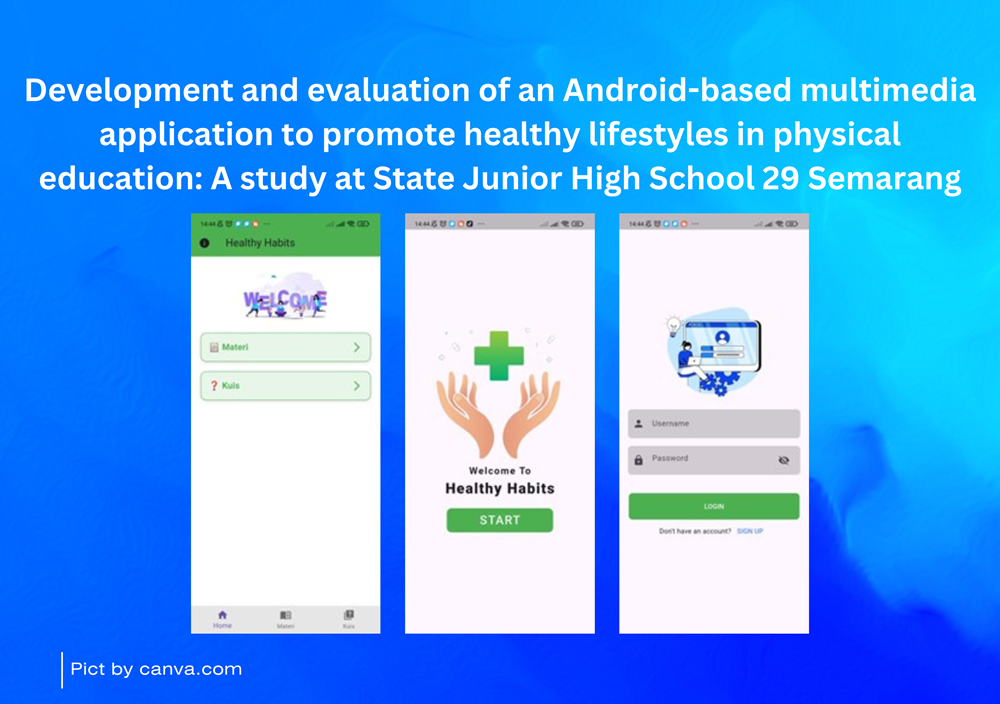
Development and evaluation of an Android-based multimedia application to promote healthy lifestyles in physical education: A study at State Junior High School 29 Semarang
Galang Yusuf Pujiyanto1, Ibnu Fatkhu Royana2, Muh. Isna Nurdin Wibisana31. Universitas PGRI Semarang , ID2. Universitas PGRI Semarang , ID3. Universitas PGRI Semarang , ID2025-07-23|page 162-174AbstractBackground: The integration of interactive, technology-based media in Physical Education, particularly for teaching health-related content, remains limited despite its potential to enhance student engagement and learning outcomes.
Objectives: This study aims to address this gap by developing and evaluating the effectiveness of an Android-based multimedia learning application, "Healthy Habits," designed to support the delivery of healthy lifestyle materials in Physical Education, Sports, and Health (Physical Education) subjects at the junior high school level.
Methods: The research employed a research and development (R&D) approach, involving expert validation from media and content specialists and usability trials with teachers and students.
Results: Validation results indicated a "Good" rating from the material expert (average score: 4.05) and a "Very Good" rating from the media expert (average score: 4.24), confirming the application's content quality and technical feasibility. Teacher evaluations also yielded a "Good" rating (average score: 4.07). Student trials produced positive responses, with small group testing receiving a "Very Good" rating (average score: 3.29), which increased to 4.23 ("Very Good") in large group testing. An effectiveness test assessing cognitive, affective, and psychomotor learning outcomes showed an average score of 85.6%, categorized as "Very Good." These findings demonstrate the feasibility and effectiveness of "Healthy Habits" as a digital learning tool for promoting healthy lifestyles in secondary school students.
Conclusions: The application offers practical value for educators and curriculum developers seeking to integrate mobile technology into Physical Education. Future studies are encouraged to explore the implementation of this application in varied educational contexts and its potential integration across other subject areas.
APA Citation StylePujiyanto, G. Y. , Royana, I. F. , & Wibisana, M. I. N. (2025). Development and evaluation of an Android-based multimedia application to promote healthy lifestyles in physical education: A study at State Junior High School 29 Semarang. Physical Education and Sports: Studies and Research, 162-174. https://doi.org/10.56003/pessr.v4i2.607 -

Teachers’ Management in Implementation of CHED Memorandum Order (CMO) 39, Series of 2021 towards the Achievement of Students’ Learning Outcomes in Physical Education
John Michael Aquino11. Laguna State Polytechnic University , PH2023-04-20|page 26-43AbstractBackground: The Commission on Higher Education (CHED) has issued Memorandum Order (CMO) No. 39, Series of 2021 that strengthens the management of physical education teachers and promotes the achievement of students’ learning outcomes. Higher education institutions will guarantee that they are adhering to the requirements of the CMO to ensure the quality of instruction in physical education and the improvement of the students’ learning outcomes.
Objectives: This research aims to investigate the process of implementation of the CMO 39, Series of 2021 and its contribution to the improvement of student learning outcomes in Physical Education (PE).
Methods: Through a qualitative research design based on a phenomenological approach, the researchers employed a purposive sampling method to select 9 male and 3 female PE teachers from Higher Learning Institution in the Philippines. A non-test instrument consisting of an interview guide was used to collect data from the study participants. The data was then analyzed to identify themes and patterns that emerged from the responses.
Results: The study revealed the effectiveness of physical education in terms of student motivation, class orientation, students’ participation, and the application of the Physical Activity Towards Health and Fitness (PATHFIT) program. The findings show that physical education is an important part of the educational process and has a direct influence on the students' learning outcomes. Furthermore, the study also highlights the importance of providing students with the necessary knowledge and skills to succeed, and of assessing the students' abilities from their performance to achieve course objective with good behavior and attitude.
Conclusion: It showed potential areas of improvement in the implementation process to ensure that the objectives of the memorandum are achieved, which is necessary for teachers to be aware of the competencies that need to be developed for students. This research will contribute to the existing literature on the importance of quality assurance programs, particularly in the area of physical education.
APA Citation StyleAquino, J. M. (2023). Teachers’ Management in Implementation of CHED Memorandum Order (CMO) 39, Series of 2021 towards the Achievement of Students’ Learning Outcomes in Physical Education. Physical Education and Sports: Studies and Research, 26-43. https://doi.org/10.56003/pessr.v2i1.190

1 - 4 of 4 items