
Search
Search Results
##search.searchResults.foundPlural##
-


Development and evaluation of an Android-based multimedia application to promote healthy lifestyles in physical education: A study at State Junior High School 29 Semarang
Galang Yusuf Pujiyanto1, Ibnu Fatkhu Royana2, Muh. Isna Nurdin Wibisana31. Universitas PGRI Semarang , ID2. Universitas PGRI Semarang , ID3. Universitas PGRI Semarang , ID2025-07-23|page 162-174AbstractBackground: The integration of interactive, technology-based media in Physical Education, particularly for teaching health-related content, remains limited despite its potential to enhance student engagement and learning outcomes.
Objectives: This study aims to address this gap by developing and evaluating the effectiveness of an Android-based multimedia learning application, "Healthy Habits," designed to support the delivery of healthy lifestyle materials in Physical Education, Sports, and Health (Physical Education) subjects at the junior high school level.
Methods: The research employed a research and development (R&D) approach, involving expert validation from media and content specialists and usability trials with teachers and students.
Results: Validation results indicated a "Good" rating from the material expert (average score: 4.05) and a "Very Good" rating from the media expert (average score: 4.24), confirming the application's content quality and technical feasibility. Teacher evaluations also yielded a "Good" rating (average score: 4.07). Student trials produced positive responses, with small group testing receiving a "Very Good" rating (average score: 3.29), which increased to 4.23 ("Very Good") in large group testing. An effectiveness test assessing cognitive, affective, and psychomotor learning outcomes showed an average score of 85.6%, categorized as "Very Good." These findings demonstrate the feasibility and effectiveness of "Healthy Habits" as a digital learning tool for promoting healthy lifestyles in secondary school students.
Conclusions: The application offers practical value for educators and curriculum developers seeking to integrate mobile technology into Physical Education. Future studies are encouraged to explore the implementation of this application in varied educational contexts and its potential integration across other subject areas.
APA Citation StylePujiyanto, G. Y. , Royana, I. F. , & Wibisana, M. I. N. (2025). Development and evaluation of an Android-based multimedia application to promote healthy lifestyles in physical education: A study at State Junior High School 29 Semarang. Physical Education and Sports: Studies and Research, 162-174. https://doi.org/10.56003/pessr.v4i2.607 -
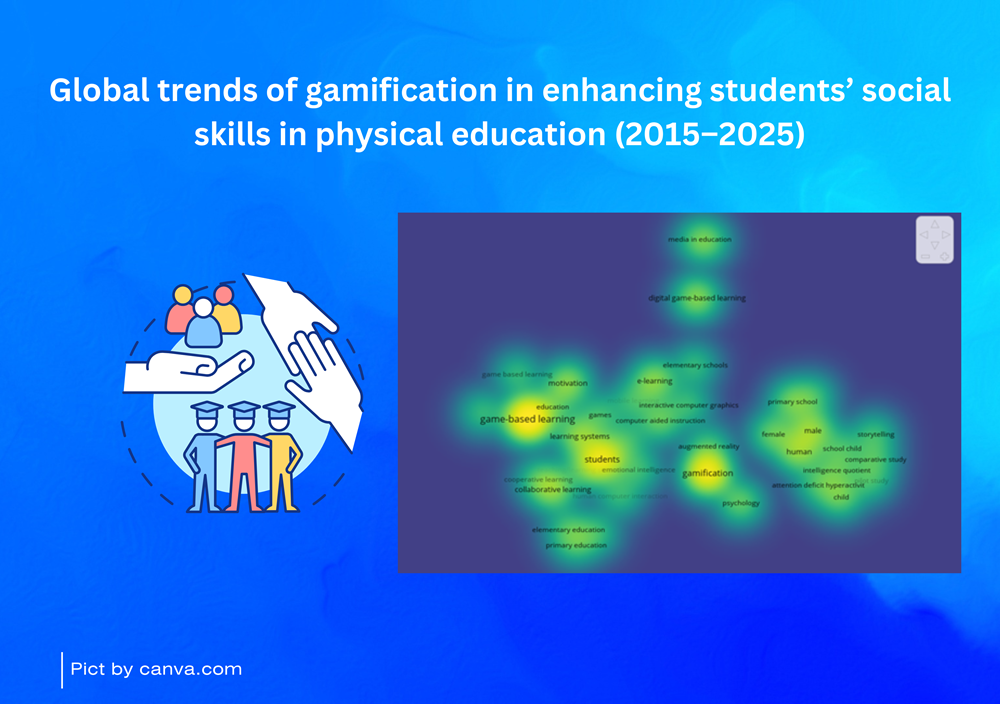
Global trends of gamification in enhancing students’ social skills in physical education (2015–2025)
Rajip Mustafillah Rusdiyanto1, Ari Wibowo Kurniawan21. State University of Malang , ID2. State University of Malang , ID2025-07-01|page 125-138AbstractBackground: The development of digital technology has triggered a more interactive learning transformation through gamification, namely using game elements to increase students' motivation, engagement, and social skills, such as cooperation, communication, empathy, and problem solving.
Objectives: This study aims to analyze global research trends on gamification in enhancing students' social skills, particularly in physical education, through a bibliometric analysis from 2015 to 2025.
Methods: This study employed a bibliometric design. Data were retrived from the Scopus database on April 22, 2025, using specific keywords: (gamification OR gamified learning OR game-base-based learning) AND ("physical education" OR "PE class" OR "sport education") AND (social skills" OR "social competence" OR "social interaction") AND (elementary school" OR "primary school" OR "midle school" OR "junior high school" OR "high school" OR "secondary school" From an initial 120 documents, 47 met the inclusion criteria. VOSViewer was used to analyze keyword co-occurrence, visualize trends, and identify thematic clusters by completely counting on all keywords with at least two documents per author.
Results: 47 relevant articles were identified, with publication peaking in 2020. Keyword analysis revealed five main thematic clusters: gamification in education, digital game-based learning, collaborative learning, emerging technologies, and motivation. The most frequent keywords were game-based learning (n=12), gamification (n=9), and students (n=8). The University of Patras emerged as the most productive institution, while the leading journal was the International Journal of Learning, Teaching and Educational Research.
Conclusions: Although research on gamification has grown significantly, its application in physical education remains underexplored. This study reveals a gap in leveraging gamification to develop students' social skills in physical education. Future research should focus on integrating gamification in this context while considering sociocultural and technological factors to ensure inclusive and effective implementation.
APA Citation StyleRusdiyanto, R. M. , & Kurniawan, A. W. (2025). Global trends of gamification in enhancing students’ social skills in physical education (2015–2025). Physical Education and Sports: Studies and Research, 125-138. https://doi.org/10.56003/pessr.v4i2.598 -

Enhancing Students' Learning Performance in Physical Education Through the Use of a Mobile Application with Game-Based Learning Approach
Carla Jobelle Culajara11. Sta. Catalina National High School , PH2023-04-19|page 1-9AbstractBackground: In response to the transition of learning from confinement at home and now having in-person classes, being flexible to the needs of students must be innovative and creative to slowly get their attention and motivation to learn.
Objectives: The objective of the study is to determine the effect of the developed mobile application to students learning performance in Physical Education.
Methods: The researcher used quasi-experimental research design utilizing pretest and posttest. Purposive sampling was used to determine the participants consisting of 25 students under control group and 25 students under experimental group which were Grade 10 students in one of the secondary schools in the Philippines. JASP Software was used to analyze the data used in the study. The research instrument was validated by the Head Teacher and Master Teacher.
Results: Data revealed that the developed mobile application has a tremendous effect on students learning performance in Physical Education. It shows that the mean scores in the before utilization on the group using the developed mobile application in the students’ learning performance has a little knowledge on the lesson, while the mean scores of the two groups after utilization shows that it has a significant effect on the learning performances. It shows that the developed mobiled application has a substantial effect on students learning performance in Physical education.
Conclusion: The developed mobile application has a significant impact to the learning of the students in Physical education. This implies that the utilization of the technology in the teaching and learning process in physical education enhances the performance and ability of an individual.
APA Citation StyleCulajara, C. J. (2023). Enhancing Students' Learning Performance in Physical Education Through the Use of a Mobile Application with Game-Based Learning Approach. Physical Education and Sports: Studies and Research, 1-9. https://doi.org/10.56003/pessr.v2i1.178 -

Immediate effect of thoracic spinal manipulation versus passive stretching on upper trapezius pain in university students: A randomized controlled trial
Sherin Nada Salsabila1, Adnan Faris Naufal21. Universitas Muhammadiyah Surakarta , ID2. Universitas Muhammadiyah Surakarta , ID2025-11-26|page 250-265AbstractBackground: Pain disorders in the upper trapezius muscle are often experienced by students due to non-ergonomic postures and excessive duration of device use. Interventions such as spinal manipulation and stretching exercises are non-invasive interventions often used to reduce pain and improve muscle function.
Objectives: This study compares the effectiveness of two interventions in reducing trapezius muscle pain among university students.
Methods: This randomized controlled trial involved 40 physiotherapy students divided equally into two intervention groups. Group I received thoracic spinal manipulation, and Group II received passive stretching. Each intervention was administered in a single 15-minute session. Pain intensity was measured using the Numeric Rating Scale (NRS) before and immediately after treatment. Data were analyzed using the Wilcoxon Signed-Rank test for within-group comparisons and the Mann–Whitney U test for between-group analysis, with an alpha level of 0.05.
Results: The Wilcoxon test revealed a significant decrease in pain within both groups (Group I: median pre 4.5 [3.63–5] to post 2.5 [1.50–3.38], p = 0.000, r = 0.879; Group II: median pre 4.25 [3–5] to post 1 [0.13–3], p = 0.000, r = 0.84), indicating a significant effect of both interventions. The Mann–Whitney U test showed no statistically significant difference in pain reduction between the two groups (median pain difference = 2 [1–3] for both, U = 186.5, Z = –0.375, p = 0.707, r = 0.06).
Conclusions: Both thoracic spinal manipulation and passive stretching were effective in reducing upper trapezius pain immediately after a single session, but no significant difference was found between the two interventions. These findings suggest that both approaches provide comparable short-term benefits; however, further research with larger samples, multiple sessions, and more extended follow-up periods is needed to confirm their long-term efficacy.
APA Citation StyleSalsabila, S. N. , & Naufal, A. F. (2025). Immediate effect of thoracic spinal manipulation versus passive stretching on upper trapezius pain in university students: A randomized controlled trial. Physical Education and Sports: Studies and Research, 250-265. https://doi.org/10.56003/pessr.v4i3.634 -
Development and evaluation of a web-based interactive flashcard tool (Aero’Zen) for low-impact rhythmic activity instruction in physical education
Zenny Ni'matul Ulya1, Donny Anhar Fahmi2, Ibnu Fatkhu Royana31. Department of Physical Education, Faculty of Social Sciences and Physical Education, Universitas PGRI Semarang , ID2. Department of Physical Education, Faculty of Social Sciences and Physical Education, Universitas PGRI Semarang , ID3. Department of Physical Education, Faculty of Social Sciences and Physical Education, Universitas PGRI Semarang , ID2026-08-31|page 233-247AbstractBackground: Teaching rhythmic activities in physical education continues to face challenges due to the limited availability of visual learning aids that demonstrate movements systematically, repeatedly, and accessibly.
Objectives: This study aimed to develop and evaluate Aero’Zen, a web-based interactive flashcard tool integrating movement illustrations, QR codes, and demonstration videos for basic low-impact rhythmic activities.
Methods: This research and development study employed the ADDIE model. Following product development and expert validation, learning outcomes were evaluated using a one-group pretest–posttest pre-experimental design involving 30 tenth-grade students at SMK Negeri 2 Semarang. Product feasibility was assessed by media experts, subject matter experts, and a physical education practitioner. Pretest and posttest scores were analyzed using the Shapiro–Wilk test for normality and paired-samples t-tests, with the significance level set at α = .05.
Results: Aero’Zen was rated highly suitable by media experts (95.75%), subject matter experts (94.50%), and a physical education practitioner (88.75%). Mean scores increased from 75.40 to 89.97 in the cognitive domain, from 28.80 to 32.77 in the affective domain, and from 19.87 to 32.00 in the psychomotor domain. Paired-samples t-tests revealed significant differences between pretest and posttest scores across all three domains (all p < .001).
Conclusions: Aero’Zen is a highly suitable web-based learning medium with the potential to support students’ cognitive, affective, and psychomotor learning outcomes, including movement coordination and performance, in low-impact rhythmic activities. Its integrated flashcards, QR-code access, and demonstration videos provide a flexible resource for repeated and independent learning. Future studies should use randomized controlled trials with larger and more diverse samples to strengthen causal inference and generalizability.
APA Citation StyleUlya, Z. N. , Fahmi, D. A. , & Royana, I. F. (2026). Development and evaluation of a web-based interactive flashcard tool (Aero’Zen) for low-impact rhythmic activity instruction in physical education. Physical Education and Sports: Studies and Research, 233-247. https://doi.org/10.56003/pessr.v5i2.761 -

Integrating technology in physical education: The impact of TPACK-based tactical and technical approaches on football skills and student motivation
Defri Mulyana1, Adang Suherman2, Komarudin Komarudin3, Bambang Abduljabar4, Fegie Rizkia Mulyana51. Indonesia University of Education , ID2. Indonesia University of Education , ID3. Indonesia University of Education , ID4. Indonesia University of Education , ID5. Siliwangi University , ID2025-05-14|page 71-82AbstractBackground: Motivation and skill development are vital in physical education, particularly football. Tactical learning emphasizes decision-making and game understanding, while technical learning focuses on mastering fundamental skills.
Objectives: This study aimed to analyze the impact of a TPACK-based tactical and technical learning approach on student motivation and football skill acquisition among high school students in Tasikmalaya.
Methods: The study applied the TPACK framework—integrating Technological, Pedagogical, and Content Knowledge—in designing the learning model. Using an experimental method with a pre-test–post-test design, 30 students were divided into two groups. Motivation was assessed via a Likert-scale questionnaire, while football skills (passing, heading, dribbling, shooting, and playing ability) were evaluated through standardized tests. Data were analyzed using paired and independent t-tests with a significance level of p < 0.05.
Results: The technical approach significantly enhanced basic football skills, notably heading (t = 8.47) and shooting (t = 8.29), proving its effectiveness in improving fundamental competencies. Conversely, the tactical approach showed a notable increase in student motivation (t = 4.98) and playing ability (t = 5.94), reflecting its strength in fostering strategic understanding and engagement. TPACK integration further reinforced both approaches through effective use of technology.
Conclusions: The study highlights the importance of combining tactical and technical approaches to promote holistic student development. Continued research is needed to explore the long-term effects and potential of integrating diverse technological tools in physical education.
APA Citation StyleMulyana, D. , Suherman, A. , Komarudin, K. , Abduljabar, B. , & Mulyana, F. R. (2025). Integrating technology in physical education: The impact of TPACK-based tactical and technical approaches on football skills and student motivation. Physical Education and Sports: Studies and Research, 71-82. https://doi.org/10.56003/pessr.v4i1.523 -
Improving physical self-perception and health-related fitness through gamification in physical education: A cluster randomized controlled trial
Ferdinando Cereda11. The Catholic University of the Sacred Heart in Milan , IT2026-03-08|page 7-27AbstractBackground: The global decline in adolescent physical activity necessitates pedagogical innovation to counter disengagement. Traditional norm-referenced physical education (PE) often alienates less skilled students, whereas gamification offers a promising criterion-referenced strategy to enhance motivation and learning.
Objectives: This study investigated the efficacy of a 12-week gamified didactic intervention on perceived physical self-concept, health-related fitness, and physical activity enjoyment among high school students.
Methods: A two-arm, parallel-group, cluster randomized controlled trial (Cluster-RCT) was conducted with 210 Italian adolescents (mean age 15.4 ± 0.9 years) nested within 10 intact classes (average cluster size = 21). Intact classes were randomised to an experimental group (gamified ‘MoveQuest’ module, k = 5) or a control group (traditional direct instruction, k = 5). Data were collected using the Revised Physical Self-Perception Profile (PSPP-R-IT), the ALPHA-FIT test battery, and the Physical Activity Enjoyment Scale (PACES). Following a per-protocol analytical approach, Linear mixed models (LMMs) were employed to analyse the data, accounting for the nested structure of the educational setting and handling cluster-level variance intraclass correlation coefficients (ICCs). Significance levels were interpreted considering the multiplicity of outcomes.
Results: Significant group × time interactions were observed, with the gamified group demonstrating superior improvements in sports competence (d = 0.65), physical self-worth (d = 0.58), and enjoyment (d = 0.82) compared to the control group. Physiologically, the experimental group showed significantly greater gains in cardiorespiratory fitness (V̇O₂ max) and agility, while body attractiveness remained stable in both groups.
Conclusions: Gamified didactics significantly enhance psychological engagement and specific motor performance parameters by prioritising individual progress over social comparison. This approach represents a valuable pedagogical tool for fostering physical literacy in secondary PE.APA Citation StyleCereda, F. (2026). Improving physical self-perception and health-related fitness through gamification in physical education: A cluster randomized controlled trial. Physical Education and Sports: Studies and Research, 7-27. https://doi.org/10.56003/pessr.v5i1.677

1 - 7 of 7 items




















