Search
Search Results
##search.searchResults.foundPlural##
-

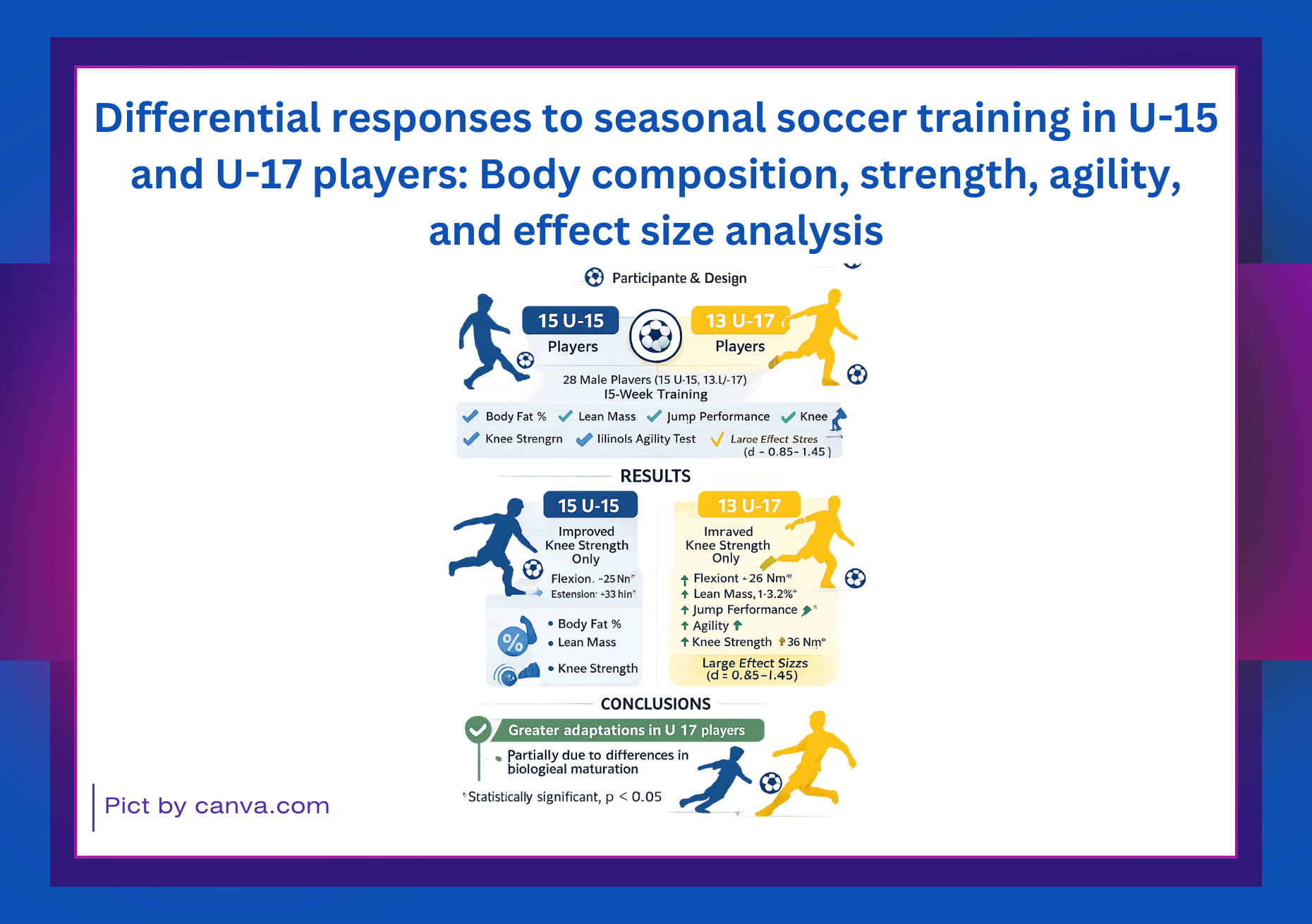
Differential responses to seasonal soccer training in U-15 and U-17 players: Body composition, strength, agility, and effect size analysis
Rick Stoop1, Georgios Georgiadis2, Iván González-García31. Football Club Utrecht, Herculesplein 241, 3584 AA Utrecht , NL2. Department of Nutrition and Movement Sciences, NUTRIM School of Nutrition and Translational Research in Metabolism, Maastricht University , NL3. Faculty of Health Sciences, Universidad Isabel I, Burgos , ES2026-06-09|page 48-63AbstractBackground: Training programs during adolescence play a crucial role in optimizing body composition and physical performance in youth soccer players. However, differences in training adaptations between age groups, particularly in agility performance, remain insufficiently explored.
Objectives: This study aimed to examine the effects of a seasonal soccer training program on body composition, strength, and agility in U-15 and U-17 soccer players.
Methods: A pre–post experimental design was applied to 28 male youth soccer players (U-15: n = 15; U-17: n = 13) competing in a football league in the Netherlands. Participants completed a 16-week training program consisting of technical, conditioning, tactical, and mental components. Body composition (height, body mass, lean mass, fat mass), jump performance (SJ, CMJ, CMJmax), isokinetic strength (knee flexion and extension peak torque), and agility (Illinois Agility Test) were assessed before and after the intervention. Data were analyzed using repeated-measures analysis of variance (ANOVA) and effect sizes were calculated using Cohen’s d.
Results: In the U-15 group, significant improvements were observed only in knee flexion (70.2 ± 15.8 vs. 95.4 ± 23.5 Nm, p = 0.006, d = 1.25) and extension peak torque (75.1 ± 20.4 vs. 96.8 ± 18.9 Nm, p = 0.012, d = 1.10). In contrast, U-17 players demonstrated significant increases in lean mass (50.2 ± 3.1% vs. 53.4 ± 2.3%, p = 0.021), reductions in fat mass (11.0 ± 2.9% vs. 8.7 ± 2.5%, p = 0.037), improvements in agility performance (16.2 ± 0.7 vs. 15.4 ± 0.65 s, p = 0.008, d = 1.18), and knee flexion peak torque (78.4 ± 26.5 vs. 118.3 ± 28.7 Nm, p = 0.003, d = 1.45), together with significant gains in jump performance (p < 0.05). Most significant changes in the U-17 group were accompanied by large effect sizes (d = 0.85–1.45).
Conclusions: The training program elicited greater physiological and performance adaptations in U-17 compared to U-15 players. The greater adaptations observed in the U-17 group may be partially influenced by differences in biological maturation; however, maturity status was not directly assessed in the present study.
APA Citation StyleStoop, R. , Georgiadis, G. , & González-García, I. (2026). Differential responses to seasonal soccer training in U-15 and U-17 players: Body composition, strength, agility, and effect size analysis. Sport, Exercise, and Injury, 48-63. https://doi.org/10.56003/sei.v2i1.735 -

Analysis of strategy and implementation of head injury prevention programs: A case study of boxers at HAN Academy Malang
Padantya Devin Sugito11. State University of Malang , ID2026-01-05|page 99-110AbstractBackground: Boxing is a high-risk combat sport with a high probability of head injuries, so effective prevention strategies are essential for athlete safety. However, empirical evidence on the implementation of head injury prevention programs at the training academy level is still limited.
Objectives: This study aims to explore strategies and the practical implementation of head injury prevention at the HAN Boxing Academy, Malang.
Methods: A qualitative case study design was used with purposive sampling. Four participants (one coach and three active athletes) were recruited. Data were collected through document review, direct observation, and semi-structured interviews, which consisted of 15 guiding questions. Data were analyzed using a thematic analysis approach, which involved data reduction, data presentation, and conclusion. Methodological triangulation was applied to enhance credibility.
Results: Three main themes emerged: (1) systematic emphasis on basic defensive techniques to minimize head collisions, (2) mandatory and consistent use of head protection during training sessions, and (3) active supervision by coaches combined with a gradual rehabilitation protocol, including competition restrictions for up to six months after a serious head injury. Participants considered head protection effective in reducing the severity of impacts, although the residual risk of head injury was still acknowledged.
Conclusions: Head injury prevention in academies is implemented through an integrated approach that combines technical skill development, the use of protective equipment, and continuous monitoring. To strengthen its effectiveness, it is recommended that structured injury prevention protocols be implemented and closer collaboration with medical professionals be fostered.APA Citation StyleSugito, P. D. (2026). Analysis of strategy and implementation of head injury prevention programs: A case study of boxers at HAN Academy Malang. Sport, Exercise, and Injury, 99-110. https://doi.org/10.56003/sei.v1i2.646 -
Comparative physical fitness profiles of female long-distance and sprint swimmers at Petrokima Gresik Club: A descriptive study
Kartika Jeaniar Fajar Nur Rahma11. State University of Malang , ID2026-01-05|page 90-98AbstractBackground: Physical condition is a fundamental factor that affects swimmers' performance in developing techniques, tactics, and competition strategies, especially for swimmers specializing in different distances, such as sprinters and long-distance swimmers.
Objectives: This study aims to analyze the dominant physical profiles of female sprinters and long-distance swimmers, providing evaluation material for coaches to develop more targeted training programs.
Methods: The study employed a quantitative descriptive design, utilizing a survey and test approach. The research subjects consisted of 20 female swimmers from the Petrokimia Gresik Club who were selected purposively, including 10 sprinters and 10 long-distance swimmers. Data collection was conducted in 2024 through push-up tests (measuring arm muscle strength), sit-ups (assessing abdominal muscle strength), vertical jump (evaluating leg muscle explosive power), and multistage fitness tests (testing aerobic endurance). Raw scores were converted into t-scores and then categorized using the Norm Reference Scale (NRS). Data analysis was performed descriptively using means, standard deviations, and percentages. This study has obtained ethical approval from the relevant ethics committee.
Results: The analysis results show that in the sprinter group, 4 out of 10 athletes (40%) were in the "fair" physical condition category, while in the long-distance group, 5 out of 10 athletes (50%) were also in this category. In general, the components of arm muscle strength, abdominal muscle strength, leg muscle power, and aerobic endurance in both groups showed a relatively balanced distribution with a predominance of the adequate category.
Conclusions: The physical condition of female sprinters and long-distance swimmers from the Petrokimia Gresik Club was at a relatively balanced level, with a predominance of the adequate category. These findings serve as a basis for evaluating and adjusting training programs according to the characteristics of specific swimming specializations.APA Citation StyleRahma, K. J. F. N. (2026). Comparative physical fitness profiles of female long-distance and sprint swimmers at Petrokima Gresik Club: A descriptive study. Sport, Exercise, and Injury, 90-98. https://doi.org/10.56003/sei.v1i2.645 -
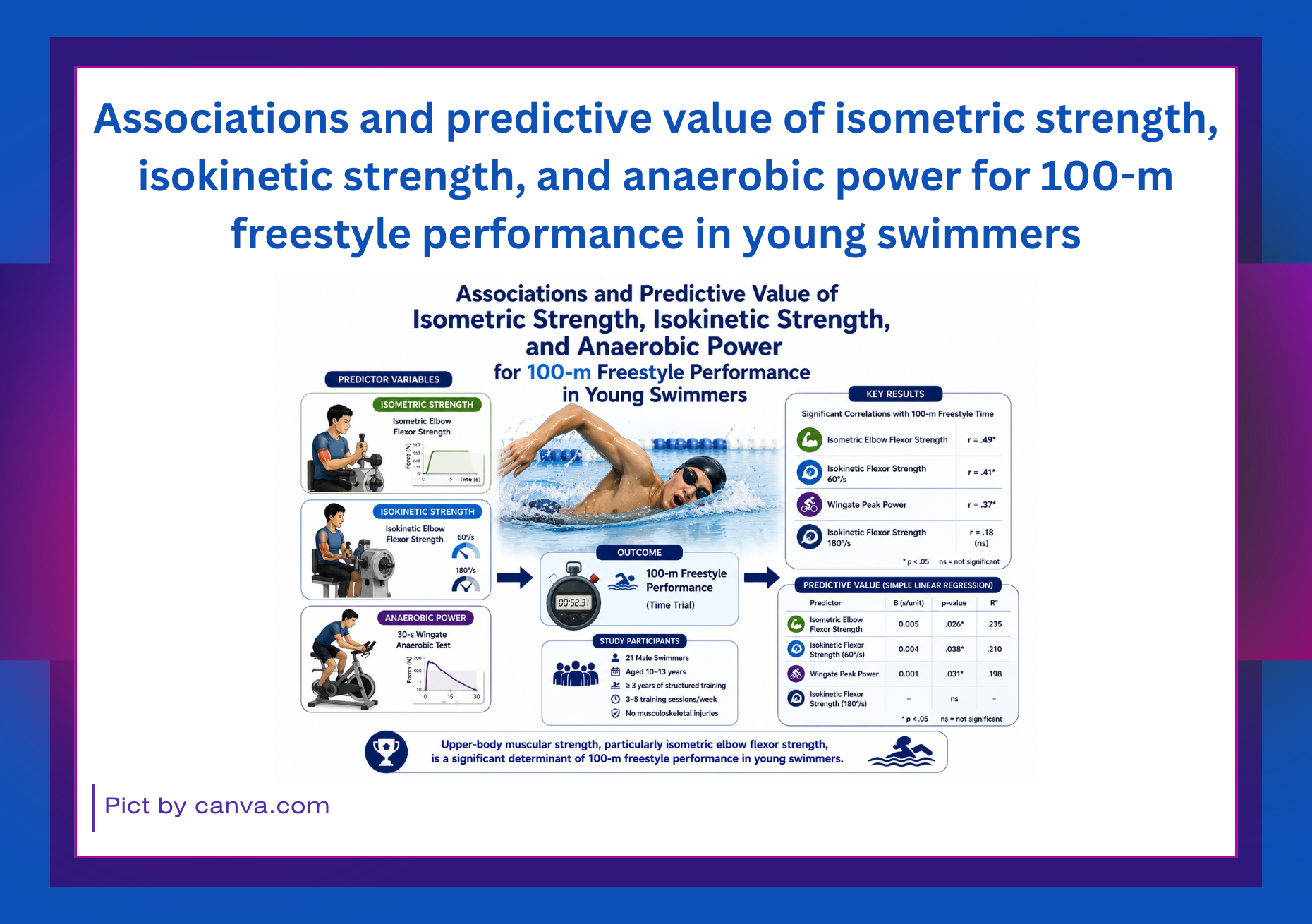
Associations and predictive value of isometric strength, isokinetic strength, and anaerobic power for 100-m freestyle performance in young swimmers
Zied Abbes1, Rabeh Labbadi2, Faten Salhi31. Physical Education Department, College of Education, Qatar University , QA2. Higher Institute of Sports and Physical Education of Kef, University of Jendouba , TN3. Higher Institute of Sports and Physical Education of Kef, University of Jendouba , TN2026-06-02|page 21-34AbstractBackground: Multiple physical and physiological factors influence sprint swimming performance; however, the relative contributions of isometric strength, isokinetic strength, and anaerobic power to 100-m freestyle performance in young swimmers remain unclear.
Objectives: This study investigated the associations and predictive contributions of physical characteristics, isometric and isokinetic upper-body strength, and anaerobic power to 100-m freestyle swimming performance in young swimmers.
Methods: A cross-sectional study was conducted with 21 male swimmers aged 10–13 years, selected purposively. Eligibility criteria included a minimum of three years of structured swimming training, regular participation in 3–5 training sessions per week, and absence of musculoskeletal injuries. Upper-body strength was assessed using isometric and isokinetic dynamometry (60°/s and 180°/s), while anaerobic power was measured using the 30-s Wingate Anaerobic Test. Swimming performance was evaluated using a 100-m freestyle time trial. Pearson correlation and linear regression analyses were performed after verification of regression assumptions.
Results: Swimming speed was significantly correlated with isometric elbow flexor strength (r = .49, p < .05), isokinetic flexor strength at 60°/s (r = .41, p < .05), and Wingate peak power (r = .37, p < .05). Simple linear regression analysis identified isometric elbow flexor strength as the strongest predictor of swimming performance (B = 0.005, p = .026, R² = .235), followed by isokinetic flexor strength at 60°/s (B = 0.004, p = .038, R² = .210) and Wingate peak power (B = 0.001, p = .031, R² = .198). No significant associations were observed for isokinetic strength at 180°/s.
Conclusions: Upper-body muscular strength, particularly isometric elbow flexor strength, is a significant determinant of 100-m freestyle swimming performance in young swimmers. These findings highlight the importance of maximal force-generating capacity, alongside anaerobic power development, for sprint swimming performance.
APA Citation StyleAbbes, Z. , Labbadi, R. , & Salhi, F. (2026). Associations and predictive value of isometric strength, isokinetic strength, and anaerobic power for 100-m freestyle performance in young swimmers. Sport, Exercise, and Injury, 21-34. https://doi.org/10.56003/sei.v2i1.726 -

Injury trends in Pencak Silat: Impact of regulation changes on sparring athletes
Jhenny Ayu Suryaningrum1, Mohamad Nizam Mohamed Shapie21. State University of Malang , ID2. MARA University of Technology , MY2025-06-17|page 15-26AbstractBackground: Pencak Silat is a martial arts sport with high physical contact intensity, resulting in a high risk of injury. To improve safety and sportsmanship, PERSILAT changed the competition rules in 2017. However, the impact of these changes on athlete injury rates is still debated.
Objectives: This study aimed to compare injury rates between the old and new rules in the sparring category of Pencak Silat athletes.
Methods: The study involved 40 sparring category Pencak Silat athletes in the Greater Malang area, aged 16-25 years, who had experience competing before and after implementing the new rules. Sampling used a purposive sampling technique. Data were collected through an online questionnaire and analyzed descriptively quantitatively with percentage calculations.
Results: The results showed a decrease in injury rates in the new rules compared to the old rules. 50.00% of respondents were injured 1-2 times under the new regulation, lower than 57.50% under the old regulation. The most common injury was bruising (27.06% under the new rules vs. 36.36% under the old rules), while dislocation injuries increased (18.82% vs. 15.58%). The most common injury was to the ankle. Most athletes stated that injuries affected their performance and daily activities.
Conclusions: Rule changes have not eliminated the risk of injury in high-contact sports such as Pencak Silat. A decrease in bruising followed by increased dislocations suggests the need for more specific prevention strategies. This study contributes to understanding the impact of new regulations on athlete safety.
APA Citation StyleSuryaningrum, J. A. , & Shapie, M. N. M. (2025). Injury trends in Pencak Silat: Impact of regulation changes on sparring athletes. Sport, Exercise, and Injury, 15-26. https://doi.org/10.56003/sei.v1i1.511 -
Analysis of dominant physical factors in volleyball skills: confirmatory analysis of the Bahana Muda volleyball team
Mahesa Dwi Chandra11. State University of Malang , ID2026-01-05|page 111-121AbstractBackground: Physical condition is an important determinant of volleyball skill performance, but few studies have empirically tested the structure of its dominant factors using a confirmatory approach.
Objectives: This study aims to identify the dominant physical condition factors that influence the playing skills of Bahana Muda Club volleyball athletes using Confirmatory Factor Analysis (CFA).
Methods: This study used a quantitative descriptive design. The sample consisted of 20 male volleyball athletes from the Bahana Muda Club who were selected through purposive sampling. The physical condition variables measured included speed (30-meter run), endurance (beep test), arm muscle strength (push-ups), abdominal muscle strength (sit-ups), leg muscle power (vertical jump), and agility (shuttle run). The analysis was conducted through an initial exploratory analysis and continued with CFA using IBM SPSS AMOS version 26. The goodness-of-fit model was evaluated using the CFI, TLI, and RMSEA indices.
Results: The CFA results show that leg muscle power (λ = 0.791), arm muscle strength (λ = 0.742), endurance (λ = 0.732), and agility (λ = 0.606) have significant factor loadings on volleyball skills (p < 0.05), while abdominal muscle speed and strength did not show significant contributions. The CFA model showed good data fit (CFI = 0.986; TLI = 0.978; RMSEA = 0.050).
Conclusions: Leg muscle power, arm muscle strength, endurance, and agility are the dominant physical factors in volleyball skills. Training programs should prioritize these components, and further research should involve larger samples and cross-clubs.APA Citation StyleChandra, M. D. (2026). Analysis of dominant physical factors in volleyball skills: confirmatory analysis of the Bahana Muda volleyball team. Sport, Exercise, and Injury, 111-121. https://doi.org/10.56003/sei.v1i2.642 -
Injury pattern and risk factors in grassroots football: A study of 10-year-old athletes
Leo Ferdinand1, Yulingga Nanda Hanief2, Randy M. Manimtim31. State University of Malang , ID2. State University of Malang , ID3. Batangas State University TNEU , PH2025-06-17|page 27-39AbstractBackground: Young football players, especially in grassroots competitions, are highly susceptible to injury due to physical contact, fatigue, and underdeveloped motor skills, making injury prevention a critical aspect of early childhood sports.
Objectives: This study aims to analyze the types, causes, and needs for injury prevention in 10-year-old football players.
Methods: A descriptive quantitative design was used with the survey method. Data was collected through a structured questionnaire distributed to players injured during the competition. A purposive sampling technique was applied with inclusion criteria: (1) players injured during the match and (2) willing to participate. The final sample consisted of 25 athletes.
Results: A total of 25 injury incidents were recorded. The most common type of injury was contusion, reaching 13 cases (52%), followed by muscle cramps (20%) and sprains (8%). Most injuries (64%) occurred in the lower extremities, especially the knee and thigh. Injuries predominantly occurred in the second half of matches (60%), with 88% caused by physical contact with an opponent. In the absence of medical personnel, coaches often found themselves in the role of first responders, a challenging position that requires adequate training and support. Many players continued to play despite their injuries, indicating a need for improved injury management.
Conclusions: The study concluded that football injuries in children generally occur in the lower extremities, with bruising being the most dominant type. Player-to-player collisions caused most injuries, and many players could continue the match. This shows the importance of prevention, education, and follow-up for developing the sport of football.
APA Citation StyleFerdinand, L. , Hanief, Y. N. , & Manimtim, R. M. (2025). Injury pattern and risk factors in grassroots football: A study of 10-year-old athletes. Sport, Exercise, and Injury, 27-39. https://doi.org/10.56003/sei.v1i1.512 -
Eccentric hamstring strength and asymmetry in female handball athletes: A descriptive study
Alvito Dandy Putra Sanjaya1, Awang Firmansyah2, Aziz Abdul Hakim3, Panji Bana41. Universitas Negeri Surabaya , ID2. Universitas Negeri Surabaya , ID3. Universitas Negeri Surabaya , ID4. Universitas Negeri Surabaya , ID2025-06-17|page 60-69AbstractBackground: Handball is a competitive sport that requires high physical strength and muscle endurance. The game requires a balance of muscle strength to support athletes in performing movements such as sprints, jumps, and fast movement maneuvers. Lack of flexibility and high hamstring muscle asymmetry values are risk factors for injury to handball athletes.
Objectives: This study aims to determine the eccentric strength and hamstring muscle asymmetry in female handball athletes in Surabaya City.
Methods: The study subjects were 13 female handball athletes from Surabaya aged 18-23 years with regional-level competition experience and no lower extremity injuries. The instrument in this study is Nordbord by Vald Performance; Nordbord is a portable rapid assessment tool that can analyze large groups, providing information about the exact functional strength parameters quickly and efficiently. This study used a quantitative descriptive method to analyze hamstring muscle strength and asymmetry data.
Results: Indicated the athletes had an average (body mass of 59.30 ± 10.94 kg and height of 164.80 ± 6.80 cm). The overall eccentric hamstring strength was 88.1% of the expected norm, with right and left maximum forces averaging 230.70 ± 48.80 N and 233.61 ± 50.15 N, respectively. The average asymmetry between legs was -1.44 ± 9.14%, suggesting relatively balanced muscle strength.
Conclusions: The study concluded that hamstring eccentric strength in both legs should be improved by approximately 11.9% while maintaining the current low asymmetry levels to support muscle balance. Targeted training interventions are recommended to increase hamstring strength and minimize asymmetry, enhancing performance and reducing injury risk in female handball athletes.
APA Citation StyleSanjaya, A. D. P. , Firmansyah, A. , Hakim, A. A. , & Bana, P. (2025). Eccentric hamstring strength and asymmetry in female handball athletes: A descriptive study. Sport, Exercise, and Injury, 60-69. https://doi.org/10.56003/sei.v1i1.553 -
Analysis of sports injuries in the implementation of the new 2023 regulations for the sport of Pencak Silat in the 17-35 age category
Muhammad Miqdam Afis11. State University of Malang , ID2026-01-05|page 80-89AbstractBackground: The changes to the 2022/2023 Pencak Silat competition rules established by PESILAT are aimed at international standardization, but these changes have the potential to affect patterns and injury risks for athletes in competition categories involving intense physical contact.
Objectives: This study aims to describe the types, frequency, and body parts injured, as well as athletes' perceptions of the impact of the implementation of the new 2023 regulations on injuries among 17-35-year-old competitive Pencak Silat athletes in Malang Regency.
Methods: The study used a quantitative descriptive design with a cross-sectional approach. The sample consisted of 30 competitive Pencak Silat athletes (aged 17–35 years) selected using purposive sampling. Data were collected in March 2025 using a questionnaire distributed online via Google Forms. Data analysis was performed descriptively using frequencies and percentages, as well as simple comparative analysis based on gender.
Results: Of the 30 respondents, the most commonly reported injuries were sprains (22.0%) and bruises (19.5%). The body parts most frequently injured were the lower extremities (feet and ankles, 20.7%), followed by the hands (14.1%). The most dominant factors causing injury were lack of warm-up (27.5%) and collision/physical contact (26.4%). A total of 64% of athletes (n = 19) stated that the implementation of the new 2023 regulations had a significant effect on the occurrence of injuries. Severe injuries such as fractures, ACL, and MCL were only found in male athletes with a low percentage, while minor injuries (bruises and sprains) were more commonly reported in female athletes.
Conclusions: Soft tissue injuries, particularly sprains and bruises, are the most common types of injuries experienced by competitive Pencak Silat athletes, with injuries predominantly occurring in the lower extremities.APA Citation StyleAfis, M. M. (2026). Analysis of sports injuries in the implementation of the new 2023 regulations for the sport of Pencak Silat in the 17-35 age category. Sport, Exercise, and Injury, 80-89. https://doi.org/10.56003/sei.v1i2.641

1 - 9 of 9 items