Associations and predictive value of isometric strength, isokinetic strength, and anaerobic power for 100-m freestyle performance in young swimmers

Downloads
Abstract
Background: Multiple physical and physiological factors influence sprint swimming performance; however, the relative contributions of isometric strength, isokinetic strength, and anaerobic power to 100-m freestyle performance in young swimmers remain unclear.
Objectives: This study investigated the associations and predictive contributions of physical characteristics, isometric and isokinetic upper-body strength, and anaerobic power to 100-m freestyle swimming performance in young swimmers.
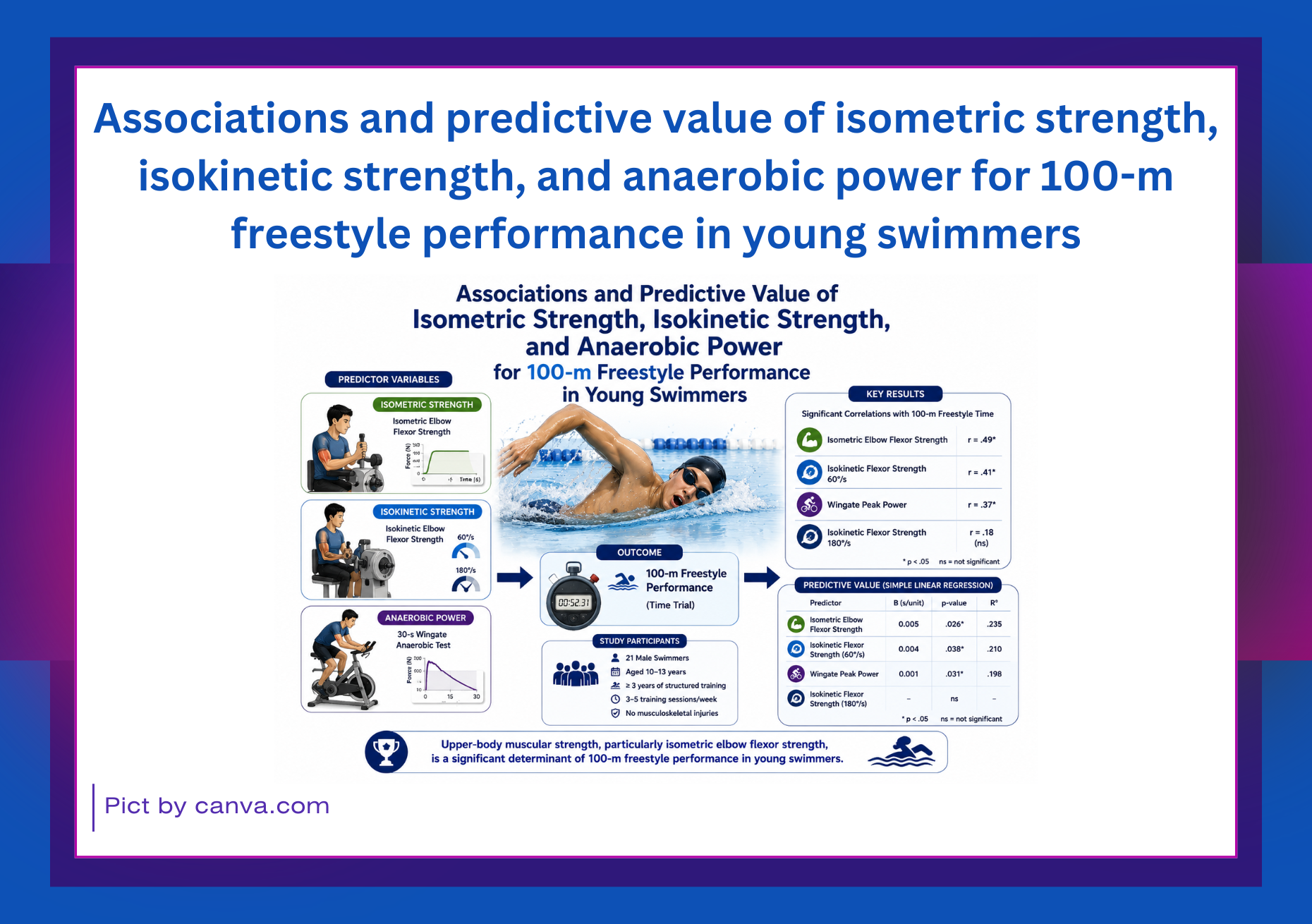
Methods: A cross-sectional study was conducted with 21 male swimmers aged 10–13 years, selected purposively. Eligibility criteria included a minimum of three years of structured swimming training, regular participation in 3–5 training sessions per week, and absence of musculoskeletal injuries. Upper-body strength was assessed using isometric and isokinetic dynamometry (60°/s and 180°/s), while anaerobic power was measured using the 30-s Wingate Anaerobic Test. Swimming performance was evaluated using a 100-m freestyle time trial. Pearson correlation and linear regression analyses were performed after verification of regression assumptions.
Results: Swimming speed was significantly correlated with isometric elbow flexor strength (r = .49, p < .05), isokinetic flexor strength at 60°/s (r = .41, p < .05), and Wingate peak power (r = .37, p < .05). Simple linear regression analysis identified isometric elbow flexor strength as the strongest predictor of swimming performance (B = 0.005, p = .026, R² = .235), followed by isokinetic flexor strength at 60°/s (B = 0.004, p = .038, R² = .210) and Wingate peak power (B = 0.001, p = .031, R² = .198). No significant associations were observed for isokinetic strength at 180°/s.
Conclusions: Upper-body muscular strength, particularly isometric elbow flexor strength, is a significant determinant of 100-m freestyle swimming performance in young swimmers. These findings highlight the importance of maximal force-generating capacity, alongside anaerobic power development, for sprint swimming performance.
Abbes, Z., Haddad, M., & Gomaa, A.-S. . (2024). Relationship between physical characteristics and 200-metre swimming performance in young amateur swimmers. Acta Kinesiologica, 17(1.), 4–9. Retrieved from https://akinesiologica.com/ojs_3.3.0-7/index.php/akinesiologica/article/view/58
Barbosa, T. M., Morais, J. E., Marques, M. C., Costa, M. J., & Marinho, D. A. (2015a). The power output and sprinting performance of young swimmers. The Journal of Strength & Conditioning Research, 29(2), 440-450. https://doi.org/10.1519/JSC.0000000000000626
Barbosa, T. M., Morais, J. E., Marques, M. C., Silva, A. J., Marinho, D. A., & Kee, Y. H. (2015b). Hydrodynamic profile of young swimmers: Changes over a competitive season. Scandinavian Journal of Medicine & Science in Sports, 25(2), e184-e196. https://doi.org/10.1111/sms.12281
Boullosa, D., Esteve-Lanao, J., Casado, A., Peyré-Tartaruga, L. A., Gomes da Rosa, R., & Del Coso, J. (2020). Factors affecting training and physical performance in recreational endurance runners. Sports, 8(3), 35. https://doi.org/10.3390/sports8030035
Cochrane, K. C., Housh, T. J., Smith, C. M., Hill, E. C., Jenkins, N. D., Johnson, G. O., ... & Cramer, J. T. (2015). Relative contributions of strength, anthropometric, and body composition characteristics to estimated propulsive force in young male swimmers. The Journal of Strength & Conditioning Research, 29(6), 1473-1479. https://doi.org/10.1519/JSC.0000000000000942
Dai, J., Dai, Z., & Ding, Y. (2025). Influence of trunk strength on sprint performance in swimmers: a cross-sectional analysis of torque-velocity relationships. Frontiers in Physiology, 16, 1625283. https://doi.org/10.3389/fphys.2025.1625283
Garrido, N., Marinho, D. A., Reis, V. M., van den Tillaar, R., Costa, A. M., Silva, A. J., & Marques, M. C. (2010). Does combined dry land strength and aerobic training inhibit performance of young competitive swimmers?. Journal of sports science & medicine, 9(2), 300-310. https://pmc.ncbi.nlm.nih.gov/articles/PMC3761739/
Gastin, P. B. (2001). Energy system interaction and relative contribution during maximal exercise. Sports medicine, 31(10), 725-741. https://doi.org/10.2165/00007256-200131100-00003
Jones, A. M., & Vanhatalo, A. (2017). The ‘critical power’concept: applications to sports performance with a focus on intermittent high-intensity exercise. Sports Medicine, 47(Suppl 1), 65-78. https://doi.org/10.1007/s40279-017-0688-0
Jones, W. C. (2019). The Influence Of A High-Nitrate Beverage On The Rate Of Force Development And Peak Force Output Of College-Aged Individuals During An Isometric Mid-Thigh Pull (Master's thesis, Kent State University). http://rave.ohiolink.edu/etdc/view?acc_num=kent1573055614095832
Kachaunov, M., & Petrov, L. (2020). Upper body anaerobic power and freestyle swimming performance. Journal of Physical Education and Sport, 20(4), 1957-1963. https://doi.org/10.7752/jpes.2020.04265
Lloyd, R. S., & Oliver, J. L. (2012). The youth physical development model: A new approach to long-term athletic development. Strength & Conditioning Journal, 34(3), 61-72. https://doi.ogr/10.1519/SSC.0b013e31825760ea
Lloyd, R. S., Oliver, J. L., Faigenbaum, A. D., Howard, R., Croix, M. B. D. S., Williams, C. A., ... & Myer, G. D. (2015). Long-term athletic development-part 1: a pathway for all youth. The Journal of Strength & Conditioning Research, 29(5), 1439-1450. https://doi.org/10.1519/JSC.0000000000000756
Lum, D., & Barbosa, T. M. (2019). Brief review: effects of isometric strength training on strength and dynamic performance. International journal of sports medicine, 40(06), 363-375. https://doi.org/10.1055/a-0863-4539
Morais, J. E., Barbosa, T. M., Neiva, H. P., & Marinho, D. A. (2019). Stability of pace and turn parameters of elite long-distance swimmers. Human movement science, 63, 108-119. https://doi.org/10.1016/j.humov.2018.11.013
Moran, J., Sandercock, G. R., Ramírez-Campillo, R., Wooller, J. J., Logothetis, S., Schoenmakers, P. P., & Parry, D. A. (2018). Maturation-related differences in adaptations to resistance training in young male swimmers. The Journal of Strength & Conditioning Research, 32(1), 139-149. https://doi.org/10.1519/JSC.0000000000001780
Morouço, P., Keskinen, K. L., Vilas-Boas, J. P., & Fernandes, R. J. (2011). Relationship between tethered forces and the four swimming techniques performance. Journal of Applied Biomechanics, 27(2), 161-169. https://doi.org/10.1123/jab.27.2.161
Natera, A. O., Cardinale, M., & Keogh, J. W. (2020). The effect of high volume power training on repeated high-intensity performance and the assessment of repeat power ability: a systematic review. Sports Medicine, 50(7), 1317-1339. https://doi.org/10.1007/s40279-020-01273-0
Price, T., Cimadoro, G., & S Legg, H. (2024). Physical performance determinants in competitive youth swimmers: a systematic review. BMC Sports Science, Medicine and Rehabilitation, 16(1), 20. https://doi.org/10.1186/s13102-023-00767-4
Psycharakis, S. G., & Coleman, S. G. (2024). Which phases of the stroke cycle are propulsive in front crawl swimming?. Research Quarterly for Exercise and Sport, 95(2), 325-333. https://doi.org/10.1080/02701367.2023.2203724
Ruiz-Navarro, J. J., Santos, C. C., Born, D. P., López-Belmonte, Ó., Cuenca-Fernández, F., Sanders, R. H., & Arellano, R. (2025). Factors relating to sprint swimming performance: a systematic review. Sports Medicine, 55(4), 899-922. https://doi.org/10.1007/s40279-024-02172-4
Salami, S., Bandeira, P. F. R., Mashhadi, M. R., Shamsipour Dehkordi, P., Luz, L. G., Martins, C. M. D. L., ... & Duncan, M. J. (2024). Associations between biological maturation, chronological age, body mass index, sex, and motor competence in prepubertal children: a network analysis. Children, 11(9), 1143. https://doi.org/10.3390/children11091143
Sandford, G. N., Laursen, P. B., & Buchheit, M. (2021). Anaerobic speed/power reserve and sport performance: scientific basis, current applications and future directions. Sports Medicine, 51(10), 2017-2028. https://doi.org/10.1007/s40279-021-01523-9
Smith, D. J. (2003). A framework for understanding the training process leading to elite performance. Sports medicine, 33(15), 1103-1126. https://doi.org/10.2165/00007256-200333150-00003
Stosic, J. (2020). Transition phase–A new phase from start/turn to free swimming in competitive swimmers (Doctoral dissertation, Ciencias). https://oa.upm.es/66955/
Suchomel, T. J., Nimphius, S., & Stone, M. H. (2016). The importance of muscular strength in athletic performance. Sports medicine, 46(10), 1419-1449. https://doi.org/10.1007/s40279-016-0486-0
Van Houwelingen, J., Schreven, S., Smeets, J. B., Clercx, H. J., & Beek, P. J. (2017). Effective propulsion in swimming: grasping the hydrodynamics of hand and arm movements. Journal of applied biomechanics, 33(1), 87-100. https://doi.org/10.1123/jab.2016-0064
Wiażewicz, A., & Eider, J. (2021). The relationship between swimming performance and isokinetic shoulder strength of elite swimmers. Human Movement, 22(4), 10-19. https://doi.org/10.5114/hm.2021.103285
Wirth, K., Keiner, M., Fuhrmann, S., Nimmerichter, A., & Haff, G. G. (2022). Strength training in swimming. International journal of environmental research and public health, 19(9), 5369. https://doi.org/10.3390/ijerph19095369
Yang, W., Ou, Z., Xu, G., Zheng, S., Bo, X., Yan, X., & Huang, W. (2026). Effects of 8-week ischemic preconditioning on swimming performance and power output in male 100-m freestyle swimmers: a randomized controlled trial. European Journal of Applied Physiology, 126(2), 991-1008. https://doi.org/10.1007/s00421-025-05982-0
Copyright (c) 2026 Zied Abbes, Rabeh Labbadi, Faten Salhi

This work is licensed under a Creative Commons Attribution-ShareAlike 4.0 International License.