Vol. 1 No. 2 (2025): Sport, Exercise, and Injury

This issue has been available online since December 30th, 2025. All articles in this issue were authored/co-authored by 7 authors from Indonesia, Italy, and Malaysia.
Published:
2025-12-30
Original Research
-

Analysis of sports injuries in the implementation of the new 2023 regulations for the sport of Pencak Silat in the 17-35 age category
Muhammad Miqdam Afis11. State University of Malang , IDAbstractBackground: The changes to the 2022/2023 Pencak Silat competition rules established by PESILAT are aimed at international standardization, but these changes have the potential to affect patterns and injury risks for athletes in competition categories involving intense physical contact.
Objectives: This study aims to describe the types, frequency, and body parts injured, as well as athletes' perceptions of the impact of the implementation of the new 2023 regulations on injuries among 17-35-year-old competitive Pencak Silat athletes in Malang Regency.
Methods: The study used a quantitative descriptive design with a cross-sectional approach. The sample consisted of 30 competitive Pencak Silat athletes (aged 17–35 years) selected using purposive sampling. Data were collected in March 2025 using a questionnaire distributed online via Google Forms. Data analysis was performed descriptively using frequencies and percentages, as well as simple comparative analysis based on gender.
Results: Of the 30 respondents, the most commonly reported injuries were sprains (22.0%) and bruises (19.5%). The body parts most frequently injured were the lower extremities (feet and ankles, 20.7%), followed by the hands (14.1%). The most dominant factors causing injury were lack of warm-up (27.5%) and collision/physical contact (26.4%). A total of 64% of athletes (n = 19) stated that the implementation of the new 2023 regulations had a significant effect on the occurrence of injuries. Severe injuries such as fractures, ACL, and MCL were only found in male athletes with a low percentage, while minor injuries (bruises and sprains) were more commonly reported in female athletes.
Conclusions: Soft tissue injuries, particularly sprains and bruises, are the most common types of injuries experienced by competitive Pencak Silat athletes, with injuries predominantly occurring in the lower extremities.APA Citation StyleAfis, M. M. (2026). Analysis of sports injuries in the implementation of the new 2023 regulations for the sport of Pencak Silat in the 17-35 age category. Sport, Exercise, and Injury, 1(2), 80-89. https://doi.org/10.56003/sei.v1i2.641 -
Comparative physical fitness profiles of female long-distance and sprint swimmers at Petrokima Gresik Club: A descriptive study
Kartika Jeaniar Fajar Nur Rahma11. State University of Malang , IDAbstractBackground: Physical condition is a fundamental factor that affects swimmers' performance in developing techniques, tactics, and competition strategies, especially for swimmers specializing in different distances, such as sprinters and long-distance swimmers.
Objectives: This study aims to analyze the dominant physical profiles of female sprinters and long-distance swimmers, providing evaluation material for coaches to develop more targeted training programs.
Methods: The study employed a quantitative descriptive design, utilizing a survey and test approach. The research subjects consisted of 20 female swimmers from the Petrokimia Gresik Club who were selected purposively, including 10 sprinters and 10 long-distance swimmers. Data collection was conducted in 2024 through push-up tests (measuring arm muscle strength), sit-ups (assessing abdominal muscle strength), vertical jump (evaluating leg muscle explosive power), and multistage fitness tests (testing aerobic endurance). Raw scores were converted into t-scores and then categorized using the Norm Reference Scale (NRS). Data analysis was performed descriptively using means, standard deviations, and percentages. This study has obtained ethical approval from the relevant ethics committee.
Results: The analysis results show that in the sprinter group, 4 out of 10 athletes (40%) were in the "fair" physical condition category, while in the long-distance group, 5 out of 10 athletes (50%) were also in this category. In general, the components of arm muscle strength, abdominal muscle strength, leg muscle power, and aerobic endurance in both groups showed a relatively balanced distribution with a predominance of the adequate category.
Conclusions: The physical condition of female sprinters and long-distance swimmers from the Petrokimia Gresik Club was at a relatively balanced level, with a predominance of the adequate category. These findings serve as a basis for evaluating and adjusting training programs according to the characteristics of specific swimming specializations.APA Citation StyleRahma, K. J. F. N. (2026). Comparative physical fitness profiles of female long-distance and sprint swimmers at Petrokima Gresik Club: A descriptive study. Sport, Exercise, and Injury, 1(2), 90-98. https://doi.org/10.56003/sei.v1i2.645 -

Analysis of strategy and implementation of head injury prevention programs: A case study of boxers at HAN Academy Malang
Padantya Devin Sugito11. State University of Malang , IDAbstractBackground: Boxing is a high-risk combat sport with a high probability of head injuries, so effective prevention strategies are essential for athlete safety. However, empirical evidence on the implementation of head injury prevention programs at the training academy level is still limited.
Objectives: This study aims to explore strategies and the practical implementation of head injury prevention at the HAN Boxing Academy, Malang.
Methods: A qualitative case study design was used with purposive sampling. Four participants (one coach and three active athletes) were recruited. Data were collected through document review, direct observation, and semi-structured interviews, which consisted of 15 guiding questions. Data were analyzed using a thematic analysis approach, which involved data reduction, data presentation, and conclusion. Methodological triangulation was applied to enhance credibility.
Results: Three main themes emerged: (1) systematic emphasis on basic defensive techniques to minimize head collisions, (2) mandatory and consistent use of head protection during training sessions, and (3) active supervision by coaches combined with a gradual rehabilitation protocol, including competition restrictions for up to six months after a serious head injury. Participants considered head protection effective in reducing the severity of impacts, although the residual risk of head injury was still acknowledged.
Conclusions: Head injury prevention in academies is implemented through an integrated approach that combines technical skill development, the use of protective equipment, and continuous monitoring. To strengthen its effectiveness, it is recommended that structured injury prevention protocols be implemented and closer collaboration with medical professionals be fostered.APA Citation StyleSugito, P. D. (2026). Analysis of strategy and implementation of head injury prevention programs: A case study of boxers at HAN Academy Malang. Sport, Exercise, and Injury, 1(2), 99-110. https://doi.org/10.56003/sei.v1i2.646 -
Analysis of dominant physical factors in volleyball skills: confirmatory analysis of the Bahana Muda volleyball team
Mahesa Dwi Chandra11. State University of Malang , IDAbstractBackground: Physical condition is an important determinant of volleyball skill performance, but few studies have empirically tested the structure of its dominant factors using a confirmatory approach.
Objectives: This study aims to identify the dominant physical condition factors that influence the playing skills of Bahana Muda Club volleyball athletes using Confirmatory Factor Analysis (CFA).
Methods: This study used a quantitative descriptive design. The sample consisted of 20 male volleyball athletes from the Bahana Muda Club who were selected through purposive sampling. The physical condition variables measured included speed (30-meter run), endurance (beep test), arm muscle strength (push-ups), abdominal muscle strength (sit-ups), leg muscle power (vertical jump), and agility (shuttle run). The analysis was conducted through an initial exploratory analysis and continued with CFA using IBM SPSS AMOS version 26. The goodness-of-fit model was evaluated using the CFI, TLI, and RMSEA indices.
Results: The CFA results show that leg muscle power (λ = 0.791), arm muscle strength (λ = 0.742), endurance (λ = 0.732), and agility (λ = 0.606) have significant factor loadings on volleyball skills (p < 0.05), while abdominal muscle speed and strength did not show significant contributions. The CFA model showed good data fit (CFI = 0.986; TLI = 0.978; RMSEA = 0.050).
Conclusions: Leg muscle power, arm muscle strength, endurance, and agility are the dominant physical factors in volleyball skills. Training programs should prioritize these components, and further research should involve larger samples and cross-clubs.APA Citation StyleChandra, M. D. (2026). Analysis of dominant physical factors in volleyball skills: confirmatory analysis of the Bahana Muda volleyball team. Sport, Exercise, and Injury, 1(2), 111-121. https://doi.org/10.56003/sei.v1i2.642

Literature Reviews
-
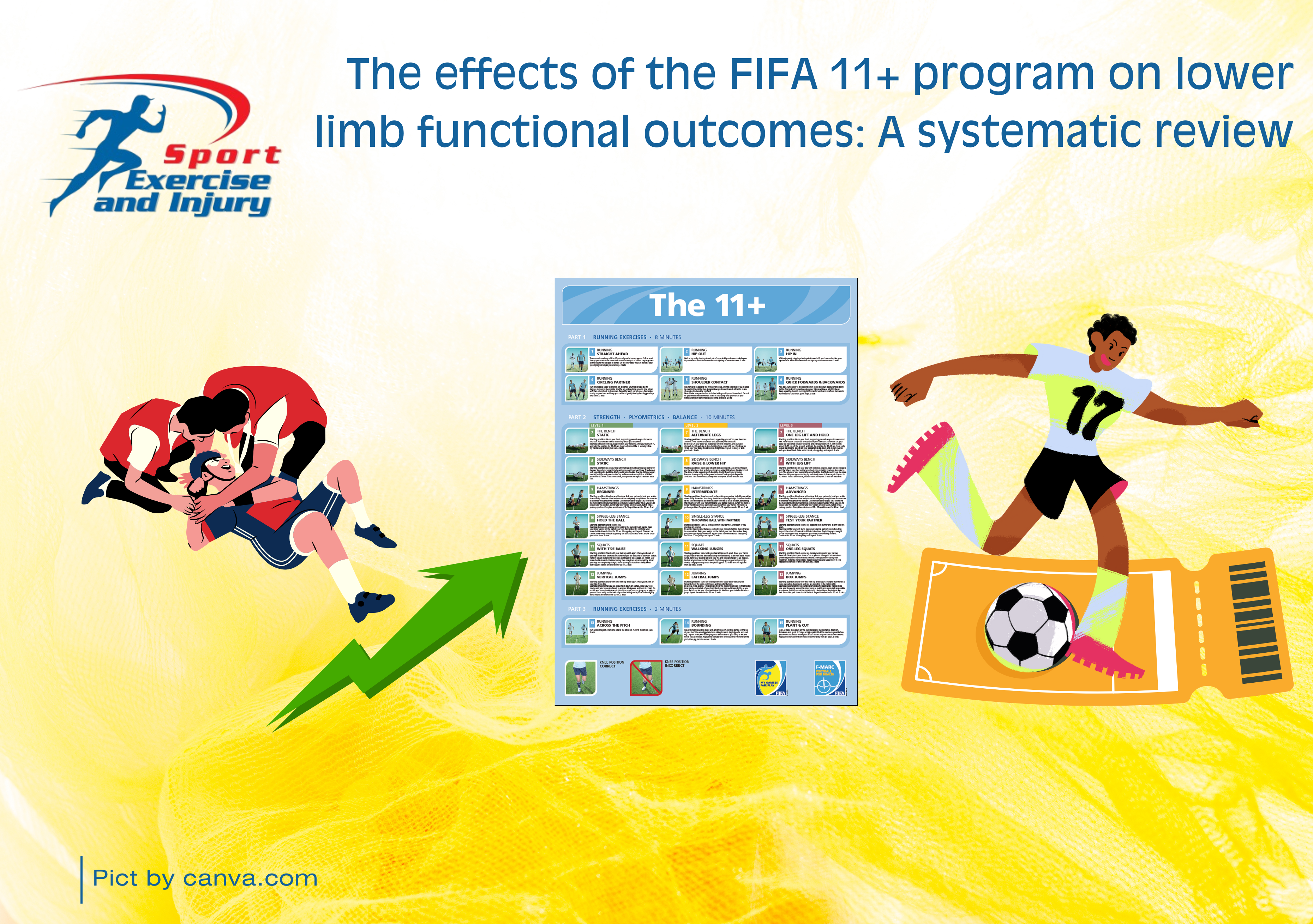
The effects of the FIFA 11+ program on lower limb functional outcomes: A systematic review
Yulingga Nanda Hanief1, Italo Sannicandro2, Raja Mohammed Firhad Raja Azidin31. State University of Malang , ID2. Clinical and Experimental Medicine Department, University of Foggia , IT3. Faculty of Sports Science and Recreation, Universiti Teknologi MARA , MYAbstractBackground: The FIFA 11+ program has been proven effective in preventing soccer injuries, but evidence regarding its impact on lower extremity functional outcomes is still scattered and reported heterogeneously.
Objectives: This systematic review aims to synthesize evidence regarding the effects of the FIFA 11+ program on lower extremity functional outcomes—including ROM, knee extension, internal and external hip rotation, and hamstring muscle strength—in athletes.
Methods: This systematic review was prospectively registered in PROSPERO (CRD420251147261) and conducted in accordance with PRISMA 2020 guidelines. A total of 14 studies involving athletes or physically active individuals met the inclusion criteria. Functional outcomes were measured using various instruments, primarily an isokinetic dynamometer for muscle strength and a goniometer for ROM measurement. The methodological quality of the studies was assessed using the Newcastle–Ottawa Scale. Due to substantial heterogeneity in study design, measurement instruments, intervention protocols, and reporting formats, a quantitative meta-analysis was not performed, and the data were synthesized using a qualitative narrative approach.
Results: Most studies (approximately 70–80%) reported an increase in hamstring muscle strength after the FIFA 11+ intervention, particularly in concentric and eccentric isokinetic measurements. Improvements in ROM and functional outcomes of the knee and hip were also reported, although results varied between studies. Evidence related to knee extension and hip rotation shows lower consistency compared to hamstring strength.
Conclusions: The FIFA 11+ program shows potential functional benefits beyond injury prevention, particularly in improving hamstring muscle strength and several aspects of joint mobility.APA Citation StyleHanief, Y. N. , Sannicandro, I. , & Azidin, R. M. F. R. (2025). The effects of the FIFA 11+ program on lower limb functional outcomes: A systematic review. Sport, Exercise, and Injury, 1(2), 122-138. https://doi.org/10.56003/sei.v1i2.670