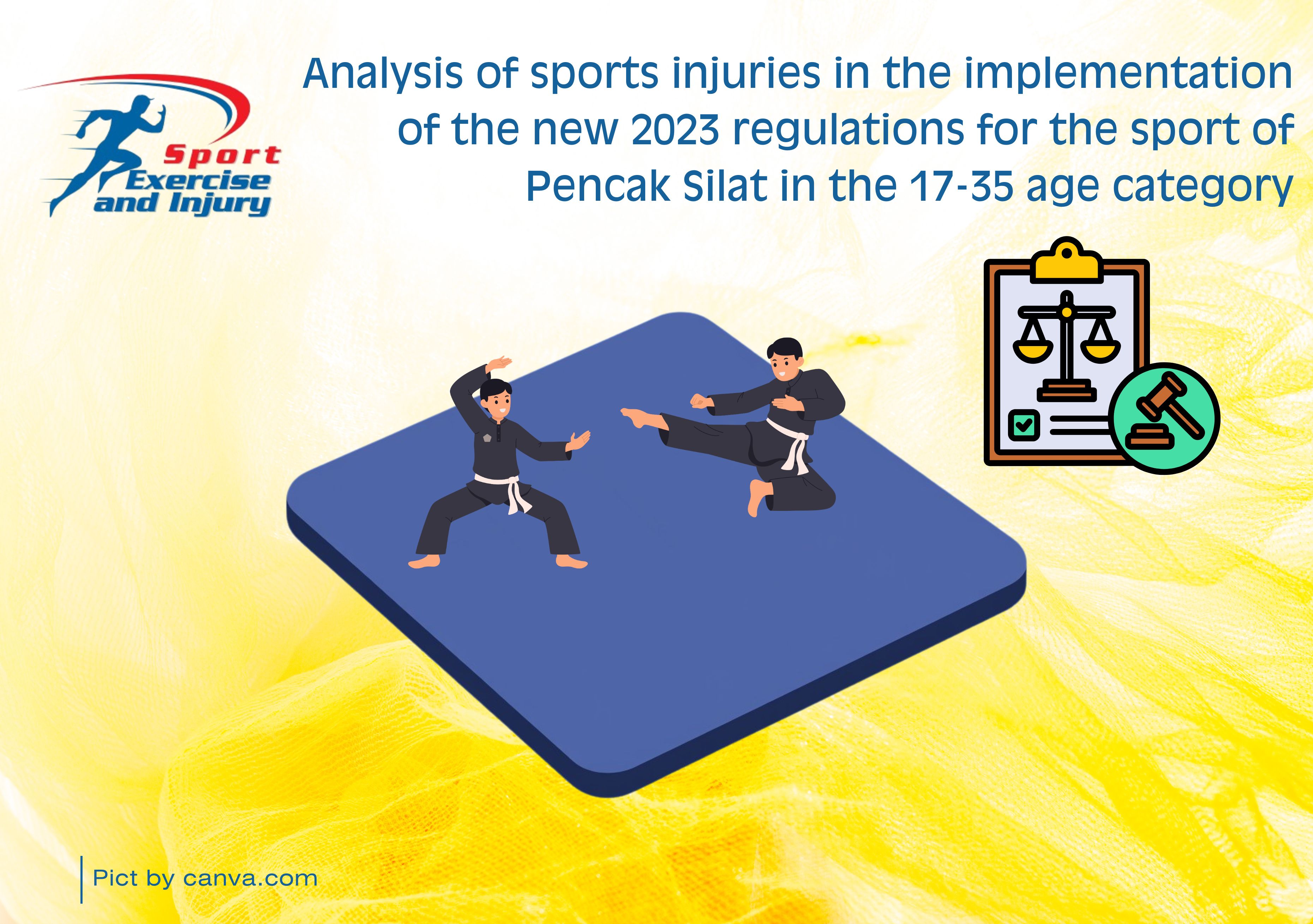
Analysis of sports injuries in the implementation of the new 2023 regulations for the sport of Pencak Silat in the 17-35 age category

Downloads
Abstract
Background: The changes to the 2022/2023 Pencak Silat competition rules established by PESILAT are aimed at international standardization, but these changes have the potential to affect patterns and injury risks for athletes in competition categories involving intense physical contact.
Objectives: This study aims to describe the types, frequency, and body parts injured, as well as athletes' perceptions of the impact of the implementation of the new 2023 regulations on injuries among 17-35-year-old competitive Pencak Silat athletes in Malang Regency.
Methods: The study used a quantitative descriptive design with a cross-sectional approach. The sample consisted of 30 competitive Pencak Silat athletes (aged 17–35 years) selected using purposive sampling. Data were collected in March 2025 using a questionnaire distributed online via Google Forms. Data analysis was performed descriptively using frequencies and percentages, as well as simple comparative analysis based on gender.
Results: Of the 30 respondents, the most commonly reported injuries were sprains (22.0%) and bruises (19.5%). The body parts most frequently injured were the lower extremities (feet and ankles, 20.7%), followed by the hands (14.1%). The most dominant factors causing injury were lack of warm-up (27.5%) and collision/physical contact (26.4%). A total of 64% of athletes (n = 19) stated that the implementation of the new 2023 regulations had a significant effect on the occurrence of injuries. Severe injuries such as fractures, ACL, and MCL were only found in male athletes with a low percentage, while minor injuries (bruises and sprains) were more commonly reported in female athletes.
Conclusions: Soft tissue injuries, particularly sprains and bruises, are the most common types of injuries experienced by competitive Pencak Silat athletes, with injuries predominantly occurring in the lower extremities.Ar Rahman, H. N. (2025). Knowledge level of sports injury first aid using PRICE method among student-athletes in Indonesia: A case study. Sport, Exercise, and Injury, 1(1), 50-59. https://doi.org/10.56003/sei.v1i1.555
Bahr, R., & Krosshaug, T. (2005). Understanding injury mechanisms: a key component of preventing injuries in sport. British Journal of Sports Medicine, 39(6), 324-329. https://doi.org/10.1136/bjsm.2005.018341
Bromley, S. J., Drew, M. K., Talpey, S., McIntosh, A. S., & Finch, C. F. (2018). A systematic review of prospective epidemiological research into injury and illness in Olympic combat sport. British Journal of Sports Medicine, 52(1), 8-16. https://doi.org/10.1136/bjsports-2016-097313
Brooks, A., McGuine, T., & Hetzel, S. (2015). Effect of New Rule Limiting Full Contact Practice on Incidence of Sport Related Concussion in High School Football Players. South African Journal of Sports Medicine, 27. https://doi.org/10.1177/0363546519860120
Candra, J. (2021). Pencak Silat. Deepublish.
Dewi, C. S., Pudjijuniarto, P., Firmansyah, A., & Irawan, R. J. (2025). Eccentric hamstring strength profile and limb asymmetry in sub-elite female taekwondo athletes: Implications for injury prevention. Sport, Exercise, and Injury, 1(1), 70-79. https://doi.org/10.56003/sei.v1i1.574
Ekegren, C. L., Donaldson, A., Gabbe, B. J., & Finch, C. F. (2014). Implementing injury surveillance systems alongside injury prevention programs: evaluation of an online surveillance system in a community setting. Injury Epidemiology, 1(1), 19. https://doi.org/10.1186/s40621-014-0019-y
Hammami, N., Hattabi, S., Salhi, A., Rezgui, T., Oueslati, M., & Bouassida, A. (2018). Combat sport injuries profile: A review. Science & Sports, 33(2), 73-79. https://doi.org/10.1016/j.scispo.2017.04.014
Herzberg, S. D., Motu’apuaka, M. L., Lambert, W., Fu, R., Brady, J., & Guise, J. M. (2017). The effect of menstrual cycle and contraceptives on ACL injuries and laxity: a systematic review and meta-analysis. Orthopaedic Journal of Sports Medicine, 5(7), 2325967117718781. https://doi.org/10.1177/2325967117718781
Lystad, R. P., Alevras, A., Rudy, I., Soligard, T., & Engebretsen, L. (2021). Injury incidence, severity and profile in Olympic combat sports: a comparative analysis of 7712 athlete exposures from three consecutive Olympic Games. British Journal of Sports Medicine, 55(19), 1077-1083. https://doi.org/10.1136/bjsports-2020-102958
Lystad, R. P., Gregory, K., & Wilson, J. (2014). The epidemiology of injuries in mixed martial arts: a systematic review and meta-analysis. Orthopaedic Journal of Sports Medicine, 2(1), 2325967113518492. https://doi.org/10.1177/2325967113518492
Parsons, J. T., & Baugh, C. (2018). The evolving landscape of policies, rules, and law in sport-related concussion. Handbook of Clinical Neurology, 158, 257-267. https://doi.org/10.1016/B978-0-444-63954-7.00025-2
PESILAT. (2023). Peraturan Pertandingan Pencak Silat 2023. Deepublish.
Raftery, M., Tucker, R., & Falvey, É. C. (2021). Getting tough on concussion: how welfare-driven law change may improve player safety—a Rugby Union experience. British Journal of Sports Medicine, 55(10), 527-529. https://doi.org/10.1136/bjsports-2019-101885
Suryaningrum, J. A., & Shapie, M. N. M. (2025). Injury trends in Pencak Silat: Impact of regulation changes on sparring athletes. Sport, Exercise, and Injury, 1(1), 15-26. https://doi.org/10.56003/sei.v1i1.511
Zazryn, T. R., McCrory, P. R., & Cameron, P. A. (2009). Injury rates and risk factors in competitive professional boxing. Clinical Journal of Sport Medicine, 19(1), 20-25. https://doi.org/10.1097/JSM.0b013e31818f1582
Copyright (c) 2025 Muhammad Miqdam Afis

This work is licensed under a Creative Commons Attribution-ShareAlike 4.0 International License.