The effects of the FIFA 11+ program on lower limb functional outcomes: A systematic review

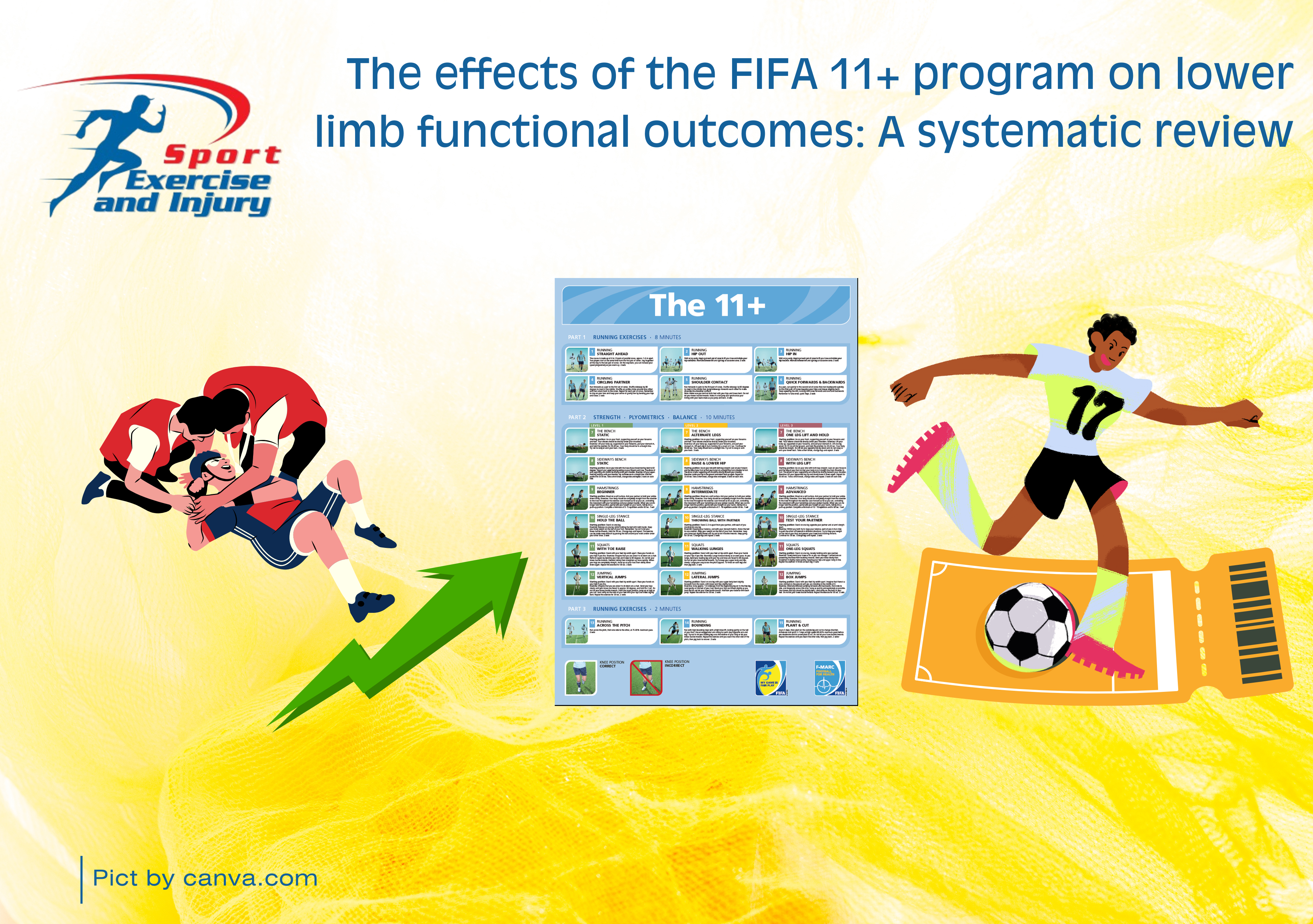
Background: The FIFA 11+ program has been proven effective in preventing soccer injuries, but evidence regarding its impact on lower extremity functional outcomes is still scattered and reported heterogeneously.
Objectives: This systematic review aims to synthesize evidence regarding the effects of the FIFA 11+ program on lower extremity functional outcomes—including ROM, knee extension, internal and external hip rotation, and hamstring muscle strength—in athletes.
Methods: This systematic review was prospectively registered in PROSPERO (CRD420251147261) and conducted in accordance with PRISMA 2020 guidelines. A total of 14 studies involving athletes or physically active individuals met the inclusion criteria. Functional outcomes were measured using various instruments, primarily an isokinetic dynamometer for muscle strength and a goniometer for ROM measurement. The methodological quality of the studies was assessed using the Newcastle–Ottawa Scale. Due to substantial heterogeneity in study design, measurement instruments, intervention protocols, and reporting formats, a quantitative meta-analysis was not performed, and the data were synthesized using a qualitative narrative approach.
Results: Most studies (approximately 70–80%) reported an increase in hamstring muscle strength after the FIFA 11+ intervention, particularly in concentric and eccentric isokinetic measurements. Improvements in ROM and functional outcomes of the knee and hip were also reported, although results varied between studies. Evidence related to knee extension and hip rotation shows lower consistency compared to hamstring strength.
Conclusions: The FIFA 11+ program shows potential functional benefits beyond injury prevention, particularly in improving hamstring muscle strength and several aspects of joint mobility.Downloads
Arsenis, S., Gioftsidou, A., Ispyrlidis, I., Kyranoudis, A., Pafis, G., Malliou, P., & Beneka, A. (2020). Effects of the FIFA 11+ injury prevention program on lower limb strength and balance. Journal of Physical Education and Sport, 20(2), 592–598. https://doi.org/10.7752/jpes.2020.02087
Ayala, F., Pomares-Noguera, C., Robles-Palazón, F., del Pilar García-Vaquero, M., Ruiz-Pérez, I., Hernández-Sánchez, S., & De Ste Croix, M. (2017). Training Effects of the FIFA 11+ and Harmoknee on Several Neuromuscular Parameters of Physical Performance Measures. International Journal of Sports Medicine, 38(04), 278–289. https://doi.org/10.1055/s-0042-121260
Bahr, R., & Krosshaug, T. (2005). Understanding injury mechanisms: a key component of preventing injuries in sport. British Journal of Sports Medicine, 39(6), 324–329. https://doi.org/10.1136/bjsm.2005.018341
Barengo, N., Meneses-Echávez, J., Ramírez-Vélez, R., Cohen, D., Tovar, G., & Bautista, J. (2014). The Impact of the FIFA 11+ Training Program on Injury Prevention in Football Players: A Systematic Review. International Journal of Environmental Research and Public Health, 11(11), 11986–12000. https://doi.org/10.3390/ijerph111111986
Behm, D. G., & Chaouachi, A. (2011). A review of the acute effects of static and dynamic stretching on performance. European Journal of Applied Physiology, 111(11), 2633–2651. https://doi.org/10.1007/s00421-011-1879-2
Bizzini, M., & Dvorak, J. (2015). FIFA 11+: an effective programme to prevent football injuries in various player groups worldwide—a narrative review. British Journal of Sports Medicine, 49(9), 577–579. https://doi.org/10.1136/bjsports-2015-094765
Brito, J., Figueiredo, P., Fernandes, L., Seabra, A., Soares, J. M., Krustrup, P., & Rebelo, A. (2010). Isokinetic strength effects of FIFA’s “The 11+” injury prevention training programme. Isokinetics and Exercise Science, 18(4), 211–215. https://doi.org/10.3233/IES-2010-0386
Bukry, S. A., Justine, M., Azidin, R. M. F. R., Azhar, N. I., Zolkafi, M. A. A., Lo, C. N., & Manaf, H. (2024). Effects of the FIFA 11+ injury prevention programme on muscle strength and landing biomechanical markers of ACL injury during fatigue among youth soccer players. Biomedical Human Kinetics, 16(1), 173-184. https://doi.org/10.2478/bhk-2024-0018
Daneshjoo, A., Mokhtar, A. H., Rahnama, N., & Yusof, A. (2012). The Effects of Injury Preventive Warm-Up Programs on Knee Strength Ratio in Young Male Professional Soccer Players. PLoS ONE, 7(12), e50979. https://doi.org/10.1371/journal.pone.0050979
Daneshjoo, A., Mokhtar, A. H., Rahnama, N., & Yusof, A. (2013). The Effects of Injury Prevention Warm-Up Programmes on Knee Strength in Male Soccer Players. Biology of Sport, 30(4), 281–288. https://doi.org/10.5604/20831862.1077554
Foqha, B. M., Schwesig, R., Ltifi, M. A., Bartels, T., Hermassi, S., & Aouadi, R. (2023). A 10-week FIFA 11+ program improves the short-sprint and modified agility T-test performance in elite seven-a-side soccer players. Frontiers in Physiology, 14. https://doi.org/10.3389/fphys.2023.1236223
García-Solano, K. B., Montealegre-Mesa, L. M., & Pérez-Parra, J. E. (2019). Efecto del programa de calentamiento FIFA 11+ sobre la prevención de lesiones deportivas de miembros inferiores en futbolistas juveniles de 14 a 16 años (11 FIFA en hombres futbolistas de 14 a 16 años). Fisioterapia, 41(2), 83–88. https://doi.org/10.1016/j.ft.2019.02.003
Ghareeb, D. M., McLaine, A. J., Wojcik, J. R., & Boyd, J. M. (2017). Effects of Two Warm-up Programs on Balance and Isokinetic Strength in Male High School Soccer Players. Journal of Strength and Conditioning Research, 31(2), 372–379. https://doi.org/10.1519/JSC.0000000000001509
Gomes Neto, M., Conceição, C. S., de Lima Brasileiro, A. J. A., de Sousa, C. S., Carvalho, V. O., & de Jesus, F. L. A. (2017). Effects of the FIFA 11 training program on injury prevention and performance in football players: a systematic review and meta-analysis. Clinical Rehabilitation, 31(5), 651–659. https://doi.org/10.1177/0269215516675906
Grooms, D. R., Palmer, T., Onate, J. A., Myer, G. D., & Grindstaff, T. (2013). Soccer-Specific Warm-Up and Lower Extremity Injury Rates in Collegiate Male Soccer Players. Journal of Athletic Training, 48(6), 782–789. https://doi.org/10.4085/1062-6050-48.4.08
Impellizzeri, F. M., Bizzini, M., Dvorak, J., Pellegrini, B., Schena, F., & Junge, A. (2013). Physiological and performance responses to the FIFA 11+ (part 2): a randomised controlled trial on the training effects. Journal of Sports Sciences, 31(13), 1491–1502. https://doi.org/10.1080/02640414.2013.802926
Mendiguchia, J., & Brughelli, M. (2011). A return-to-sport algorithm for acute hamstring injuries. Physical Therapy in Sport, 12(1), 2–14. https://doi.org/10.1016/j.ptsp.2010.07.003
Oshima, T., Nakase, J., Inaki, A., Mochizuki, T., Takata, Y., Shimozaki, K., Kinuya, S., & Tsuchiya, H. (2020). Comparison of muscle activity, strength, and balance, before and after a 6-month training using the FIFA11+ program (part 2). Journal of Orthopaedic Surgery, 28(1). https://doi.org/10.1177/2309499019891541
Page, M. J., McKenzie, J. E., Bossuyt, P. M., Boutron, I., Hoffmann, T. C., Mulrow, C. D., Shamseer, L., Tetzlaff, J. M., Akl, E. A., Brennan, S. E., Chou, R., Glanville, J., Grimshaw, J. M., Hróbjartsson, A., Lalu, M. M., Li, T., Loder, E. W., Mayo-Wilson, E., McDonald, S., … Moher, D. (2021). The PRISMA 2020 statement: an updated guideline for reporting systematic reviews. BMJ, n71. https://doi.org/10.1136/bmj.n71
Panchal, R., Rizvi, M. R., Sharma, A., Ahmad, F., Hasan, S., Shaik, A. R., Seyam, M. K., Uddin, S., Ahamed, W. M., Iqbal, A., & Alghadir, A. H. (2025). Comparing the effectiveness of the FIFA 11+ warm-up and conventional warm-up in enhancing cyclist performance and mitigating injury risk. Scientific Reports, 15(1), 9430. https://doi.org/10.1038/s41598-025-91005-z
Pun, R. (2020). Hamstring injury prevention: a systematic review. University of Chichester.
Robles-Palazón, F. J., Blázquez-Rincón, D., López-Valenciano, A., Comfort, P., López-López, J. A., & Ayala, F. (2024). A systematic review and network meta-analysis on the effectiveness of exercise-based interventions for reducing the injury incidence in youth team-sport players. Part 1: an analysis by classical training components. Annals of Medicine, 56(1). https://doi.org/10.1080/07853890.2024.2408457
Soussi, B., Horváth, T., Lacza, Z., & Ambrus, M. (2025). The Effect of the FIFA 11+ Warm-Up Program on Knee Instability and Motor Performance in Male Youth Soccer Players. Sensors, 25(8), 2425. https://doi.org/10.3390/s25082425
Sumartiningsih, S., Risdiyanto, A., Yusof, A., Rahayu, S., Handoyo, E., Puspita, M. A., Mukarromah, S. B., Hooi, L. B., Lubis, J., & Hanief, Y. N. (2022). The FIFA 11+ for kids warm-up program improved balance and leg muscle strength in children (9–12 years old). Journal of Physical Education and Sport, 22(12), 3122–3127.
Veith, S., Whalan, M., Williams, S., Colyer, S., & Sampson, J. A. (2021). Part 2 of the 11+ as an effective home-based exercise programme in elite academy football (soccer) players: a one-club matched-paired randomised controlled trial. Science and Medicine in Football, 5(4), 339–346. https://doi.org/10.1080/24733938.2021.1874616
Zhou, X., Luo, A., Wang, Y., Zhang, Q., Zha, Y., Wang, S., Ashton, C., Andamasaris, J. E., Wang, H., & Wang, Q. (2022). The Effect of FIFA 11+ on the Isometric Strength and Running Ability of Young Soccer Players. International Journal of Environmental Research and Public Health, 19(20), 13186. https://doi.org/10.3390/ijerph192013186
Copyright (c) 2025 Yulingga Nanda Hanief, Italo Sannicandro, Raja Mohammed Firhad Raja Azidin

This work is licensed under a Creative Commons Attribution-ShareAlike 4.0 International License.