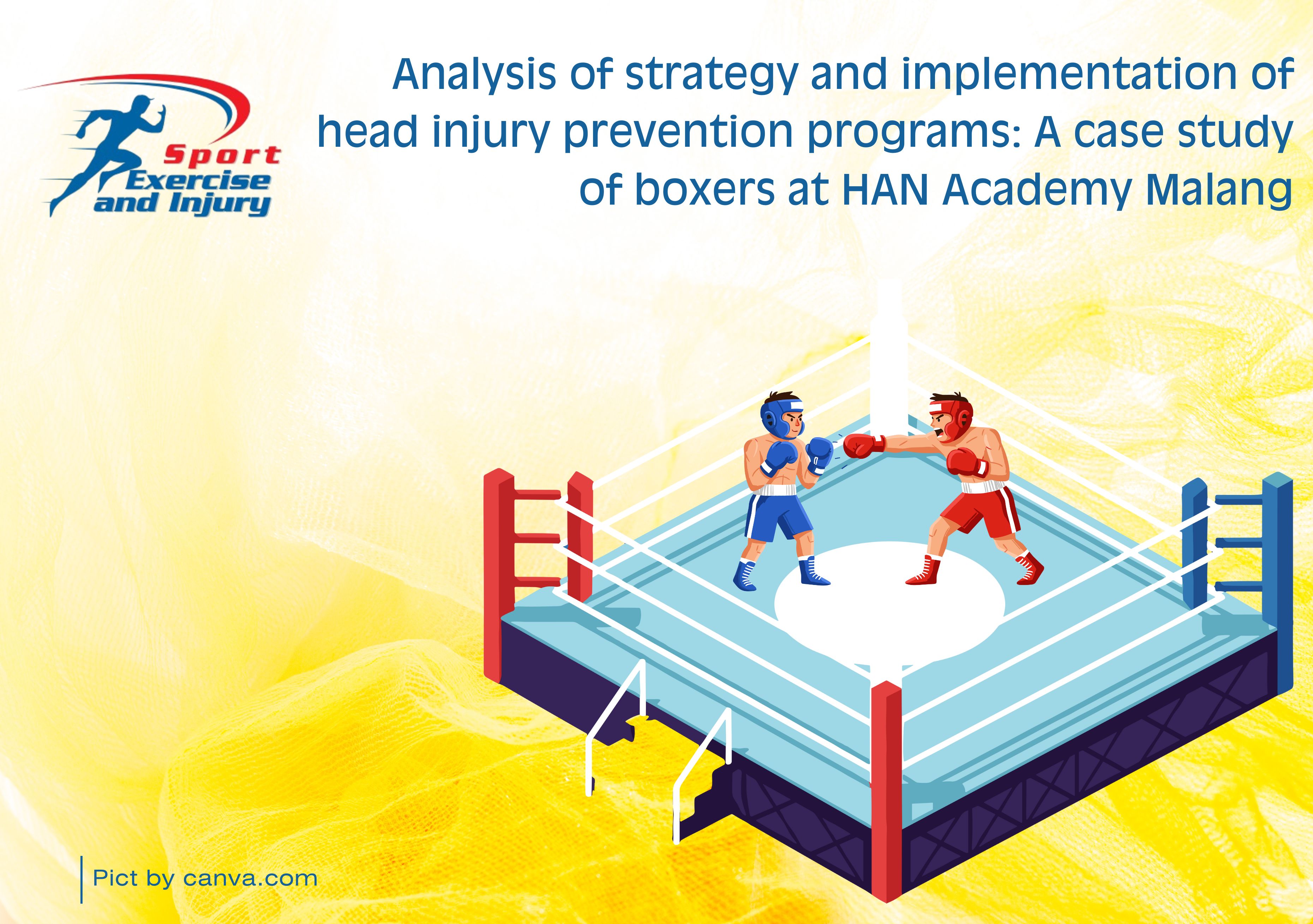
Analysis of strategy and implementation of head injury prevention programs: A case study of boxers at HAN Academy Malang

Downloads
Abstract
Background: Boxing is a high-risk combat sport with a high probability of head injuries, so effective prevention strategies are essential for athlete safety. However, empirical evidence on the implementation of head injury prevention programs at the training academy level is still limited.
Objectives: This study aims to explore strategies and the practical implementation of head injury prevention at the HAN Boxing Academy, Malang.
Methods: A qualitative case study design was used with purposive sampling. Four participants (one coach and three active athletes) were recruited. Data were collected through document review, direct observation, and semi-structured interviews, which consisted of 15 guiding questions. Data were analyzed using a thematic analysis approach, which involved data reduction, data presentation, and conclusion. Methodological triangulation was applied to enhance credibility.
Results: Three main themes emerged: (1) systematic emphasis on basic defensive techniques to minimize head collisions, (2) mandatory and consistent use of head protection during training sessions, and (3) active supervision by coaches combined with a gradual rehabilitation protocol, including competition restrictions for up to six months after a serious head injury. Participants considered head protection effective in reducing the severity of impacts, although the residual risk of head injury was still acknowledged.
Conclusions: Head injury prevention in academies is implemented through an integrated approach that combines technical skill development, the use of protective equipment, and continuous monitoring. To strengthen its effectiveness, it is recommended that structured injury prevention protocols be implemented and closer collaboration with medical professionals be fostered.Al Attar, W. S. A., Mahmoud, H., Alfadel, A., & Faude, O. (2024). Does headgear prevent sport-related concussion? A systematic review and meta-analysis of randomized controlled trials including 6311 players and 173,383 exposure hours. Sports Health, 16(3), 473-480. https://doi.org/10.1177/19417381231174461
Bandura, A. (1986). Social foundations of thought and action. Englewood Cliffs, NJ, 1986(23-28), 2.
Beattie, K., & Ruddock, A. D. (2025). Strength Training Practices in Amateur and Professional Boxing. The Journal of Strength & Conditioning Research, 39(6), 672-679. https://doi.org/10.1519/JSC.0000000000005088
Bernick, C., Banks, S. J., Shin, W., Obuchowski, N., Butler, S., Noback, M., ... & Modic, M. (2015). Repeated head trauma is associated with smaller thalamic volumes and slower processing speed: the Professional Fighters’ Brain Health Study. British Journal of Sports Medicine, 49(15), 1007-1011. https://doi.org/10.1136/bjsports-2014-093877
Bernick, C., Banks, S., Phillips, M., Lowe, M., Shin, W., Obuchowski, N., ... & Modic, M. (2013). Professional fighters brain health study: rationale and methods. American Journal of Epidemiology, 178(2), 280-286. https://doi.org/10.1093/aje/kws456
Braun, V., & Clarke, V. (2006). Using thematic analysis in psychology. Qualitative research in psychology, 3(2), 77-101. https://doi.org/10.1191/1478088706qp063oa
Braun, V., & Clarke, V. (2021). One size fits all? What counts as quality practice in (reflexive) thematic analysis?. Qualitative research in psychology, 18(3), 328-352. https://doi.org/10.1080/14780887.2020.1769238
Creswell, J. W., & Poth, C. N. (2016). Qualitative inquiry and research design: Choosing among five approaches. Sage publications.
Del Vecchio, F. B., Farias, C. B., De Leon, R. C., Rocha, A. C. C. A., Galliano, L. M., & Coswig, V. S. (2018). Injuries in martial arts and combat sports: Prevalence, characteristics and mechanisms. Science & Sports, 33(3), 158-163. https://doi.org/10.1016/j.scispo.2018.02.003
Dickinson, P., & Rempel, P. (2016). Prohibiting headgear for safety in amateur boxing? Opinion of the Canadian boxing community: an online poll. Sports Medicine Open, 2(1), 19. https://doi.org/10.1186/s40798-016-0043-2
Dunn, E. C., Humberstone, C. E., Franchini, E., Iredale, F. K., & Blazevich, A. J. (2022). The effect of fatiguing lower-body exercise on punch forces in highly-trained boxers. European journal of sport science, 22(7), 964-972. https://doi.org/10.1080/17461391.2021.1916085
Fletcher, D. (2025). Psychological Resilience and Sport Performance. In The Routledge International Handbook of Psychosocial Resilience (pp. 346-365). Routledge. https://doi.org/10.4324/9781003603115
Flynn, R. (2024). Impact of Head Injury on Cognitive Functioning and Social Cognition in UK-based Female Rugby Players (Doctoral dissertation, University of East London).
Haddon Jr, W. (1973). Energy damage and the ten countermeasure strategies. Human Factors, 15(4), 355-366. https://doi.org/10.1177/001872087301500407
Hanson, E., Stracciolini, A., Mannix, R., & Meehan III, W. P. (2014). Management and prevention of sport-related concussion. Clinical Pediatrics, 53(13), 1221-1230. https://doi.org/10.1177/0009922813518429
Kirk, C. (2022). An evaluation of coaching and training practices in mixed martial arts: A mixed methods approach. Liverpool John Moores University (United Kingdom).
Loosemore, M., Lightfoot, J., Palmer-Green, D., Gatt, I., Bilzon, J., & Beardsley, C. (2015). Boxing injury epidemiology in the Great Britain team: a 5-year surveillance study of medically diagnosed injury incidence and outcome. British Journal of Sports Medicine, 49(17), 1100-1107. https://doi.org/10.1136/bjsports-2015-094755
Malterud, K., Siersma, V. D., & Guassora, A. D. (2016). Sample size in qualitative interview studies: guided by information power. Qualitative health research, 26(13), 1753-1760. https://doi.org/10.1177/1049732315617444
McKee, A. C., Alosco, M. L., & Huber, B. R. (2016). Repetitive head impacts and chronic traumatic encephalopathy. Neurosurgery Clinics of North America, 27(4), 529-535. https://doi.org/10.1016/j.nec.2016.05.009
Meeuwisse, W. H., Tyreman, H., Hagel, B., & Emery, C. (2007). A dynamic model of etiology in sport injury: the recursive nature of risk and causation. Clinical Journal of Sport Medicine, 17(3), 215-219. https://doi.org/10.1097/JSM.0b013e3180592a48
Patricios, J. S., Schneider, K. J., Dvorak, J., Ahmed, O. H., Blauwet, C., Cantu, R. C., ... & Meeuwisse, W. (2023). Consensus statement on concussion in sport: the 6th International Conference on Concussion in Sport–Amsterdam, October 2022. British Journal of Sports Medicine, 57(11), 695-711. https://doi.org/10.1136/bjsports-2023-106898
Ruddock, A. D., Wilson, D. C., Thompson, S. W., Hembrough, D., & Winter, E. M. (2016). Strength and conditioning for professional boxing: Recommendations for physical preparation. Strength & Conditioning Journal, 38(3), 81-90. https://doi.org/10.1519/SSC.0000000000000217
Schneider, K. J., Leddy, J. J., Guskiewicz, K. M., Seifert, T., McCrea, M., Silverberg, N. D., ... & Makdissi, M. (2017). Rest and treatment/rehabilitation following sport-related concussion: a systematic review. British Journal of Sports Medicine, 51(12), 930-934. https://doi.org/10.1136/bjsports-2016-097475
Stewart, C., Cornett, R., Baker, J. S., Gu, Y., Dutheil, F., & Ugbolue, U. C. (2025). The Role of Lower Limb Kinetics in Boxing Punches and the Impact of Fatigue on Biomechanical Performance. Bioengineering, 12(12), 1355. https://doi.org/10.3390/bioengineering12121355
Tjønndal, A., Haudenhuyse, R., de Geus, B., & Buyse, L. (2022). Concussions, cuts and cracked bones: a systematic literature review on protective headgear and head injury prevention in Olympic boxing. European Journal of Sport Science, 22(3), 447-459. https://doi.org/10.1080/17461391.2021.1872711
Wu, C. H., Yang, Y., Xu, X., Wang, N., Li, Q., Geng, L., & Bao, S. J. (2025). Mental Fatigue Impairs Temporal Perceptual Prediction: A Study on Boxing Performance Across Skill Levels. Sports, 13(5), 154. https://doi.org/10.3390/sports13050154
Copyright (c) 2025 Padantya Devin Sugito

This work is licensed under a Creative Commons Attribution-ShareAlike 4.0 International License.