Differential responses to seasonal soccer training in U-15 and U-17 players: Body composition, strength, agility, and effect size analysis

Downloads
Abstract
Background: Training programs during adolescence play a crucial role in optimizing body composition and physical performance in youth soccer players. However, differences in training adaptations between age groups, particularly in agility performance, remain insufficiently explored.
Objectives: This study aimed to examine the effects of a seasonal soccer training program on body composition, strength, and agility in U-15 and U-17 soccer players.
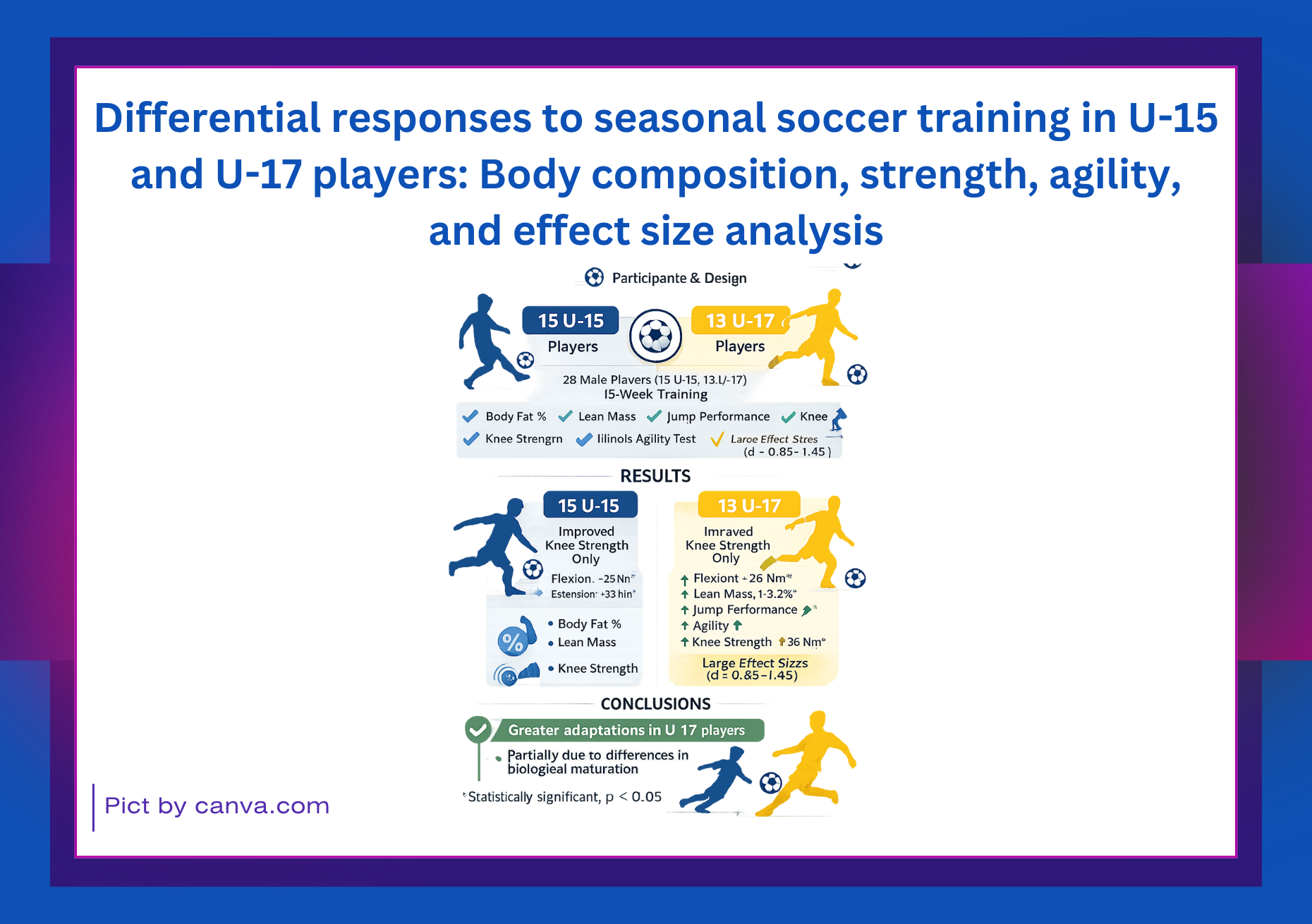
Methods: A pre–post experimental design was applied to 28 male youth soccer players (U-15: n = 15; U-17: n = 13) competing in a football league in the Netherlands. Participants completed a 16-week training program consisting of technical, conditioning, tactical, and mental components. Body composition (height, body mass, lean mass, fat mass), jump performance (SJ, CMJ, CMJmax), isokinetic strength (knee flexion and extension peak torque), and agility (Illinois Agility Test) were assessed before and after the intervention. Data were analyzed using repeated-measures analysis of variance (ANOVA) and effect sizes were calculated using Cohen’s d.
Results: In the U-15 group, significant improvements were observed only in knee flexion (70.2 ± 15.8 vs. 95.4 ± 23.5 Nm, p = 0.006, d = 1.25) and extension peak torque (75.1 ± 20.4 vs. 96.8 ± 18.9 Nm, p = 0.012, d = 1.10). In contrast, U-17 players demonstrated significant increases in lean mass (50.2 ± 3.1% vs. 53.4 ± 2.3%, p = 0.021), reductions in fat mass (11.0 ± 2.9% vs. 8.7 ± 2.5%, p = 0.037), improvements in agility performance (16.2 ± 0.7 vs. 15.4 ± 0.65 s, p = 0.008, d = 1.18), and knee flexion peak torque (78.4 ± 26.5 vs. 118.3 ± 28.7 Nm, p = 0.003, d = 1.45), together with significant gains in jump performance (p < 0.05). Most significant changes in the U-17 group were accompanied by large effect sizes (d = 0.85–1.45).
Conclusions: The training program elicited greater physiological and performance adaptations in U-17 compared to U-15 players. The greater adaptations observed in the U-17 group may be partially influenced by differences in biological maturation; however, maturity status was not directly assessed in the present study.
Batterham, A. M., & Hopkins, W. G. (2006). Making Meaningful Inferences About Magnitudes. International Journal of Sports Physiology and Performance, 1(1), 50–57. https://doi.org/10.1123/ijspp.1.1.50
Bisanz, G., & Gerisch, G. (2008). Fussball: Kondition-Technik-Taktik und Coaching. Meyer & Meyer Verlag.
Claudino, J. G., Cronin, J., Mezêncio, B., McMaster, D. T., McGuigan, M., Tricoli, V., Amadio, A. C., & Serrão, J. C. (2017). The countermovement jump to monitor neuromuscular status: A meta-analysis. Journal of Science and Medicine in Sport, 20(4), 397–402. https://doi.org/10.1016/j.jsams.2016.08.011
Cohen, J. (2013). Statistical power analysis for the behavioral sciences. routledge. https://doi.org/10.4324/9780203771587
Croisier, J.-L., Ganteaume, S., Binet, J., Genty, M., & Ferret, J.-M. (2008). Strength Imbalances and Prevention of Hamstring Injury in Professional Soccer Players. The American Journal of Sports Medicine, 36(8), 1469–1475. https://doi.org/10.1177/0363546508316764
Deprez, D., Valente-Dos-Santos, J., Coelho-e-Silva, M., Lenoir, M., Philippaerts, R., & Vaeyens, R. (2015). Longitudinal Development of Explosive Leg Power from Childhood to Adulthood in Soccer Players. International Journal of Sports Medicine, 36(08), 672–679. https://doi.org/10.1055/s-0034-1398577
Ford, P., De Ste Croix, M., Lloyd, R., Meyers, R., Moosavi, M., Oliver, J., Till, K., & Williams, C. (2011). The Long-Term Athlete Development model: Physiological evidence and application. Journal of Sports Sciences, 29(4), 389–402. https://doi.org/10.1080/02640414.2010.536849
Hachana, Y., Chaabène, H., Nabli, M. A., Attia, A., Moualhi, J., Farhat, N., & Elloumi, M. (2013). Test-retest reliability, criterion-related validity, and minimal detectable change of the Illinois agility test in male team sport athletes. The Journal of Strength & Conditioning Research, 27(10), 2752-2759. https://doi.org/10.1519/JSC.0b013e3182890ac3
Hammami, M. A., Ben Abderrahmane, A., Nebigh, A., Le Moal, E., Ben Ounis, O., Tabka, Z., & Zouhal, H. (2013). Effects of a soccer season on anthropometric characteristics and physical fitness in elite young soccer players. Journal of Sports Sciences, 31(6), 589–596. https://doi.org/10.1080/02640414.2012.746721
Helgerud, J., Engen, L. C., Wisløff, U., & Hoff, J. A. N. (2001). Aerobic endurance training improves soccer performance. Medicine & Science in Sports & Exercise, 33(11), 1925–1931. https://doi.org/10.1097/00005768-200111000-00019
Issurin, V. B. (2016). Benefits and Limitations of Block Periodized Training Approaches to Athletes’ Preparation: A Review. Sports Medicine, 46(3), 329–338. https://doi.org/10.1007/s40279-015-0425-5
Lehnert, M., Xaverová, Z., & Croix, M. D. S. (2014). Changes in Muscle Strength in U19 Soccer Players During an Annual Training Cycle. Journal of Human Kinetics, 42(1), 175–185. https://doi.org/10.2478/hukin-2014-0072
Lloyd, R. S., Cronin, J. B., Faigenbaum, A. D., Haff, G. G., Howard, R., Kraemer, W. J., Micheli, L. J., Myer, G. D., & Oliver, J. L. (2016). National Strength and Conditioning Association Position Statement on Long-Term Athletic Development. Journal of Strength and Conditioning Research, 30(6), 1491–1509. https://doi.org/10.1519/JSC.0000000000001387
Lloyd, R. S., & Oliver, J. L. (2012). The Youth Physical Development Model. Strength & Conditioning Journal, 34(3), 61–72. https://doi.org/10.1519/SSC.0b013e31825760ea
Malina, R. M., Bouchard, C., & Bar-Or, O. (2004). Growth, maturation, and physical activity. Human kinetics. https://doi.org/10.5040/9781492596837
Malina, R. M., Rogol, A. D., Cumming, S. P., Coelho e Silva, M. J., & Figueiredo, A. J. (2015). Biological maturation of youth athletes: assessment and implications. British Journal of Sports Medicine, 49(13), 852–859. https://doi.org/10.1136/bjsports-2015-094623
Markovic, G., Dizdar, D., Jukic, I., & Cardinale, M. (2004). Reliability and factorial validity of squat and countermovement jump tests. The Journal of Strength & Conditioning Research, 18(3), 551-555. https://doi.org/10.1519/00124278-200408000-00028
Markovic, G., & Mikulic, P. (2010). Neuro-Musculoskeletal and Performance Adaptations to Lower-Extremity Plyometric Training. Sports Medicine, 40(10), 859–895. https://doi.org/10.2165/11318370-000000000-00000
Milanese, C., Piscitelli, F., Cavedon, V., & Zancanaro, C. (2013). Body composition changes in elite soccer players along the competitive season. Italian Journal of Anatomy and Embryology, 118(2), 139. https://hdl.handle.net/11562/746564
Moran, J. J., Sandercock, G. R. H., Ramírez-Campillo, R., Meylan, C. M. P., Collison, J. A., & Parry, D. A. (2017). Age-Related Variation in Male Youth Athletes’ Countermovement Jump After Plyometric Training: A Meta-Analysis of Controlled Trials. Journal of Strength and Conditioning Research, 31(2), 552–565. https://doi.org/10.1519/JSC.0000000000001444
Negra, Y., Chaabene, H., Sammoud, S., Bouguezzi, R., Abbes, M., Hachana, Y., & Granacher, U. (2017). Effects of Plyometric Training on Physical Fitness in Prepuberal Soccer Athletes. International Journal of Sports Medicine, 38(05), 370–377. https://doi.org/10.1055/s-0042-122337
Padulo, J., Tiloca, A., Powell, D., Granatelli, G., Bianco, A., & Paoli, A. (2013). EMG amplitude of the biceps femoris during jumping compared to landing movements. SpringerPlus, 2(1), 520. https://doi.org/10.1186/2193-1801-2-520
Philippaerts, R. M., Vaeyens, R., Janssens, M., Van Renterghem, B., Matthys, D., Craen, R., Bourgois, J., Vrijens, J., Beunen, G., & Malina, R. M. (2006). The relationship between peak height velocity and physical performance in youth soccer players. Journal of Sports Sciences, 24(3), 221–230. https://doi.org/10.1080/02640410500189371
Sarmento, H., Anguera, M. T., Pereira, A., & Araújo, D. (2018). Talent Identification and Development in Male Football: A Systematic Review. Sports Medicine, 48(4), 907–931. https://doi.org/10.1007/s40279-017-0851-7
Sermaxhaj, S., Arifi, F., Alaj, I., Kelmendi, D., Gjonbalaj, M., & Sermaxhaj, S. (2024). The Impact of the Soccer Training Season on the Body Composition and Physical Performances of Young Soccer Players. Sport Mont, 22(1), 31–36. https://doi.org/10.26773/smj.240205
Sheppard, J. M., & Young, W. B. (2006). Agility literature review: Classifications, training and testing. Journal of Sports Sciences, 24(9), 919–932. https://doi.org/10.1080/02640410500457109
Slimani, M., & Nikolaidis, P. T. (2018). Anthropometric and physiological characteristics of male soccer players according to their competitive level, playing position and age group: a systematic review. The Journal of Sports Medicine and Physical Fitness, 59(1). https://doi.org/10.23736/S0022-4707.17.07950-6
Sperlich, B., De Marées, M., Koehler, K., Linville, J., Holmberg, H.-C., & Mester, J. (2011). Effects of 5 Weeks of High-Intensity Interval Training vs. Volume Training in 14-Year-Old Soccer Players. Journal of Strength and Conditioning Research, 25(5), 1271–1278. https://doi.org/10.1519/JSC.0b013e3181d67c38
Stastny, P., Lehnert, M., & Tufano, J. J. (2018). Muscle imbalances: Testing and training functional eccentric hamstring strength in athletic populations. Journal of visualized experiments: JoVE, (135), 57508. https://doi.org/10.3791/57508
Stolen, T., Chamari, K., Castagna, C., & Wisl??ff, U. (2005). Physiology of Soccer. Sports Medicine, 35(6), 501–536. https://doi.org/10.2165/00007256-200535060-00004
Suchomel, T. J., Nimphius, S., & Stone, M. H. (2016). The Importance of Muscular Strength in Athletic Performance. Sports Medicine, 46(10), 1419–1449. https://doi.org/10.1007/s40279-016-0486-0
Tuominen, J., Leppänen, M., Jarske, H., Pasanen, K., Vasankari, T., & Parkkari, J. (2023). Test-retest reliability of isokinetic ankle, knee and hip strength in physically active adults using Biodex system 4 pro. Methods and protocols, 6(2), 26. https://doi.org/10.3390/mps6020026
Utczás, K., Tróznai, Z., Pálinkás, G., Kalabiska, I., & Petridis, L. (2020). How length sizes affect body composition estimation in adolescent athletes using bioelectrical impedance. Journal of Sports Science & Medicine, 19(3), 577. https://pmc.ncbi.nlm.nih.gov/articles/PMC7429426/pdf/jssm-19-577.pdf
Vänttinen, T., Blomqvist, M., Nyman, K., & Häkkinen, K. (2011). Changes in Body Composition, Hormonal Status, and Physical Fitness in 11-, 13-, and 15-Year-Old Finnish Regional Youth Soccer Players During a Two-Year Follow-Up. Journal of Strength and Conditioning Research, 25(12), 3342–3351. https://doi.org/10.1519/JSC.0b013e318236d0c2
Young, W., & Farrow, D. (2006). A review of agility: Practical applications for strength and conditioning. Strength & Conditioning Journal, 28(5), 24-29. https://doi.org/10.1519/00126548-200610000-00004
Copyright (c) 2026 Rick Stoop, Georgios Georgiadis, Iván González-García

This work is licensed under a Creative Commons Attribution-ShareAlike 4.0 International License.