Effects of combined exercise and manual therapy on pain and physical function in overweight older adults with knee osteoarthritis: A randomized controlled trial

Downloads
Abstract
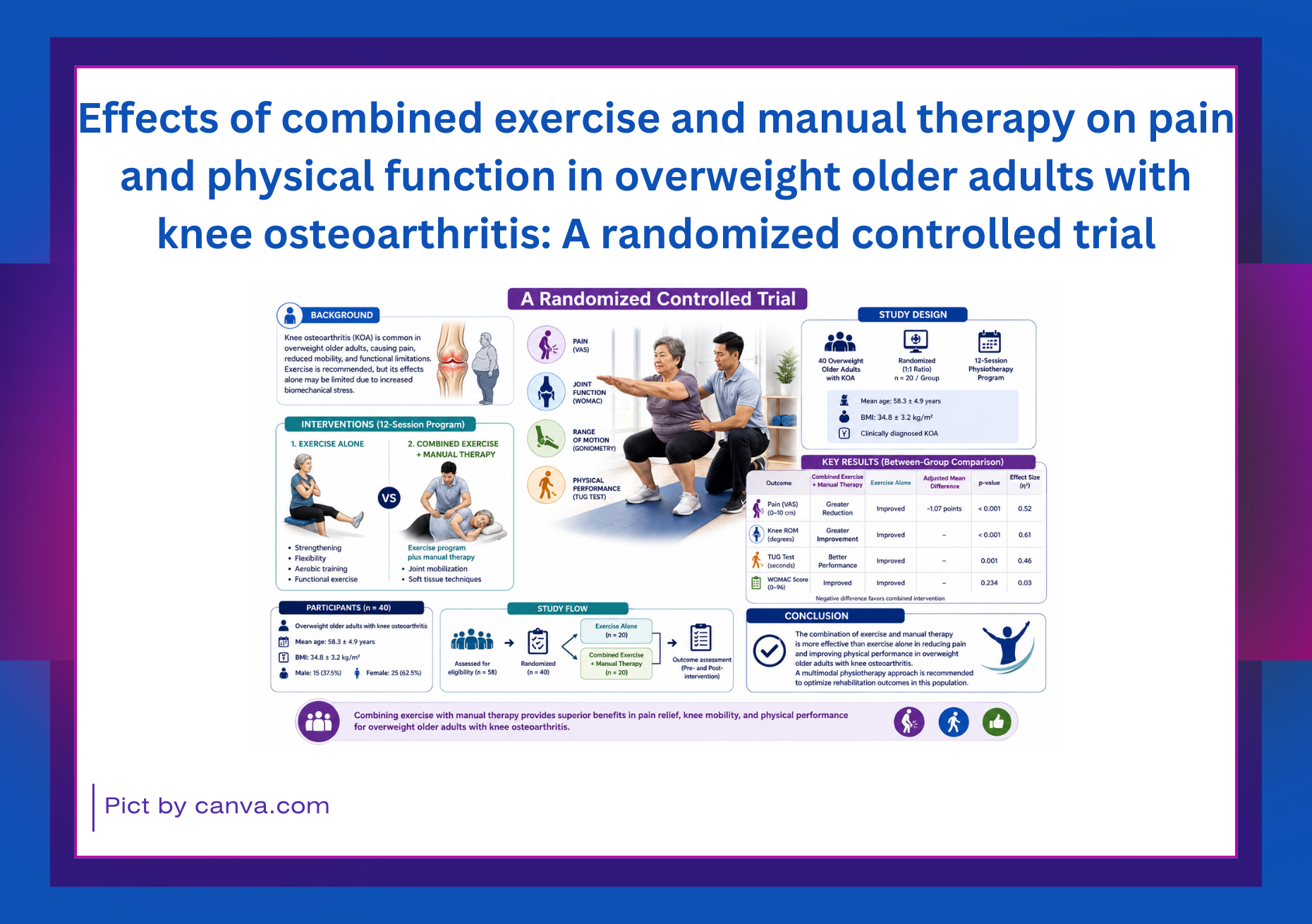
Background: Knee osteoarthritis (KOA) is a prevalent musculoskeletal disorder that leads to pain, reduced mobility, and functional limitations, particularly among overweight older adults. While exercise therapy is widely recommended as a primary non-pharmacological intervention, its effectiveness as a standalone approach may be limited due to increased biomechanical stress in this population.
Objectives: This study aimed to evaluate and compare the effectiveness of exercise therapy alone and a combination of exercise and manual therapy on pain, joint function, range of motion (ROM), and physical performance in overweight older adults with KOA.
Methods: A randomized controlled trial design was employed, involving 40 participants who were randomly allocated (1:1 ratio) using a computer-generated simple randomization sequence. Forty overweight older adults (mean age 58.3 ± 4.9 years; BMI 34.8 ± 3.2 kg/m²) with clinically diagnosed KOA participated in the study. Both groups underwent a 12-session physiotherapy program. Data were collected using the Visual Analog Scale (VAS) for pain, WOMAC for joint function, goniometry for ROM, and the Timed Up and Go (TUG) test for physical performance. Statistical analysis was conducted using JASP, including descriptive statistics, independent-samples t-tests, paired-samples t-tests, repeated-measures ANOVA, and ANCOVA to control for potential confounders.
Results: Both groups demonstrated significant improvements in all outcome measures. Compared with exercise alone, the combined intervention resulted in greater pain reduction (adjusted mean difference = -1.07 points, p < 0.001, η² = 0.52), greater improvement in knee ROM (p < 0.001, η² = 0.61), and better TUG performance (p = 0.001, η² = 0.46). No significant between-group difference was observed for WOMAC scores (p = 0.234, η² = 0.03).
Conclusions: The combination of exercise and manual therapy is more effective than exercise alone in improving pain and physical performance in overweight older adults with KOA. A multimodal physiotherapy approach is recommended to optimize rehabilitation outcomes in this population.
Abbott, J. H., Robertson, M. C., Chapple, C., Pinto, D., Wright, A. A., Leon de la Barra, S., Baxter, G. D., Theis, J.-C., & Campbell, A. J. (2013). Manual therapy, exercise therapy, or both, in addition to usual care, for osteoarthritis of the hip or knee: a randomized controlled trial. 1: clinical effectiveness. Osteoarthritis and Cartilage, 21(4), 525–534. https://doi.org/10.1016/j.joca.2012.12.014
Bagheri Roochi, A., Mohammadi, F., Khorani, H., & Motalebi, S. A. (2021). Intrinsic Factors of Home Fall Among Older Adults in Qazvin City, Iran, 2018. Iranian Rehabilitation Journal, 2(SpecialIssue), 29–36. https://doi.org/10.32598/irj.20.SpecialIssue.825.2
Bennell, K. L., Nelligan, R. K., Kimp, A. J., Schwartz, S., Kasza, J., Wrigley, T. V., Metcalf, B., Hodges, P. W., & Hinman, R. S. (2020). What type of exercise is most effective for people with knee osteoarthritis and co-morbid obesity?: The TARGET randomized controlled trial. Osteoarthritis and Cartilage, 28(6), 755–765. https://doi.org/10.1016/j.joca.2020.02.838
Bialosky, J. E., Bishop, M. D., Price, D. D., Robinson, M. E., & George, S. Z. (2009). The mechanisms of manual therapy in the treatment of musculoskeletal pain: A comprehensive model. Manual Therapy, 14(5), 531–538. https://doi.org/10.1016/j.math.2008.09.001
Bliddal, H., Leeds, A. R., & Christensen, R. (2014). Osteoarthritis, obesity and weight loss: evidence, hypotheses and horizons – a scoping review. Obesity Reviews, 15(7), 578–586. https://doi.org/10.1111/obr.12173
Carvalho, G. F., Adamczyk, W. M., Ludes, C. S., Scharbach, R., Jung, A., Karstens, S., Luedtke, K., & Szikszay, T. M. (2025). Perceptions and beliefs of physical therapists regarding the mechanisms of manual therapy. Brazilian Journal of Physical Therapy, 29(6), 101231. https://doi.org/10.1016/j.bjpt.2025.101231
DeVita, P., Aaboe, J., Bartholdy, C., Leonardis, J. M., Bliddal, H., & Henriksen, M. (2018). Quadriceps-strengthening exercise and quadriceps and knee biomechanics during walking in knee osteoarthritis: A two-centre randomized controlled trial. Clinical Biomechanics, 59, 199–206. https://doi.org/10.1016/j.clinbiomech.2018.09.016
Deyle, G. D., Allison, S. C., Matekel, R. L., Ryder, M. G., Stang, J. M., Gohdes, D. D., Hutton, J. P., Henderson, N. E., & Garber, M. B. (2005). Physical Therapy Treatment Effectiveness for Osteoarthritis of the Knee: A Randomized Comparison of Supervised Clinical Exercise and Manual Therapy Procedures Versus a Home Exercise Program. Physical Therapy, 85(12), 1301–1317. https://doi.org/10.1093/ptj/85.12.1301
Eftekhar-Sadat, B., Niknejad-Hosseyni, S. H., Babaei-Ghazani, A., Toopchizadeh, V., & Sadeghi, H. (2015). Reliability and validity of Persian version of Western Ontario and McMaster Universities Osteoarthritis index in knee osteoarthritis. Journal of Analytical Research in Clinical Medicine, 3(3), 170–177. https://doi.org/10.15171/jarcm.2015.027
Espírito Santo, J., Moita, J., & Nunes, A. (2024). The Efficacy of Manual Therapy on Musculoskeletal Pain in Menopause: A Systematic Review. Healthcare, 12(18), 1838. https://doi.org/10.3390/healthcare12181838
Eymir, M., Erduran, M., & Ünver, B. (2021). Active heel‐slide exercise therapy facilitates the functional and proprioceptive enhancement following total knee arthroplasty compared to continuous passive motion. Knee Surgery, Sports Traumatology, Arthroscopy, 29(10), 3352–3360. https://doi.org/10.1007/s00167-020-06181-4
Fransen, M., McConnell, S., Harmer, A. R., Van der Esch, M., Simic, M., & Bennell, K. L. (2015). Exercise for osteoarthritis of the knee: a Cochrane systematic review. British Journal of Sports Medicine, 49(24), 1554–1557. https://doi.org/10.1136/bjsports-2015-095424
Genç, H., & Atılgan, E. (2024). Efficiency of a structured squat-based program in knee osteoarthritis rehabilitation. Physiotherapy Practice and Research, 45(1), 59–66. https://doi.org/10.3233/PPR-240847
Hosseini, S. E., & Dudonienė, V. (2025). Effects of an 8-Week Exercise and Manual Therapy Programme Versus Exercise Alone on Knee Pain and Joint Function in Postmenopausal Women With Knee Osteoarthritis. Reabilitacijos Mokslai: Slauga, Kineziterapija, Ergoterapija, 1(32), 100–112. https://doi.org/10.33607/rmske.v1i32.1605
Kandada, S., & Heggannavar, A. (2015). Effect of Mulligans MWM Versus Macquarie Injury Management Group (MIMG) Protocol on Pain And Function in Osteoarthritis of Knee: A Randomized Clinical Trial. International Journal of Therapies and Rehabilitation Research, 4(4), 125. https://doi.org/10.5455/ijtrr.00000078
Laimi, K., Mäkilä, A., Bärlund, E., Katajapuu, N., Oksanen, A., Seikkula, V., Karppinen, J., & Saltychev, M. (2018). Effectiveness of myofascial release in treatment of chronic musculoskeletal pain: a systematic review. Clinical Rehabilitation, 32(4), 440–450. https://doi.org/10.1177/0269215517732820
Nath, J. (2015). Knee osteoarthritis with special emphasis to physiotherapy treatment focusing various stimulation. International Journal of Scientific and Research Publications, 5(3), 1–10.
Runge, N., Aina, A., & May, S. (2022). The Benefits of Adding Manual Therapy to Exercise Therapy for Improving Pain and Function in Patients With Knee or Hip Osteoarthritis: A Systematic Review With Meta-analysis. Journal of Orthopaedic & Sports Physical Therapy, 52(10), 675-A13. https://doi.org/10.2519/jospt.2022.11062
Tsokanos, A., Livieratou, E., Billis, E., Tsekoura, M., Tatsios, P., Tsepis, E., & Fousekis, K. (2021). The efficacy of manual therapy in patients with knee osteoarthritis: a systematic review. Medicina, 57(7), 696. https://doi.org/10.3390/medicina57070696
Wolf, D. F., Carvalho, C., Moreira Padovez, R. de F. C., Braz de Oliveira, M. P., & Mendes da Silva Serrão, P. R. (2024). Effects of physical exercise on muscle function of the knee, pain and quality of life in postmenopausal women with knee osteoarthritis: A systematic review with meta-analysis. Musculoskeletal Science and Practice, 71, 102929. https://doi.org/10.1016/j.msksp.2024.102929
Young, J. J., Pedersen, J. R., & Bricca, A. (2023). Exercise Therapy for Knee and Hip Osteoarthritis: Is There An Ideal Prescription? Current Treatment Options in Rheumatology, 9(3), 82–98. https://doi.org/10.1007/s40674-023-00205-z
Zhang, E. W., Jones, L. E., & Whitburn, L. Y. (2023). Tools for assessing labour pain: a comprehensive review of research literature. Pain, 164(12), 2642–2652. https://doi.org/10.1097/j.pain.0000000000003004
Copyright (c) 2026 Seyed Ehsan Hosseini

This work is licensed under a Creative Commons Attribution-ShareAlike 4.0 International License.