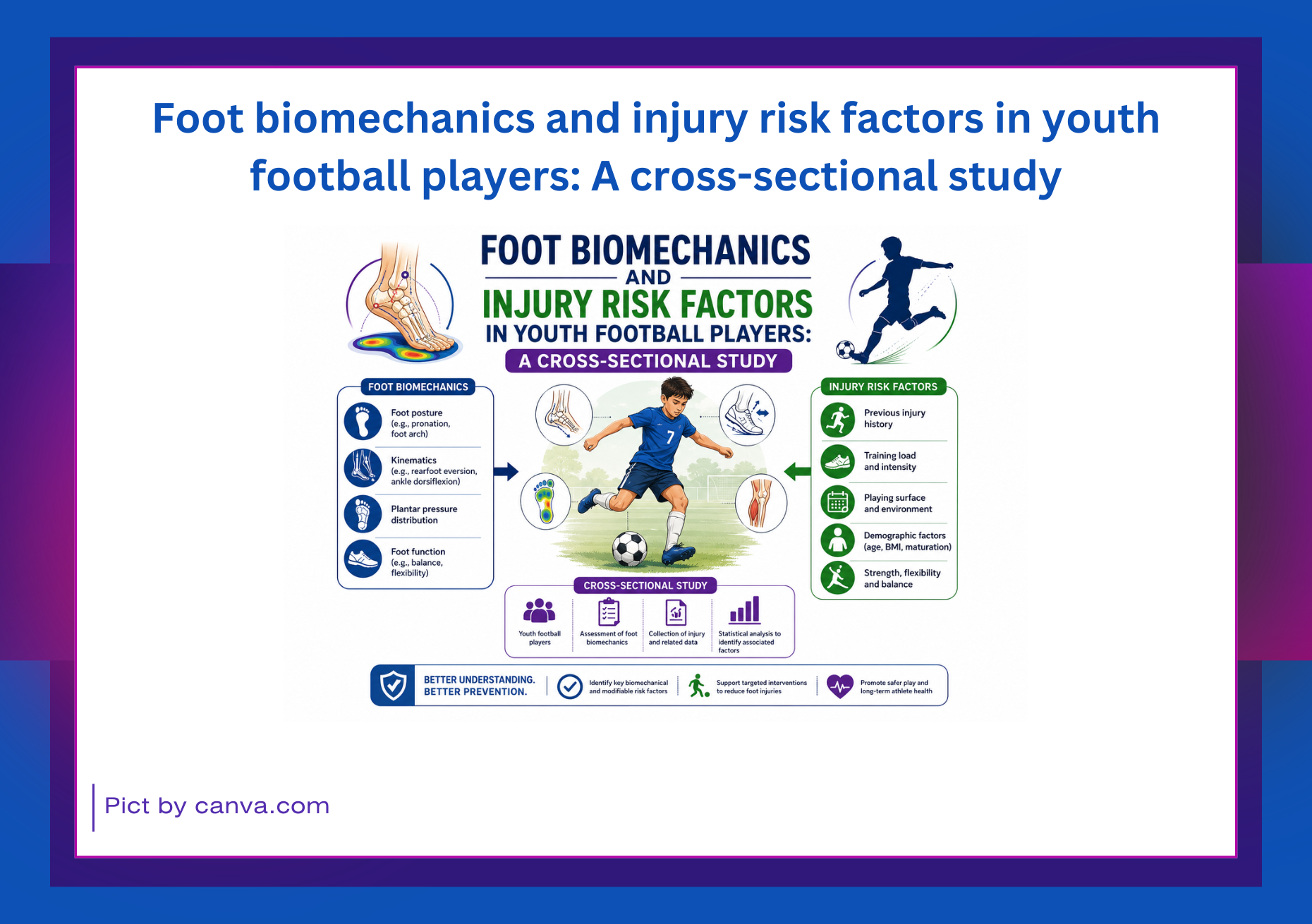
Foot biomechanics and injury risk factors in youth football players: A cross-sectional study

Downloads
Background: Altered plantar pressure distribution and foot alignment have been suggested in previous studies to be associated with ankle instability and overuse injuries; however, evidence in youth populations remains limited.
Objectives: This study aimed to investigate foot biomechanics and potential injury risk factors in youth football players aged 5–15 years.
Methods: This study employed an analytical cross-sectional design involving 30 youth football players recruited from local football academies. Participants were categorized into three age groups: 5–9 years (n = 10), 10–12 years (n = 10), and 13–15 years (n = 10). Data were collected through pedobarographic plantar pressure assessment, hallux valgus angle (HVA) measurement using a goniometer, navicular drop test (NDT), and subtalar angle assessment. Statistical analyses included descriptive statistics, Shapiro–Wilk normality test, Pearson correlation, independent t-test, and one-way ANOVA with effect size (η²). A significance level of p ≤ 0.05 was applied.
Results: The results showed that hindfoot plantar pressure was higher than forefoot pressure in both feet, indicating a posterior loading pattern. Hallux valgus angles were within normal ranges, while subtalar angles demonstrated a tendency toward pronation. Significant differences were observed in left foot HVA and left hindfoot pressure across age groups (p < 0.05), with moderate effect sizes (η² = 0.20–0.21). Correlation analysis revealed moderate to strong positive relationships between subtalar pronation and HVA variables.
Conclusions: Youth football players exhibit biomechanical characteristics, such as increased hindfoot loading and subtalar pronation, that may represent adaptive responses to sport-specific demands and be associated with potential injury risk. However, given the study's cross-sectional design, these findings should be interpreted as descriptive biomechanical patterns rather than as direct predictors of injury. Early biomechanical screening and targeted preventive training may help support optimal athletic development.
Downloads
Chow, T.-H. (2025). A preliminary exploration of plantar load distributions and foot postures in Taiwanese collegiate athletes with Morton’s neuroma. BMC Sports Science, Medicine and Rehabilitation, 17(1), 169. https://doi.org/10.1186/s13102-025-01207-1
De Ridder, R., Willems, T., & Roosen, P. (2012). Plantar pressure distribution during gait and running in subjects with chronic ankle instability. Journal of Foot and Ankle Research, 5(S1). https://doi.org/10.1186/1757-1146-5-S1-P32
Fort-Vanmeerhaeghe, A., Romero-Rodriguez, D., Lloyd, R. S., Kushner, A., & Myer, G. D. (2016). Integrative Neuromuscular Training in Youth Athletes. Part II: Strategies to Prevent Injuries and Improve Performance. Strength & Conditioning Journal, 38(4), 9–27. https://doi.org/10.1519/SSC.0000000000000234
Fort-Vanmeerhaeghe, A., Romero-Rodriguez, D., Montalvo, A. M., Kiefer, A. W., Lloyd, R. S., & Myer, G. D. (2016). Integrative Neuromuscular Training and Injury Prevention in Youth Athletes. Part I. Strength & Conditioning Journal, 38(3), 36–48. https://doi.org/10.1519/SSC.0000000000000229
Gao, C.-C., Chern, J.-S., Chang, C.-J., Lai, P.-L., & Lung, C.-W. (2019). Center of pressure progression patterns during level walking in adolescents with idiopathic scoliosis. PLOS ONE, 14(4), e0212161. https://doi.org/10.1371/journal.pone.0212161
Kasahara, S., Saito, H., Anjiki, T., & Osanai, H. (2015). The effect of aging on vertical postural control during the forward and backward shift of the center of pressure. Gait & Posture, 42(4), 448–454. https://doi.org/10.1016/j.gaitpost.2015.07.056
Li, B., Xiang, Q., & Zhang, X. (2020). The center of pressure progression characterizes the dynamic function of high-arched feet during walking. Journal of Leather Science and Engineering, 2(1), 1. https://doi.org/10.1186/s42825-019-0016-6
Mikolajczyk, E., Jankowicz-Szymańska, A., & Smola, E. (2018). Characteristics of foot arches and foot pressure distribution in 10-11-year-old male soccer players. Journal of Kinesiology and Exercise Sciences, 28(83), 37-43. https://doi.org/10.5604/01.3001.0013.6498
Omar, K. M., Mohamed, A. A. K., Essa, M. M. M., Elzanaty, M. Y., & Mahmoud, M. M. M. (2025). The influence of hallux valgus severity on postural stability and risk of fall: a cross-sectional study design. BMC Musculoskeletal Disorders, 27(1), 29. https://doi.org/10.1186/s12891-025-09357-6
San Antolín-Gil, M., García-García, D., Calvo-Lobo, C., Llamas-Ramos, R., Alvarado-Omenat, J. J., Ceballos-Laita, L., Jiménez-Del-Barrio, S., Rodríguez-Sanz, D., & Llamas-Ramos, I. (2026). The role of morphology and function of intrinsic foot muscles in young handball players with chronic ankle instability. BMC Sports Science, Medicine and Rehabilitation. https://doi.org/10.1186/s13102-026-01605-z
Sañudo, B., Sánchez-Hernández, J., Bernardo-Filho, M., Abdi, E., Taiar, R., & Núñez, J. (2019). Integrative Neuromuscular Training in Young Athletes, Injury Prevention, and Performance Optimization: A Systematic Review. Applied Sciences, 9(18), 3839. https://doi.org/10.3390/app9183839
Seyhan, S., & Açar, G. (2025). Foot and Ankle Biomechanical Assessment in Soccer Players: A Narrative Review of Testing Methods. Journal of Education and Recreation Patterns, 6(2), 349–363. https://doi.org/10.53016/jerp.v6i2.299
Seyhan, S., Açar, G., Yaşasın, Y., Üzümcü, B., & Sinen, H. (2024). Investigation of Foot Biomechanics in 5-15 Years Old Children Performing Gymnastics. Research in Sport Education and Sciences. https://doi.org/10.62425/rses.1502932
Shen, J., Liu, J., Liang, F., Liu, X., & Zhang, M. (2024). Prevalence of flatfoot and analysis of plantar pressure distribution in adolescents based on body mass index: a regional study. Journal of Orthopaedic Surgery and Research, 19(1), 864. https://doi.org/10.1186/s13018-024-05365-9
Tekscan. (2026). Pedobarography systems for plantar pressure measurement. https://www.tekscan.com/pedobarography-systems-plantar-pressure-measurement
Wan, D., Bao, H., Wang, J., Wei, J., Ma, J., Yao, S., & Xu, C. (2023). Plantar Pressure Distribution and Posture Balance During Walking in Individuals with Unilateral Chronic Ankle Instability: An Observational Study. Medical Science Monitor, 29. https://doi.org/10.12659/MSM.940252
Wang, A., Zhang, Q., Li, C., Tian, Z., Zhang, X., & Sun, Y. (2025). Plantar pressure in athletes with chronic ankle instability during single-leg landings at different heights. Frontiers in Bioengineering and Biotechnology, 13. https://doi.org/10.3389/fbioe.2025.1702852
Wittwer, A. (2012). The Effect of Chronic Ankle Instability on Lower Extremity Frontal-plane Kinematics and Plantar Pressure During a Dynamic Postural Control Task [University of Toledo]. http://rave.ohiolink.edu/etdc/view?acc_num=toledo1333379147
Copyright (c) 2026 Hamza Sinen, Amirhossein Ghanbarian

This work is licensed under a Creative Commons Attribution-ShareAlike 4.0 International License.