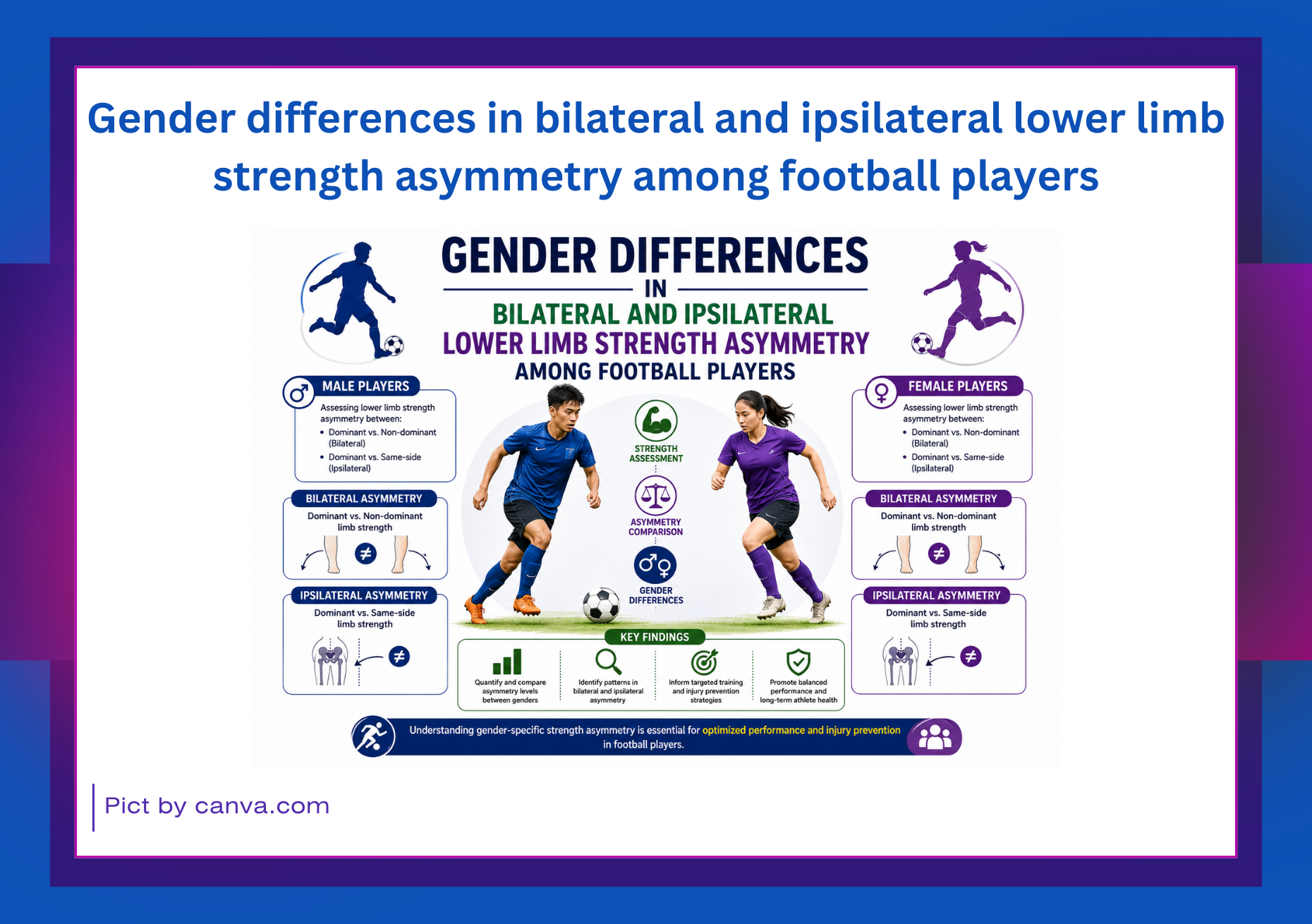
Gender differences in bilateral and ipsilateral lower limb strength asymmetry among football players

Background: Lower limb muscle strength asymmetry is a significant factor that can impact playing ability and increase the risk of injury in soccer players. Differences in leg use and the specific movement requirements of a sport can lead to strength imbalances, either on both sides of the body or on the same side. Lower limb muscle strength asymmetry, particularly bilateral and ipsilateral strength asymmetry, is a significant factor influencing performance and increasing injury risk in football players. Differences in limb dominance and sport-specific movement demands can lead to strength imbalances.
Objectives: This study aimed to compare bilateral and ipsilateral lower limb strength asymmetry between male and female football players.
Methods: A cross-sectional study was conducted involving 50 amateur football players (26 males and 24 females; aged 18–21 years). Isokinetic strength testing of knee extensors and flexors was performed at 60°/s. Bilateral asymmetry was calculated based on peak torque differences between limbs, while ipsilateral asymmetry was assessed using the hamstring-to-quadriceps (H/Q) ratio. Statistical analyses included the Mann–Whitney U test and independent t-test (p < 0.05).
Results: Significant sex differences were found in bilateral strength asymmetry for both quadriceps (7.21 ± 4.04% vs 5.04 ± 3.13%, p = 0.02) and hamstrings (9.13 ± 5.15% vs 5.06 ± 4.04%, p = 0.01), with males showing greater asymmetry. Female athletes demonstrated values closer to the recommended asymmetry threshold (≤10–15%). No significant differences were observed in ipsilateral strength asymmetry (H/Q ratio) between groups (p > 0.05).
Conclusions: Bilateral strength asymmetry differs by sex, with male athletes exhibiting higher imbalance, while ipsilateral strength balance is comparable between groups. These findings highlight the importance of monitoring individual strength asymmetry to inform targeted training strategies, reduce injury risk, and optimize performance in football players.
Downloads
Aiello, F., Impellizzeri, F. M., Brown, S. J., Serner, A., & McCall, A. (2023). Injury-Inciting Activities in Male and Female Football Players: A Systematic Review. Sports Medicine, 53(1), 151–176. https://doi.org/10.1007/s40279-022-01753-5
Akarsu Taşman, G., Güven, E., & Acar, N. E. (2025). Comparison Of Lower Extremity Bilateral and Ipsilateral Strength Asymmetry in Male and Female Soccer Players. Research in Sport Education and Sciences, 27(3), 176–183. https://doi.org/10.62425/rses.1637439
Alyami, A. H., Darraj, H., Hamdi, S., Saber, A., Bakri, N., Maghrabi, R., Hakami, K. M., & Darraj, A. (2023). Awareness of Anterior Cruciate Ligament Injury—Preventive Training Programs among Saudi Athletes. Clinics and Practice, 13(3), 656–665. https://doi.org/10.3390/clinpract13030060
Bailey, C. A., Sato, K., Burnett, A., & Stone, M. H. (2015). Force-Production Asymmetry in Male and Female Athletes of Differing Strength Levels. International Journal of Sports Physiology and Performance, 10(4), 504–508. https://doi.org/10.1123/ijspp.2014-0379
Baroni, B. M., Ruas, C. V., Ribeiro-Alvares, J. B., & Pinto, R. S. (2020). Hamstring-to-Quadriceps Torque Ratios of Professional Male Soccer Players: A Systematic Review. Journal of Strength and Conditioning Research, 34(1), 281–293. https://doi.org/10.1519/JSC.0000000000002609
Bell, D. R., Sanfilippo, J. L., Binkley, N., & Heiderscheit, B. C. (2014). Lean Mass Asymmetry Influences Force and Power Asymmetry During Jumping in Collegiate Athletes. Journal of Strength and Conditioning Research, 28(4), 884–891. https://doi.org/10.1519/JSC.0000000000000367
Benson, E. M., Elphingstone, J. W., Paul, K. D., Schick, S., Shihab, Y. A., Barlow, D., Ponce, B. A., Brabston, E. W., & Momaya, A. M. (2024). Eccentric Hamstring Strength Imbalance among Football and Soccer Athletes. Southern Medical Journal, 117(4), 214–219. https://doi.org/10.14423/SMJ.0000000000001674
Bishop, C., Turner, A., & Read, P. (2018). Effects of inter-limb asymmetries on physical and sports performance: a systematic review. Journal of Sports Sciences, 36(10), 1135–1144. https://doi.org/10.1080/02640414.2017.1361894
Brownstein, C. G., Millet, G. Y., & Thomas, K. (2021). Neuromuscular responses to fatiguing locomotor exercise. Acta Physiologica, 231(2). https://doi.org/10.1111/apha.13533
Coto Martín, R., Pérez Mallada, N., Martínez Beltrán, M. J., Cuéllar Marín, L., Borrás Luján, P. J., Arroyo, O. O., Sáenz-Nuño, M. A., & Arribas-Marín, J. M. (2025). Differences in Strength, Muscle Work, and Hamstring/Quadriceps Ratio in Professional and Junior Elite Basketball Players According to Sex. Journal of Functional Morphology and Kinesiology, 10(2), 204. https://doi.org/10.3390/jfmk10020204
Daneshjoo, A., Rahnama, N., Mokhtar, A. H., & Yusof, A. (2013). Bilateral and Unilateral Asymmetries of Isokinetic Strength and Flexibility in Male Young Professional Soccer Players. Journal of Human Kinetics, 36(1), 45–53. https://doi.org/10.2478/hukin-2013-0005
Dos’Santos, T., Thomas, C., & Jones, P. A. (2021). The effect of angle on change of direction biomechanics: Comparison and inter-task relationships. Journal of Sports Sciences, 39(22), 2618–2631. https://doi.org/10.1080/02640414.2021.1948258
Ferdinand, L., Hanief, Y. N., & Manimtim, R. M. (2025). Injury pattern and risk factors in grassroots football: A study of 10-year-old athletes. Sport, Exercise, and Injury, 1(1), 27–39. https://doi.org/10.56003/sei.v1i1.512
Fernandez-Fernandez, J., Kinner, V., & Ferrauti, A. (2010). The Physiological Demands of Hitting and Running in Tennis on Different Surfaces. Journal of Strength and Conditioning Research, 24(12), 3255–3264. https://doi.org/10.1519/JSC.0b013e3181e8745f
Hanief, Y. N., Sumartiningsih, S., Rahayu, S., Setyawati, H., Hadi, H., & Jaskulski, K. (2025). Neuromuscular hamstring profile based on strength imbalance as a basis for injury prevention in youth football players. Indonesian Journal of Research in Physical Education, Sport, and Health, 3(2), 107–115. https://doi.org/10.17977/um086v3i22025p107-115
Huygaerts, S., Cos, F., Cohen, D. D., Calleja-González, J., Guitart, M., Blazevich, A. J., & Alcaraz, P. E. (2020). Mechanisms of Hamstring Strain Injury: Interactions between Fatigue, Muscle Activation and Function. Sports, 8(5), 65. https://doi.org/10.3390/sports8050065
Iga, J., George, K., Lees, A., & Reilly, T. (2009). Cross‐sectional investigation of indices of isokinetic leg strength in youth soccer players and untrained individuals. Scandinavian Journal of Medicine & Science in Sports, 19(5), 714–719. https://doi.org/10.1111/j.1600-0838.2008.00822.x
Kalata, M., Maly, T., Hank, M., Michalek, J., Bujnovsky, D., Kunzmann, E., & Zahalka, F. (2020). Unilateral and Bilateral Strength Asymmetry among Young Elite Athletes of Various Sports. Medicina, 56(12), 683. https://doi.org/10.3390/medicina56120683
Loose, O., Fellner, B., Lehmann, J., Achenbach, L., Krutsch, V., Gerling, S., Jansen, P., Angele, P., Nerlich, M., & Krutsch, W. (2019). Injury incidence in semi-professional football claims for increased need of injury prevention in elite junior football. Knee Surgery, Sports Traumatology, Arthroscopy, 27(3), 978–984. https://doi.org/10.1007/s00167-018-5119-8
Maloney, S. J. (2019). The Relationship Between Asymmetry and Athletic Performance: A Critical Review. Journal of Strength and Conditioning Research, 33(9), 2579–2593. https://doi.org/10.1519/JSC.0000000000002608
Read, P. J., Oliver, J. L., De Ste Croix, M. B. A., Myer, G. D., & Lloyd, R. S. (2019). A Review of Field-Based Assessments of Neuromuscular Control and Their Utility in Male Youth Soccer Players. Journal of Strength and Conditioning Research, 33(1), 283–299. https://doi.org/10.1519/JSC.0000000000002069
Ruscello, B., Esposito, M., Partipilo, F., Di Cicco, D., Filetti, C., Pantanella, L., & D’ottavio, S. (2018). Exercise-to-rest ratios in repeated sprint ability training in women’s soccer. The Journal of Sports Medicine and Physical Fitness, 58(12). https://doi.org/10.23736/S0022-4707.17.07741-6
Taylor, J. B., Kantor, J. L., Hockenjos, T. J., Barnes, H. C., & Dischiavi, S. L. (2019). Jump load and landing patterns of collegiate female volleyball players during practice and competition. The Journal of Sports Medicine and Physical Fitness, 59(11). https://doi.org/10.23736/S0022-4707.19.09650-6
Tengku Kamalden, T. F., Gasibat, Q., Samsudin, S., & Anak Joseph, J. (2021). Occurrence of Muscle Imbalance and Risk of Injuries in Athletes using Overhead Movements: A Systematic Review. Sport Mont, 19(3), 115–122. https://doi.org/10.26773/smj.211012
Tøien, T., Unhjem, R., Berg, O. K., Aagaard, P., & Wang, E. (2023). Strength versus endurance trained master athletes: Contrasting neurophysiological adaptations. Experimental Gerontology, 171, 112038. https://doi.org/10.1016/j.exger.2022.112038
Copyright (c) 2026 Randy R. Manimtim, Eissel Ronquillo

This work is licensed under a Creative Commons Attribution-ShareAlike 4.0 International License.