Search
Search Results
##search.searchResults.foundPlural##
-

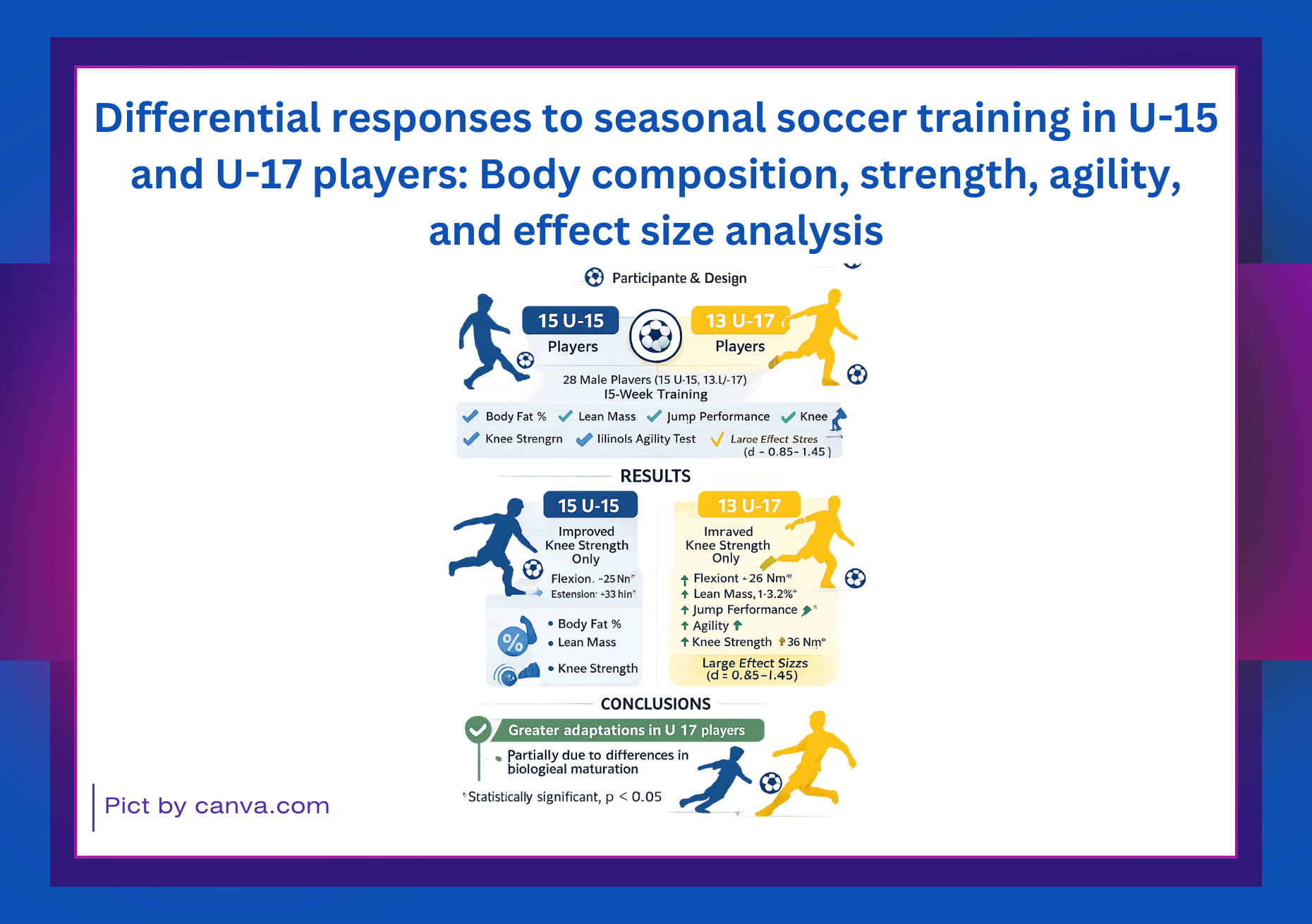
Differential responses to seasonal soccer training in U-15 and U-17 players: Body composition, strength, agility, and effect size analysis
Rick Stoop1, Georgios Georgiadis2, Iván González-García31. Football Club Utrecht, Herculesplein 241, 3584 AA Utrecht , NL2. Department of Nutrition and Movement Sciences, NUTRIM School of Nutrition and Translational Research in Metabolism, Maastricht University , NL3. Faculty of Health Sciences, Universidad Isabel I, Burgos , ES2026-06-09|page 48-63AbstractBackground: Training programs during adolescence play a crucial role in optimizing body composition and physical performance in youth soccer players. However, differences in training adaptations between age groups, particularly in agility performance, remain insufficiently explored.
Objectives: This study aimed to examine the effects of a seasonal soccer training program on body composition, strength, and agility in U-15 and U-17 soccer players.
Methods: A pre–post experimental design was applied to 28 male youth soccer players (U-15: n = 15; U-17: n = 13) competing in a football league in the Netherlands. Participants completed a 16-week training program consisting of technical, conditioning, tactical, and mental components. Body composition (height, body mass, lean mass, fat mass), jump performance (SJ, CMJ, CMJmax), isokinetic strength (knee flexion and extension peak torque), and agility (Illinois Agility Test) were assessed before and after the intervention. Data were analyzed using repeated-measures analysis of variance (ANOVA) and effect sizes were calculated using Cohen’s d.
Results: In the U-15 group, significant improvements were observed only in knee flexion (70.2 ± 15.8 vs. 95.4 ± 23.5 Nm, p = 0.006, d = 1.25) and extension peak torque (75.1 ± 20.4 vs. 96.8 ± 18.9 Nm, p = 0.012, d = 1.10). In contrast, U-17 players demonstrated significant increases in lean mass (50.2 ± 3.1% vs. 53.4 ± 2.3%, p = 0.021), reductions in fat mass (11.0 ± 2.9% vs. 8.7 ± 2.5%, p = 0.037), improvements in agility performance (16.2 ± 0.7 vs. 15.4 ± 0.65 s, p = 0.008, d = 1.18), and knee flexion peak torque (78.4 ± 26.5 vs. 118.3 ± 28.7 Nm, p = 0.003, d = 1.45), together with significant gains in jump performance (p < 0.05). Most significant changes in the U-17 group were accompanied by large effect sizes (d = 0.85–1.45).
Conclusions: The training program elicited greater physiological and performance adaptations in U-17 compared to U-15 players. The greater adaptations observed in the U-17 group may be partially influenced by differences in biological maturation; however, maturity status was not directly assessed in the present study.
APA Citation StyleStoop, R. , Georgiadis, G. , & González-García, I. (2026). Differential responses to seasonal soccer training in U-15 and U-17 players: Body composition, strength, agility, and effect size analysis. Sport, Exercise, and Injury, 48-63. https://doi.org/10.56003/sei.v2i1.735 -
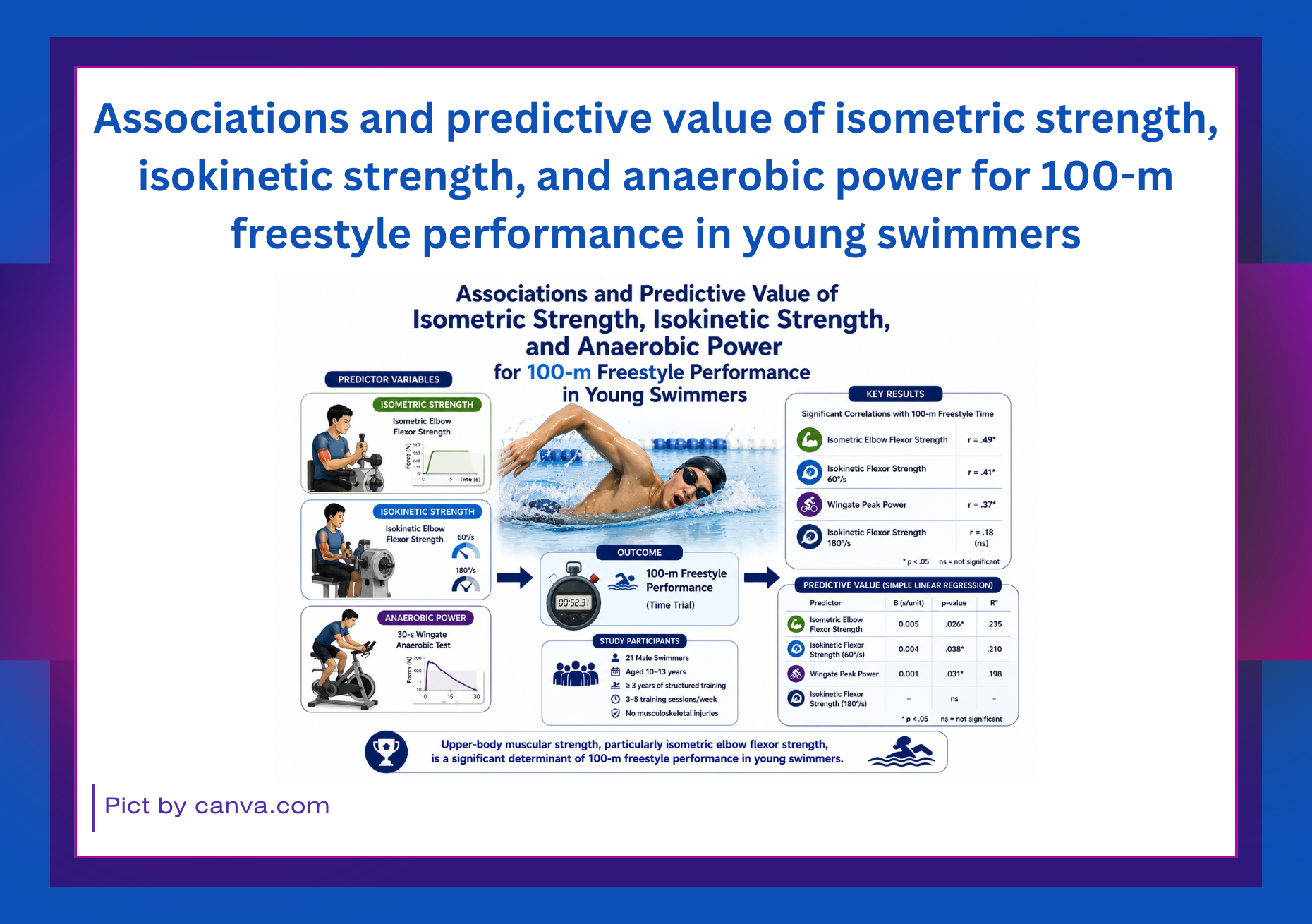
Associations and predictive value of isometric strength, isokinetic strength, and anaerobic power for 100-m freestyle performance in young swimmers
Zied Abbes1, Rabeh Labbadi2, Faten Salhi31. Physical Education Department, College of Education, Qatar University , QA2. Higher Institute of Sports and Physical Education of Kef, University of Jendouba , TN3. Higher Institute of Sports and Physical Education of Kef, University of Jendouba , TN2026-06-02|page 21-34AbstractBackground: Multiple physical and physiological factors influence sprint swimming performance; however, the relative contributions of isometric strength, isokinetic strength, and anaerobic power to 100-m freestyle performance in young swimmers remain unclear.
Objectives: This study investigated the associations and predictive contributions of physical characteristics, isometric and isokinetic upper-body strength, and anaerobic power to 100-m freestyle swimming performance in young swimmers.
Methods: A cross-sectional study was conducted with 21 male swimmers aged 10–13 years, selected purposively. Eligibility criteria included a minimum of three years of structured swimming training, regular participation in 3–5 training sessions per week, and absence of musculoskeletal injuries. Upper-body strength was assessed using isometric and isokinetic dynamometry (60°/s and 180°/s), while anaerobic power was measured using the 30-s Wingate Anaerobic Test. Swimming performance was evaluated using a 100-m freestyle time trial. Pearson correlation and linear regression analyses were performed after verification of regression assumptions.
Results: Swimming speed was significantly correlated with isometric elbow flexor strength (r = .49, p < .05), isokinetic flexor strength at 60°/s (r = .41, p < .05), and Wingate peak power (r = .37, p < .05). Simple linear regression analysis identified isometric elbow flexor strength as the strongest predictor of swimming performance (B = 0.005, p = .026, R² = .235), followed by isokinetic flexor strength at 60°/s (B = 0.004, p = .038, R² = .210) and Wingate peak power (B = 0.001, p = .031, R² = .198). No significant associations were observed for isokinetic strength at 180°/s.
Conclusions: Upper-body muscular strength, particularly isometric elbow flexor strength, is a significant determinant of 100-m freestyle swimming performance in young swimmers. These findings highlight the importance of maximal force-generating capacity, alongside anaerobic power development, for sprint swimming performance.
APA Citation StyleAbbes, Z. , Labbadi, R. , & Salhi, F. (2026). Associations and predictive value of isometric strength, isokinetic strength, and anaerobic power for 100-m freestyle performance in young swimmers. Sport, Exercise, and Injury, 21-34. https://doi.org/10.56003/sei.v2i1.726 -
Comparative physical fitness profiles of female long-distance and sprint swimmers at Petrokima Gresik Club: A descriptive study
Kartika Jeaniar Fajar Nur Rahma11. State University of Malang , ID2026-01-05|page 90-98AbstractBackground: Physical condition is a fundamental factor that affects swimmers' performance in developing techniques, tactics, and competition strategies, especially for swimmers specializing in different distances, such as sprinters and long-distance swimmers.
Objectives: This study aims to analyze the dominant physical profiles of female sprinters and long-distance swimmers, providing evaluation material for coaches to develop more targeted training programs.
Methods: The study employed a quantitative descriptive design, utilizing a survey and test approach. The research subjects consisted of 20 female swimmers from the Petrokimia Gresik Club who were selected purposively, including 10 sprinters and 10 long-distance swimmers. Data collection was conducted in 2024 through push-up tests (measuring arm muscle strength), sit-ups (assessing abdominal muscle strength), vertical jump (evaluating leg muscle explosive power), and multistage fitness tests (testing aerobic endurance). Raw scores were converted into t-scores and then categorized using the Norm Reference Scale (NRS). Data analysis was performed descriptively using means, standard deviations, and percentages. This study has obtained ethical approval from the relevant ethics committee.
Results: The analysis results show that in the sprinter group, 4 out of 10 athletes (40%) were in the "fair" physical condition category, while in the long-distance group, 5 out of 10 athletes (50%) were also in this category. In general, the components of arm muscle strength, abdominal muscle strength, leg muscle power, and aerobic endurance in both groups showed a relatively balanced distribution with a predominance of the adequate category.
Conclusions: The physical condition of female sprinters and long-distance swimmers from the Petrokimia Gresik Club was at a relatively balanced level, with a predominance of the adequate category. These findings serve as a basis for evaluating and adjusting training programs according to the characteristics of specific swimming specializations.APA Citation StyleRahma, K. J. F. N. (2026). Comparative physical fitness profiles of female long-distance and sprint swimmers at Petrokima Gresik Club: A descriptive study. Sport, Exercise, and Injury, 90-98. https://doi.org/10.56003/sei.v1i2.645 -
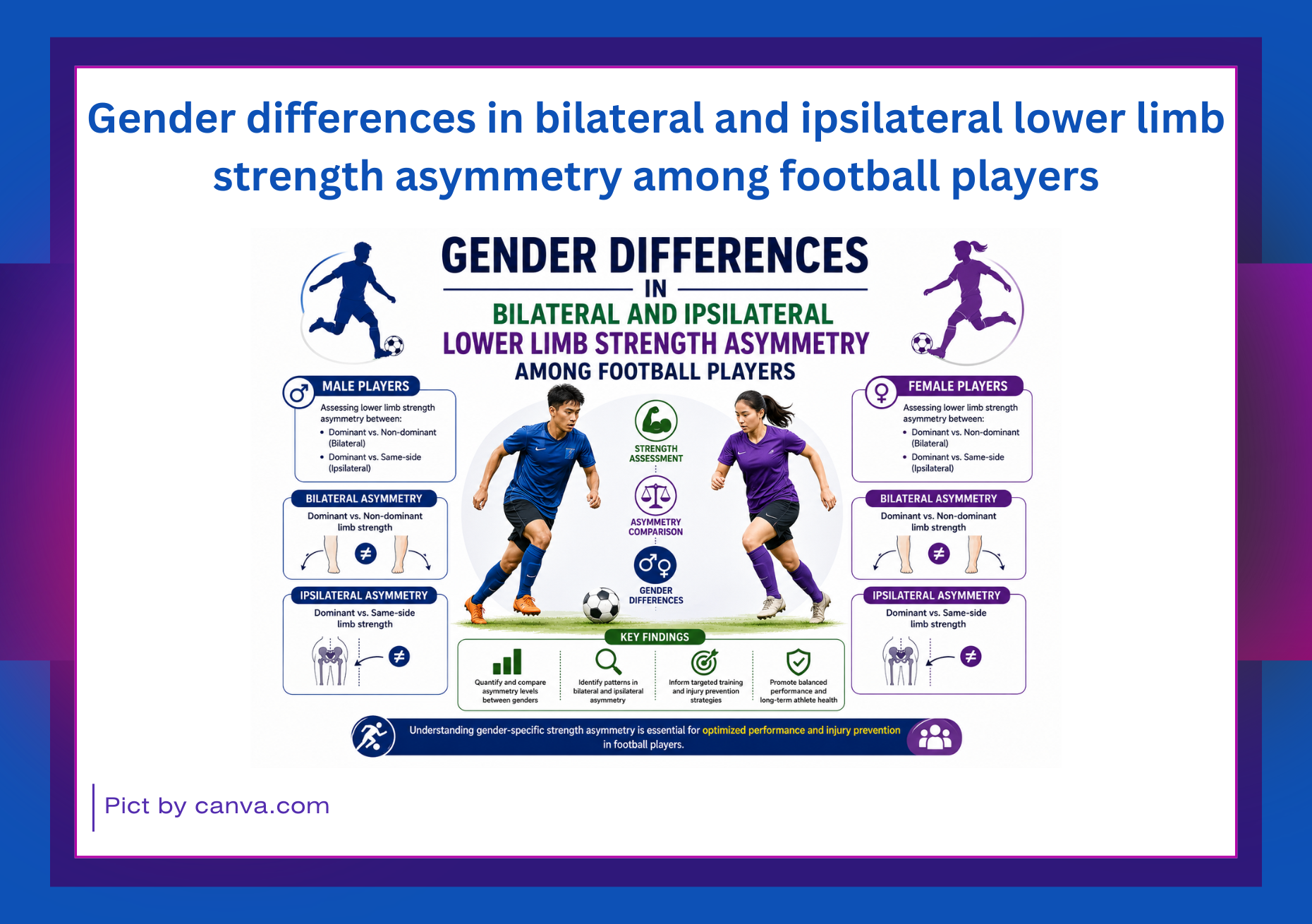
Gender differences in bilateral and ipsilateral lower limb strength asymmetry among football players
Randy R. Manimtim1, Eissel Ronquillo21. Office of Sports Development Program, Batangas State University The National Engineering University Lipa Campus , PH2. Department of Physical Education, School of Education, Holy Angel University , PH2026-06-02|page 1-10AbstractBackground: Lower limb muscle strength asymmetry is a significant factor that can impact playing ability and increase the risk of injury in soccer players. Differences in leg use and the specific movement requirements of a sport can lead to strength imbalances, either on both sides of the body or on the same side. Lower limb muscle strength asymmetry, particularly bilateral and ipsilateral strength asymmetry, is a significant factor influencing performance and increasing injury risk in football players. Differences in limb dominance and sport-specific movement demands can lead to strength imbalances.
Objectives: This study aimed to compare bilateral and ipsilateral lower limb strength asymmetry between male and female football players.
Methods: A cross-sectional study was conducted involving 50 amateur football players (26 males and 24 females; aged 18–21 years). Isokinetic strength testing of knee extensors and flexors was performed at 60°/s. Bilateral asymmetry was calculated based on peak torque differences between limbs, while ipsilateral asymmetry was assessed using the hamstring-to-quadriceps (H/Q) ratio. Statistical analyses included the Mann–Whitney U test and independent t-test (p < 0.05).
Results: Significant sex differences were found in bilateral strength asymmetry for both quadriceps (7.21 ± 4.04% vs 5.04 ± 3.13%, p = 0.02) and hamstrings (9.13 ± 5.15% vs 5.06 ± 4.04%, p = 0.01), with males showing greater asymmetry. Female athletes demonstrated values closer to the recommended asymmetry threshold (≤10–15%). No significant differences were observed in ipsilateral strength asymmetry (H/Q ratio) between groups (p > 0.05).
Conclusions: Bilateral strength asymmetry differs by sex, with male athletes exhibiting higher imbalance, while ipsilateral strength balance is comparable between groups. These findings highlight the importance of monitoring individual strength asymmetry to inform targeted training strategies, reduce injury risk, and optimize performance in football players.
APA Citation StyleManimtim, R. R. , & Ronquillo, E. (2026). Gender differences in bilateral and ipsilateral lower limb strength asymmetry among football players. Sport, Exercise, and Injury, 1-10. https://doi.org/10.56003/sei.v2i1.681

1 - 4 of 4 items