Search
Search Results
##search.searchResults.foundPlural##
-

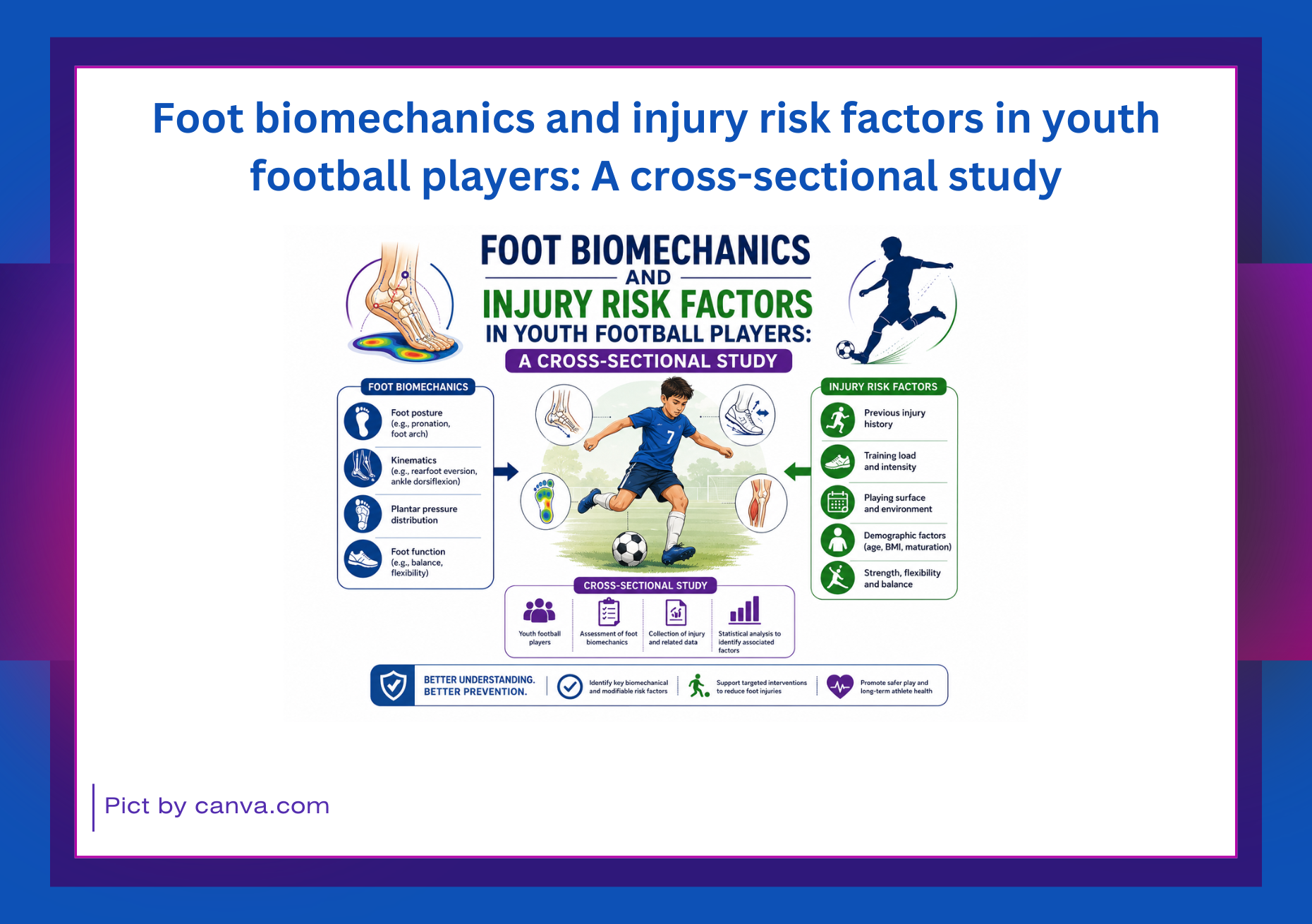
Foot biomechanics and injury risk factors in youth football players: A cross-sectional study
Hamza Sinen1, Amirhossein Ghanbarian21. Sintech Prosthesis Orthosis R&D and Innovation Trade Limited Company , TR2. Department of Biomechanics and Sport Injuries , Faculty of Physical Education and Sport Sciences, Kharazmi University, Tehran , IR2026-06-02|page 11-20AbstractBackground: Altered plantar pressure distribution and foot alignment have been suggested in previous studies to be associated with ankle instability and overuse injuries; however, evidence in youth populations remains limited.
Objectives: This study aimed to investigate foot biomechanics and potential injury risk factors in youth football players aged 5–15 years.
Methods: This study employed an analytical cross-sectional design involving 30 youth football players recruited from local football academies. Participants were categorized into three age groups: 5–9 years (n = 10), 10–12 years (n = 10), and 13–15 years (n = 10). Data were collected through pedobarographic plantar pressure assessment, hallux valgus angle (HVA) measurement using a goniometer, navicular drop test (NDT), and subtalar angle assessment. Statistical analyses included descriptive statistics, Shapiro–Wilk normality test, Pearson correlation, independent t-test, and one-way ANOVA with effect size (η²). A significance level of p ≤ 0.05 was applied.
Results: The results showed that hindfoot plantar pressure was higher than forefoot pressure in both feet, indicating a posterior loading pattern. Hallux valgus angles were within normal ranges, while subtalar angles demonstrated a tendency toward pronation. Significant differences were observed in left foot HVA and left hindfoot pressure across age groups (p < 0.05), with moderate effect sizes (η² = 0.20–0.21). Correlation analysis revealed moderate to strong positive relationships between subtalar pronation and HVA variables.
Conclusions: Youth football players exhibit biomechanical characteristics, such as increased hindfoot loading and subtalar pronation, that may represent adaptive responses to sport-specific demands and be associated with potential injury risk. However, given the study's cross-sectional design, these findings should be interpreted as descriptive biomechanical patterns rather than as direct predictors of injury. Early biomechanical screening and targeted preventive training may help support optimal athletic development.
APA Citation StyleSinen, H. , & Ghanbarian, A. (2026). Foot biomechanics and injury risk factors in youth football players: A cross-sectional study. Sport, Exercise, and Injury, 11-20. https://doi.org/10.56003/sei.v2i1.713 -
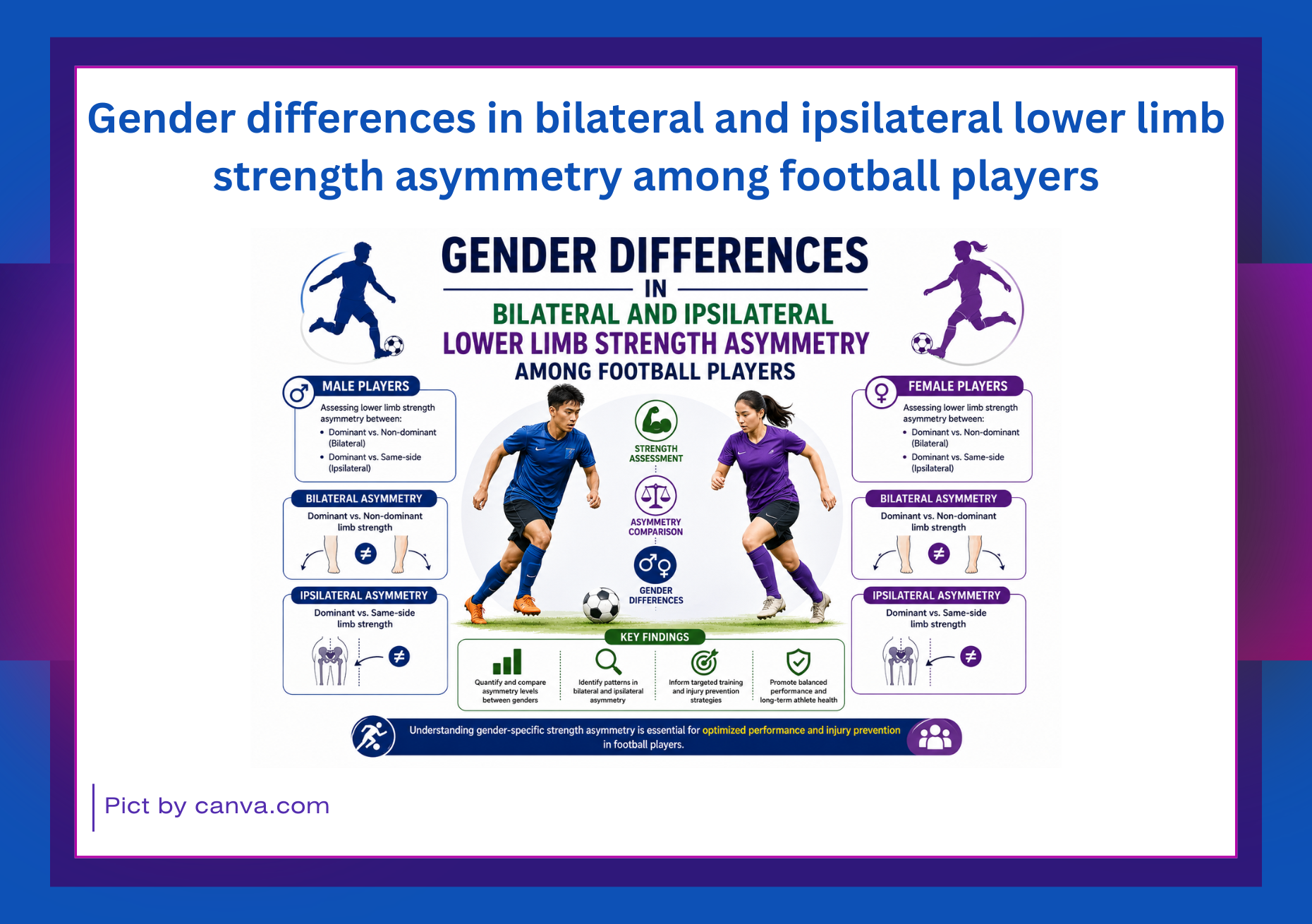
Gender differences in bilateral and ipsilateral lower limb strength asymmetry among football players
Randy R. Manimtim1, Eissel Ronquillo21. Office of Sports Development Program, Batangas State University The National Engineering University Lipa Campus , PH2. Department of Physical Education, School of Education, Holy Angel University , PH2026-06-02|page 1-10AbstractBackground: Lower limb muscle strength asymmetry is a significant factor that can impact playing ability and increase the risk of injury in soccer players. Differences in leg use and the specific movement requirements of a sport can lead to strength imbalances, either on both sides of the body or on the same side. Lower limb muscle strength asymmetry, particularly bilateral and ipsilateral strength asymmetry, is a significant factor influencing performance and increasing injury risk in football players. Differences in limb dominance and sport-specific movement demands can lead to strength imbalances.
Objectives: This study aimed to compare bilateral and ipsilateral lower limb strength asymmetry between male and female football players.
Methods: A cross-sectional study was conducted involving 50 amateur football players (26 males and 24 females; aged 18–21 years). Isokinetic strength testing of knee extensors and flexors was performed at 60°/s. Bilateral asymmetry was calculated based on peak torque differences between limbs, while ipsilateral asymmetry was assessed using the hamstring-to-quadriceps (H/Q) ratio. Statistical analyses included the Mann–Whitney U test and independent t-test (p < 0.05).
Results: Significant sex differences were found in bilateral strength asymmetry for both quadriceps (7.21 ± 4.04% vs 5.04 ± 3.13%, p = 0.02) and hamstrings (9.13 ± 5.15% vs 5.06 ± 4.04%, p = 0.01), with males showing greater asymmetry. Female athletes demonstrated values closer to the recommended asymmetry threshold (≤10–15%). No significant differences were observed in ipsilateral strength asymmetry (H/Q ratio) between groups (p > 0.05).
Conclusions: Bilateral strength asymmetry differs by sex, with male athletes exhibiting higher imbalance, while ipsilateral strength balance is comparable between groups. These findings highlight the importance of monitoring individual strength asymmetry to inform targeted training strategies, reduce injury risk, and optimize performance in football players.
APA Citation StyleManimtim, R. R. , & Ronquillo, E. (2026). Gender differences in bilateral and ipsilateral lower limb strength asymmetry among football players. Sport, Exercise, and Injury, 1-10. https://doi.org/10.56003/sei.v2i1.681

1 - 2 of 2 items