Search
Search Results
##search.searchResults.foundPlural##
-

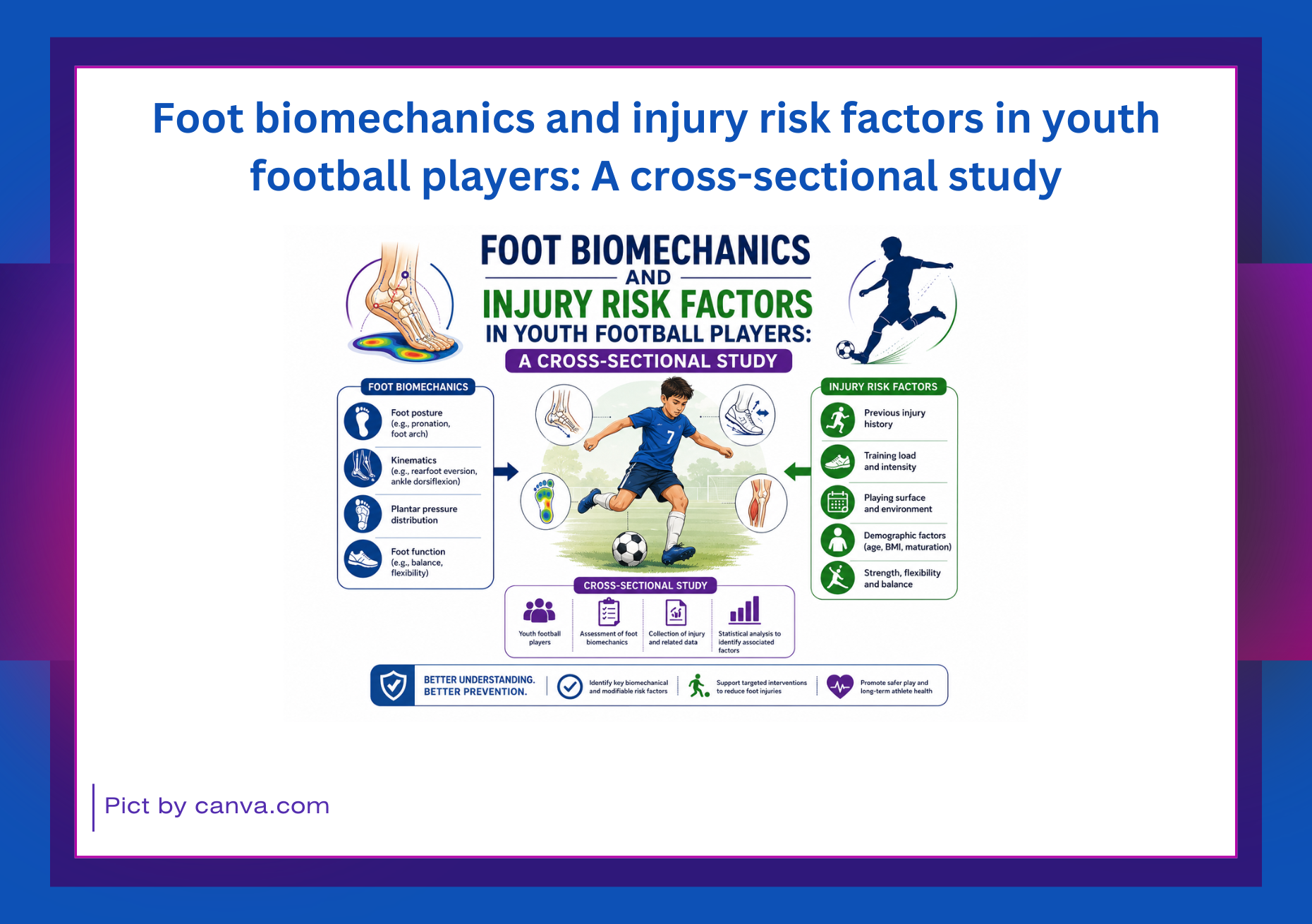
Foot biomechanics and injury risk factors in youth football players: A cross-sectional study
Hamza Sinen1, Amirhossein Ghanbarian21. Sintech Prosthesis Orthosis R&D and Innovation Trade Limited Company , TR2. Department of Biomechanics and Sport Injuries , Faculty of Physical Education and Sport Sciences, Kharazmi University, Tehran , IR2026-06-02|page 11-20AbstractBackground: Altered plantar pressure distribution and foot alignment have been suggested in previous studies to be associated with ankle instability and overuse injuries; however, evidence in youth populations remains limited.
Objectives: This study aimed to investigate foot biomechanics and potential injury risk factors in youth football players aged 5–15 years.
Methods: This study employed an analytical cross-sectional design involving 30 youth football players recruited from local football academies. Participants were categorized into three age groups: 5–9 years (n = 10), 10–12 years (n = 10), and 13–15 years (n = 10). Data were collected through pedobarographic plantar pressure assessment, hallux valgus angle (HVA) measurement using a goniometer, navicular drop test (NDT), and subtalar angle assessment. Statistical analyses included descriptive statistics, Shapiro–Wilk normality test, Pearson correlation, independent t-test, and one-way ANOVA with effect size (η²). A significance level of p ≤ 0.05 was applied.
Results: The results showed that hindfoot plantar pressure was higher than forefoot pressure in both feet, indicating a posterior loading pattern. Hallux valgus angles were within normal ranges, while subtalar angles demonstrated a tendency toward pronation. Significant differences were observed in left foot HVA and left hindfoot pressure across age groups (p < 0.05), with moderate effect sizes (η² = 0.20–0.21). Correlation analysis revealed moderate to strong positive relationships between subtalar pronation and HVA variables.
Conclusions: Youth football players exhibit biomechanical characteristics, such as increased hindfoot loading and subtalar pronation, that may represent adaptive responses to sport-specific demands and be associated with potential injury risk. However, given the study's cross-sectional design, these findings should be interpreted as descriptive biomechanical patterns rather than as direct predictors of injury. Early biomechanical screening and targeted preventive training may help support optimal athletic development.
APA Citation StyleSinen, H. , & Ghanbarian, A. (2026). Foot biomechanics and injury risk factors in youth football players: A cross-sectional study. Sport, Exercise, and Injury, 11-20. https://doi.org/10.56003/sei.v2i1.713 -
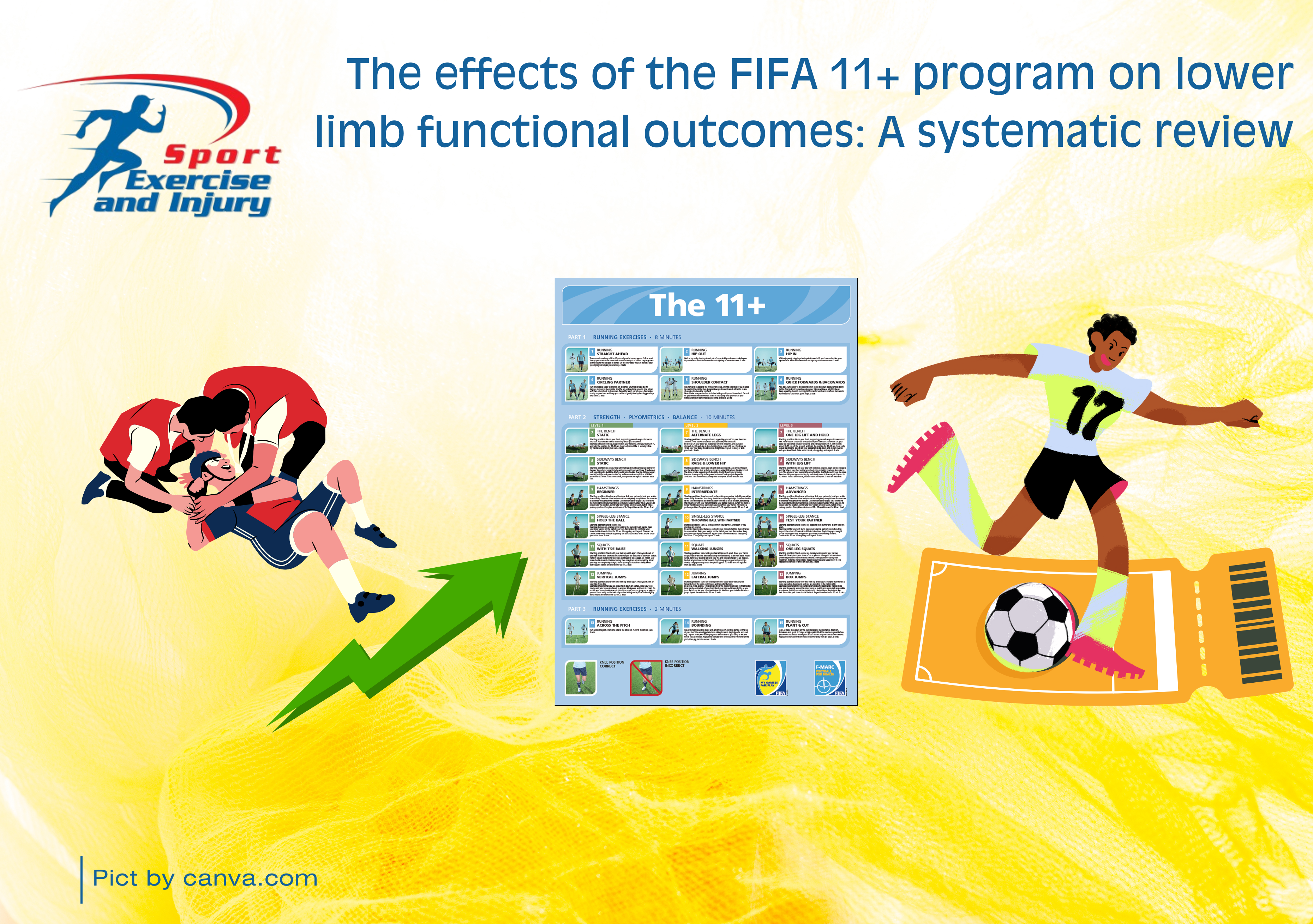
The effects of the FIFA 11+ program on lower limb functional outcomes: A systematic review
Yulingga Nanda Hanief1, Italo Sannicandro2, Raja Mohammed Firhad Raja Azidin31. State University of Malang , ID2. Clinical and Experimental Medicine Department, University of Foggia , IT3. Faculty of Sports Science and Recreation, Universiti Teknologi MARA , MY2025-12-30|page 122-138AbstractBackground: The FIFA 11+ program has been proven effective in preventing soccer injuries, but evidence regarding its impact on lower extremity functional outcomes is still scattered and reported heterogeneously.
Objectives: This systematic review aims to synthesize evidence regarding the effects of the FIFA 11+ program on lower extremity functional outcomes—including ROM, knee extension, internal and external hip rotation, and hamstring muscle strength—in athletes.
Methods: This systematic review was prospectively registered in PROSPERO (CRD420251147261) and conducted in accordance with PRISMA 2020 guidelines. A total of 14 studies involving athletes or physically active individuals met the inclusion criteria. Functional outcomes were measured using various instruments, primarily an isokinetic dynamometer for muscle strength and a goniometer for ROM measurement. The methodological quality of the studies was assessed using the Newcastle–Ottawa Scale. Due to substantial heterogeneity in study design, measurement instruments, intervention protocols, and reporting formats, a quantitative meta-analysis was not performed, and the data were synthesized using a qualitative narrative approach.
Results: Most studies (approximately 70–80%) reported an increase in hamstring muscle strength after the FIFA 11+ intervention, particularly in concentric and eccentric isokinetic measurements. Improvements in ROM and functional outcomes of the knee and hip were also reported, although results varied between studies. Evidence related to knee extension and hip rotation shows lower consistency compared to hamstring strength.
Conclusions: The FIFA 11+ program shows potential functional benefits beyond injury prevention, particularly in improving hamstring muscle strength and several aspects of joint mobility.APA Citation StyleHanief, Y. N. , Sannicandro, I. , & Azidin, R. M. F. R. (2025). The effects of the FIFA 11+ program on lower limb functional outcomes: A systematic review. Sport, Exercise, and Injury, 122-138. https://doi.org/10.56003/sei.v1i2.670

1 - 2 of 2 items