Maternal education and child stunting in Kenya: The role of socio-economic confounding using DHS 2022 data

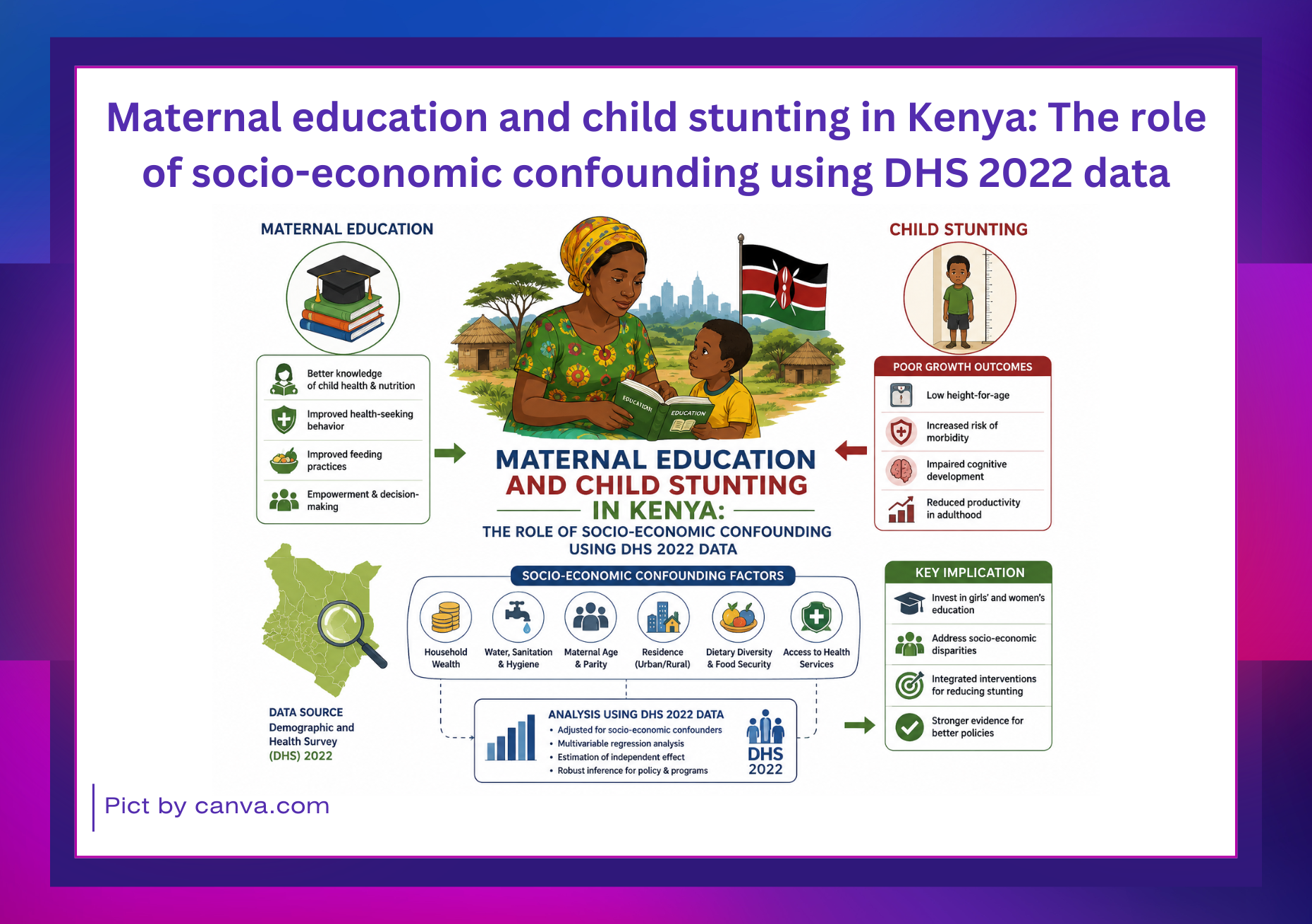
Background: Child stunting remains a major public health challenge in Kenya, reflecting long‑term nutritional deprivation and socioeconomic inequalities. Although maternal education is widely considered protective, its independent effect is often unclear due to confounding by structural factors.
Objectives: To examine the association between maternal education and child stunting among children under five in Kenya and to assess the extent of confounding and effect modification by key sociodemographic factors.
Methods: A cross‑sectional analytical study was conducted using data from the 2022 Kenya Demographic and Health Survey (KDHS). The sample included 19,530 children aged 0–59 months. Stunting was defined using height‑for‑age z-scores (<-2 SD). Descriptive, bivariate, stratified, and multivariable logistic regression analyses were performed, accounting for the complex survey design.
Results: Stunting prevalence was 18.2%. Stunting decreased with increasing maternal education, from 21.4–21.7% among children of mothers with no or primary education to 8.7% among those with higher education (χ² = 238, p < 0.001). However, the association was weak (Cramer’s V = 0.117) and attenuated after adjustment for socioeconomic factors. Household wealth was the strongest predictor, with children in the richest households having significantly lower odds of stunting than those in the poorest households (AOR = 0.268; 95% CI: 0.222–0.323; p < 0.001). Stunting risk increased with age, particularly among children aged 6–23 months, while females had lower odds than males (OR = 0.717; 95% CI: 0.662–0.776). Stratified analyses showed stronger protective effects of maternal education among older children. In contrast, variation across wealth groups should be interpreted cautiously, given inconsistent and non-significant findings in some strata. No meaningful effect modification by child sex was identified.
Conclusions: Child stunting in Kenya is primarily driven by structural socioeconomic factors. While maternal education is associated with reduced stunting, its effect is highly context dependent. Addressing poverty and inequality is essential for effective and equitable reductions in child stunting.
Downloads
Abuya, B. A., Ciera, J., & Kimani-Murage, E. (2012). Effect of mother’s education on child’s nutritional status in the slums of Nairobi. BMC pediatrics, 12(1), 80. https://doi.org/10.1186/1471-2431-12-80
Ahmed, K. Y., Dadi, A. F., Ogbo, F. A., et al. (2023). Population-modifiable risk factors associated with childhood stunting in sub-Saharan Africa. JAMA Network Open, 6(10), e2338321. https://doi.org/10.1001/jamanetworkopen.2023.38321
Akombi, B. J., Chitekwe, S., Sahle, B. W., & Renzaho, A. M. N. (2019). Estimating the Double Burden of Malnutrition among 595,975 Children in 65 Low- and Middle-Income Countries: A Meta-Analysis of Demographic and Health Surveys. International Journal of Environmental Research and Public Health, 16(16), 2886. https://doi.org/10.3390/ijerph16162886
Amalia, R., Wardani, H. E., Tama, T. D., & Hapsari, A. (2025). Exploring the interplay of gender, breastfeeding practices, and minimum dietary diversity on stunting among Indonesian children aged 6–23 months. Public Health and Occupational Safety Journal, 1(1), 114-126. https://doi.org/10.56003/phosj.v1i1.540
Cunningham, K., Headey, D., Singh, A., Karmacharya, C., & Rana, P. P. (2017). Maternal and Child Nutrition in Nepal: Examining drivers of progress from the mid-1990s to 2010s. Global Food Security, Stories of Change in Nutrition, 13, 30–37. https://doi.org/10.1016/j.gfs.2017.02.001
Dewey, K. G., & Begum, K. (2011). Long-term consequences of stunting in early life. Maternal & Child Nutrition, 7(s3), 5–18. https://doi.org/10.1111/j.1740-8709.2011.00349
Ettyang, G. A., & Sawe, C. J. (2016). Factors associated with stunting in children under age 2 in the Cambodia and Kenya 2014 Demographic and Health Surveys. https://dhsprogram.com/pubs/pdf/WP126/WP126.pdf
Ettyang, G. A. K., Sawe, C. J., & Ayiro, L. P. (2019). Stunted too early: Analysis of the Cambodia and Kenya 2014 Demographic and Health Survey data. World Nutrition, 10(1), 1–17. https://doi.org/10.26596/wn.201910463-85
Gordis, L. (2014). Epidemiology: (Chapters 15-20) (5th edn). Saunders, Elsevier Inc. https://euclid.egnyte.com/dl/SIL51G1i8H
IPC. (2024, March 26). Kenya: Acute Malnutrition Situation October 2023 - February 2024. https://www.ipcinfo.org/ipc-country-analysis/details-map/en/c/1156894/
Kajjura, R. B., Veldman, F. J., & Kassier, S. M. (2019). Effect of Nutrition Education on Knowledge, Complementary Feeding, and Hygiene Practices of Mothers With Moderate Acutely Malnourished Children in Uganda. Food and Nutrition Bulletin, 40(2), 221–230. https://doi.org/10.1177/0379572119840214
Kenya National Bureau of Statistics. (2019). 2019 Kenya population and Housing Census (No. 3; Distribution of Population by Age and Sex Volume 3, p. 526). Kenya National Bureau of Statistics. https://www.knbs.or.ke/wp-content/uploads/2023/09/2019-Kenya-population-and-Housing-Census-Volume-3-Distribution-of-Population-by-Age-and-Sex.pdf
Kenya Institute for Public Policy Research and Analysis (KIPPRA). (2024). Drivers of stunting reduction in Kenya. KIPPRA. https://jamanetwork.com/journals/jamanetworkopen/fullarticle/2810821
Mbuma, V., Lissner, L., & Hunsberger, M. (2021). Parental investment can moderate the negative effects of low socioeconomic status on children’s health: An analysis of Kenyan national data. Journal of Global Health Reports, 5, e2021097. https://doi.org/10.29392/001c.29462
Moreno, J. M., Chapman, A. J., Ebido, C. C., Sougou, N. M., Diallo, A. H., Tening, R. N., Dial, F. B., Massonnié, J., Firoozmand, M., Niang, C. E. H. A., Heffernan, C., & Harder, M. K. (2023). Local contextual factors of child stunting found via shared values of stakeholder groups: An exploratory case study in Kaffrine, Senegal. Public Health Nutrition, 26(11), 2418–2432. https://doi.org/10.1017/S1368980023001088
Njoroge, E., Mwangi, K., Chongwo, E. J., Kaniala, M., Wekesa, K., Lihanda, I., et al. (2026). Factors associated with stunting and underweight indices among children 0–3 years in Nairobi, Kenya: A cross-sectional study. Frontiers in Nutrition, 13, 1793821. https://doi.org/10.3389/fnut.2026.1793821
Pramesti, A., Wardani, H. E., Tama, T. D., & Hapsari, A. (2025). The relationship between quality and quantity of antenatal care services and stunting in children 24–59 months of age. Public Health and Occupational Safety Journal, 1(1), 97-113. https://doi.org/10.56003/phosj.v1i1.539
Rahman, Md. M., Saima, U., & Goni, Md. A. (2015). Impact of Maternal Household Decision-Making Autonomy on Child Nutritional Status in Bangladesh. Asia Pacific Journal of Public Health, 27(5), 509–520. https://doi.org/10.1177/1010539514568710
Raiten, D. J., & Bremer, A. A. (2020). Exploring the Nutritional Ecology of Stunting: New Approaches to an Old Problem. Nutrients, 12(2), 371. https://doi.org/10.3390/nu12020371
Rezaeizadeh, G., Mansournia, M. A., Keshtkar, A., Farahani, Z., Zarepour, F., & Sharafkhah, M., et al. (2024). Maternal education and its influence on child growth and nutritional status: A systematic review and meta-analysis. eClinicalMedicine, 71, 102574. https://doi.org/10.1016/j.eclinm.2024.102574
Rogawski McQuade, E. T., Platts-Mills, J. A., Gratz, J., Zhang, J., Moulton, L. H., Mutasa, K., Majo, F. D., Tavengwa, N., Ntozini, R., Prendergast, A. J., Humphrey, J. H., Liu, J., & Houpt, E. R. (2020). Impact of Water Quality, Sanitation, Handwashing, and Nutritional Interventions on Enteric Infections in Rural Zimbabwe: The Sanitation Hygiene Infant Nutrition Efficacy (SHINE) Trial. The Journal of Infectious Diseases, 221(8), 1379–1386. https://doi.org/10.1093/infdis/jiz179
Schooling, C., Chow, C., & Au Yeung, S. (2016). Causality and causal inference in epidemiology: We need also to address causes of effects. International Journal of Epidemiology, 45(6), 2200–2201. https://doi.org/10.1093/ije/dyw160
Shahid, M., Xie, Y., Bashir, S., Noureen, N., Song, J., Malik, N. I., & Tang, K. (2024). Association among Household Wealth, Maternal Employment, and Undernutrition in Children under Three Years of Age in Pakistan. Children, 11(7), 872. https://doi.org/10.3390/children11070872
Tamir, T. T., Gezhegn, S. A., Dagnew, D. T., Mekonenne, A. T., Aweke, G. T., & Lakew, A. M. (2024). Determinants of childhood stunting in low- and lower-middle-income African countries. PLOS ONE, 19(4), e0302212. https://doi.org/10.1371/journal.pone.0302212
Thompson, A. L. (2021). Greater male vulnerability to stunting? Evaluating sex differences in growth, pathways and biocultural mechanisms. Annals of Human Biology, 48(6), 466–473. https://doi.org/10.1080/03014460.2021.1998622
UNICEF. (2026). UNICEF Data: Monitoring the Situation of Children and Women (Kenya). https://data.unicef.org/country/ken/
United Nations Children’s Fund, World Health Organization, & International Bank for Reconstruction and Development/The World Bank. (2023). Levels and trends in child malnutrition: UNICEF / WHO / World Bank Group Joint Child Malnutrition Estimates: Key findings of the 2023 edition. https://www.who.int/publications/i/item/9789240073791
Vaivada, T., Akseer, N., Akseer, S., Somaskandan, A., Stefopulos, M., & Bhutta, Z. A. (2020). Stunting in childhood: An overview of global burden, trends, determinants, and drivers of decline. The American Journal of Clinical Nutrition, 112, 777S-791S. https://doi.org/10.1093/ajcn/nqaa159
WHO. (2016, April 7). Childhood Stunting: Context, Causes and Consequences. https://www.who.int/publications/m/item/childhood-stunting-context-causes-and-consequences-framework
WHO. (2025, October 22). Global Nutrition Targets 2030: Stunting Brief. https://www.who.int/publications/i/item/B09383
Zenbaba, D., & Yaya, S. (2026). Breaking the Cycle: Intergenerational Transmission of Stunting in Sub‐Saharan Africa—Evidence From 19 Countries. Maternal & Child Nutrition, 22(1), e70177. https://doi.org/10.1111/mcn.70177
Copyright (c) 2026 Anastacia Katungo Maluki, Zerai Hagos, Kabiru Gulma, Michael Musili Nzau

This work is licensed under a Creative Commons Attribution-ShareAlike 4.0 International License.