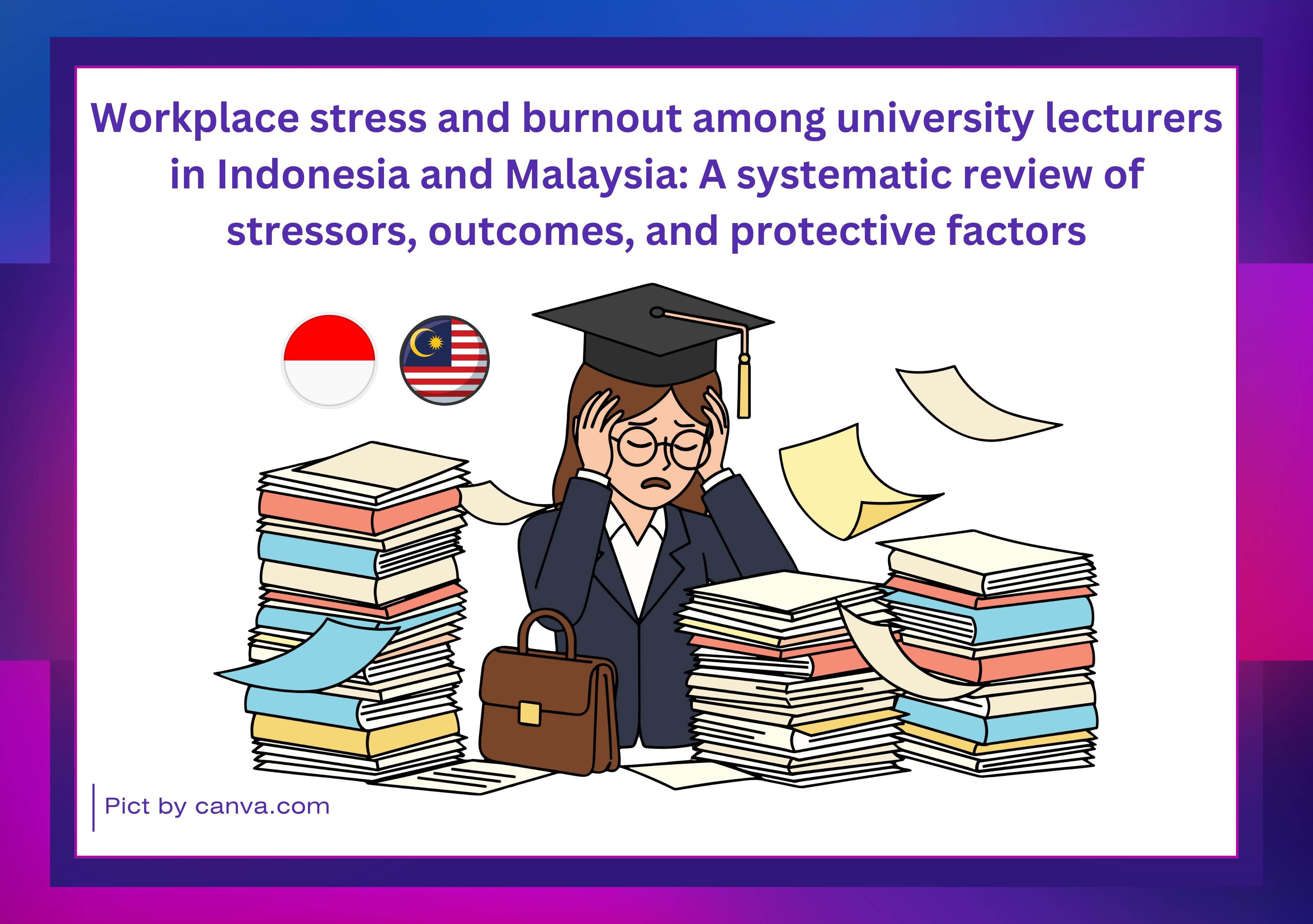
Workplace stress and burnout among university lecturers in Indonesia and Malaysia: A systematic review of stressors, outcomes, and protective factors

Downloads
Background: Workplace stress and burnout have emerged as critical occupational health concerns among university lecturers, particularly amid increasing academic workloads, performance pressures, and organizational demands intensified during and after the COVID-19 pandemic. Despite growing empirical attention, evidence remains fragmented, especially within Southeast Asian higher education contexts.
Objectives: This study aims to systematically review empirical research on workplace stress and burnout among university lecturers in Indonesia and Malaysia, with a focus on identifying key stressors, associated outcomes, and protective factors.
Methods: A systematic literature review was conducted following the PRISMA 2020 guidelines. Peer-reviewed articles published in English were retrieved from the Scopus database using predefined search terms related to workplace stress, burnout, lecturers, and higher education in Indonesia and Malaysia. After screening and eligibility assessment, 19 studies published between 2004 and 2025 were included. Methodological quality was assessed using the Newcastle–Ottawa Scale, and findings were synthesized through qualitative narrative analysis due to study heterogeneity.
Results: The review reveals that workplace stress and burnout are prevalent among university lecturers in both countries. Major stressors include excessive workload, role ambiguity, performance-based evaluation systems, work–life imbalance, and limited organizational support. These stressors are consistently associated with adverse outcomes such as emotional exhaustion, reduced job satisfaction, impaired performance, and increased turnover intention. Protective factors, including social support, supportive leadership, emotional intelligence, and workplace spirituality, were found to mitigate stress and burnout effects.
Conclusions: Workplace stress and burnout among university lecturers in Indonesia and Malaysia are multifactorial and systemic issues embedded in contemporary academic work environments. Organizational- and policy-level interventions are essential to promote lecturer well-being and ensure sustainable academic careers.
Downloads
Astuti, R. J., Haryono, T., Harsono, M., Hendarsjah, H., & Maryati, T. (2023). Antecedents and Consequences of Innovative Work Behavior in Indonesian Higher Education During the COVID-19 Pandemic. International Journal of Sustainable Development and Planning, 18(1), 181–191. https://doi.org/10.18280/ijsdp.180119
Bakker, A. B., & Demerouti, E. (2007). The Job Demands‐Resources model: state of the art. Journal of Managerial Psychology, 22(3), 309–328. https://doi.org/10.1108/02683940710733115
Chienwattanasook, K., & Jermsittiparsert, K. (2019). Factors affecting job stress among employees in the banking sector of Malaysia. International Journal of Innovation, Creativity and Change, 6(2), 288–302. https://ww.ijicc.net/images/Vol6Iss2/6220_Chienwattanasook_2019_TD_R.pdf
Effendi, M. S., Komariah, A., Agustina, S. S., & Dikdik, A. (2025). Beyond Workload: Uncovering the Link Between Supervisor Support, Work–Life Balance, and Lecturer Productivity. Education Sciences, 15(9), 1122. https://doi.org/10.3390/educsci15091122
Godber, K. A., & Atkins, D. R. (2021). COVID-19 Impacts on Teaching and Learning: A Collaborative Autoethnography by Two Higher Education Lecturers. Frontiers in Education, 6. https://doi.org/10.3389/feduc.2021.647524
Goi, M. T., Samat, N., & Azim, A. M. M. (2024). Impact of Workplace Bullying on Psychological Distress: Role of Perceived Organisational Support and Religious Coping. Asian Academy of Management Journal, 29(2), 243-265. https://doi.org/10.21315/aamj2024.29.2.9
Hamukti, W., Andrawina, L., & Suwarsono, L. W. (2017). Analisis Beban Kerja Dosen Bidang Pendidikan dan Penunjang Menggunakan Metode Knowledge Conversion 5C-4C. JISI: Jurnal Integrasi Sistem Industri, 4(2), 73–84. https://jurnal.umj.ac.id/index.php/jisi/article/view/2227
Henny, J., Anita, A. R., Hayati, K. S., & Rampal, L. (2014). Prevalence of burnout and its associated factors among faculty academicians. Malaysian Journal of Medicine and Health Sciences, 10(1), 51–59. https://medic.upm.edu.my/dokumen/FKUSK1_MJMHS_2014V10N1_OP08.pdf
Herdiana, D. (2020). Inovasi proses pembelajaran daring bagi mahasiswa kelas karyawan di masa pandemi covid-19. Konferensi Nasional Pendidikan I, June, 129–137. https://www.researchgate.net/profile/Dian-Herdiana/publication/344404341_Inovasi_Pembelajaran_Daring_Bagi_Mahasiswa_Kelas_Karyawan_di_Masa_Pandemi_COVID-19/links/5f71e30b92851c14bc9b1a5a/Inovasi-Pembelajaran-Daring-Bagi-Mahasiswa-Kelas-Karyawan-di-Masa-Pandemi-COVID-19.pdf
Houston, D., Meyer, L. H., & Paewai, S. (2006). Academic Staff Workloads and Job Satisfaction: Expectations and values in academe. Journal of Higher Education Policy and Management, 28(1), 17–30. https://doi.org/10.1080/13600800500283734
Huda, B. Z., Rusli, B. N., Naing, L., Tengku, M. A., Winn, T., & Rampal, K. G. (2004). A study of job strain and dissatisfaction among lecturers in the School of Medical Sciences Universiti Sains Malaysia. Southeast Asian Journal of Tropical Medicine and Public Health, 35, 210–218. https://pubmed.ncbi.nlm.nih.gov/15272771/
Islam, S., Adawiyah, W., & Daryono, D. (2025). Role of social support in weakening the negative influence of job stress on life satisfaction and professional commitment. Organizatsionnaya Psikhologiya, 15(2), 186–209. https://doi.org/10.17323/2312-5942-2025-15-2-186-209
Jermsittiparsert, K., Petchchedchoo, P., Kumsuprom, S., & Panmanee, P. (2021). The impact of the workload on the job satisfaction: Does the job stress matter? Academy of Strategic Management Journal, 20, 1–13.
Kidd, W., & Murray, J. (2020). The Covid-19 pandemic and its effects on teacher education in England: how teacher educators moved practicum learning online. European Journal of Teacher Education, 43(4), 542–558. https://doi.org/10.1080/02619768.2020.1820480
Kinman, G., & Johnson, S. (2019). Special section on well-being in academic employees. International Journal of Stress Management, 26(2), 159–161. https://doi.org/10.1037/str0000131
Kinman, G., & Wray, S. (2013). Higher stress: A survey of stress and well-being among staff in higher education. London, UK: University and College Union.
Koon, V.-Y., & Pun, P.-Y. (2018). The Mediating Role of Emotional Exhaustion and Job Satisfaction on the Relationship Between Job Demands and Instigated Workplace Incivility. The Journal of Applied Behavioral Science, 54(2), 187–207. https://doi.org/10.1177/0021886317749163
Kori, F. A., Omar, M. K., Mohd, I. H., & Ahmad, M. F. (2022). Individual, organizational, and environmental factors affecting work-life balance among Malaysian lecturers amidst COVID-19 pandemic. Clinical Case Reports: Open Access. https://www.yumedtext.com/storage/ccr-235.pdf
Ladyanna, S., & Aslinda. (2021). Problems and Challenges of Online Lectures in Indonesia During the Pandemic COVID-19. https://doi.org/10.2991/assehr.k.210202.016
Lina, L. (2018). The mediation effect of burnout on the influence of role stressors towards lecturer performance: Empirical evidence from Indonesia. Journal of Business & Retail Management Research, 12(04). https://doi.org/10.24052/JBRMR/V12IS04/ART-08
Maslach, C., & Leiter, M. P. (2016). Understanding the burnout experience: recent research and its implications for psychiatry. World Psychiatry, 15(2), 103–111. https://doi.org/10.1002/wps.20311
Mei Teh Goi, Nusrah Samat, & Abdul Mutalib Mohamed Azim. (2024). Impact of Workplace Bullying on Psychological Distress: Role of Perceived Organisational Support and Religious Coping. Asian Academy of Management Journal, 29(2), 243–265. https://doi.org/10.21315/aamj2024.29.2.9
Muafiah, E., Sofiana, N. E., & Nurhidayati, M. (2023). Exploring the Influence of Work-Family Balance and Burnout on Working Mothers’ Character Building Efforts in a Post-Pandemic World. Islamic Guidance and Counseling Journal, 6(1). https://doi.org/10.25217/igcj.v6i1.3623
Multamasatika, D. F., Akbar, K. A., Hartanti, R. I., & Kallawicha, K. (2023). Work factors affect work stress among lecturers: study in Indonesia. Neurology, Neuropsychiatry, Psychosomatics, 15(4), 12–16. https://doi.org/10.14412/2074-2711-2023-4-12-16
MZ, N. A., Huda, B. Z., & Hejar, A. R. (2016). Job stress and its determinants among academic staff in a university in Klang Valley, Malaysia. International Journal of Public Health and Clinical Sciences, 3(6), 125–136. https://publichealthmy.org/ejournal/ojs2/index.php/ijphcs/article/view/370
Nur Aqilah, M. Y., & Juliana, J. (2012). Association between Occupational Stress and Respiratory Symptoms among Lecturers in Universiti Putra Malaysia. Global Journal of Health Science, 4(6). https://doi.org/10.5539/gjhs.v4n6p160
Nurhayati, E., Wibowo, A., Soedirham, O., & Widati, S. (2025). Beyond Burden: How Workload Balance Promotes Social Well-Being among University Lecturers in Indonesia. Journal of Cultural Analysis and Social Change, 1370–1382. https://doi.org/10.64753/jcasc.v10i2.1808
Page, M. J., McKenzie, J. E., Bossuyt, P. M., Boutron, I., Hoffmann, T. C., Mulrow, C. D., Shamseer, L., Tetzlaff, J. M., Akl, E. A., Brennan, S. E., Chou, R., Glanville, J., Grimshaw, J. M., Hróbjartsson, A., Lalu, M. M., Li, T., Loder, E. W., Mayo-Wilson, E., McDonald, S., … Moher, D. (2021). The PRISMA 2020 statement: an updated guideline for reporting systematic reviews. BMJ, n71. https://doi.org/10.1136/bmj.n71
Pariyanti, E., Adawiyah, W. R., & Wulandari, S. Z. (2022). Organizational justice, job stress, and cyberloafing: the moderating role of Islamic workplace spirituality. The Journal of Behavioral Science, 17(3), 90–105. https://so06.tci-thaijo.org/index.php/IJBS/article/view/257361
Raharjo, R., Abdullah, I., Indiyanto, A., Mariam, S., & Raharjo, F. H. (2023). Impact of Online Learning on Teachers’ Authority During the COVID-19 Pandemic in Indonesia. International Journal of Educational Reform, 32(2), 230–246. https://doi.org/10.1177/10567879221140091
Rahmayati, T. E., Sariyanto, S., & Adriansyah, T. M. (2022). Pengaruh Work-Life Balance Terhadap Work Engagement Pada Dosen Wanita Dalam Menghadapi Dunia Pendidikan Di Era Digital. Journal of Education, Humaniora and Social Sciences (JEHSS), 5(2), 1448–1456. https://doi.org/10.34007/jehss.v5i2.1486
Rusdi, F. A., Razak, A. A., & Embong, Z. (2023). “I find it very difficult to go to work; it is emotionally exhausting”: Understanding the Burnout and Underlying Emotions among Malaysian University Academics. International Journal of Learning, Teaching and Educational Research, 22(10), 37–53. https://doi.org/10.26803/ijlter.22.10.3
Subramaniam, G., Ramachandran, J., Putit, L., & Raju, R. (2020). Exploring Academics’ Work-Life Balance and Stress Levels Using Flexible Working Arrangements. Environment-Behaviour Proceedings Journal, 5(15), 469–476. https://doi.org/10.21834/ebpj.v5i15.2497
Suhariadi, F., Sugiarti, R., Hardaningtyas, D., Mulyati, R., Kurniasari, E., Saadah, N., Yumni, H., & Abbas, A. (2023). Work from home: A behavioral model of Indonesian education workers’ productivity during Covid-19. Heliyon, 9(3), e14082. https://doi.org/10.1016/j.heliyon.2023.e14082
Susanto, A., Wijaya, E., Nasib, N., Fadila, Z., & Amelia, R. (2025). Digital burnout, work alienation, and turnover intention: Unveiling the mediating role of toxic leadership among Generation Y lecturers in leading universities in Medan. International Journal of ADVANCED AND APPLIED SCIENCES, 12(11), 106–120. https://doi.org/10.21833/ijaas.2025.11.011
Suwarsi, S., Ridwan, R., & Fauzan, N. (2024). Evaluating workload impacts on lecturer mental health and productivity in indonesian private universities: A case study from bandung. Multidisciplinary Science Journal, 7(1), 2025045. https://doi.org/10.31893/multiscience.2025045
Watts, J., & Robertson, N. (2011). Burnout in university teaching staff: a systematic literature review. Educational Research, 53(1), 33–50. https://doi.org/10.1080/00131881.2011.552235
Yousefi, M., & Abdullah, A. G. K. (2019). The Impact of Organizational Stressors on Job Performance among Academic Staff. International Journal of Instruction, 12(3), 561–576. https://doi.org/10.29333/iji.2019.12334a
Copyright (c) 2025 Mimi Haryani Hassim, Dian Puspitaningtyas Laksana, Rachmy Rosyida Rais, Ronal Surya Aditya

This work is licensed under a Creative Commons Attribution-ShareAlike 4.0 International License.