Abstract
Background: Digital storytelling has emerged as an innovative pedagogical approach that promotes meaningful learning experiences and enhances student engagement.
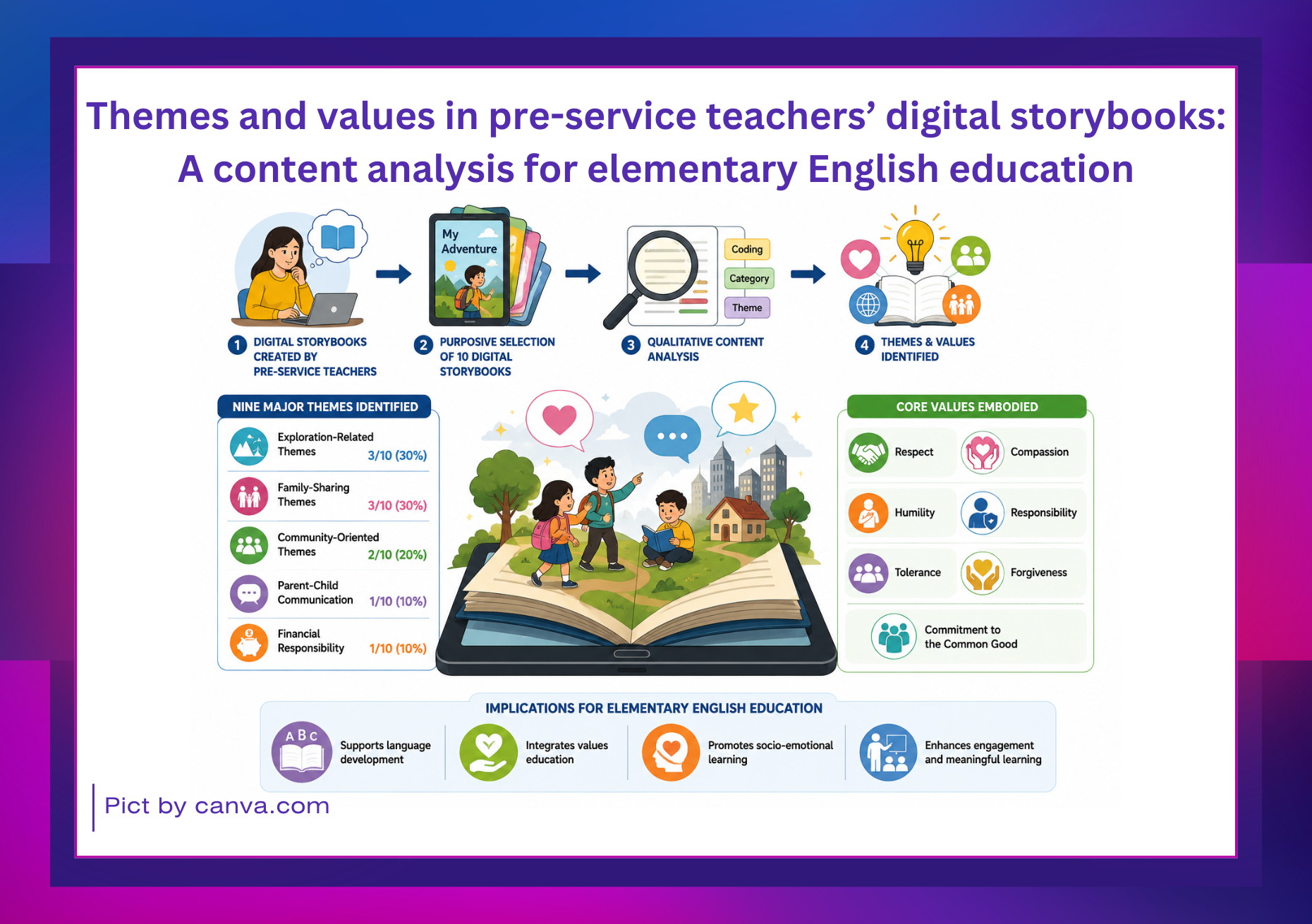
Objectives: This study examined the themes and values embedded in digital storybooks created by pre-service teachers and explored their implications for teaching English in elementary education.
Methods: Using a qualitative content analysis design, ten digital storybooks were purposively selected based on predetermined inclusion criteria. Data were analyzed through directed content analysis using an adapted thematic analysis framework.
Results: Findings revealed nine major themes. The most prominent were exploration-related themes (3 out of 10 storybooks, 30%) and family-sharing themes (3 out of 10 storybooks, 30%), followed by community-oriented themes (2 out of 10 storybooks, 20%). Other themes included parent-child communication and financial responsibility. The digital storybooks also embodied core values such as respect, compassion, humility, responsibility, tolerance, forgiveness, and commitment to the common good.
Conclusions: These findings suggest that digital storybooks can serve as effective resources for integrating language development, values education, and socio-emotional learning in elementary English classrooms. The study is limited by its small sample size and context-specific dataset. Further research should include a larger dataset and cross-cultural analysis to strengthen the generalizability of findings.
Keywords:
ARTICLE INFORMATION
LICENSE
Copyright (c) 2026 Najma Macatanto, Desiery Maghinay, John Dale Pendon, Carla Marie Rubio, Esmeraldo Sarad, Kim Silva

This work is licensed under a Creative Commons Attribution-ShareAlike 4.0 International License.
HOW TO CITE
Macatanto, N. , Maghinay, D. , Pendon, J. D. , Rubio, C. M. , Sarad, E. , & Silva, K. (2026). Themes and values in pre-service teachers’ digital storybooks: A content analysis for elementary English education. Journal of Artificial Intelligence in Education & Learning Innovation, 2(1), 32-43. https://doi.org/10.56003/jaieli.v2i1.701
DOWNLOADS
References
Belda‑Medina, J., & Goddard, M. B. (2024). The effect of digital storytelling on English vocabulary learning in inclusive and diverse education. International Journal of English Language Studies, 6(1), 110–118. https://doi.org/10.32996/ijels.2024.6.1.11
Daulay, S. H., Nasution, R. A., & Novita, N. (2023). Thematic‑based interactive learning multimedia in early childhood language development. Jurnal Pendidikan Anak Usia Dini Undiksha, 11(1), 106–112. https://doi.org/10.23887/paud.v11i1.53469
Demirbaş, İ., & Şahin, A. (2022). The Effect of Digital Stories on Primary School Students' Listening Comprehension Skills. Participatory Educational Research, 9(6), 380-397. https://doi.org/10.17275/per.22.144.9.6
Gultekin, M., & May, L. (2020). Children's literature as fun‐house mirrors, blind spots, and curtains. The Reading Teacher, 73(5), 627-635. https://doi.org/10.1002/trtr.1867
Gunawardena, M., & Brown, B. (2021). Fostering values through authentic storytelling. Australian Journal of Teacher Education (Online), 46(6), 36-53. https://search.informit.org/doi/abs/10.3316/informit.045067489909904
Ince Samur, A. Ö. (2021). Analysis of Preschool Children’s Books in The Context of Children's Literature: Case of University of London Library, International Journal of Eurasian Education and Culture, 6(15), 2561-2594. DOI: http://dx.doi.org/10.35826/ijoecc.498
John, E. A., & Ukpai, G. (2025). Digital storytelling: A systematic review of its impact in language education. Asian Journal of Applied Education, 4(4), 461–472. https://doi.org/10.55927/ajae.v4i4.14698
Kılınçcı, E., & Bayraktar, A. (2021). Early literacy materials and teacher practices in preschool classrooms. Pegem Journal of Education and Instruction, 11(1), 447-478. https://doi.org/10.14527/pegegog.2021.012
Kurniawan, M., & Wijayaningsih, L. (2025). Bilingual digital storytelling as a method to enhance children’s English language skills: A micro‑linguistic perspective. Jo‑ELT (Journal of English Language Teaching), 12(2), 563–577. https://doi.org/10.33394/jo-elt.v12i2.17994
Lin, Y., Ab Kadir, M. A., & Kaur, D. (2025). Preschool educators’ perceptions on values education and its role in children’s moral development. Education Sciences, 15(2), 140. https://doi.org/10.3390/educsci15020140
Liu, K. P., Tai, S. J. D., & Liu, C. C. (2018). Enhancing language learning through creation: The effect of digital storytelling on student learning motivation and performance in a school English course. Educational technology research and development, 66(4), 913-935. https://doi.org/10.1007/s11423-018-9592-z
Maya, L., Sumarni, S., & Suseno, M. (2022). Digital storytelling to support young learners’ English vocabulary development. Jurnal Bahasa Lingua Scientia, 14(1), 145–163. https://doi.org/10.21274/ls.2022.14.1.145-163
Mukarromah, N., Lidyasari, A. T., & Pangestu, R. F. (2025). Enhancing elementary students’ narrative writing skills through digital storytelling projects. World Journal on Educational Technology: Current Issues, 17(2), 58–66. https://doi.org/10.18844/wjet.v17i2.9345
Nasir, W. M. F. W. M., Halim, L., & Arsad, N. M. (2024). Digital storytelling learning outcomes and critical factors: A scoping review. International Journal of Learning, Teaching and Educational Research, 23(5), 323-344. https://doi.org/10.26803/ijlter.23.5.17
Pisa, O. E. C. D. (2023). results (volume I): the state of learning and equity in education. PISA. Paris. https://doi.org/10.1787/53f23881-en
Safii, R., Tjalau, C. A., & Pakaya, N. A. (2025). The Integration of Digital Storytelling in Arabic Language Learning: A Pedagogical Approach to Speaking Skill Development. Assuthur: Jurnal Pendidikan Bahasa Arab, 4(2), 84-96. https://doi.org/10.58194/as.v4i2.3049
Swanson, D. (2016). Fictional stories with ethical content: Guidelines for using stories to improve ethical behavior. Ethics & Behavior, 26(7), 545-561. https://doi.org/10.1080/10508422.2015.1081095
Turhan, O., Baş, B., & Turhan, F. K. (2020). Examining the Themes of Turkish Children’s Literature Through Book Catalogues.
UNESCO. (2023). Global education monitoring report 2023: Technology in education—A tool on whose terms? UNESCO.
World Bank. (2022). The state of global learning poverty: 2022 update. World Bank. https://www.worldbank.org/en/topic/education/brief/learning-poverty
Yu, B., & Zeng, Y. (2026). A systematic review of digital storytelling in English language learning and teaching. Educational Studies, 1-28. https://doi.org/10.1080/03055698.2026.2648654